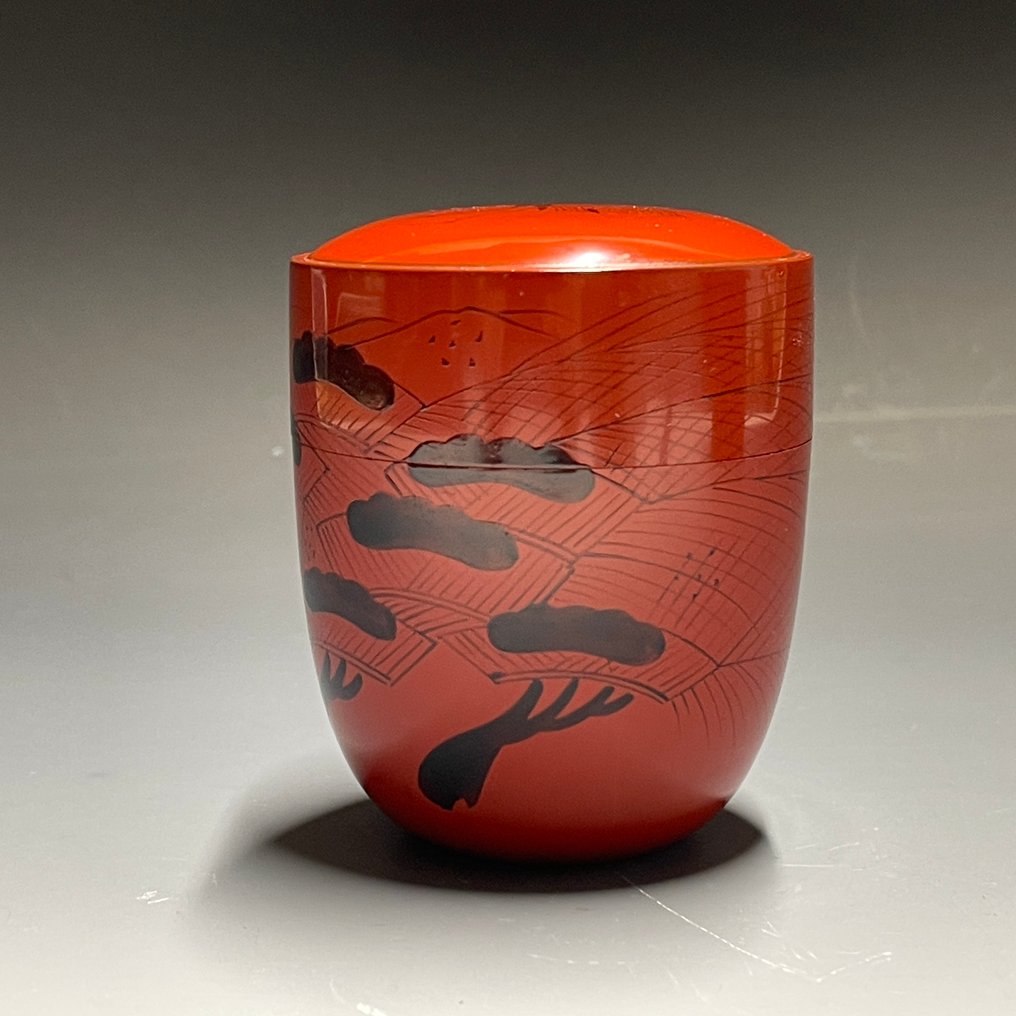
Akebono Natsume / Japanese Tea Caddy - Gengensaigonomi Utsushi - Natsume - Crane, Pine Tree, and Tortoise Makie - Wood / lacquerware - Tea Ceremony Matcha




02
days
10
hours
49
minutes
15
seconds

29 other people are watching this object
 Bidder 6288 Bidder 6288 | €4 | |
|---|---|---|
| Bidder 0332 | €2 |
Catawiki Buyer Protection
Your payment’s safe with us until you receive your object.View details
Trustpilot 4.4 | 123779 reviews
Rated Excellent on Trustpilot.
The Akebono Natsume tea caddy by Gengensaigonomi Utsushi, lacquered in Akebono-iro with a crane makie on the lid and a pine and tortoise makie on the body, Japan, circa 1960s–2000s, 80 mm high by 65 mm wide, weighing 43 g, in Good condition and not intended for daily use.
AI-assisted summary
Description from the seller
Import duties*
taxes, and charges are not included in the item price or shipping cost.
These charges are the buyer's responsibility.
Please check with your country's customs office to determine what these additional costs will be prior to bidding or buying.
Thank you for your understanding.
The Akebono Natsume, Gengensai Preference (Akebono Natsume Gengensai Gonomi) is a piece of lacquerware known as a natsume (a thin tea caddy). It is one of the tea utensils "preferred" (designed or endorsed for use) by Gengensai Seichu Sosho, the 11th Grand Master of the Urasenke School (a master who led Urasenke into modern Sado).
It is exceptionally ornate and is known for being used at auspicious occasions, particularly New Year's celebrations and Hatsugama (the first tea ceremony of the year).
The Akebono Natsume is finished in Akebono-iro (曙色, Dawn Color) vermilion lacquer (a pale reddish-pink with a yellowish tint), which evokes the color of the sky at dawn.
The lid is decorated with a single crane depicted in Maki-e (sprinkled lacquer decoration) on a black lacquer ground. The body features a Maki-e design, also in black lacquer, of Pine and Tortoise (the Horai Island motif).
This Akebono Natsume is one of the representative natsume preferred by Gengensai, symbolizing auspiciousness and splendor, and it remains widely cherished today.
Condition*
In Good condition.
There are pain and stains due to aged deterioration,but no problem with functionality.
Please use zoom to inspect all pictures closely for the cosmetic condition.
This item is sold as a collectible, decor and not intended for daily use.
Shipping*
We will send items from yabai artworks Japan.
FedEx International Priority
DHL WORLD WIDE
UPS Worldwide Saver
Import duties*
taxes, and charges are not included in the item price or shipping cost.
These charges are the buyer's responsibility.
Please check with your country's customs office to determine what these additional costs will be prior to bidding or buying.
Thank you for your understanding.
Handling of ceramics (pottery)
*Care for pottery (sealing treatment)*
Starch will coat the surface and prevent stains from seeping into the pottery.
1. Insert the pottery into a pot filled with starch water (from washing rice or corn or potato starch melted in water) and bring it to a boil on low to medium heat. Let it boil for around 20 minutes on low heat.
2. Let it cool down, then rinse, and allow it to dry naturally.
3. If the crevices are not totally filled after one application, you may try again until they are totally filled.
**Prevent Stains, Odors, and Mold**
If you soak the product in clean water before use and let it absorb some of the water, this will reduce the amount of impurities able to penetrate the surface. Pottery products are water absorbent, so if they are left in water for a long time, they may absorb impurities, causing stains, odors, and mold. Please wash the product immediately with detergent and dry well. When storing the container, ensure it is kept sufficiently dry. Insufficient drying may cause an odor or mold growth.
If the product does become stained or smelly, you can remedy this by dissolving baking soda or kitchen bleach in water and soaking the product in it.
***About crazing***
When pottery and porcelain are fired with glaze, a material containing characteristics similar to glass, it not only adds color and texture to the ceramics, but also prevents water absorption and discoloration. Firing at high temperatures allows the glaze to adhere to the ceramic, but as it naturally cools, cracks may appear on the surface. Cracks may also appear when a vessel is suddenly filled with something hot, and the formation of these cracks is called crazing. Physical objects have the property of expanding when heated and contracting when cooled.
Since the ceramic and the glaze have different rates of expansion and contraction, they interfere with each other as the temperature changes, resulting in crazing. Crazing does not mean that the piece is broken or damaged, and there is no impact on its usability, so please do not worry about using it. With continuous use, water and food color will seep through the crazing and give a deeper flavor to the vessel. If you wish to prevent this from happening, you can boil it in water mixed with rice or flour to fill in the cracks before the first usage.
Seller's Story
Konnichiwa.
The yabai brand targets collector who are culturally sophisticated and self-expressive through a unique merchandise mix, catawiki applications.
The product offering includes Japanese vintage and curiosities.
All over the world / Super Fast Shipping.
Australia, Austria, Belgium, Canada, Canary Islands, Croatia, Cyprus, Czech Republic, Denmark, Estonia, Finland, France, Germany, Hong Kong, Hungary, Ireland, Israel, Italy, Luxembourg, Malaysia, Malta, Netherland, New Zealand, Norway, Philippines, Poland, Portugal, Romania, Singapore, South Korea, Spain, Sweden, Switzerland, Taiwan, Thailand, United Arab Emirates, United Kingdom, United States.
Arigato.
yabai artworks.
Import duties*
taxes, and charges are not included in the item price or shipping cost.
These charges are the buyer's responsibility.
Please check with your country's customs office to determine what these additional costs will be prior to bidding or buying.
Thank you for your understanding.
The Akebono Natsume, Gengensai Preference (Akebono Natsume Gengensai Gonomi) is a piece of lacquerware known as a natsume (a thin tea caddy). It is one of the tea utensils "preferred" (designed or endorsed for use) by Gengensai Seichu Sosho, the 11th Grand Master of the Urasenke School (a master who led Urasenke into modern Sado).
It is exceptionally ornate and is known for being used at auspicious occasions, particularly New Year's celebrations and Hatsugama (the first tea ceremony of the year).
The Akebono Natsume is finished in Akebono-iro (曙色, Dawn Color) vermilion lacquer (a pale reddish-pink with a yellowish tint), which evokes the color of the sky at dawn.
The lid is decorated with a single crane depicted in Maki-e (sprinkled lacquer decoration) on a black lacquer ground. The body features a Maki-e design, also in black lacquer, of Pine and Tortoise (the Horai Island motif).
This Akebono Natsume is one of the representative natsume preferred by Gengensai, symbolizing auspiciousness and splendor, and it remains widely cherished today.
Condition*
In Good condition.
There are pain and stains due to aged deterioration,but no problem with functionality.
Please use zoom to inspect all pictures closely for the cosmetic condition.
This item is sold as a collectible, decor and not intended for daily use.
Shipping*
We will send items from yabai artworks Japan.
FedEx International Priority
DHL WORLD WIDE
UPS Worldwide Saver
Import duties*
taxes, and charges are not included in the item price or shipping cost.
These charges are the buyer's responsibility.
Please check with your country's customs office to determine what these additional costs will be prior to bidding or buying.
Thank you for your understanding.
Handling of ceramics (pottery)
*Care for pottery (sealing treatment)*
Starch will coat the surface and prevent stains from seeping into the pottery.
1. Insert the pottery into a pot filled with starch water (from washing rice or corn or potato starch melted in water) and bring it to a boil on low to medium heat. Let it boil for around 20 minutes on low heat.
2. Let it cool down, then rinse, and allow it to dry naturally.
3. If the crevices are not totally filled after one application, you may try again until they are totally filled.
**Prevent Stains, Odors, and Mold**
If you soak the product in clean water before use and let it absorb some of the water, this will reduce the amount of impurities able to penetrate the surface. Pottery products are water absorbent, so if they are left in water for a long time, they may absorb impurities, causing stains, odors, and mold. Please wash the product immediately with detergent and dry well. When storing the container, ensure it is kept sufficiently dry. Insufficient drying may cause an odor or mold growth.
If the product does become stained or smelly, you can remedy this by dissolving baking soda or kitchen bleach in water and soaking the product in it.
***About crazing***
When pottery and porcelain are fired with glaze, a material containing characteristics similar to glass, it not only adds color and texture to the ceramics, but also prevents water absorption and discoloration. Firing at high temperatures allows the glaze to adhere to the ceramic, but as it naturally cools, cracks may appear on the surface. Cracks may also appear when a vessel is suddenly filled with something hot, and the formation of these cracks is called crazing. Physical objects have the property of expanding when heated and contracting when cooled.
Since the ceramic and the glaze have different rates of expansion and contraction, they interfere with each other as the temperature changes, resulting in crazing. Crazing does not mean that the piece is broken or damaged, and there is no impact on its usability, so please do not worry about using it. With continuous use, water and food color will seep through the crazing and give a deeper flavor to the vessel. If you wish to prevent this from happening, you can boil it in water mixed with rice or flour to fill in the cracks before the first usage.
Seller's Story
Konnichiwa.
The yabai brand targets collector who are culturally sophisticated and self-expressive through a unique merchandise mix, catawiki applications.
The product offering includes Japanese vintage and curiosities.
All over the world / Super Fast Shipping.
Australia, Austria, Belgium, Canada, Canary Islands, Croatia, Cyprus, Czech Republic, Denmark, Estonia, Finland, France, Germany, Hong Kong, Hungary, Ireland, Israel, Italy, Luxembourg, Malaysia, Malta, Netherland, New Zealand, Norway, Philippines, Poland, Portugal, Romania, Singapore, South Korea, Spain, Sweden, Switzerland, Taiwan, Thailand, United Arab Emirates, United Kingdom, United States.
Arigato.
yabai artworks.
Details
Era
1900-2000
Weight
43 g
Title additional information
Tea Ceremony Matcha
No. of items
1
Country of Origin
Japan
Manufacturer/ Brand
Akebono Natsume / Japanese Tea Caddy
Material
Wood / lacquerware
Designer/Artist/Maker
Gengensaigonomi Utsushi
Model
Crane, Pine Tree, and Tortoise Makie
Style
Vintage
Condition
Good condition - used with small signs of ageing
Height
80 mm
Width
65 mm
Depth
0 mm
Estimated Period
1960-1970, 1970-1980, 1980-1990, 1990-2000
Sold by
