Carl Schweninger Jr. (1854-1903) - Lady with a Cigarette



Open for bids in 55min
Starting bid
€ 1
Add to your favourites to get an alert when the auction starts.

Catawiki Buyer Protection
Your payment’s safe with us until you receive your object.View details
Trustpilot 4.4 | 122813 reviews
Rated Excellent on Trustpilot.
Description from the seller
Carl Schweninger Jr. (1854–1903, Austria)
Lady with a Cigarette
End of the 19th century
Oil on wooden panel
32.2 x 25.6 cm (unframed)
45 x 36.5 cm (framed, gilt stucco frame)
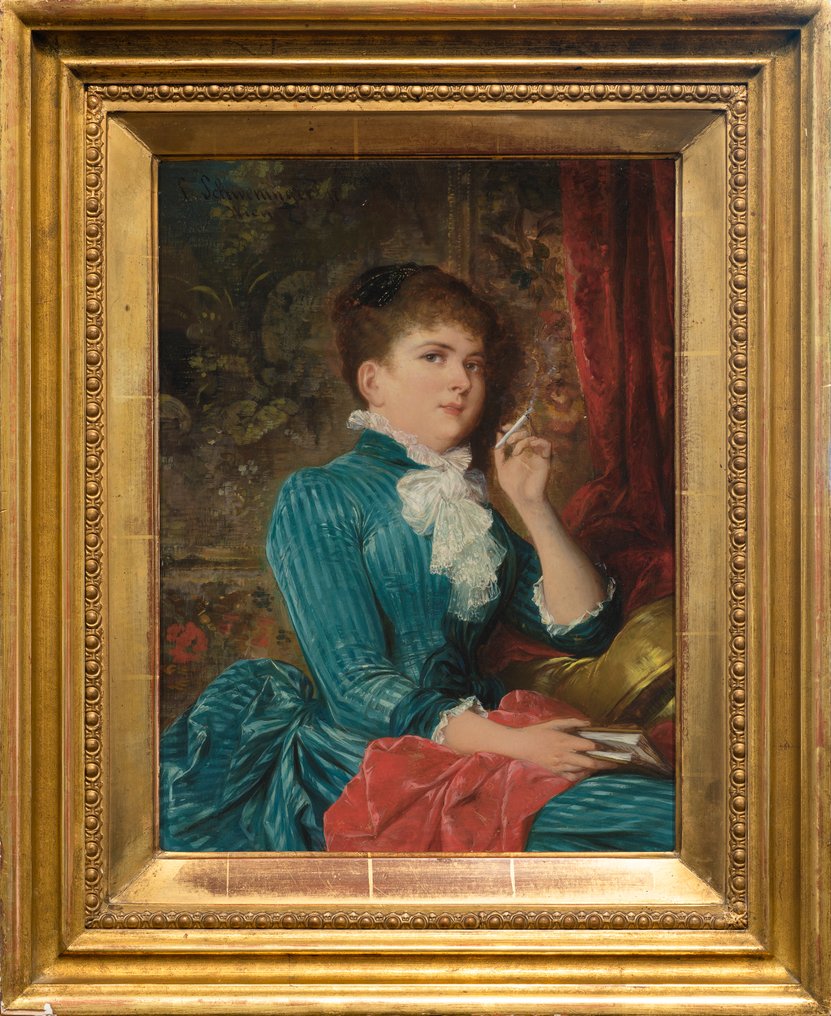
Signed C. Schweninger Jr. and inscribed Wien (upper left)
Reverse: Wax seal of “Hischler & Comp.,” a Viennese art gallery
Carl Schweninger Jr. was a renowned Austrian genre painter and the son of the distinguished German artist Carl Schweninger Sr. (1818–1887), one of the most esteemed painters of his time. His sister, Rosa Schweninger, was also an accomplished artist specializing in portraits and genre depictions. Schweninger Jr. trained under his father before furthering his studies at the academies in Vienna and Munich. His works vividly capture the fin de siècle lifestyle, reflecting themes of modernity, feminism, and social transformation.
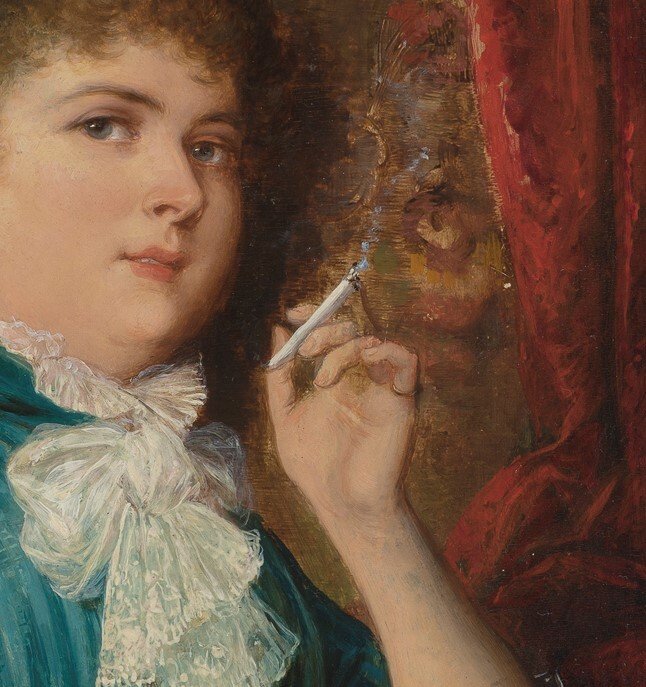
This painting portrays a young woman dressed in the typical daytime attire and hairstyle of the late 19th century. Notably, she wears a "pinky ring" on the little finger of her left hand—a subtle Zeitgeist symbol indicating her disinterest in marriage. Between her fingers, she holds a smoldering cigarette, a daring element at the time. While smoking at home was already common for women in Eastern and Southern Europe by the late 19th century, its depiction in art was still considered provocative, symbolizing liberalism, feminism, and, at times, political extremism, such as anarchism. Simultaneously, it conveyed an image of allure, sensuality, and defiance of social norms.
The composition unfolds through multiple layers of meaning. Seated in a richly draped drawing room, the woman not only holds a cigarette but also a book, alluding to her education and intellectual pursuits. Additionally, historical evidence suggests she may have been a known Amazon—a term often used for independent and unconventional women of the era. The photograph on the postcard depicts the same young woman in St. Petersburg in 1909, in a Rococo-style setting, hinting at her possible role as a salonnière or an adventurous figure of Viennese society.
Condition
The painting is in very good condition. The varnish has slightly darkened with age, and minor scattered marks are visible. Some scuffing is present along the upper edges and corners due to the frame. The frame itself exhibits signs of wear, with a small area of material loss near the lower left corner.
Provenance
- Auctionhouse Düsseldorf, May 2006
- From 2006: Private collection, Tallinn, Estonia
- From 2022: Flegma Gallery, Amsterdam/Tallinn
This work was exhibited in 2011 at the PortraitArea exhibition at the Mikkel Museum (Art Museum of Estonia/Kadriorg Museum) in Tallinn. See attached photos from the exhibition catalogue.
Carl Schweninger Jr. (1854–1903, Austria)
Lady with a Cigarette
End of the 19th century
Oil on wooden panel
32.2 x 25.6 cm (unframed)
45 x 36.5 cm (framed, gilt stucco frame)
Signed C. Schweninger Jr. and inscribed Wien (upper left)
Reverse: Wax seal of “Hischler & Comp.,” a Viennese art gallery
Carl Schweninger Jr. was a renowned Austrian genre painter and the son of the distinguished German artist Carl Schweninger Sr. (1818–1887), one of the most esteemed painters of his time. His sister, Rosa Schweninger, was also an accomplished artist specializing in portraits and genre depictions. Schweninger Jr. trained under his father before furthering his studies at the academies in Vienna and Munich. His works vividly capture the fin de siècle lifestyle, reflecting themes of modernity, feminism, and social transformation.
This painting portrays a young woman dressed in the typical daytime attire and hairstyle of the late 19th century. Notably, she wears a "pinky ring" on the little finger of her left hand—a subtle Zeitgeist symbol indicating her disinterest in marriage. Between her fingers, she holds a smoldering cigarette, a daring element at the time. While smoking at home was already common for women in Eastern and Southern Europe by the late 19th century, its depiction in art was still considered provocative, symbolizing liberalism, feminism, and, at times, political extremism, such as anarchism. Simultaneously, it conveyed an image of allure, sensuality, and defiance of social norms.
The composition unfolds through multiple layers of meaning. Seated in a richly draped drawing room, the woman not only holds a cigarette but also a book, alluding to her education and intellectual pursuits. Additionally, historical evidence suggests she may have been a known Amazon—a term often used for independent and unconventional women of the era. The photograph on the postcard depicts the same young woman in St. Petersburg in 1909, in a Rococo-style setting, hinting at her possible role as a salonnière or an adventurous figure of Viennese society.
Condition
The painting is in very good condition. The varnish has slightly darkened with age, and minor scattered marks are visible. Some scuffing is present along the upper edges and corners due to the frame. The frame itself exhibits signs of wear, with a small area of material loss near the lower left corner.
Provenance
- Auctionhouse Düsseldorf, May 2006
- From 2006: Private collection, Tallinn, Estonia
- From 2022: Flegma Gallery, Amsterdam/Tallinn
This work was exhibited in 2011 at the PortraitArea exhibition at the Mikkel Museum (Art Museum of Estonia/Kadriorg Museum) in Tallinn. See attached photos from the exhibition catalogue.
Details
Artist
Carl Schweninger Jr. (1854-1903)
Sold with frame
Yes
Title of artwork
Lady with a Cigarette
Technique
Oil painting
Signature
Hand signed
Country of Origin
Austria
Condition
Excellent condition
Height
45 cm
Width
37 cm
Depiction/Theme
Interior scene
Style
Realism
Period
19th century
Sold by
