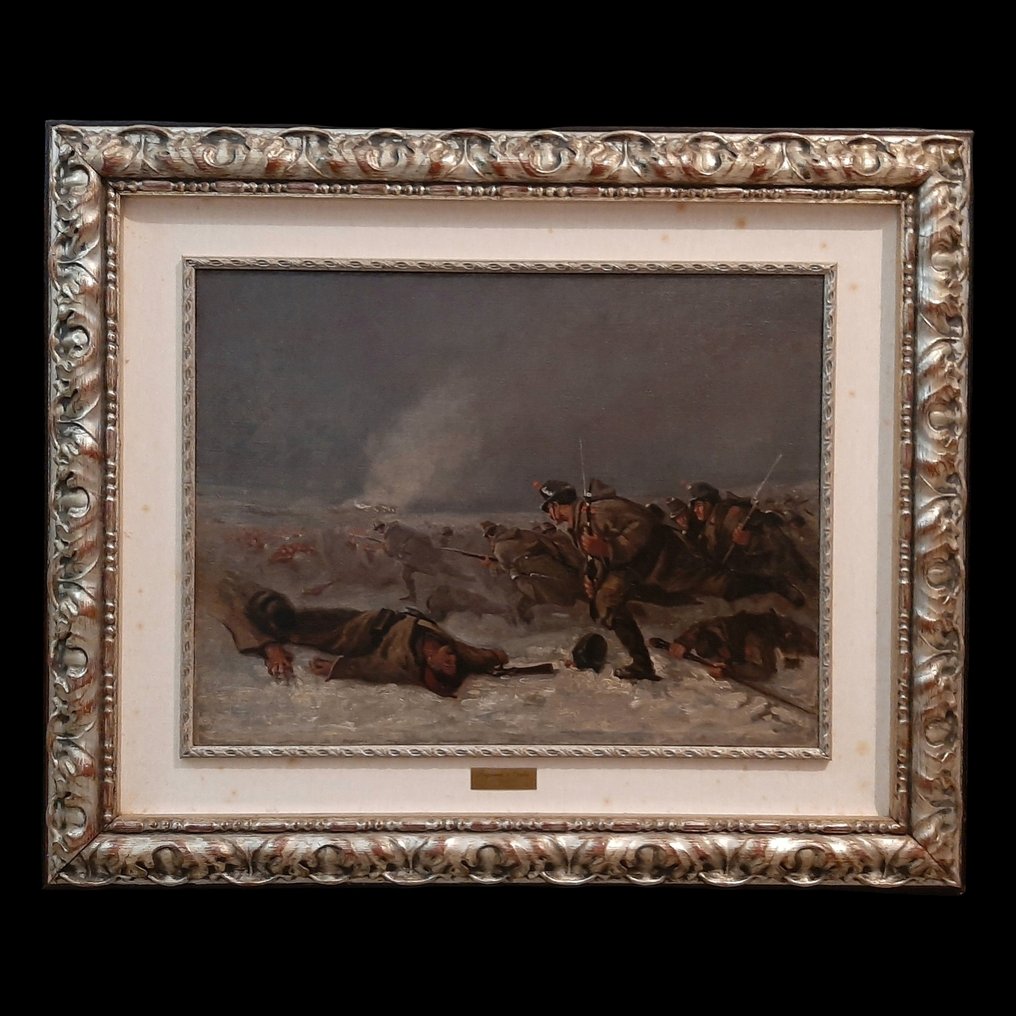
Nicolae Grigorescu (1838-1907), Circle of - L'attacco di Smârdan



01
day
15
hours
19
minutes
28
seconds
Current bid
€ 2,000
No reserve price

Expert
Selected by Caterina Maffeis
Master in early Renaissance Italian painting with internship at Sotheby’s and 15 years' experience.
Estimate € 400 - € 700
59 other people are watching this object
 Bidder 1533 Bidder 1533 | €2,000 | |
|---|---|---|
| Bidder 1980 | €1,100 | |
| Bidder 1533 | €1,000 | |
Catawiki Buyer Protection
Your payment’s safe with us until you receive your object.View details
Trustpilot 4.4 | 121899 reviews
Rated Excellent on Trustpilot.
Oil on canvas from the Circolo di Nicolae Grigorescu, portraying the Smârdan attack in the late nineteenth century with a framed presentation.
AI-assisted summary
Description from the seller
AUTHOR (Circle of)
Nicolae Grigorescu (1838-1907) was a Romanian painter. He is considered one of the fathers of modern Romanian painting and an icon of national art. Born in a small village in Wallachia in 1838, his artistic training began early, first as an apprentice painter of icons and religious frescoes, and then, thanks to a scholarship awarded for his precocious talent, he moved to Paris in 1861. There, he attended the École des Beaux-Arts and the studios of influential artists such as Sébastien Cornu. Crucially, he became acquainted with the Barbizon School, discovering plein air painting and a focus on landscapes and rural life, far from rigid academic conventions. This experience led him to develop a personal style, characterized by vibrant brushwork, warm light, and an intimate sensibility in depicting bucolic scenes, peasants, and the authentic atmosphere of his homeland.
His return to Romania, particularly after 1877 during the War of Independence, where he served as a war painter, marked the most mature and popular phase of his career. Grigorescu devoted himself to capturing the soul of the Romanian countryside, with his ox-drawn carriages, shepherds, and portraits of peasant girls, elevating simple life to a subject worthy of art. His work was distinguished by its luminosity and lyricism, profoundly influencing subsequent generations of Romanian artists. He died in 1907 in the city of Campina, in southeastern Romania, where he had moved in 1890.
Description
"The Attack of Smârdan," oil on canvas, 88*74cm with frame, 68*54cm on the canvas alone, by an artist belonging to Nicolae Grigorescu's circle, dating to the late 19th century. The painting has been relined and restretched on the back.
The painting presented here is a remake of "The Attack of Smârdan" from 1885, housed at the National Museum of Romanian History in Bucharest. The subject is a heroic episode from the Romanian War of Independence (1877–1878), specifically the assault conducted by Romanian troops to conquer the fortified village of Smârdan. The scene is constructed around a dynamic diagonal that leads the eye through the charge of the soldiers, who advance in tight formation. In the foreground, wounded Turkish soldiers on the ground anchor the scene in the tragic reality of combat, adding a strong dramatic and commemorative accent. This late-nineteenth-century artist replicated Grigorescu's iconography and celebratory intent, likely drawing directly from his works.
Technically and chromatically, the artist adopts the Master's pictorial sensibility. The chromatic palette is sober and consistent with the drama depicted, dominated by cold, muted colors—the leaden grays, the browns of the uniforms, and the dirty whites of the snow—reflecting the wintry setting and the harshness of war. The brushstrokes are rapid, vibrant, and free, a distinctive trait that Grigorescu acquired through his study of the artists of the Barbizon School and which drew him to Impressionism. This technique imbues the pictorial surface with a sense of immediacy, capturing the turbulent atmosphere and rapid movement of the troops.
The painting fits into the context of the master's mature period, where, through his original work, a current of historical and patriotic painting was established. The artists in his circle thus contributed to spreading and consolidating Grigorescu's influence, using his modern pictorial language to celebrate Romanian identity and history, combining direct observation (typical of his approach) with a strong romantic and national sentiment.
Condition Report
The overall condition is excellent, the work is intact throughout, with vivid, clearly legible colors and brushstrokes. The painting has been relined and restretched on the back. The frame is complimentary.
Tracked and insured shipment with adequate packaging.
AUTHOR (Circle of)
Nicolae Grigorescu (1838-1907) was a Romanian painter. He is considered one of the fathers of modern Romanian painting and an icon of national art. Born in a small village in Wallachia in 1838, his artistic training began early, first as an apprentice painter of icons and religious frescoes, and then, thanks to a scholarship awarded for his precocious talent, he moved to Paris in 1861. There, he attended the École des Beaux-Arts and the studios of influential artists such as Sébastien Cornu. Crucially, he became acquainted with the Barbizon School, discovering plein air painting and a focus on landscapes and rural life, far from rigid academic conventions. This experience led him to develop a personal style, characterized by vibrant brushwork, warm light, and an intimate sensibility in depicting bucolic scenes, peasants, and the authentic atmosphere of his homeland.
His return to Romania, particularly after 1877 during the War of Independence, where he served as a war painter, marked the most mature and popular phase of his career. Grigorescu devoted himself to capturing the soul of the Romanian countryside, with his ox-drawn carriages, shepherds, and portraits of peasant girls, elevating simple life to a subject worthy of art. His work was distinguished by its luminosity and lyricism, profoundly influencing subsequent generations of Romanian artists. He died in 1907 in the city of Campina, in southeastern Romania, where he had moved in 1890.
Description
"The Attack of Smârdan," oil on canvas, 88*74cm with frame, 68*54cm on the canvas alone, by an artist belonging to Nicolae Grigorescu's circle, dating to the late 19th century. The painting has been relined and restretched on the back.
The painting presented here is a remake of "The Attack of Smârdan" from 1885, housed at the National Museum of Romanian History in Bucharest. The subject is a heroic episode from the Romanian War of Independence (1877–1878), specifically the assault conducted by Romanian troops to conquer the fortified village of Smârdan. The scene is constructed around a dynamic diagonal that leads the eye through the charge of the soldiers, who advance in tight formation. In the foreground, wounded Turkish soldiers on the ground anchor the scene in the tragic reality of combat, adding a strong dramatic and commemorative accent. This late-nineteenth-century artist replicated Grigorescu's iconography and celebratory intent, likely drawing directly from his works.
Technically and chromatically, the artist adopts the Master's pictorial sensibility. The chromatic palette is sober and consistent with the drama depicted, dominated by cold, muted colors—the leaden grays, the browns of the uniforms, and the dirty whites of the snow—reflecting the wintry setting and the harshness of war. The brushstrokes are rapid, vibrant, and free, a distinctive trait that Grigorescu acquired through his study of the artists of the Barbizon School and which drew him to Impressionism. This technique imbues the pictorial surface with a sense of immediacy, capturing the turbulent atmosphere and rapid movement of the troops.
The painting fits into the context of the master's mature period, where, through his original work, a current of historical and patriotic painting was established. The artists in his circle thus contributed to spreading and consolidating Grigorescu's influence, using his modern pictorial language to celebrate Romanian identity and history, combining direct observation (typical of his approach) with a strong romantic and national sentiment.
Condition Report
The overall condition is excellent, the work is intact throughout, with vivid, clearly legible colors and brushstrokes. The painting has been relined and restretched on the back. The frame is complimentary.
Tracked and insured shipment with adequate packaging.
Details
Artist
Nicolae Grigorescu (1838-1907)
Sold with frame
Yes
Attribution
Circle of
Title of artwork
L'attacco di Smârdan
Technique
Oil painting
Signature
Not signed
Country of Origin
Romania
Condition
Excellent condition
Height
88 cm
Width
74 cm
Style
Impressionism
Period
19th century
Sold by
