Antonio Fontanesi (1818–1882), Attrib. - Paesaggio con fiume



02
days
05
hours
11
minutes
56
seconds
Current bid
€ 200
Reserve price not met

Expert
Selected by Caterina Maffeis
Master in early Renaissance Italian painting with internship at Sotheby’s and 15 years' experience.
Estimate € 1,000 - € 1,500
17 other people are watching this object
 Bidder 0625 Bidder 0625 | €200 |
|---|
Catawiki Buyer Protection
Your payment’s safe with us until you receive your object.View details
Trustpilot 4.4 | 122053 reviews
Rated Excellent on Trustpilot.
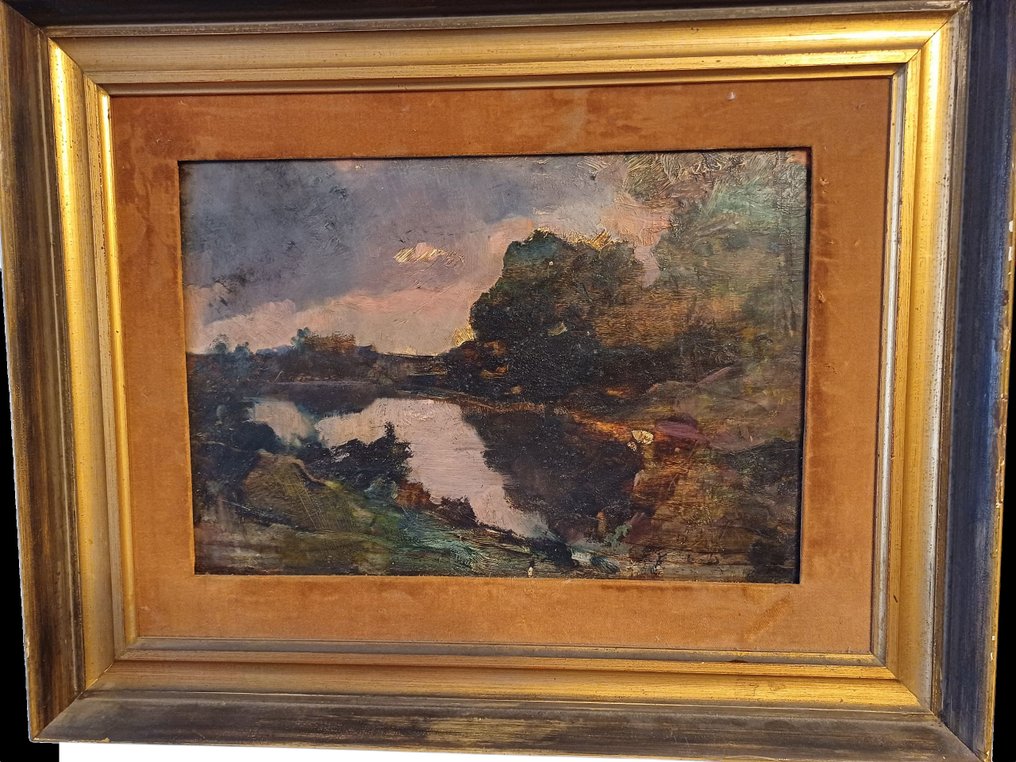
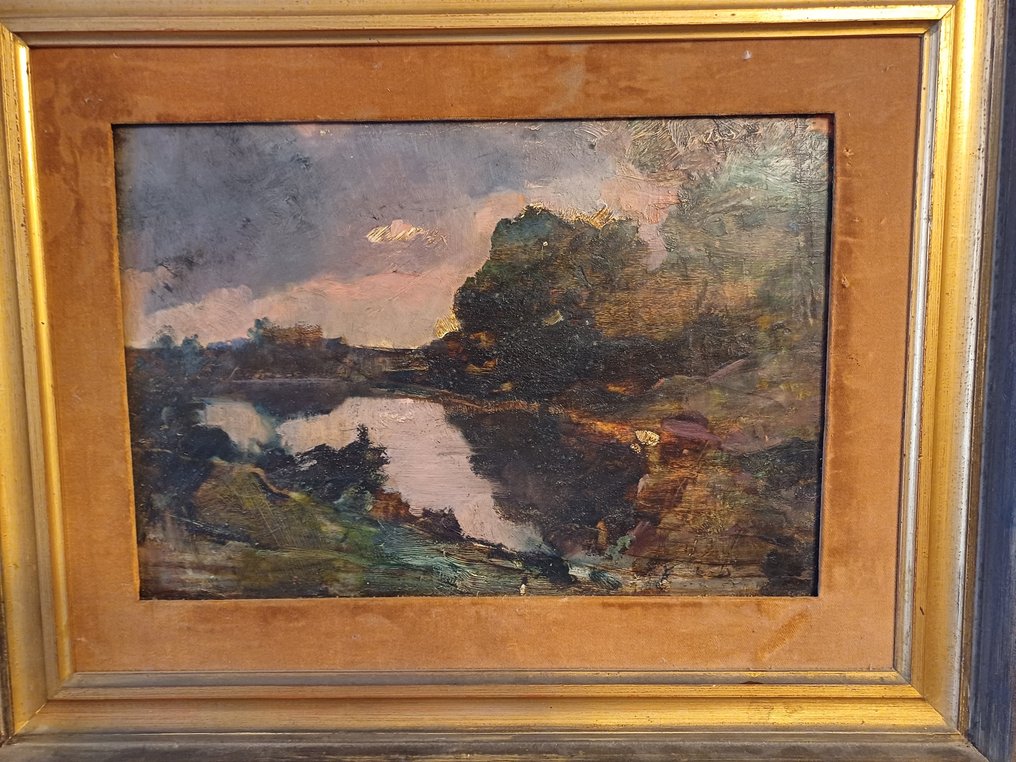
Landscape with a river attributed to Antonio Fontanesi, oil on panel, 45 by 57 cm, Italian origin, and sold with frame.
AI-assisted summary
Description from the seller
Interesting work attributed to the painter Antonio Fontanesi (Reggio Emilia, February 23, 1818 – Turin, April 17, 1882) painted in oil on a wooden panel in good condition. The artwork measures 27.4 x 39.3 cm.
A retro, an inscription from Archivio
Initials label on the front bottom right.
Antonio Fontanesi is among the most sensitive of Italian romantic painters and one of the great European landscape artists, certainly also one of the most appreciated engravers of the 19th century. Emiliano, he moved to Geneva in 1850, where he came into contact with art dealer Victor Brachard and painter Alexandre Calame: in 1855, he visited the Universal Exposition in Paris and the Palais des Beaux-Arts, where he saw the works of Corot, Daubigny, Rousseau, and Troyon. Three years later, he began frequenting the circle of painters who gathered around François-Auguste Ravier in Dauphiné. In 1867, he was in Florence, where he painted "Sunset on the Arno," now in the Modern Art Gallery of Palazzo Pitti: while the Arno has been a very common subject since the mid-18th century, both among local and foreign artists, Fontanesi chose not to conform to the previous tradition but adopted a more 'impressionistic' approach rather than a 'view.' Here, and more generally, we can find the poetry of truth, determined by a Romantic sensibility, illuminated by an unparalleled light and at the same time characterized by the best fidelity to the truth of en plein air painting. His goal was to capture the fleeting variation of light at sunset on the landscape, thus conveying his free impression and lyrical vocation of the truth, achieved through a quick and careful application, alternating textured impasto with thin brushstrokes. The execution technique, with sharp contrasts between light and shadow and a lively palette, suggests placing the creation of our painting also in the Florentine stay.
Origin of the collection from a private Italian collection.
Fast shipping with secure packaging
Seller's Story
Art dealer specializing in old master paintings and 19th century works
In collaboration with ART & INVESTIGATION historical and artistic investigations on works of art
Translated by Google TranslateInteresting work attributed to the painter Antonio Fontanesi (Reggio Emilia, February 23, 1818 – Turin, April 17, 1882) painted in oil on a wooden panel in good condition. The artwork measures 27.4 x 39.3 cm.
A retro, an inscription from Archivio
Initials label on the front bottom right.
Antonio Fontanesi is among the most sensitive of Italian romantic painters and one of the great European landscape artists, certainly also one of the most appreciated engravers of the 19th century. Emiliano, he moved to Geneva in 1850, where he came into contact with art dealer Victor Brachard and painter Alexandre Calame: in 1855, he visited the Universal Exposition in Paris and the Palais des Beaux-Arts, where he saw the works of Corot, Daubigny, Rousseau, and Troyon. Three years later, he began frequenting the circle of painters who gathered around François-Auguste Ravier in Dauphiné. In 1867, he was in Florence, where he painted "Sunset on the Arno," now in the Modern Art Gallery of Palazzo Pitti: while the Arno has been a very common subject since the mid-18th century, both among local and foreign artists, Fontanesi chose not to conform to the previous tradition but adopted a more 'impressionistic' approach rather than a 'view.' Here, and more generally, we can find the poetry of truth, determined by a Romantic sensibility, illuminated by an unparalleled light and at the same time characterized by the best fidelity to the truth of en plein air painting. His goal was to capture the fleeting variation of light at sunset on the landscape, thus conveying his free impression and lyrical vocation of the truth, achieved through a quick and careful application, alternating textured impasto with thin brushstrokes. The execution technique, with sharp contrasts between light and shadow and a lively palette, suggests placing the creation of our painting also in the Florentine stay.
Origin of the collection from a private Italian collection.
Fast shipping with secure packaging
Seller's Story
Art dealer specializing in old master paintings and 19th century works
In collaboration with ART & INVESTIGATION historical and artistic investigations on works of art
Translated by Google TranslateDetails
Artist
Antonio Fontanesi (1818–1882), Attrib.
Sold with frame
Yes
Title of artwork
Paesaggio con fiume
Country of Origin
Italy
Condition
Good condition
Height
45 cm
Width
57 cm
Sold by
