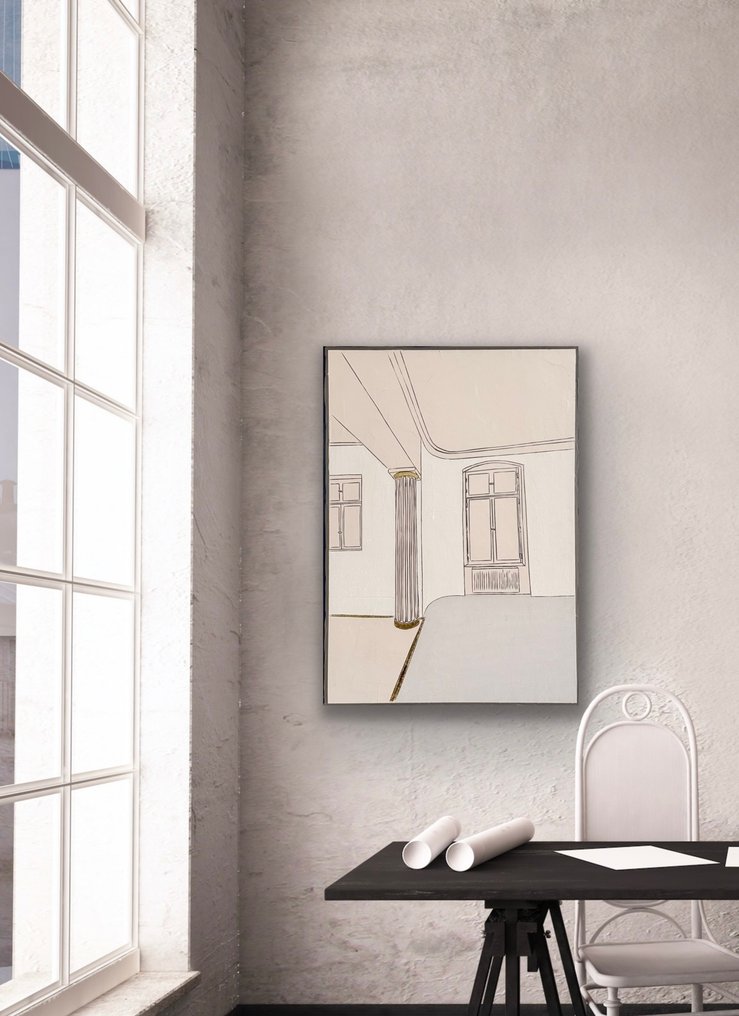
Andrea Imwiehe - Memory Room_Golden_03



02
days
19
hours
56
minutes
12
seconds
Current bid
€ 110
Reserve price not met

Expert
Selected by Itziar Ramos
Holds a bachelor’s degree in art history and led modern and contemporary post-war art at Bonhams.
Gallery Estimate € 2,200 - € 2,700
25 other people are watching this object
 Bidder 4096 Bidder 4096 | €110 | |
|---|---|---|
| Bidder 4436 | €100 | |
| Bidder 4436 | €20 | |
Catawiki Buyer Protection
Your payment’s safe with us until you receive your object.View details
Trustpilot 4.4 | 122290 reviews
Rated Excellent on Trustpilot.
Andrea Imwiehe’s Memory Room_Golden_03, a 2024 acrylic on wood panel in crème colours, 70 × 50 cm, an original edition in Minimalism, hand-signed, sold directly by the artist, ready to hang and accompanied by an authenticity certificate.
AI-assisted summary
Description from the seller
Andrea Imwiehe, winner of the art prize of AOK Nordost, Berlin/Brandenburg, and recipient of a scholarship from the Künstlerhaus Lukas in Ahrenshoop, is a graduate of the Hochschule für Bildende Künste Braunschweig. She has been passionately engaged with painting since her youth and now lives and works in a studio in the old imperial post office in the heart of Berlin.
Your acrylic paintings are inspired by personal memory but go beyond these. Their aim is to create an atmosphere through painting.
Your artworks are today part of numerous private collections and have been exhibited in galleries, museums, and renowned art exhibitions. https://artfacts.net/artist/andrea-imwiehe/383311
No textual content provided for translation.
Instagram: https://www.instagram.com/andreaimwiehe/
Andrea Imwiehe works with a combination of acrylic painting and line drawing, where the lines are cut directly into the acrylic paint to form a recessed relief.
The artwork at a glance:
Image of the series 'Memory Rooms' – impressions of spaces and memories through unique painting.
- Combination of acrylic painting and line drawing - unique surface texture
Painted on high-quality wooden painting ground – ready to hang immediately.
Signed on the back, numbered, and accompanied by all image information.
Shipping is carried out professionally wrapped in tissue paper and bubble wrap.
Certificate of authenticity included
Andrea Imwiehe is a memory archaeologist. The things she handles – the colors she chooses, the lines she draws, and the motifs she selects – revolve around this vague realm where lost and past things are stored – and recreated! Because memory is not a drawer where what has been placed there once can be taken out untouched, but each act of remembering is a re-creation made anew in the respective moment. These paintings are also related to a reconstruction intent: they allude to a lost world and to isolated, somewhat questionable objects in their meaning, which, however, are treated in such a special way that they invite not only the artist but also viewers to reimagine their vanished context anew. (...).
The painter draws from her own concrete memories and objects that have personal significance for her, without turning them into a personal mythology that viewers would have to identify with. Instead, she renders the objects into the supra-personal and universal through their isolation and careful, detailed individual presentation, so that her own experiences and images are evoked within us. Her life context is not elaborate—where these freely floating, collage-like motifs placed onto the picture plane actually exist is entirely indeterminate.
They float on a homogeneous colored surface composed of three to four overlaid layers of color, from each of which narrow strips at the bottom remain visible, surrounding the image like its own frame. Here too, we have an analogy to memory, in which new layers are formed day after day. The past can never be re-experienced as a whole, but only retrieved in parts.
Dr. Anette Naumann
Andrea Imwiehe, winner of the art prize of AOK Nordost, Berlin/Brandenburg, and recipient of a scholarship from the Künstlerhaus Lukas in Ahrenshoop, is a graduate of the Hochschule für Bildende Künste Braunschweig. She has been passionately engaged with painting since her youth and now lives and works in a studio in the old imperial post office in the heart of Berlin.
Your acrylic paintings are inspired by personal memory but go beyond these. Their aim is to create an atmosphere through painting.
Your artworks are today part of numerous private collections and have been exhibited in galleries, museums, and renowned art exhibitions. https://artfacts.net/artist/andrea-imwiehe/383311
No textual content provided for translation.
Instagram: https://www.instagram.com/andreaimwiehe/
Andrea Imwiehe works with a combination of acrylic painting and line drawing, where the lines are cut directly into the acrylic paint to form a recessed relief.
The artwork at a glance:
Image of the series 'Memory Rooms' – impressions of spaces and memories through unique painting.
- Combination of acrylic painting and line drawing - unique surface texture
Painted on high-quality wooden painting ground – ready to hang immediately.
Signed on the back, numbered, and accompanied by all image information.
Shipping is carried out professionally wrapped in tissue paper and bubble wrap.
Certificate of authenticity included
Andrea Imwiehe is a memory archaeologist. The things she handles – the colors she chooses, the lines she draws, and the motifs she selects – revolve around this vague realm where lost and past things are stored – and recreated! Because memory is not a drawer where what has been placed there once can be taken out untouched, but each act of remembering is a re-creation made anew in the respective moment. These paintings are also related to a reconstruction intent: they allude to a lost world and to isolated, somewhat questionable objects in their meaning, which, however, are treated in such a special way that they invite not only the artist but also viewers to reimagine their vanished context anew. (...).
The painter draws from her own concrete memories and objects that have personal significance for her, without turning them into a personal mythology that viewers would have to identify with. Instead, she renders the objects into the supra-personal and universal through their isolation and careful, detailed individual presentation, so that her own experiences and images are evoked within us. Her life context is not elaborate—where these freely floating, collage-like motifs placed onto the picture plane actually exist is entirely indeterminate.
They float on a homogeneous colored surface composed of three to four overlaid layers of color, from each of which narrow strips at the bottom remain visible, surrounding the image like its own frame. Here too, we have an analogy to memory, in which new layers are formed day after day. The past can never be re-experienced as a whole, but only retrieved in parts.
Dr. Anette Naumann
Details
Artist
Andrea Imwiehe
Sold with frame
No
Sold by
Direct from the artist
Edition
Original
Title of artwork
Memory Room_Golden_03
Technique
Acrylic painting
Signature
Hand signed
Country of Origin
Germany
Year
2024
Condition
Excellent condition
Colour
Cream
Height
70 cm
Width
50 cm
Depiction/Theme
Interior scene
Style
Minimalism
Period
2020+
Sold by