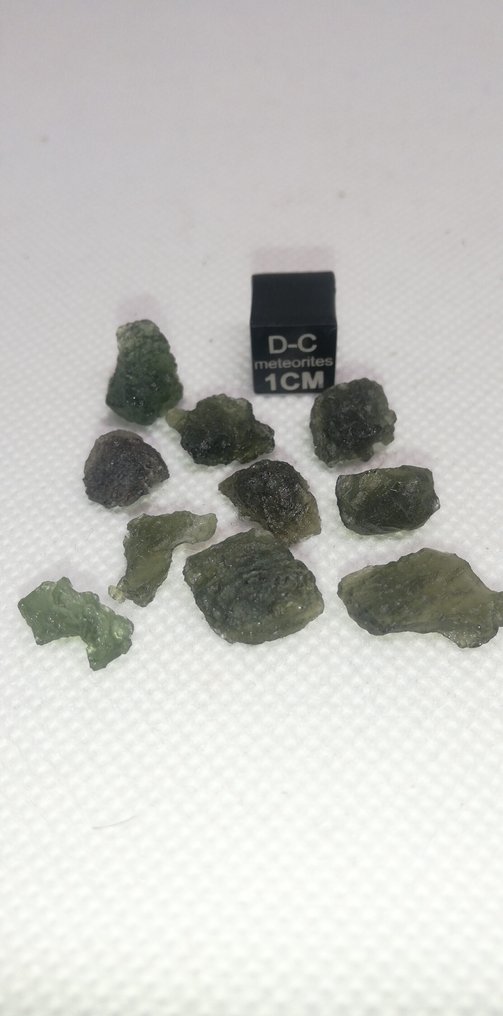
Set of 10 Moldavite Chlum stones. Moldavite - 5 g - (10)



05
days
01
hour
33
minutes
15
seconds

4 other people are watching this object
 Bidder 1090 Bidder 1090 | €1 |
|---|
Catawiki Buyer Protection
Your payment’s safe with us until you receive your object.View details
Trustpilot 4.4 | 122630 reviews
Rated Excellent on Trustpilot.
Lot of 10 Moldavite Chlum, a moldavite tektite meteorite from the Czech Republic (Chlum).
AI-assisted summary
Description from the seller
Formation and origin of moldavites
The formation of Moldavites was caused by a colossal meteorite that struck the territory of present-day Germany 15 million years ago. The meteorite landed between Nuremberg, Stuttgart, and Munich, and the crater created by this impact is currently called Ries. People might wonder how the meteorite in Germany is related to the formation of Moldavites in the Czech Republic. The giant meteorite struck German territory at a sharp angle and was so hot during its passage through the atmosphere that, upon falling, drops of molten rock and parts of the meteorite spilled over the territory of southern Czechia and partly over southwestern Moravia. Naturshop.cz leans towards this theory, although there are perhaps three theories explaining the formation of Moldavites, which many scientists still contest.
The reason we believe in the theory that these gemstones are formed by large meteorites is that moldavites contain a rare substance called lechatelierite, which cannot be found anywhere else on our planet. Lechatelierite is a natural quartz glass that can appear yellow, green, or brown, and is an integral part of moldavites, depending on the ability to recognize the authenticity of these different gemstones. Another interesting point is that moldavites contain almost no water, compared to other volcanic glasses like obsidian, which contains water.
Types of Tectite
Moldavites come from the Czech Republic; they have a bottle green color, as well as their surface and internal structure. They contain a unique lechatelierite that is found elsewhere than in this gemstone.
Bediasites - Tektites originating from North America are oval-shaped and have a black color.
Ivorites - black tektites from the southwestern part of Africa, particularly from the region called Côte d'Ivoire.
Irgizites come from Kazakhstan, formed by the meteorite one million years ago, and the crater formed by the meteorite is called Žamašin.
Australites come from the deserts and sand deposits in the western part of Australia. They are black in color, and when viewed against the light, they appear darker.
Asian tektites - these stones date back 770,000 years, and the crater from a meteorite impact has not yet been found; they are found in Asia and are named after various locations: Indochinites, Philippinites, Malaysinites, Javanites, and Billitonites.
Seller's Story
As a collector and meteorite enthusiast and member of the IMCA.
(International Association of Meteorite Collectors),
I guarantee the authenticity of all my meteorites, selected with care, to offer you the best service.
IMCA # 6758
DC meteorites
Translated by Google TranslateFormation and origin of moldavites
The formation of Moldavites was caused by a colossal meteorite that struck the territory of present-day Germany 15 million years ago. The meteorite landed between Nuremberg, Stuttgart, and Munich, and the crater created by this impact is currently called Ries. People might wonder how the meteorite in Germany is related to the formation of Moldavites in the Czech Republic. The giant meteorite struck German territory at a sharp angle and was so hot during its passage through the atmosphere that, upon falling, drops of molten rock and parts of the meteorite spilled over the territory of southern Czechia and partly over southwestern Moravia. Naturshop.cz leans towards this theory, although there are perhaps three theories explaining the formation of Moldavites, which many scientists still contest.
The reason we believe in the theory that these gemstones are formed by large meteorites is that moldavites contain a rare substance called lechatelierite, which cannot be found anywhere else on our planet. Lechatelierite is a natural quartz glass that can appear yellow, green, or brown, and is an integral part of moldavites, depending on the ability to recognize the authenticity of these different gemstones. Another interesting point is that moldavites contain almost no water, compared to other volcanic glasses like obsidian, which contains water.
Types of Tectite
Moldavites come from the Czech Republic; they have a bottle green color, as well as their surface and internal structure. They contain a unique lechatelierite that is found elsewhere than in this gemstone.
Bediasites - Tektites originating from North America are oval-shaped and have a black color.
Ivorites - black tektites from the southwestern part of Africa, particularly from the region called Côte d'Ivoire.
Irgizites come from Kazakhstan, formed by the meteorite one million years ago, and the crater formed by the meteorite is called Žamašin.
Australites come from the deserts and sand deposits in the western part of Australia. They are black in color, and when viewed against the light, they appear darker.
Asian tektites - these stones date back 770,000 years, and the crater from a meteorite impact has not yet been found; they are found in Asia and are named after various locations: Indochinites, Philippinites, Malaysinites, Javanites, and Billitonites.
Seller's Story
As a collector and meteorite enthusiast and member of the IMCA.
(International Association of Meteorite Collectors),
I guarantee the authenticity of all my meteorites, selected with care, to offer you the best service.
IMCA # 6758
DC meteorites
Translated by Google TranslateDetails
Number of items
10
Name of meteorite
Set of 10 Moldavite Chlum stones.
Type of meteorite
Moldavite
Weight
5 g
Country of Origin
Czech Republic
Sold by