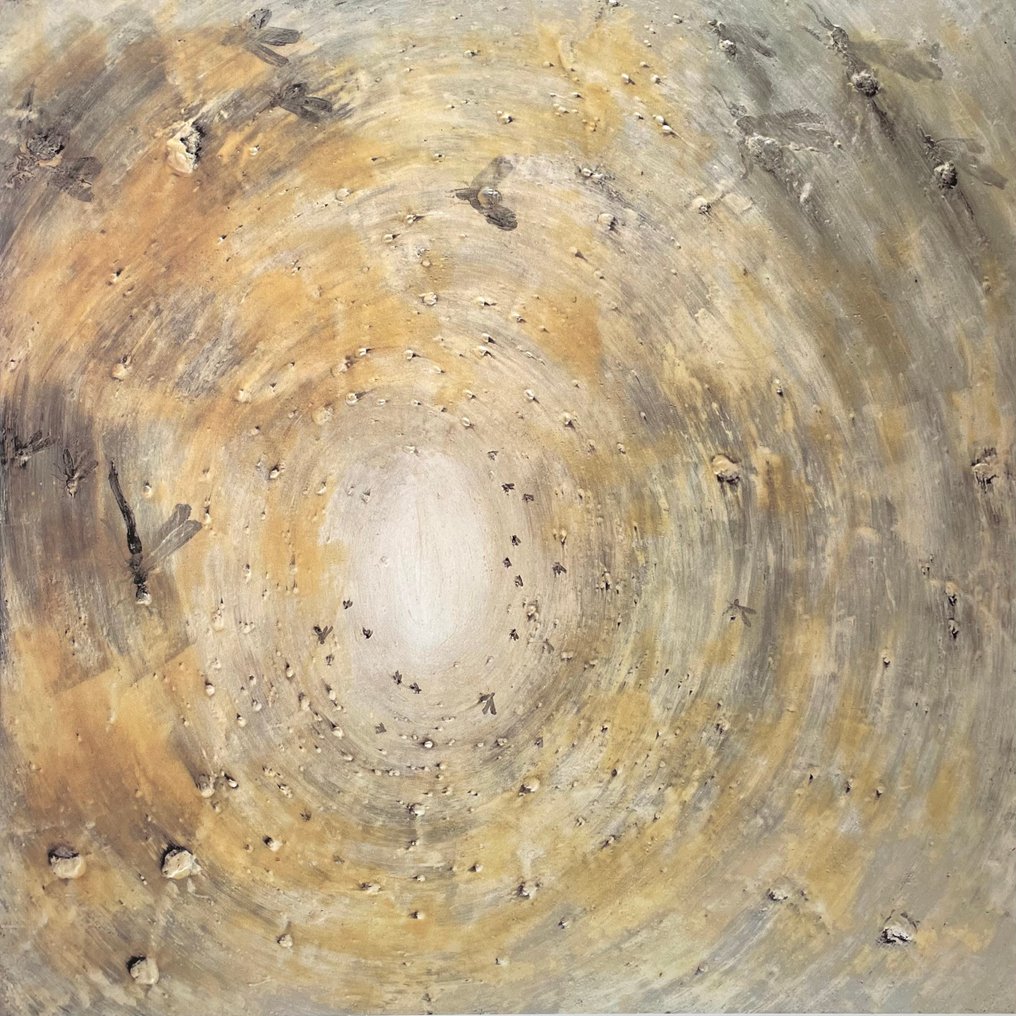
Miquel Barceló (after) - Constelació Nº4 - Offset Lithography - Licensed print


04
days
05
hours
19
minutes
31
seconds
Current bid
€ 2
Reserve price not met

Expert
Selected by Juan Antonio Rodríguez
Eight years experience valuing posters, previously valuer at Balclis, Barcelona.
Estimate € 150 - € 200
9 other people are watching this object
 Bidder 0061 Bidder 0061 | €2 | |
|---|---|---|
 Bidder 1589 Bidder 1589 | €1 |
Catawiki Buyer Protection
Your payment’s safe with us until you receive your object.View details
Trustpilot 4.4 | 122385 reviews
Rated Excellent on Trustpilot.
Description from the seller
Offset lithography after Miquel Barceló
Reproduction of the work 'Constelació Nº4' (**), mixed media of pigments and latex on canvas created by Barceló in 1989.
Printed on high-quality thick Art Fine paper (200g)
Published by the Museum of Contemporary Spanish Art of Palma de Mallorca.
Authorized printing with legal copyright and serial number.
Large Format.
- Sheet dimensions: 68 x 68 cm
Condition: Excellent (this artwork has never been framed or exhibited, always stored in a professional art folder, and therefore remains in perfect condition).
The artwork will be carefully handled and packaged in a reinforced cardboard box. The shipment will be certified with a tracking number.
The shipment will also include transport insurance for the final value of the work with full reimbursement in case of loss or damage, at no cost to the buyer.
(*) Miquel Barceló's early interest in art comes from his mother, a painter in the Mallorcan landscape tradition; his first revelation came when he traveled to Paris in 1974 and discovered the paintings of Paul Klee, Jean Dubuffet, and the works of art brut in general, which would have a lasting impact on him.
That same year he began attending drawing and modeling classes at the School of Decorative Arts in Palma de Mallorca, and shortly afterwards he entered the Sant Jordi School of Fine Arts in Barcelona, although he barely attended classes during the first few months; instead, his self-taught training was decisive: he voraciously read all kinds of works and gradually explored the paintings of Lucio Fontana, Mark Rothko, Jackson Pollock and Willem de Kooning, among other prominent artists.
In 1976, he participated in the happenings and protest actions of the Taller Llunàtic group, and with them, he held his first exhibition in Barcelona at the Mec-Mec gallery in 1977. The following year, he exhibited canvases covered in paint, incorporating organic elements, in Mallorca. Later, he experimented with thick layers of paint on canvases exposed to the elements, provoking spontaneous physical and chemical reactions such as oxidation and cracking, which revealed the painting's inner workings. He never abandoned experimenting with organic materials and forms drawn from nature.
His participation in the São Paulo Biennial (1981) and Documenta VII in Kassel (1982) propelled him onto the international art scene at a young age. Major museums and galleries around the world began seeking his work, and his paintings fetched exceptionally high prices, unheard of for an artist of his age. Important awards followed with equal speed: in 1986 he received the National Prize for Visual Arts, and in 2003 he was awarded the Prince of Asturias Award for the Arts.
Barceló has spent long periods in Mali, an African country whose light, like that of the Mediterranean, has profoundly influenced his painting. In 1992, he secretly married Cecile, a Dutch literature specialist, in the town of Artá. Months later, in August of that year, he became a father for the first time when his wife gave birth to a daughter in Mallorca, whom they named Marcela María Celia. The couple lives in their home and studio in Sa Devesa de Ferrutx (Mallorca). In 2002, he created a memorable illustration of Dante's Divine Comedy, and in 2007, he unveiled an extraordinary ceramic altarpiece in the Chapel of the Blessed Sacrament in Palma de Mallorca Cathedral, which recreates the miracle of the loaves and fishes.
In November 2008, the decoration of the dome of Room XX at the United Nations Palace in Geneva, named the "Human Rights and Alliance of Civilizations Room," was unveiled to the public. This work, covering 1,600 square meters and costing 20 million euros, can only be appreciated by the viewer in fragments due to its vast surface area; on it, the artist shaped thousands of marine stalactites that together evoke a vast universal sea.
Baroque painting, art brut, American abstract expressionism, Italian arte povera, the works of Joan Miró and Antoni Tàpies are among the influences that Barceló has transfigured into a formidable personal synthesis of a neo-expressionist nature and overflowing imagination, with a dense material presence and immense plastic richness.
(**) The enormous international success achieved by Miquel Barceló is largely due to the plastic force of his paintings, the originality of his repertoire of characteristic themes and a technique based on certain resources, such as the mastery of aerial perspective, from which he usually offers bird's-eye views of spaces difficult to represent and the passage from minuscule to cosmic scales, showing both objects of immediate presence and immense places, such as the sea that lacks concrete limits.
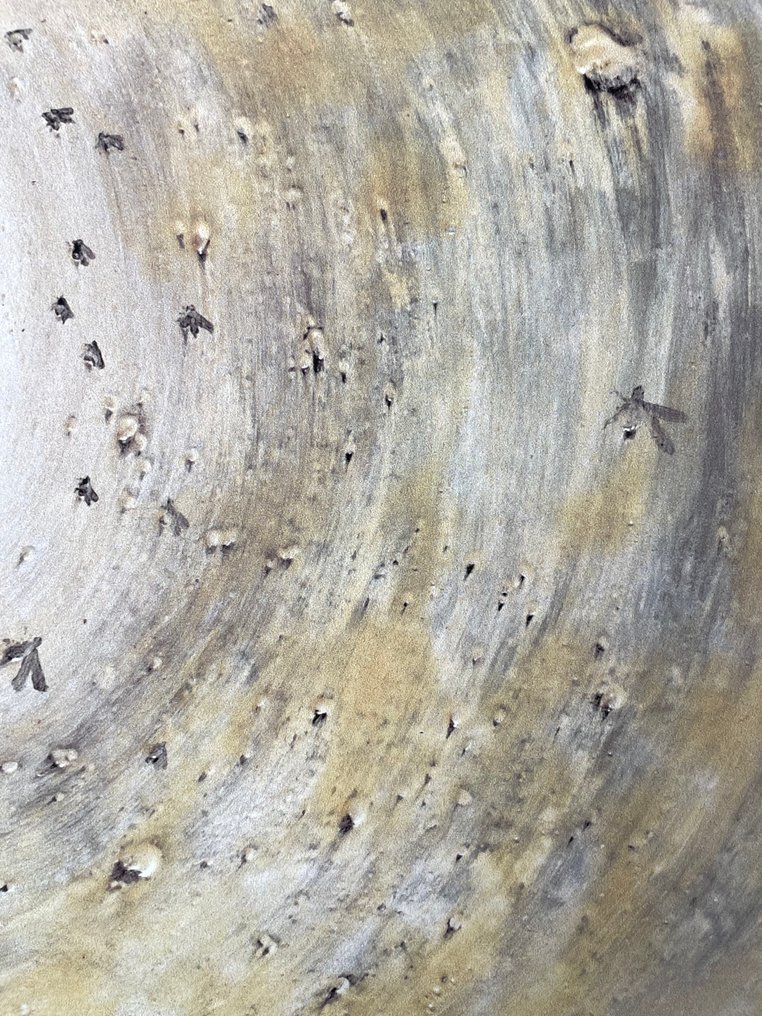
In the case of Constel·lació núm. 4 (Forat blanc), a word that seems to have been taken from the mythical world of another great Mallorcan painter, Joan Miró, we are confronted with a cosmogonic space, without limits or references to a specific place or scale, in which everything seems to revolve around a large white hole, as if they were planets or stars forming a milky constellation around a great central void. However, some material protuberances in the painting seem to project shadows on the canvas that suggest the shapes of dragonflies or flying insects, which would place this constellation on the scale of the minuscule.
But if we compare those protuberances that populate the canvas of the painting, like excrescences, with those that appear in La Flaque, we could interpret this space as the consequence of a mirage produced by the desert light, where the stones on the ground, covered in blinding sand, seem to have begun to spin before our eyes. In this painting, the cosmic and the earthly go hand in hand.
Seller's Story
EsKobARTE carefully selects artworks and posters from recognized and emerging artists worldwide to offer them here at affordable prices.*** AUTHENTIC WORKS *** We only sell genuine artworks and posters, as well as officially authorized prints.*** WE ARE PROFESSIONALS *** You can bid on your items with complete confidence. Over 1,000 positive reviews from our clients attest to our experience and professionalism on Catawiki.*** PROTECTED, CERTIFIED, AND INSURED SHIPPING *** All our items are carefully packaged in eco-friendly cardboard packaging. We work with the best shipping companies (UPS-DPD-DHL-FEDEX) to ensure the best service and tracking. Additionally, our shipments include insurance against damage or loss at no cost to the buyer.*** IF YOU PURCHASE MORE THAN ONE ITEM, WE COMBINE SHIPPING *** Even if they come from different auctions, you'll only have to pay the shipping cost for a single item.*** ANY QUESTIONS? CONTACT US *** You can use the chat to talk to us; we will be happy to assist you as soon as possible.*** THANK YOU AND GOOD LUCK WITH YOUR BIDS! ***
Translated by Google TranslateOffset lithography after Miquel Barceló
Reproduction of the work 'Constelació Nº4' (**), mixed media of pigments and latex on canvas created by Barceló in 1989.
Printed on high-quality thick Art Fine paper (200g)
Published by the Museum of Contemporary Spanish Art of Palma de Mallorca.
Authorized printing with legal copyright and serial number.
Large Format.
- Sheet dimensions: 68 x 68 cm
Condition: Excellent (this artwork has never been framed or exhibited, always stored in a professional art folder, and therefore remains in perfect condition).
The artwork will be carefully handled and packaged in a reinforced cardboard box. The shipment will be certified with a tracking number.
The shipment will also include transport insurance for the final value of the work with full reimbursement in case of loss or damage, at no cost to the buyer.
(*) Miquel Barceló's early interest in art comes from his mother, a painter in the Mallorcan landscape tradition; his first revelation came when he traveled to Paris in 1974 and discovered the paintings of Paul Klee, Jean Dubuffet, and the works of art brut in general, which would have a lasting impact on him.
That same year he began attending drawing and modeling classes at the School of Decorative Arts in Palma de Mallorca, and shortly afterwards he entered the Sant Jordi School of Fine Arts in Barcelona, although he barely attended classes during the first few months; instead, his self-taught training was decisive: he voraciously read all kinds of works and gradually explored the paintings of Lucio Fontana, Mark Rothko, Jackson Pollock and Willem de Kooning, among other prominent artists.
In 1976, he participated in the happenings and protest actions of the Taller Llunàtic group, and with them, he held his first exhibition in Barcelona at the Mec-Mec gallery in 1977. The following year, he exhibited canvases covered in paint, incorporating organic elements, in Mallorca. Later, he experimented with thick layers of paint on canvases exposed to the elements, provoking spontaneous physical and chemical reactions such as oxidation and cracking, which revealed the painting's inner workings. He never abandoned experimenting with organic materials and forms drawn from nature.
His participation in the São Paulo Biennial (1981) and Documenta VII in Kassel (1982) propelled him onto the international art scene at a young age. Major museums and galleries around the world began seeking his work, and his paintings fetched exceptionally high prices, unheard of for an artist of his age. Important awards followed with equal speed: in 1986 he received the National Prize for Visual Arts, and in 2003 he was awarded the Prince of Asturias Award for the Arts.
Barceló has spent long periods in Mali, an African country whose light, like that of the Mediterranean, has profoundly influenced his painting. In 1992, he secretly married Cecile, a Dutch literature specialist, in the town of Artá. Months later, in August of that year, he became a father for the first time when his wife gave birth to a daughter in Mallorca, whom they named Marcela María Celia. The couple lives in their home and studio in Sa Devesa de Ferrutx (Mallorca). In 2002, he created a memorable illustration of Dante's Divine Comedy, and in 2007, he unveiled an extraordinary ceramic altarpiece in the Chapel of the Blessed Sacrament in Palma de Mallorca Cathedral, which recreates the miracle of the loaves and fishes.
In November 2008, the decoration of the dome of Room XX at the United Nations Palace in Geneva, named the "Human Rights and Alliance of Civilizations Room," was unveiled to the public. This work, covering 1,600 square meters and costing 20 million euros, can only be appreciated by the viewer in fragments due to its vast surface area; on it, the artist shaped thousands of marine stalactites that together evoke a vast universal sea.
Baroque painting, art brut, American abstract expressionism, Italian arte povera, the works of Joan Miró and Antoni Tàpies are among the influences that Barceló has transfigured into a formidable personal synthesis of a neo-expressionist nature and overflowing imagination, with a dense material presence and immense plastic richness.
(**) The enormous international success achieved by Miquel Barceló is largely due to the plastic force of his paintings, the originality of his repertoire of characteristic themes and a technique based on certain resources, such as the mastery of aerial perspective, from which he usually offers bird's-eye views of spaces difficult to represent and the passage from minuscule to cosmic scales, showing both objects of immediate presence and immense places, such as the sea that lacks concrete limits.
In the case of Constel·lació núm. 4 (Forat blanc), a word that seems to have been taken from the mythical world of another great Mallorcan painter, Joan Miró, we are confronted with a cosmogonic space, without limits or references to a specific place or scale, in which everything seems to revolve around a large white hole, as if they were planets or stars forming a milky constellation around a great central void. However, some material protuberances in the painting seem to project shadows on the canvas that suggest the shapes of dragonflies or flying insects, which would place this constellation on the scale of the minuscule.
But if we compare those protuberances that populate the canvas of the painting, like excrescences, with those that appear in La Flaque, we could interpret this space as the consequence of a mirage produced by the desert light, where the stones on the ground, covered in blinding sand, seem to have begun to spin before our eyes. In this painting, the cosmic and the earthly go hand in hand.
Seller's Story
EsKobARTE carefully selects artworks and posters from recognized and emerging artists worldwide to offer them here at affordable prices.*** AUTHENTIC WORKS *** We only sell genuine artworks and posters, as well as officially authorized prints.*** WE ARE PROFESSIONALS *** You can bid on your items with complete confidence. Over 1,000 positive reviews from our clients attest to our experience and professionalism on Catawiki.*** PROTECTED, CERTIFIED, AND INSURED SHIPPING *** All our items are carefully packaged in eco-friendly cardboard packaging. We work with the best shipping companies (UPS-DPD-DHL-FEDEX) to ensure the best service and tracking. Additionally, our shipments include insurance against damage or loss at no cost to the buyer.*** IF YOU PURCHASE MORE THAN ONE ITEM, WE COMBINE SHIPPING *** Even if they come from different auctions, you'll only have to pay the shipping cost for a single item.*** ANY QUESTIONS? CONTACT US *** You can use the chat to talk to us; we will be happy to assist you as soon as possible.*** THANK YOU AND GOOD LUCK WITH YOUR BIDS! ***
Translated by Google TranslateDetails
Era
After 2000
Designer/Artist
Miquel Barceló (after)
Poster title
Constelació Nº4 - Offset Lithography - Licensed print
Subject
Art
Country of Origin
Spain
Condition
A (excellent - mint condition)
Height
68 cm
Width
68 cm