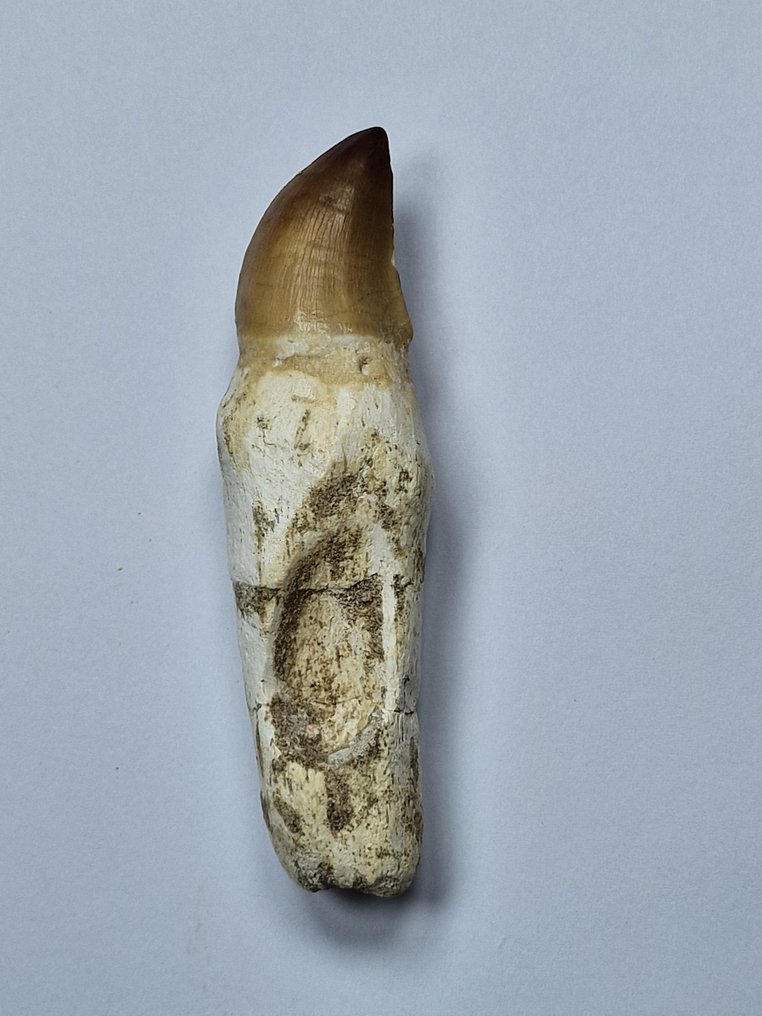
Mosasaur - Fossil tooth - 9 cm (No Reserve Price)


00
days
12
hours
55
minutes
08
seconds

10 other people are watching this object
 Bidder 3184 Bidder 3184 | €12 | |
|---|---|---|
 Bidder 8161 Bidder 8161 | €5 | |
| Bidder 6034 | €2 | |
Catawiki Buyer Protection
Your payment’s safe with us until you receive your object.View details
Trustpilot 4.4 | 121798 reviews
Rated Excellent on Trustpilot.
9 cm Mosasaurus tooth from Morocco with root and part of a jaw bone, partially restored but showing natural bone porosity, a natural specimen from a large Cretaceous predator.
AI-assisted summary
Description from the seller
Enormous Mosasaurus tooth from Morocco with root and part of mandibular bone, partially restored bone, but natural bone porosity can still be seen. Completely natural tooth. Belonged to a large adult specimen. Found in the northwestern Sahara area. This Cretaceous animal was one of the largest marine predators.
Mosasaurus was one of the last mosasaurids, as well as one of the largest. Like most mosasaurids, its limbs had evolved into short but efficient fins, with the front fins being larger than the rear fins. The largest known species, M. hoffmannii, could reach a length of 17-18 meters (56 feet), slightly longer than its closest relatives Tylosaurus and Hainosaurus. Additionally, Mosasaurus was also the most robust among mosasaurids, reaching an impressive weight of 25-30 tons in the most developed specimens, especially the skull, which had a jaw closely connected to the skull. The body was long, thick, and barrel-shaped. The eyes were relatively large but provided poor binocular vision, and the olfactory bulbs were underdeveloped; therefore, experts believe that Mosasaurus lived near the surface.
Enormous Mosasaurus tooth from Morocco with root and part of mandibular bone, partially restored bone, but natural bone porosity can still be seen. Completely natural tooth. Belonged to a large adult specimen. Found in the northwestern Sahara area. This Cretaceous animal was one of the largest marine predators.
Mosasaurus was one of the last mosasaurids, as well as one of the largest. Like most mosasaurids, its limbs had evolved into short but efficient fins, with the front fins being larger than the rear fins. The largest known species, M. hoffmannii, could reach a length of 17-18 meters (56 feet), slightly longer than its closest relatives Tylosaurus and Hainosaurus. Additionally, Mosasaurus was also the most robust among mosasaurids, reaching an impressive weight of 25-30 tons in the most developed specimens, especially the skull, which had a jaw closely connected to the skull. The body was long, thick, and barrel-shaped. The eyes were relatively large but provided poor binocular vision, and the olfactory bulbs were underdeveloped; therefore, experts believe that Mosasaurus lived near the surface.
Details
Specimen
Mosasaur
Country of Origin
Morocco
Geological Period
Cretaceous (145 - 66 million years)
Condition
Restored
Height
9 cm
Sold by