Johan Hendrik van Mastenbroek (1875-1945) - In-/Uitgang Leuvehaven Rotterdam met in de verte de Boogbruggen



08
days
01
hour
10
minutes
49
seconds
Current bid
€ 464
Reserve price not met

Expert
Selected by Leo Setz
Over 30 years’ experience as art dealer, appraiser and restorer.
Estimate € 1,000 - € 1,100
26 other people are watching this object
 Bidder 1525 Bidder 1525 | €464 | |
|---|---|---|
| Bidder 9714 | €444 | |
| Bidder 9714 | €2 | |
Catawiki Buyer Protection
Your payment’s safe with us until you receive your object.View details
Trustpilot 4.4 | 122190 reviews
Rated Excellent on Trustpilot.
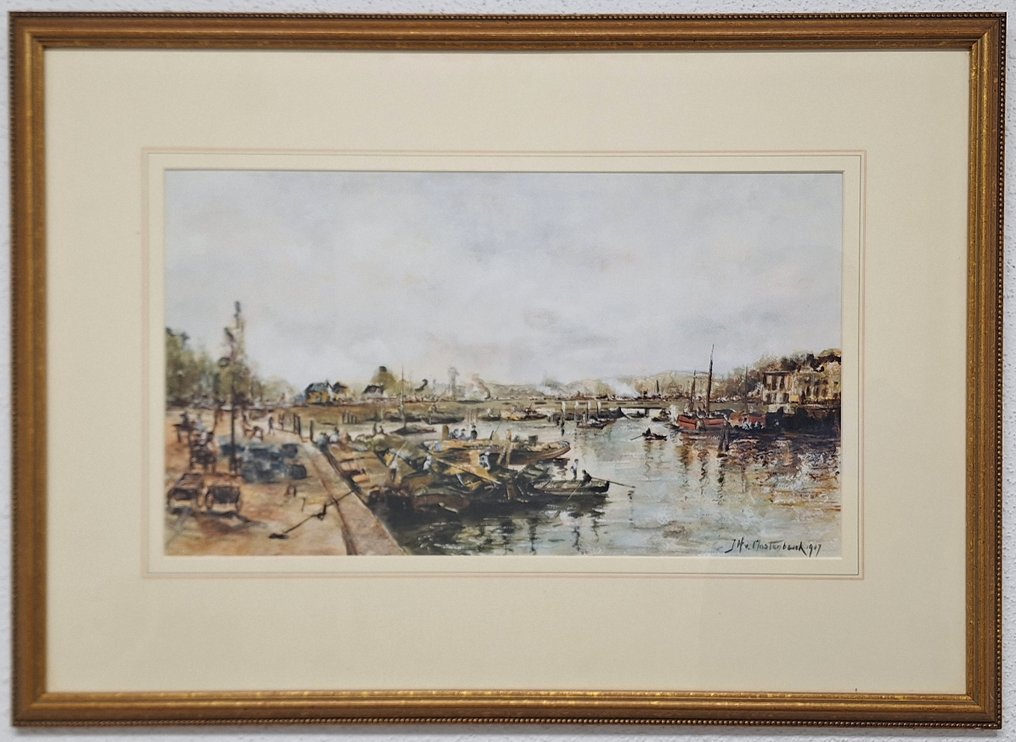
Early twentieth century watercolour by Johan Hendrik van Mastenbroek showing Leuvehaven Rotterdam with the Boogbruggen, dated 1900-1910, a carefully preserved mixed technique piece from the Netherlands.
AI-assisted summary
Description from the seller
Watercolor of the Leuvehaven in Rotterdam in 1907.
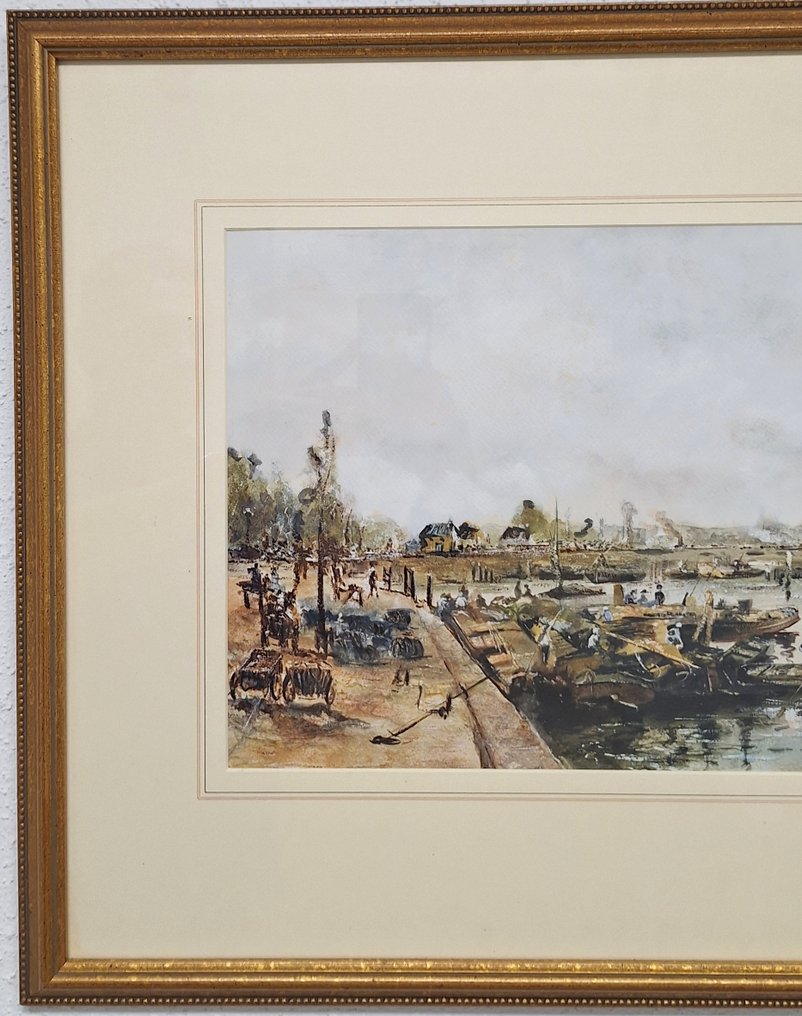
Beautiful work in excellent condition. The entrance/exit of Leuvehaven with the Boogbruggen in the background to the right, visible blade size 28x48cm.
In possession of a gilded wooden frame with mat in very good condition. Recently framed, the work has been stored in a folder for many years. Therefore, the colors are still phenomenal!!
The painting can be viewed on-site before the end of the auction; please ask the auctioneer for information.
Johan Hendrik van Mastenbroek was an Impressionist painter, considered part of the second generation of The Hague School. He gained international fame for his river and harbor scenes. The Rotterdam native was fascinated by the activity in the Rotterdam harbors and along the quays of the historic city, which remained fully intact before the outbreak of World War II. He primarily painted and watercolorized atmospheric, spacious cityscapes with boats and ships. His work is also sometimes compared to that of Jacob Maris, one of the more renowned masters of The Hague School, whom Van Mastenbroek greatly admired. Van Mastenbroek primarily painted his oil paintings at home in his studio, while his watercolors were more accurately created outdoors in nature.
At a certain point in his career, van Mastenbroek began to show more interest in the changing Dutch landscape, where industrialization became rapidly visible. Modern motorboats, steamships, steel bridges, and sometimes cranes and dockworkers appeared in the painter's work. The early 20th century was an exciting time, during which Rotterdam was developing into a world port. After the great flood disaster in 1916, which van Mastenbroek closely followed and documented in drawings, work finally began in 1920 on one of the most spectacular projects of the century, the Zuiderzee Works: the closure of the Zuiderzee, the formation of the IJsselmeer, and the drainage and reclamation of Flevoland.
Work is carefully packaged and shipped internationally with insurance and registered mail.
Watercolor of the Leuvehaven in Rotterdam in 1907.
Beautiful work in excellent condition. The entrance/exit of Leuvehaven with the Boogbruggen in the background to the right, visible blade size 28x48cm.
In possession of a gilded wooden frame with mat in very good condition. Recently framed, the work has been stored in a folder for many years. Therefore, the colors are still phenomenal!!
The painting can be viewed on-site before the end of the auction; please ask the auctioneer for information.
Johan Hendrik van Mastenbroek was an Impressionist painter, considered part of the second generation of The Hague School. He gained international fame for his river and harbor scenes. The Rotterdam native was fascinated by the activity in the Rotterdam harbors and along the quays of the historic city, which remained fully intact before the outbreak of World War II. He primarily painted and watercolorized atmospheric, spacious cityscapes with boats and ships. His work is also sometimes compared to that of Jacob Maris, one of the more renowned masters of The Hague School, whom Van Mastenbroek greatly admired. Van Mastenbroek primarily painted his oil paintings at home in his studio, while his watercolors were more accurately created outdoors in nature.
At a certain point in his career, van Mastenbroek began to show more interest in the changing Dutch landscape, where industrialization became rapidly visible. Modern motorboats, steamships, steel bridges, and sometimes cranes and dockworkers appeared in the painter's work. The early 20th century was an exciting time, during which Rotterdam was developing into a world port. After the great flood disaster in 1916, which van Mastenbroek closely followed and documented in drawings, work finally began in 1920 on one of the most spectacular projects of the century, the Zuiderzee Works: the closure of the Zuiderzee, the formation of the IJsselmeer, and the drainage and reclamation of Flevoland.
Work is carefully packaged and shipped internationally with insurance and registered mail.
Details
Artist
Johan Hendrik van Mastenbroek (1875-1945)
Sold by
Gallery
Edition
Original
Title of artwork
In-/Uitgang Leuvehaven Rotterdam met in de verte de Boogbruggen
Technique
Mixed media, Watercolour painting
Signature
Hand signed
Country of Origin
Netherlands
Condition
Excellent condition
Height
51 cm
Width
71 cm
Weight
4 kg
Style
Impressionism
Period
1900-1910
Sold by
