Scipione - Famiglie Nobili Fiorentine - 1615


08
days
06
hours
48
minutes
54
seconds
Current bid
€ 1,250
Reserve price not met

Expert
Selected by Ilaria Colombo
Specialist in old books, specialising in theological disputes since 1999.
Estimate € 2,800 - € 3,500
11 other people are watching this object
 Bidder 2012 Bidder 2012 | €1,250 | |
|---|---|---|
| Bidder 3693 | €110 | |
| Bidder 9511 | €100 | |
Catawiki Buyer Protection
Your payment’s safe with us until you receive your object.View details
Trustpilot 4.4 | 122529 reviews
Rated Excellent on Trustpilot.
Delle Famiglie Nobili Fiorentine by Scipione Ammirato, 1st illustrated edition published in 1615 in Firenze, bound in full leather with folding plates, 232 pages, large folio format (405 x 270 mm), in Italian as the original language and focusing on heraldry.
AI-assisted summary
Description from the seller
The Hidden Roots of Florentine Power: The Secret Memory of the Medici and Their Ancestors
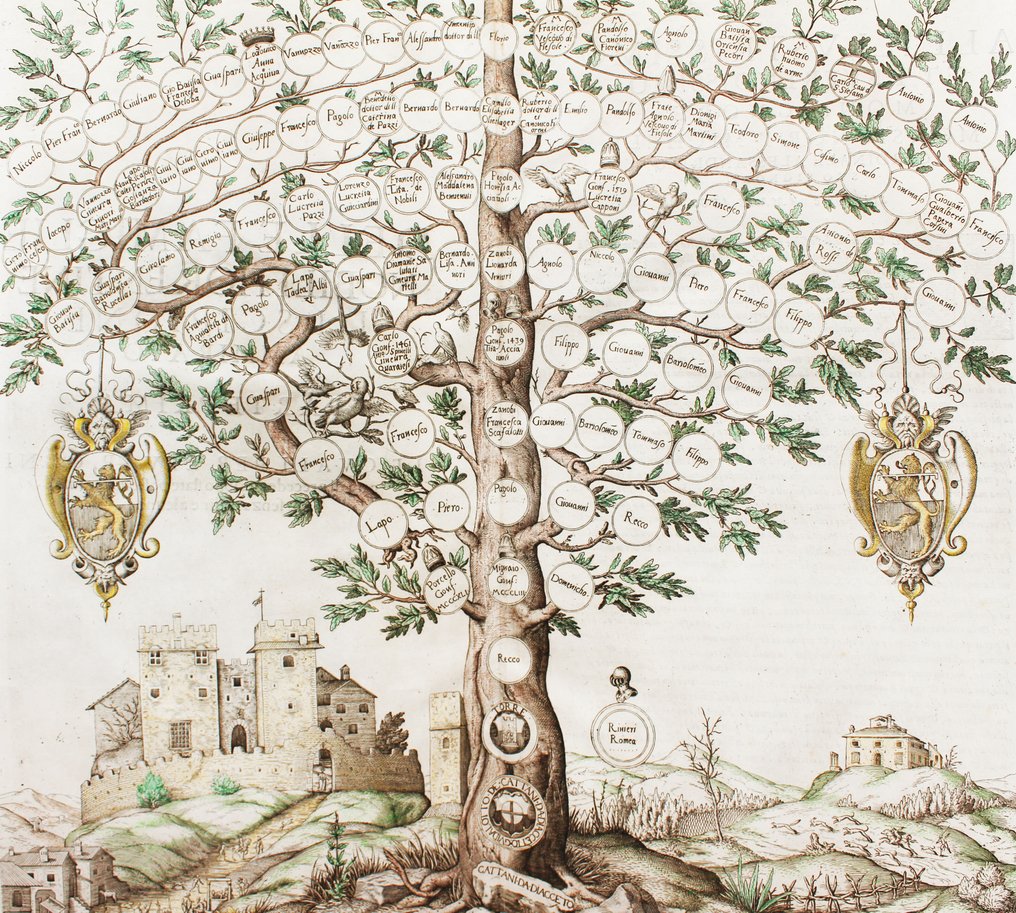
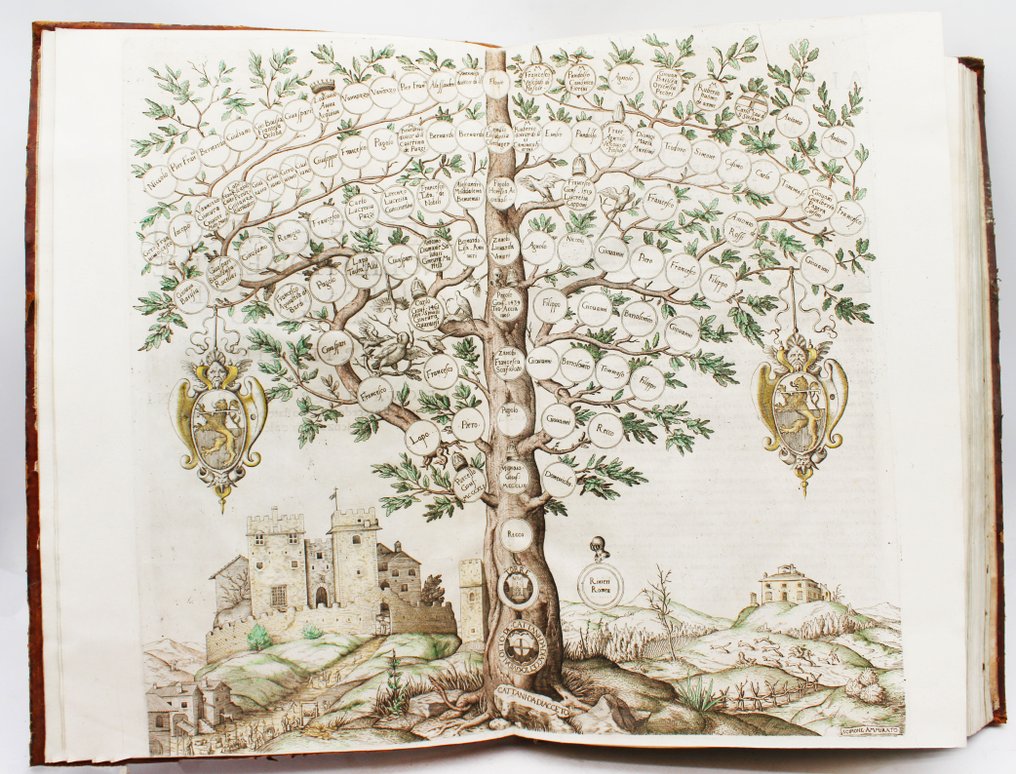
Monumental and solemn work, Delle Famiglie Nobili Fiorentine by Scipione Ammirato represents both an erudite and political pillar, which orders, justifies, and celebrates the ancient aristocratic power of the great Florentine families. Splendid genealogical trees, one of which is finely watercolor-painted.
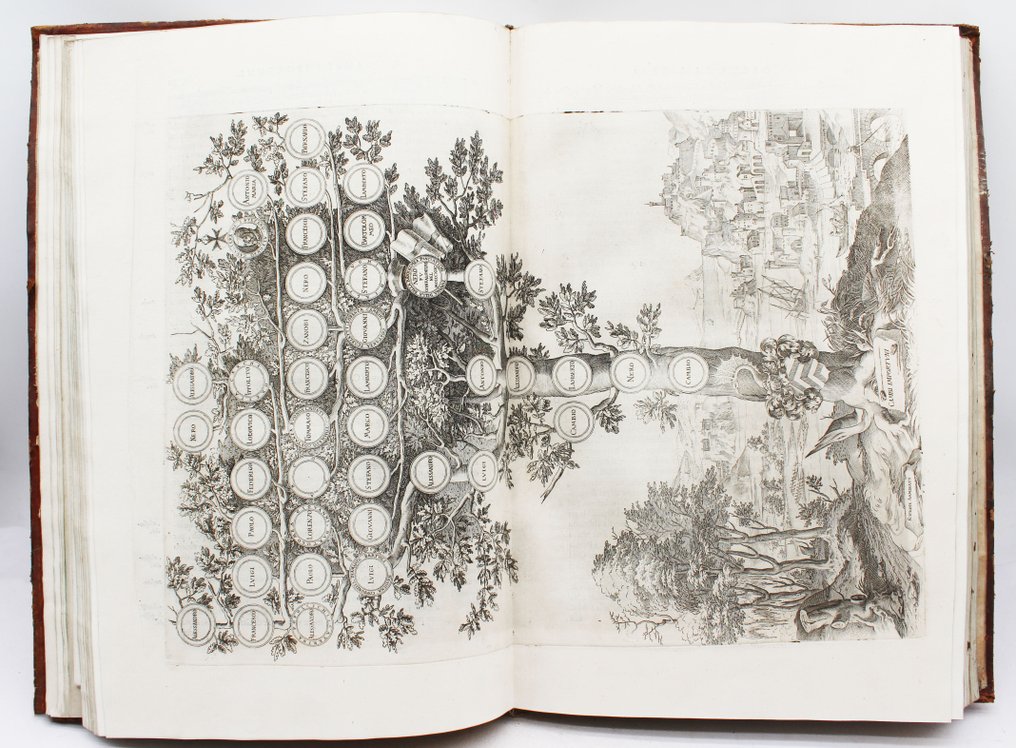
Printed in Florence in 1615, during the height of the Medici era, this work is conceived as an atlas of memory, a heraldic map that makes visible the fabric of blood, glory, and privileges accumulated over the centuries. The extensive genealogical tables spread across multiple panels here take on the value of true esoteric diagrams, where the tree of ancestors becomes a cosmic symbol that describes the order of the world, the continuity of virtue, and the sacred justification of dominion.
In a single, imposing Part One – the only published – Ammirato forever fixes the genealogy of civic powers, returning a monument to civic memory and a structural document of Florentine political culture between the Renaissance and the early Seventeenth century.
Market value
First edition copies of Ammirato in folio with present and intact genealogical tables, even when repaired or folded, typically range in value from 2,500 to 4,500 euros for copies in contemporary binding with evident signs of use; the most complete copies in better condition can reach around 5,000–6,500 euros; copies with significant provenance and well-preserved ancient bindings can exceed 7,000 euros.
Physical description and condition
Contemporary full leather binding with dry decoration, plates with floral motif frames, and spine with ribs and gold friezes; signs of wear. Frontispiece with a large engraved Medici coat of arms. Stunning genealogical trees, one finely watercolor-painted. The author's portrait is present. Contains 13 engraved genealogical plates, many folded over multiple panels; signs of use and small straps that do not touch the engravings. Well-preserved paper, with some browning. Ex-libris of Societatis Jesu, Antwerp, 1648. Pages (2); 8 unnumbered; 212; 8 unnumbered; (2).
Full title and author
Of the noble families of Florence
Florence, by Gio:Donato, and Bernardino Giunti, & Compagni, 1615.
Scipione Ammirato
Context and Significance
The work was created during the height of the political-cultural season when Florence was consolidating itself as the capital of Medici power. Already an author of a comprehensive history of the city, Ammirato offers here a genealogical systematization that is not merely a heraldic repertoire but a true political tool, aimed at affirming the antiquity of the lineages and defining a map of the city’s nobility consistent with the new court balances. The iconographic apparatus is among the most spectacular of the period: the genealogical tables, spread across multiple panels, form true symbolic landscapes, with castles, views, and heraldic devices that integrate visual elements with the manuscript tradition of family trees. The structure of the work – with only Part One published – made the 1615 edition a closed and definitive corpus, whose rarity is increased by the physical fragility of the large folded plates. It is a fundamental document for the study of Florentine families, Tuscan heraldry, and the culture of power between the 16th and 17th centuries.
Biography of the Author
Scipione Ammirato (Lecce, 1531 – Florence, 1601) was one of the greatest Italian historians of the sixteenth century. Trained in Naples, Rome, and Florence, he became attached to the Medici court and was the author of the monumental Florence History. An erudite man of letters and a central figure in genealogical studies of his time, Ammirato represents a bridge between humanist historiography and the political culture of the early seventeenth century. His genealogical work demonstrates meticulous research into sources, combined with an awareness of the political role of family memory.
Printing history and circulation
First edition, Florence, Giunti, 1615. The work had no further parts, despite the title announcing only Part One. The print runs of the Giunti in folio with large illustrated apparatus involved high costs and technical complexity, especially for the large-format genealogical tables. Complete copies of the tables, particularly intact and untrimmed, are now rare. Cited as rare by Lozzi I, 1578, with particular emphasis on the quality of the illustrative content. The circulation was mainly Tuscan and linked to the noble circles of the time.
BIBLIOGRAPHY AND REFERENCES
Lozzi, Historical Library of Tuscany, I, 1578.
BNF, bibliographic notice on the first edition (collation and variants).
OPAC SBN, copies preserved in the main Italian libraries.
Giunti Historical Catalogs (Florence)
Literature on Florentine genealogy and 17th-century iconographic apparatus.
Studies on Scipione Ammirato and the Medicean historiographical tradition.
Seller's Story
Luxury Books: Your Go-To Guide for Nabbing Literary Treasures!
Embarking on the thrilling journey of collecting rare and timeless printed works? Here's your snappy rundown, "The Collector's Cheat Sheet," to ensure you're not just flipping pages but stacking up the value:
1. Edition and Rarity: Rarity is the name of the game. First editions, limited printings, and books flaunting unique features like eye-catching illustrations or mind-blowing bindings? Consider them the VIPs of the collector's world.
2. Condition & Dimension: Picture this – a book in mint condition, untouched by the woes of wear and tear. Now, flip the script: wear, foxing, discoloration – they're the villains here. And don't forget to size up the dimensions, because a book's size matters in the collector's universe.
3. Authenticity: In a world of replicas and forgeries, verifying a book's authenticity is your superhero move. Expert examination and authentication – your trusty sidekicks in this quest.
4. Provenance: Who owned it before you? If the book has hobnobbed with famous figures or danced through historical events, its value skyrockets. Every book has a story, but some have blockbuster tales.
5. Demand and Market Trends: Think of book values as the stock market of the literary world. Stay savvy on collector trends and market shifts to ride the waves of value.
6. Subject Matter: Some topics are like fine wine – they get better with time. Dive into subjects with a timeless appeal or ride the wave of emerging cultural and historical relevance.
7. Binding and Design: Beauty is more than skin deep. Intricate bindings, stunning covers, and illustrations – these are the accessories that make a book runway-ready in the collector's eyes.
8. Association Copies: Books with a personal touch – whether it's a connection to the author or a famous personality – elevate the historical vibes. A book with a backstory? Count us in.
9. Investment Potential: Passion is the engine, but some collectors eye future returns. Keep in mind, though, that the book market can be as unpredictable as a plot twist.
10. Expert Advice: New to the game? Don't play solo. Seek wisdom from the book gurus, hit up book fairs, and join collector communities. We at Luxury Books are the Yodas of the rare book galaxy, helping you build collections that scream sophistication and cultural clout.
Because collecting rare books isn't just about dollar signs – it's a journey of preserving heritage and embracing literary treasures. Happy collecting!
Translated by Google TranslateThe Hidden Roots of Florentine Power: The Secret Memory of the Medici and Their Ancestors
Monumental and solemn work, Delle Famiglie Nobili Fiorentine by Scipione Ammirato represents both an erudite and political pillar, which orders, justifies, and celebrates the ancient aristocratic power of the great Florentine families. Splendid genealogical trees, one of which is finely watercolor-painted.
Printed in Florence in 1615, during the height of the Medici era, this work is conceived as an atlas of memory, a heraldic map that makes visible the fabric of blood, glory, and privileges accumulated over the centuries. The extensive genealogical tables spread across multiple panels here take on the value of true esoteric diagrams, where the tree of ancestors becomes a cosmic symbol that describes the order of the world, the continuity of virtue, and the sacred justification of dominion.
In a single, imposing Part One – the only published – Ammirato forever fixes the genealogy of civic powers, returning a monument to civic memory and a structural document of Florentine political culture between the Renaissance and the early Seventeenth century.
Market value
First edition copies of Ammirato in folio with present and intact genealogical tables, even when repaired or folded, typically range in value from 2,500 to 4,500 euros for copies in contemporary binding with evident signs of use; the most complete copies in better condition can reach around 5,000–6,500 euros; copies with significant provenance and well-preserved ancient bindings can exceed 7,000 euros.
Physical description and condition
Contemporary full leather binding with dry decoration, plates with floral motif frames, and spine with ribs and gold friezes; signs of wear. Frontispiece with a large engraved Medici coat of arms. Stunning genealogical trees, one finely watercolor-painted. The author's portrait is present. Contains 13 engraved genealogical plates, many folded over multiple panels; signs of use and small straps that do not touch the engravings. Well-preserved paper, with some browning. Ex-libris of Societatis Jesu, Antwerp, 1648. Pages (2); 8 unnumbered; 212; 8 unnumbered; (2).
Full title and author
Of the noble families of Florence
Florence, by Gio:Donato, and Bernardino Giunti, & Compagni, 1615.
Scipione Ammirato
Context and Significance
The work was created during the height of the political-cultural season when Florence was consolidating itself as the capital of Medici power. Already an author of a comprehensive history of the city, Ammirato offers here a genealogical systematization that is not merely a heraldic repertoire but a true political tool, aimed at affirming the antiquity of the lineages and defining a map of the city’s nobility consistent with the new court balances. The iconographic apparatus is among the most spectacular of the period: the genealogical tables, spread across multiple panels, form true symbolic landscapes, with castles, views, and heraldic devices that integrate visual elements with the manuscript tradition of family trees. The structure of the work – with only Part One published – made the 1615 edition a closed and definitive corpus, whose rarity is increased by the physical fragility of the large folded plates. It is a fundamental document for the study of Florentine families, Tuscan heraldry, and the culture of power between the 16th and 17th centuries.
Biography of the Author
Scipione Ammirato (Lecce, 1531 – Florence, 1601) was one of the greatest Italian historians of the sixteenth century. Trained in Naples, Rome, and Florence, he became attached to the Medici court and was the author of the monumental Florence History. An erudite man of letters and a central figure in genealogical studies of his time, Ammirato represents a bridge between humanist historiography and the political culture of the early seventeenth century. His genealogical work demonstrates meticulous research into sources, combined with an awareness of the political role of family memory.
Printing history and circulation
First edition, Florence, Giunti, 1615. The work had no further parts, despite the title announcing only Part One. The print runs of the Giunti in folio with large illustrated apparatus involved high costs and technical complexity, especially for the large-format genealogical tables. Complete copies of the tables, particularly intact and untrimmed, are now rare. Cited as rare by Lozzi I, 1578, with particular emphasis on the quality of the illustrative content. The circulation was mainly Tuscan and linked to the noble circles of the time.
BIBLIOGRAPHY AND REFERENCES
Lozzi, Historical Library of Tuscany, I, 1578.
BNF, bibliographic notice on the first edition (collation and variants).
OPAC SBN, copies preserved in the main Italian libraries.
Giunti Historical Catalogs (Florence)
Literature on Florentine genealogy and 17th-century iconographic apparatus.
Studies on Scipione Ammirato and the Medicean historiographical tradition.
Seller's Story
Luxury Books: Your Go-To Guide for Nabbing Literary Treasures!
Embarking on the thrilling journey of collecting rare and timeless printed works? Here's your snappy rundown, "The Collector's Cheat Sheet," to ensure you're not just flipping pages but stacking up the value:
1. Edition and Rarity: Rarity is the name of the game. First editions, limited printings, and books flaunting unique features like eye-catching illustrations or mind-blowing bindings? Consider them the VIPs of the collector's world.
2. Condition & Dimension: Picture this – a book in mint condition, untouched by the woes of wear and tear. Now, flip the script: wear, foxing, discoloration – they're the villains here. And don't forget to size up the dimensions, because a book's size matters in the collector's universe.
3. Authenticity: In a world of replicas and forgeries, verifying a book's authenticity is your superhero move. Expert examination and authentication – your trusty sidekicks in this quest.
4. Provenance: Who owned it before you? If the book has hobnobbed with famous figures or danced through historical events, its value skyrockets. Every book has a story, but some have blockbuster tales.
5. Demand and Market Trends: Think of book values as the stock market of the literary world. Stay savvy on collector trends and market shifts to ride the waves of value.
6. Subject Matter: Some topics are like fine wine – they get better with time. Dive into subjects with a timeless appeal or ride the wave of emerging cultural and historical relevance.
7. Binding and Design: Beauty is more than skin deep. Intricate bindings, stunning covers, and illustrations – these are the accessories that make a book runway-ready in the collector's eyes.
8. Association Copies: Books with a personal touch – whether it's a connection to the author or a famous personality – elevate the historical vibes. A book with a backstory? Count us in.
9. Investment Potential: Passion is the engine, but some collectors eye future returns. Keep in mind, though, that the book market can be as unpredictable as a plot twist.
10. Expert Advice: New to the game? Don't play solo. Seek wisdom from the book gurus, hit up book fairs, and join collector communities. We at Luxury Books are the Yodas of the rare book galaxy, helping you build collections that scream sophistication and cultural clout.
Because collecting rare books isn't just about dollar signs – it's a journey of preserving heritage and embracing literary treasures. Happy collecting!
Translated by Google TranslateDetails
Number of Books
1
Subject
Heraldry
Book Title
Famiglie Nobili Fiorentine
Author/ Illustrator
Scipione
Condition
Good
Publication year oldest item
1615
Height
405 mm
Edition
1st Edition, Illustrated Edition
Width
270 mm
Language
Italian
Original language
Yes
Publisher
Firenze, appresso Gio:Donato, e Bernardino Giunti, & Compagni, 1615
Binding/ Material
Leather
Extras
Fold out maps or plates
Number of pages
232
Sold by
