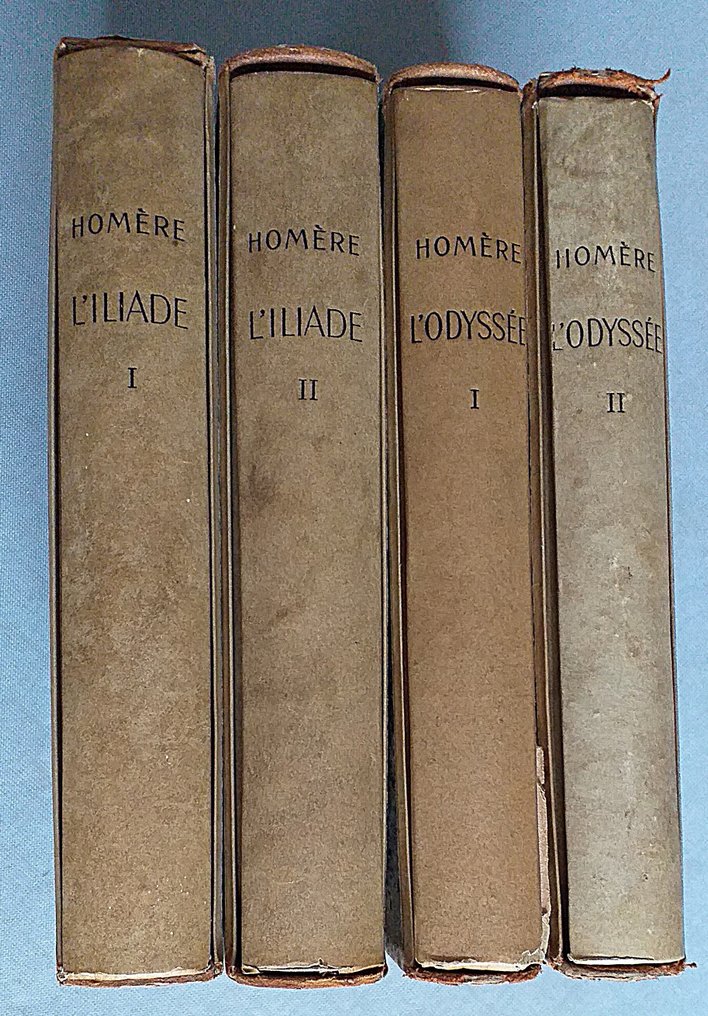
Homère. Illustrations de Berthold Mahn - L'Iliade. L'odyssée - 1943



11
days
19
hours
24
minutes
46
seconds

6 other people are watching this object
 Bidder 2783 Bidder 2783 | €4 | |
|---|---|---|
| Bidder 2581 | €3 | |
| Bidder 8638 | €2 |
Catawiki Buyer Protection
Your payment’s safe with us until you receive your object.View details
Trustpilot 4.4 | 123536 reviews
Rated Excellent on Trustpilot.
Four-volume illustrated edition of Homer's Iliad and Odyssey, translated by Mario Meunier (1943), with Berthold Mahn in-text illustrations, copy 5268/7250 on vélin chiffon, in French, hardcover with slipcase, published by Union latine d'éditions, 1300 pages, 24 × 18 cm, about 6 kg, in very good condition.
AI-assisted summary
Description from the seller
Four volumes in very good condition containing the Iliad and the Odyssey in full translation by Mario Meunier from 1943. Each frontispiece is illustrated, and the endpapers feature a color map. In-text illustrations by Berthold Mahn.
Copy 5268/7250 on chiffon vellum.
Homer is believed to have been a poet from the late 8th century BC. The two earliest works of Western literature, the Iliad and the Odyssey, are attributed to him.
It is difficult today to say whether Homer is a historical figure or a constructed identity, and whether he is indeed the author of the two epics. Modern scholars believe he is a fictional character.
Homer's place in Greek literature is significant, as he alone represents the epic genre of this period: the Iliad and the Odyssey are attributed to him from the 6th century BC. He wrote in an already archaic language in the 8th century BC, and even more so at the time of the definitive fixation of the text, in the 6th century BC.
The name of Iliad comes from the periphrase "the poem of Ilion," which is the other name for the city of Troy.
The Iliad consists of 15,693 dactylic hexameters and, since the Hellenistic period, has been divided into twenty-four books. The text was probably composed between 850 and 750 BC, that is, four centuries after the period with which historians associate the mythic war it recounts. In antiquity, the Iliad was part of an epic cycle, the Trojan cycle, but only the Iliad and the Odyssey have been preserved.
The epic unfolds during the Trojan War, in which the Achaeans from all over Greece face the Trojans and their allies, each side supported by various deities such as Athena, Poseidon, or Apollo. The Iliad details events that occurred over a few weeks in the tenth and final year of the war. After a ten-year siege, the outcome of the battle still hangs in the balance. Achilles is the greatest warrior of the Achaean army. But a quarrel with King Agamemnon, leader of the Achaeans, angers Achilles, who decides to withdraw from the fight, threatening to turn the tide of the war in favor of the Trojans, galvanized by Hector, Troy’s greatest warrior. The story culminates with Achilles returning to battle and dueling Hector, followed by the outrages Achilles inflicts on the body of his defeated enemy. The Iliad ends with Hector’s funeral. The conclusion hints at an imminent victory for the Achaeans.
The Odyssey is believed to have been composed after the Iliad, around the end of the 8th century BC. Composed of 12,109 dactylic hexameters, it is considered, along with the Iliad, as one of the greatest masterpieces of world literature.
The Odyssey recounts the return home of the hero Ulysses, who, after the Trojan War in which he played a decisive role, takes ten years to return to his island of Ithaque, where he reunites with his wife Penelope, whom he frees from the suitors, and his son Telemachus. During his perilous sea voyage, made dangerous by the wrath of the god Poseidon, Ulysses encounters many mythological characters, such as the nymph Calypso, the princess Nausicaa, the Cyclopes, the sorceress Circe, and the sirens. The epic also includes several episodes that complement the story of the Trojan War, such as the construction of the Trojan horse and the fall of the city, which are not mentioned in the Iliad.
The term 'odyssey' has become a common noun referring to 'a travel story that is more or less eventful and filled with unique adventures.'
Weight 6 kgs.
Shipping via Mondial Relay (delivery to a relay point) for: France, Belgium, Germany, Austria, Luxembourg, Italy, Spain, the Netherlands, Portugal, Poland (unless requested by you and with acceptance of the additional cost).
Other countries via Colissimo (unless requested by you and with acceptance of the additional cost).
Four volumes in very good condition containing the Iliad and the Odyssey in full translation by Mario Meunier from 1943. Each frontispiece is illustrated, and the endpapers feature a color map. In-text illustrations by Berthold Mahn.
Copy 5268/7250 on chiffon vellum.
Homer is believed to have been a poet from the late 8th century BC. The two earliest works of Western literature, the Iliad and the Odyssey, are attributed to him.
It is difficult today to say whether Homer is a historical figure or a constructed identity, and whether he is indeed the author of the two epics. Modern scholars believe he is a fictional character.
Homer's place in Greek literature is significant, as he alone represents the epic genre of this period: the Iliad and the Odyssey are attributed to him from the 6th century BC. He wrote in an already archaic language in the 8th century BC, and even more so at the time of the definitive fixation of the text, in the 6th century BC.
The name of Iliad comes from the periphrase "the poem of Ilion," which is the other name for the city of Troy.
The Iliad consists of 15,693 dactylic hexameters and, since the Hellenistic period, has been divided into twenty-four books. The text was probably composed between 850 and 750 BC, that is, four centuries after the period with which historians associate the mythic war it recounts. In antiquity, the Iliad was part of an epic cycle, the Trojan cycle, but only the Iliad and the Odyssey have been preserved.
The epic unfolds during the Trojan War, in which the Achaeans from all over Greece face the Trojans and their allies, each side supported by various deities such as Athena, Poseidon, or Apollo. The Iliad details events that occurred over a few weeks in the tenth and final year of the war. After a ten-year siege, the outcome of the battle still hangs in the balance. Achilles is the greatest warrior of the Achaean army. But a quarrel with King Agamemnon, leader of the Achaeans, angers Achilles, who decides to withdraw from the fight, threatening to turn the tide of the war in favor of the Trojans, galvanized by Hector, Troy’s greatest warrior. The story culminates with Achilles returning to battle and dueling Hector, followed by the outrages Achilles inflicts on the body of his defeated enemy. The Iliad ends with Hector’s funeral. The conclusion hints at an imminent victory for the Achaeans.
The Odyssey is believed to have been composed after the Iliad, around the end of the 8th century BC. Composed of 12,109 dactylic hexameters, it is considered, along with the Iliad, as one of the greatest masterpieces of world literature.
The Odyssey recounts the return home of the hero Ulysses, who, after the Trojan War in which he played a decisive role, takes ten years to return to his island of Ithaque, where he reunites with his wife Penelope, whom he frees from the suitors, and his son Telemachus. During his perilous sea voyage, made dangerous by the wrath of the god Poseidon, Ulysses encounters many mythological characters, such as the nymph Calypso, the princess Nausicaa, the Cyclopes, the sorceress Circe, and the sirens. The epic also includes several episodes that complement the story of the Trojan War, such as the construction of the Trojan horse and the fall of the city, which are not mentioned in the Iliad.
The term 'odyssey' has become a common noun referring to 'a travel story that is more or less eventful and filled with unique adventures.'
Weight 6 kgs.
Shipping via Mondial Relay (delivery to a relay point) for: France, Belgium, Germany, Austria, Luxembourg, Italy, Spain, the Netherlands, Portugal, Poland (unless requested by you and with acceptance of the additional cost).
Other countries via Colissimo (unless requested by you and with acceptance of the additional cost).
Details
Number of Books
4
Subject
Illustrated, Literature, Poetry
Book Title
L'Iliade. L'odyssée
Author/ Illustrator
Homère. Illustrations de Berthold Mahn
Condition
Very good
Publication year oldest item
1943
Height
24 cm
Edition
Illustrated Edition, Limited edition, Numbered edition
Width
18 cm
Language
French
Original language
No
Publisher
Union latine d'éditions
Binding/ Material
Hardback
Extras
Slipcase
Number of pages
1300
