Basnage / de Hooghe - T Groot Waerelds Tafereel - 1721


08
days
23
hours
04
minutes
10
seconds
Current bid
€ 600
Reserve price not met

Expert
Selected by Ilaria Colombo
Specialist in old books, specialising in theological disputes since 1999.
Estimate € 1,500 - € 2,500
8 other people are watching this object
 Bidder 2151 Bidder 2151 | €600 |
|---|
Catawiki Buyer Protection
Your payment’s safe with us until you receive your object.View details
Trustpilot 4.4 | 122473 reviews
Rated Excellent on Trustpilot.
T Groot Waerelds Tafereel, an illustrated Dutch edition (1721) by Jacques Basnage with Romeyn de Hooghe, in a leather binding, 502 pages, 1 volume, with hand-coloured illustrations, published in Amsterdam by J. Lindenberg; first edition in this format.
AI-assisted summary
Description from the seller
Monumental and blazing Dutch binding: Baroque splendor between gold and colors.
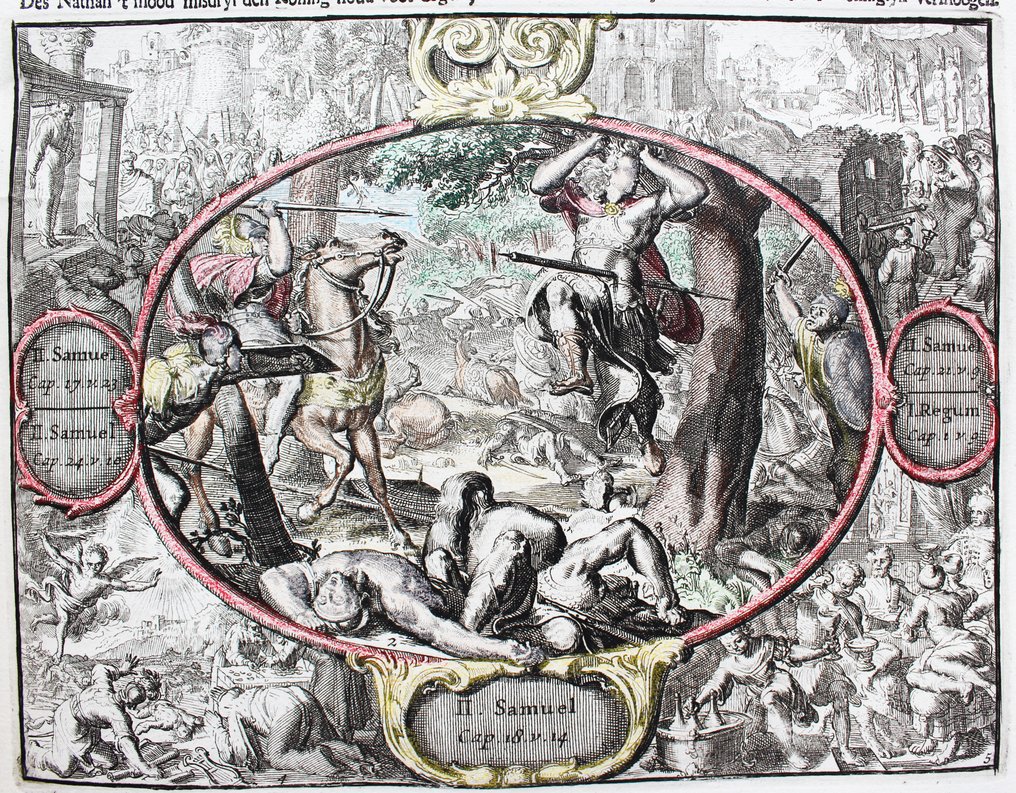
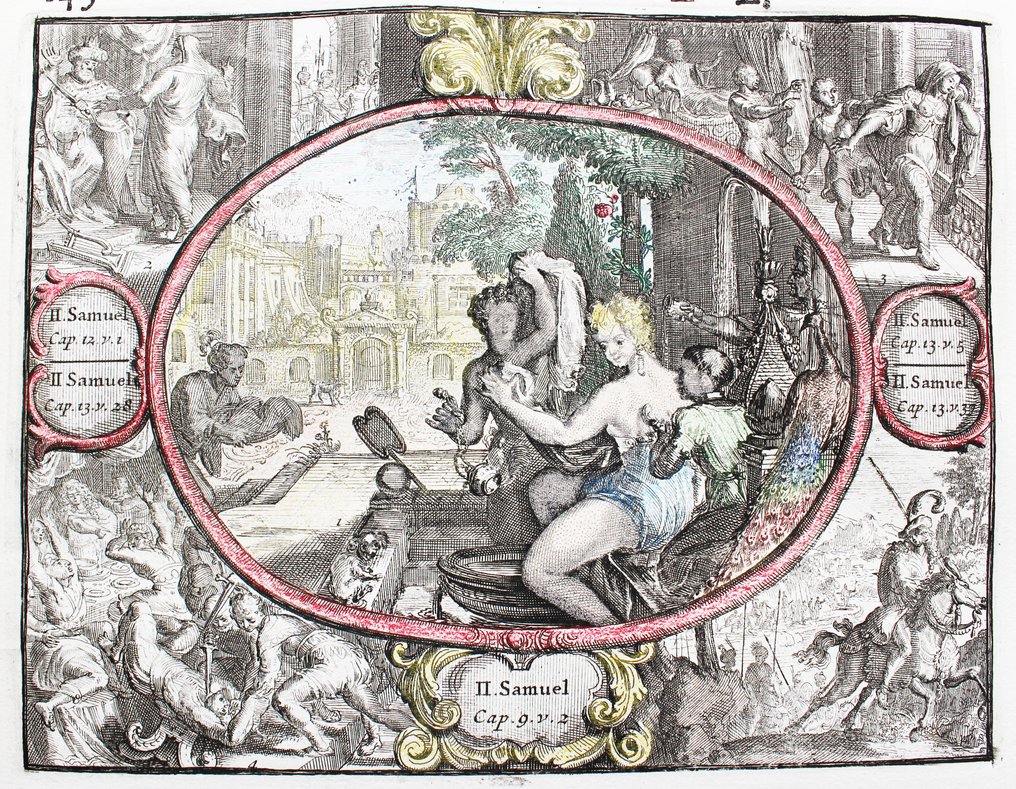
The monumental work of the Dutch illustrated tradition represents an expanded version of Jacques Basnage's Grand Tableau de l’Univers. It combines biblical exegesis, sacred geography, moral iconography, and universal history into a highly coherent figurative system. The plates by Romeyn de Hooghe, here in one of his most magnificent engraved cycles, explore the relationship between sacred history and human history through allegories, maps, prophetic visions, and moral scenes, while Jacques Basnage, Abraham Alewyn, and Mattheus Gargon form the textual framework that accompanies and interprets the iconographic material.
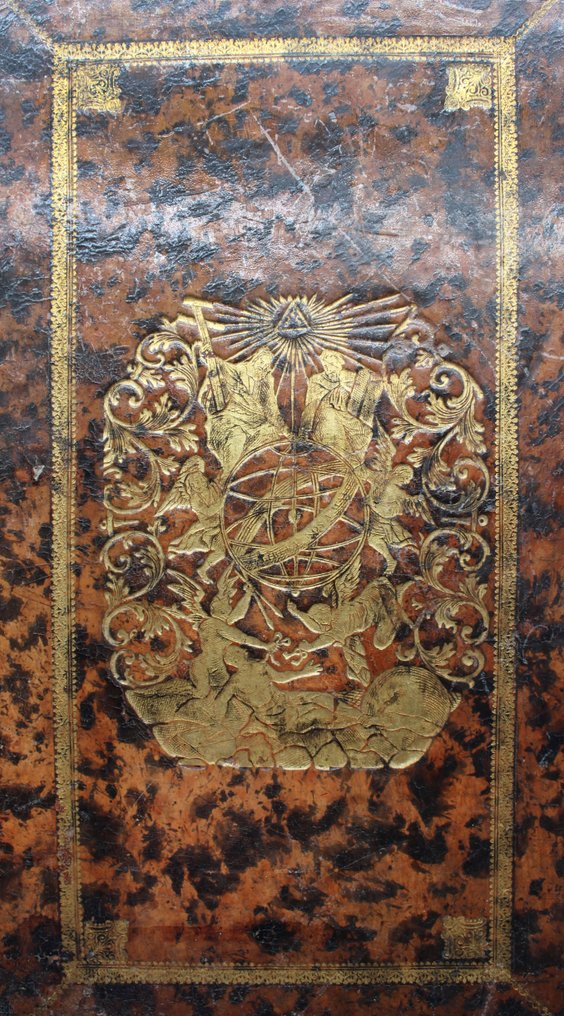
The specimen stands out for its splendid contemporary Flemish binding, attributed to the Double Drawer Handle Bindery, with a rich central gilded plaque and a decorative apparatus framing the work as a true book art object from the first half of the eighteenth century.
Market value
Complete and well-preserved copies of the 1721 tenth edition regularly appear at auctions in the Netherlands and the north-European area, with values generally ranging between 3,200 and 4,000 euros. Examples featuring a contemporary colored engraved title page, Dutch artistic bindings, or intact iconography tend to reach the higher end of the price range. The presence of the three large folded maps, often deteriorated or missing, significantly increases interest, while any gaps in the illustration apparatus can affect the value.
Physical description and condition
Contemporary binding in mottled Dutch leather, attributed to the Double Drawer Handle Bindery, with a wide central gold plate, roll-frames, and a richly decorated compartmented spine. Some browning and foxing. Frontispiece engraved and colored by Romeyn de Hooghe; vignette at the title; three large folded plates (world map; Temple of Jerusalem; De reysen Christi des Heyland map); one full-page plate for the New Testament; 139 rectangular illustrations within the text; 42 tailpieces (one colored) and three headpieces (one colored). Collation: pp. (2); 14 unnumbered; 482; (4).
In ancient books with a centuries-old history, some imperfections may be present, which are not always noted in the description.
Full title and author
The Great World's Scene
Amsterdam, J. Lindenberg, 1721.
Jacques Basnage; Abraham Alewyn; Mattheus Gargon.
Context and Significance
This work represents the expanded Dutch version of Jacques Basnage's Grand Tableau de l’Univers, one of the most influential attempts to combine biblical exegesis, cosmography, moral iconography, and universal history into a coherent narrative and figurative structure. The illustrative design by Romeyn de Hooghe shapes the entire cycle of sacred history, from origins to Revelation, through a synthesis of symbolic cartography, moral allegories, historical scenes, and prophetic visions. The 1721 edition, the tenth in the Dutch series and enriched by Mattheus Gargon, consolidates a model of biblical iconographic dissemination aimed at an educated audience within the Reformed area, where the illustrated book becomes a tool for teaching, meditation, and artistic expression.
Biography of the Authors
Jacques Basnage (1653–1723) was a prominent Protestant theologian and historian, exiled from France after the revocation of the Edict of Nantes, and a central figure in the scholarship that took refuge in the Netherlands. Author of essential historical works, he contributed to an educational model that combines philological precision with clarity of exposition. Abraham Alewyn (1664–1721), Dutch poet and man of letters, composed explanatory verses intended to guide the reader through the iconographic apparatus. Mattheus Gargon (1661–1728), preacher and rector in Vlissingen, intervened with expansions and integrations, giving the work a more detailed didactic structure.
Printing history and circulation
The Grand Tableau of the Universe experienced many versions between the 17th and 18th centuries, in French and Dutch. The Dutch tradition was distinguished by the breadth of its illustrative apparatus, the quality of its engravings, and the constant updating of its content. The present edition from 1721, printed by J. Lindenberg, catered to the collecting and educational tastes of the Dutch Reformed communities, and was widely circulated in private libraries, schools, noble households, and scholarly circles where large illustrated Bibles served as signs of cultural prestige.
BIBLIOGRAPHY AND REFERENCES
STCN
Landwehr, Romeyn de Hooghe – The Book Illustrations of Romeyn de Hooghe, 100
Storm van Leeuwen, Dutch Decorated Bookbinding in the Eighteenth Century, I:2.2.5
International auction catalogs for comparable specimens
Seller's Story
Luxury Books: Your Go-To Guide for Nabbing Literary Treasures!
Embarking on the thrilling journey of collecting rare and timeless printed works? Here's your snappy rundown, "The Collector's Cheat Sheet," to ensure you're not just flipping pages but stacking up the value:
1. Edition and Rarity: Rarity is the name of the game. First editions, limited printings, and books flaunting unique features like eye-catching illustrations or mind-blowing bindings? Consider them the VIPs of the collector's world.
2. Condition & Dimension: Picture this – a book in mint condition, untouched by the woes of wear and tear. Now, flip the script: wear, foxing, discoloration – they're the villains here. And don't forget to size up the dimensions, because a book's size matters in the collector's universe.
3. Authenticity: In a world of replicas and forgeries, verifying a book's authenticity is your superhero move. Expert examination and authentication – your trusty sidekicks in this quest.
4. Provenance: Who owned it before you? If the book has hobnobbed with famous figures or danced through historical events, its value skyrockets. Every book has a story, but some have blockbuster tales.
5. Demand and Market Trends: Think of book values as the stock market of the literary world. Stay savvy on collector trends and market shifts to ride the waves of value.
6. Subject Matter: Some topics are like fine wine – they get better with time. Dive into subjects with a timeless appeal or ride the wave of emerging cultural and historical relevance.
7. Binding and Design: Beauty is more than skin deep. Intricate bindings, stunning covers, and illustrations – these are the accessories that make a book runway-ready in the collector's eyes.
8. Association Copies: Books with a personal touch – whether it's a connection to the author or a famous personality – elevate the historical vibes. A book with a backstory? Count us in.
9. Investment Potential: Passion is the engine, but some collectors eye future returns. Keep in mind, though, that the book market can be as unpredictable as a plot twist.
10. Expert Advice: New to the game? Don't play solo. Seek wisdom from the book gurus, hit up book fairs, and join collector communities. We at Luxury Books are the Yodas of the rare book galaxy, helping you build collections that scream sophistication and cultural clout.
Because collecting rare books isn't just about dollar signs – it's a journey of preserving heritage and embracing literary treasures. Happy collecting!
Translated by Google TranslateMonumental and blazing Dutch binding: Baroque splendor between gold and colors.
The monumental work of the Dutch illustrated tradition represents an expanded version of Jacques Basnage's Grand Tableau de l’Univers. It combines biblical exegesis, sacred geography, moral iconography, and universal history into a highly coherent figurative system. The plates by Romeyn de Hooghe, here in one of his most magnificent engraved cycles, explore the relationship between sacred history and human history through allegories, maps, prophetic visions, and moral scenes, while Jacques Basnage, Abraham Alewyn, and Mattheus Gargon form the textual framework that accompanies and interprets the iconographic material.
The specimen stands out for its splendid contemporary Flemish binding, attributed to the Double Drawer Handle Bindery, with a rich central gilded plaque and a decorative apparatus framing the work as a true book art object from the first half of the eighteenth century.
Market value
Complete and well-preserved copies of the 1721 tenth edition regularly appear at auctions in the Netherlands and the north-European area, with values generally ranging between 3,200 and 4,000 euros. Examples featuring a contemporary colored engraved title page, Dutch artistic bindings, or intact iconography tend to reach the higher end of the price range. The presence of the three large folded maps, often deteriorated or missing, significantly increases interest, while any gaps in the illustration apparatus can affect the value.
Physical description and condition
Contemporary binding in mottled Dutch leather, attributed to the Double Drawer Handle Bindery, with a wide central gold plate, roll-frames, and a richly decorated compartmented spine. Some browning and foxing. Frontispiece engraved and colored by Romeyn de Hooghe; vignette at the title; three large folded plates (world map; Temple of Jerusalem; De reysen Christi des Heyland map); one full-page plate for the New Testament; 139 rectangular illustrations within the text; 42 tailpieces (one colored) and three headpieces (one colored). Collation: pp. (2); 14 unnumbered; 482; (4).
In ancient books with a centuries-old history, some imperfections may be present, which are not always noted in the description.
Full title and author
The Great World's Scene
Amsterdam, J. Lindenberg, 1721.
Jacques Basnage; Abraham Alewyn; Mattheus Gargon.
Context and Significance
This work represents the expanded Dutch version of Jacques Basnage's Grand Tableau de l’Univers, one of the most influential attempts to combine biblical exegesis, cosmography, moral iconography, and universal history into a coherent narrative and figurative structure. The illustrative design by Romeyn de Hooghe shapes the entire cycle of sacred history, from origins to Revelation, through a synthesis of symbolic cartography, moral allegories, historical scenes, and prophetic visions. The 1721 edition, the tenth in the Dutch series and enriched by Mattheus Gargon, consolidates a model of biblical iconographic dissemination aimed at an educated audience within the Reformed area, where the illustrated book becomes a tool for teaching, meditation, and artistic expression.
Biography of the Authors
Jacques Basnage (1653–1723) was a prominent Protestant theologian and historian, exiled from France after the revocation of the Edict of Nantes, and a central figure in the scholarship that took refuge in the Netherlands. Author of essential historical works, he contributed to an educational model that combines philological precision with clarity of exposition. Abraham Alewyn (1664–1721), Dutch poet and man of letters, composed explanatory verses intended to guide the reader through the iconographic apparatus. Mattheus Gargon (1661–1728), preacher and rector in Vlissingen, intervened with expansions and integrations, giving the work a more detailed didactic structure.
Printing history and circulation
The Grand Tableau of the Universe experienced many versions between the 17th and 18th centuries, in French and Dutch. The Dutch tradition was distinguished by the breadth of its illustrative apparatus, the quality of its engravings, and the constant updating of its content. The present edition from 1721, printed by J. Lindenberg, catered to the collecting and educational tastes of the Dutch Reformed communities, and was widely circulated in private libraries, schools, noble households, and scholarly circles where large illustrated Bibles served as signs of cultural prestige.
BIBLIOGRAPHY AND REFERENCES
STCN
Landwehr, Romeyn de Hooghe – The Book Illustrations of Romeyn de Hooghe, 100
Storm van Leeuwen, Dutch Decorated Bookbinding in the Eighteenth Century, I:2.2.5
International auction catalogs for comparable specimens
Seller's Story
Luxury Books: Your Go-To Guide for Nabbing Literary Treasures!
Embarking on the thrilling journey of collecting rare and timeless printed works? Here's your snappy rundown, "The Collector's Cheat Sheet," to ensure you're not just flipping pages but stacking up the value:
1. Edition and Rarity: Rarity is the name of the game. First editions, limited printings, and books flaunting unique features like eye-catching illustrations or mind-blowing bindings? Consider them the VIPs of the collector's world.
2. Condition & Dimension: Picture this – a book in mint condition, untouched by the woes of wear and tear. Now, flip the script: wear, foxing, discoloration – they're the villains here. And don't forget to size up the dimensions, because a book's size matters in the collector's universe.
3. Authenticity: In a world of replicas and forgeries, verifying a book's authenticity is your superhero move. Expert examination and authentication – your trusty sidekicks in this quest.
4. Provenance: Who owned it before you? If the book has hobnobbed with famous figures or danced through historical events, its value skyrockets. Every book has a story, but some have blockbuster tales.
5. Demand and Market Trends: Think of book values as the stock market of the literary world. Stay savvy on collector trends and market shifts to ride the waves of value.
6. Subject Matter: Some topics are like fine wine – they get better with time. Dive into subjects with a timeless appeal or ride the wave of emerging cultural and historical relevance.
7. Binding and Design: Beauty is more than skin deep. Intricate bindings, stunning covers, and illustrations – these are the accessories that make a book runway-ready in the collector's eyes.
8. Association Copies: Books with a personal touch – whether it's a connection to the author or a famous personality – elevate the historical vibes. A book with a backstory? Count us in.
9. Investment Potential: Passion is the engine, but some collectors eye future returns. Keep in mind, though, that the book market can be as unpredictable as a plot twist.
10. Expert Advice: New to the game? Don't play solo. Seek wisdom from the book gurus, hit up book fairs, and join collector communities. We at Luxury Books are the Yodas of the rare book galaxy, helping you build collections that scream sophistication and cultural clout.
Because collecting rare books isn't just about dollar signs – it's a journey of preserving heritage and embracing literary treasures. Happy collecting!
Translated by Google TranslateDetails
Number of Books
1
Subject
Illustrated
Book Title
T Groot Waerelds Tafereel
Author/ Illustrator
Basnage / de Hooghe
Condition
Good
Publication year oldest item
1721
Height
437 mm
Edition
1st Edition Thus, Illustrated Edition
Width
280 mm
Language
Dutch
Original language
Yes
Publisher
Amsterdam, J. Lindenberg, 1721
Binding/ Material
Leather
Extras
Hand coloured illustrations
Number of pages
502
Sold by
