Cristofano Allori (1577-1621), Scuola di - Giuditta e Oloferne


03
days
04
hours
00
minutes
31
seconds
Current bid
€ 650
Reserve price not met

69 other people are watching this object
 Bidder 8958 Bidder 8958 | €650 | |
|---|---|---|
| Bidder 8958 | €600 | |
 Bidder 9859 Bidder 9859 | €550 | |
Catawiki Buyer Protection
Your payment’s safe with us until you receive your object.View details
Trustpilot 4.4 | 122290 reviews
Rated Excellent on Trustpilot.
Giuditta e Oloferne, an 18th‑century oil painting from Italy, sold with frame.
AI-assisted summary
Description from the seller
The painting measures 144.5cm by 116.5cm without the frame, and with it, it measures 132.5cm by 160.5cm. It is on canvas. The frame is from the late 19th century, while the painting is dated between the end of the 18th century (18th century) and the early 19th century. This monumental work of art is attributed to a follower of Cristofano Allori (1577-1621). Firstly, the work was originally on a slightly smaller canvas than the current one, which replaced it at the end of the 19th century. In fact, small holes are still visible on the right edge of the painting (see detail photograph), which held the nails that were on the back, on the side that was on the right of the original frame.
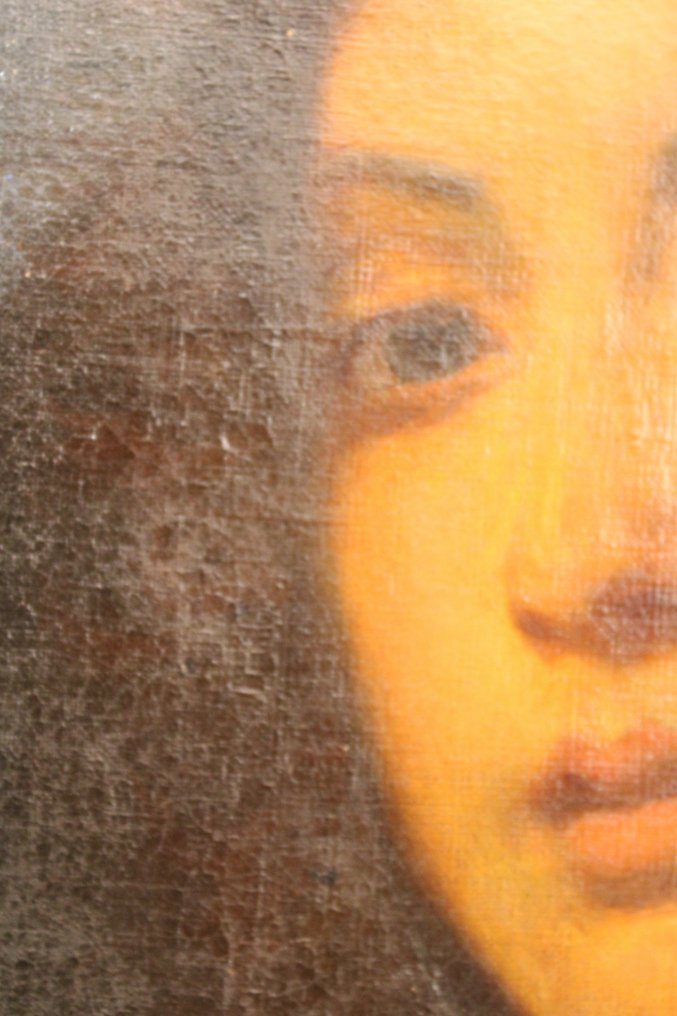
The work was therefore about a couple of centimeters smaller. Additionally, the quality of the painting is exceptional, and as can be seen from the photograph of the detail of Judith's face, the craquelure is dense and typical of an antique piece. The canvas has a vertical and diagonal weave.
Finally, there is an inscription on the back, through which it can be inferred that this work was kept in Florence until at least the end of the 19th century (see photographs). In fact, the inscription bears the address of the painting's owner, to whom the painting was supposed to be sent after framing and restoration. Therefore, the work was definitely produced in the Florence area.
The painting shows some substantial differences from the original: the robe features a brighter color, as does Judith's complexion. The work combines high quality with variation on the model of the piece preserved at the Uffizi. The quality is extremely high, and the artist used many glazes to render the figures with effects of great transparency, especially in the skin tones.
According to Wikipedia, Cristofano Allori was born in Florence to Maria and the painter Alessandro di Cristofano Allori, a pupil and protégé of the renowned Agnolo di Cosimo, known as the Bronzino, a nickname he inherited from his master and which he also passed on to his son. Alessandro, who after the deaths of the Bronzino (1572) and Vasari (1574) could boast of being among the leading painters in Florence and enjoying great esteem at court, took him into his workshop at a very young age, so much so that by 1590 Cristofano was already signing his first canvas, an early Portrait of Count Ugo of Tuscany. In the workshop, he absorbed his father's drawing style, dedicated himself to copying paintings by Raphael and Fra Bartolomeo, studied the works of the Bronzino and Ligozzi, and focused on portraiture: the portraits of Francesco and Caterina de' Medici are from 1596.
His masterpiece is probably Judith with the Head of Holofernes. It exists in three versions: one at Palazzo Pitti in Florence, the second in the Queen's Gallery in London, and a third at the Kunsthistorisches Museum in Vienna. The model for Judith was his lover, Maria di Giovanni Mazzafirri, known as Mazzafirra, a courtesan of renowned beauty. She is also depicted in the Magdalene and in a portrait housed at the Museum of Art and History in Geneva. The head of Holofernes is considered an self-portrait of Allori, who, for the beautiful Mazzafirra, metaphorically lost his head.
The painting can be shipped throughout the European Union. Shipping will be carried out via the 'Mail Boxes etc' service.
The painting measures 144.5cm by 116.5cm without the frame, and with it, it measures 132.5cm by 160.5cm. It is on canvas. The frame is from the late 19th century, while the painting is dated between the end of the 18th century (18th century) and the early 19th century. This monumental work of art is attributed to a follower of Cristofano Allori (1577-1621). Firstly, the work was originally on a slightly smaller canvas than the current one, which replaced it at the end of the 19th century. In fact, small holes are still visible on the right edge of the painting (see detail photograph), which held the nails that were on the back, on the side that was on the right of the original frame.
The work was therefore about a couple of centimeters smaller. Additionally, the quality of the painting is exceptional, and as can be seen from the photograph of the detail of Judith's face, the craquelure is dense and typical of an antique piece. The canvas has a vertical and diagonal weave.
Finally, there is an inscription on the back, through which it can be inferred that this work was kept in Florence until at least the end of the 19th century (see photographs). In fact, the inscription bears the address of the painting's owner, to whom the painting was supposed to be sent after framing and restoration. Therefore, the work was definitely produced in the Florence area.
The painting shows some substantial differences from the original: the robe features a brighter color, as does Judith's complexion. The work combines high quality with variation on the model of the piece preserved at the Uffizi. The quality is extremely high, and the artist used many glazes to render the figures with effects of great transparency, especially in the skin tones.
According to Wikipedia, Cristofano Allori was born in Florence to Maria and the painter Alessandro di Cristofano Allori, a pupil and protégé of the renowned Agnolo di Cosimo, known as the Bronzino, a nickname he inherited from his master and which he also passed on to his son. Alessandro, who after the deaths of the Bronzino (1572) and Vasari (1574) could boast of being among the leading painters in Florence and enjoying great esteem at court, took him into his workshop at a very young age, so much so that by 1590 Cristofano was already signing his first canvas, an early Portrait of Count Ugo of Tuscany. In the workshop, he absorbed his father's drawing style, dedicated himself to copying paintings by Raphael and Fra Bartolomeo, studied the works of the Bronzino and Ligozzi, and focused on portraiture: the portraits of Francesco and Caterina de' Medici are from 1596.
His masterpiece is probably Judith with the Head of Holofernes. It exists in three versions: one at Palazzo Pitti in Florence, the second in the Queen's Gallery in London, and a third at the Kunsthistorisches Museum in Vienna. The model for Judith was his lover, Maria di Giovanni Mazzafirri, known as Mazzafirra, a courtesan of renowned beauty. She is also depicted in the Magdalene and in a portrait housed at the Museum of Art and History in Geneva. The head of Holofernes is considered an self-portrait of Allori, who, for the beautiful Mazzafirra, metaphorically lost his head.
The painting can be shipped throughout the European Union. Shipping will be carried out via the 'Mail Boxes etc' service.
Details
Artist
Cristofano Allori (1577-1621), Scuola di
Sold with frame
Yes
Title of artwork
Giuditta e Oloferne
Technique
Oil painting
Signature
Not signed
Country of Origin
Italy
Condition
Excellent condition
Height
160.5 cm
Width
132.5 cm
Style
Baroque
Period
18th century
Sold by
