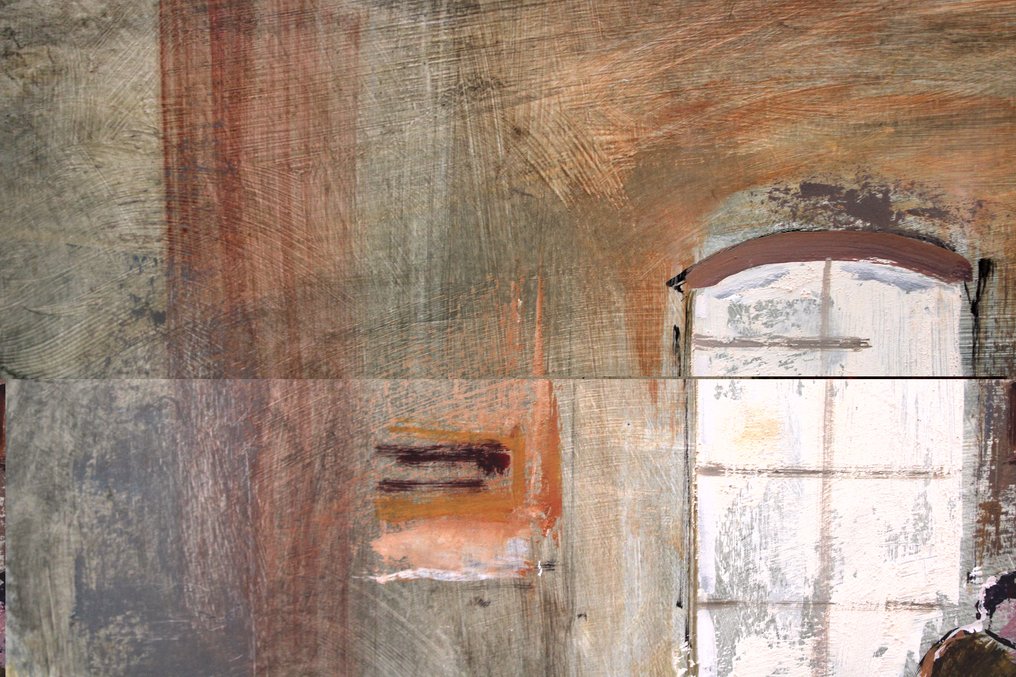
Manuel Doblas Pinto (1957) - Conversando en el bar


01
day
01
hour
14
minutes
12
seconds
Current bid
€ 170
Reserve price not met

Expert
Selected by Caterina Maffeis
Master in early Renaissance Italian painting with internship at Sotheby’s and 15 years' experience.
Estimate € 250 - € 300
7 other people are watching this object
 Bidder 0171 Bidder 0171 | €170 | |
|---|---|---|
 Bidder 0275 Bidder 0275 | €150 | |
| Bidder 0275 | €130 | |
Catawiki Buyer Protection
Your payment’s safe with us until you receive your object.View details
Trustpilot 4.4 | 121899 reviews
Rated Excellent on Trustpilot.
Oil painting titled 'Conversando en el bar' by Manuel Doblas Pinto (1957), from 1980-1990, Spain, sold with frame.
AI-assisted summary
Description from the seller
Signed by the artist at the bottom
The work is presented framed.
The work is in good condition.
Work dimensions: 65 cm high x 81 cm wide
Frame measurements: 83 cm in height x 99 cm in width.
:::::::::::::::::::::::::::::::::::::::::::::::::::::::
Artist's Biography
Manuel Doblas, born in Humilladero (Málaga) in 1957, but raised from a very young age in Catalonia and with a mindset well rooted among us, has been a painter for many years. He followed the path of group exhibitions starting in 1981 and held his first solo show in 1992, precisely in this same Sala Rusiñol where we now find him again. He has won many awards in various places and has not hesitated to regularly participate – he still does – in quick painting contests across Spain. This, which might be a hurdle for others because, after helping to gain confidence and find personal formulas that define their style, often leads to recurring methods, has in his case represented a highly useful system for discovering himself and being able to properly express what he desires.
Only those who are afraid to explain themselves believe that they will find themselves very soon. And those who are always thinking – this is the case of Manuel Doblas – never stop feeling the restlessness of moving forward. That is why this painter, whose recent work we are now viewing, seeks high spaces by capturing the verticality of skyscrapers and depicts abandoned train stations because he is not interested in waiting, but rather in finding exits toward a horizon marked by iron tracks that, after crossing intersections, remain fixed because they serve the inner movement of people.
Manuel Doblas has changed the way he expresses himself, and he has done so for the better. Gifted in visual expression and skilled in technique, he does not stop but advances.
Signed by the artist at the bottom
The work is presented framed.
The work is in good condition.
Work dimensions: 65 cm high x 81 cm wide
Frame measurements: 83 cm in height x 99 cm in width.
:::::::::::::::::::::::::::::::::::::::::::::::::::::::
Artist's Biography
Manuel Doblas, born in Humilladero (Málaga) in 1957, but raised from a very young age in Catalonia and with a mindset well rooted among us, has been a painter for many years. He followed the path of group exhibitions starting in 1981 and held his first solo show in 1992, precisely in this same Sala Rusiñol where we now find him again. He has won many awards in various places and has not hesitated to regularly participate – he still does – in quick painting contests across Spain. This, which might be a hurdle for others because, after helping to gain confidence and find personal formulas that define their style, often leads to recurring methods, has in his case represented a highly useful system for discovering himself and being able to properly express what he desires.
Only those who are afraid to explain themselves believe that they will find themselves very soon. And those who are always thinking – this is the case of Manuel Doblas – never stop feeling the restlessness of moving forward. That is why this painter, whose recent work we are now viewing, seeks high spaces by capturing the verticality of skyscrapers and depicts abandoned train stations because he is not interested in waiting, but rather in finding exits toward a horizon marked by iron tracks that, after crossing intersections, remain fixed because they serve the inner movement of people.
Manuel Doblas has changed the way he expresses himself, and he has done so for the better. Gifted in visual expression and skilled in technique, he does not stop but advances.
Details
Artist
Manuel Doblas Pinto (1957)
Sold with frame
Yes
Sold by
Gallery
Edition
Original
Title of artwork
Conversando en el bar
Technique
Oil painting
Signature
Hand signed
Country of Origin
Spain
Condition
Good condition
Height
83 cm
Width
99 cm
Period
1980-1990
Sold by
