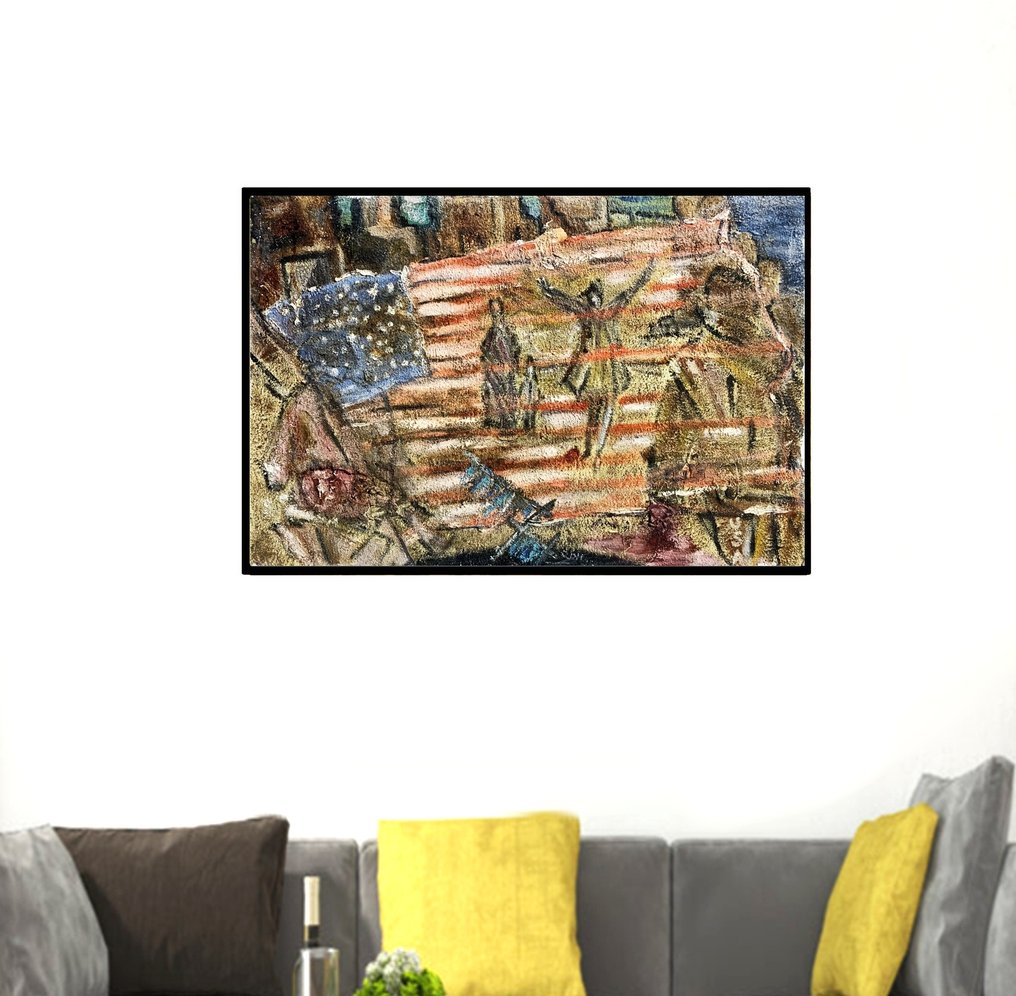
Roberto Lazzarini (1951) - Arriva la mamma



03
days
13
hours
02
minutes
14
seconds

No bids placed
Catawiki Buyer Protection
Your payment’s safe with us until you receive your object.View details
Trustpilot 4.4 | 122553 reviews
Rated Excellent on Trustpilot.
Description from the seller
Textured acrylic painting on canvas.
Roberto Lazzarini (1951)
signed work
With certificate of authenticity
We also invite you to visit the online gallery 'delauretisart' on the Web; you're going to like it!
Biography
Roberto Lazzarini was born in Massarosa in 1951, with roots firmly anchored in Versilia, just a step from the sea. His artistic journey began at a young age, characterized by continuous research and experimentation. Those who know him personally would say: a restless soul who does not oppose an artistic spirit. His early works, with an expressionist tone, already reveal a strong personality and a creative impulse expressed through the use of color. The chromatic blends are energetic, decisive, often contrasting, with a rich and textured impasto. For many years, Lazzarini struggled to detach himself completely from figuration; he painted men, houses, trees, rivers, animals, set within a very particular space where color dominates over forms. His paintings lack compositional order and do not follow the rules of perspective; they are images of the mind and inner reality materialized on the canvas in a spontaneous, gestural manner. There is no preparatory drawing or rational scheme; the idea erupts forcefully and invades the canvas space. Lazzarini prefers to use a spatula over a brush because the mark is sharp, and the gesture expresses strength and determination, with no turning back. Over the years, he gradually moved away from figurative representation and began exploring abstraction, where he seemed to have found his way home. Never has color been more expressive; the gestures are quick and confident, and the forms emerge from the depth of chromatic juxtaposition in a continuous layering. The 2008 collages mark a transition towards seeking a depth or three-dimensionality that is no longer illusion or appearance, with color skillfully balanced on the two-dimensional surface. With these works, the canvases, attached and overlapped one another, extend beyond the frame, creating shadows and subtle reliefs.
Seller's Story
Translated by Google TranslateTextured acrylic painting on canvas.
Roberto Lazzarini (1951)
signed work
With certificate of authenticity
We also invite you to visit the online gallery 'delauretisart' on the Web; you're going to like it!
Biography
Roberto Lazzarini was born in Massarosa in 1951, with roots firmly anchored in Versilia, just a step from the sea. His artistic journey began at a young age, characterized by continuous research and experimentation. Those who know him personally would say: a restless soul who does not oppose an artistic spirit. His early works, with an expressionist tone, already reveal a strong personality and a creative impulse expressed through the use of color. The chromatic blends are energetic, decisive, often contrasting, with a rich and textured impasto. For many years, Lazzarini struggled to detach himself completely from figuration; he painted men, houses, trees, rivers, animals, set within a very particular space where color dominates over forms. His paintings lack compositional order and do not follow the rules of perspective; they are images of the mind and inner reality materialized on the canvas in a spontaneous, gestural manner. There is no preparatory drawing or rational scheme; the idea erupts forcefully and invades the canvas space. Lazzarini prefers to use a spatula over a brush because the mark is sharp, and the gesture expresses strength and determination, with no turning back. Over the years, he gradually moved away from figurative representation and began exploring abstraction, where he seemed to have found his way home. Never has color been more expressive; the gestures are quick and confident, and the forms emerge from the depth of chromatic juxtaposition in a continuous layering. The 2008 collages mark a transition towards seeking a depth or three-dimensionality that is no longer illusion or appearance, with color skillfully balanced on the two-dimensional surface. With these works, the canvases, attached and overlapped one another, extend beyond the frame, creating shadows and subtle reliefs.
Seller's Story
Translated by Google TranslateDetails
Artist
Roberto Lazzarini (1951)
Sold with frame
No
Sold by
Gallery
Edition
Original
Title of artwork
Arriva la mamma
Technique
Acrylic painting
Signature
Hand signed
Country of Origin
Italy
Year
2023
Condition
Excellent condition
Colour
Multicolour
Height
60 cm
Width
40 cm
Depiction/Theme
Day scene
Style
Contemporary
Period
2020+
Sold by
