USAAF Bomber / Fighter Pilot Handbook Airforce - Cockpit instruments - Flying - Named to Co-pilot of B17 of 427th Bomb Group - Stationed in England - 1943


10
days
03
hours
10
minutes
48
seconds

6 other people are watching this object
 Bidder 3342 Bidder 3342 | €3 |
|---|
Catawiki Buyer Protection
Your payment’s safe with us until you receive your object.View details
Trustpilot 4.4 | 121980 reviews
Rated Excellent on Trustpilot.
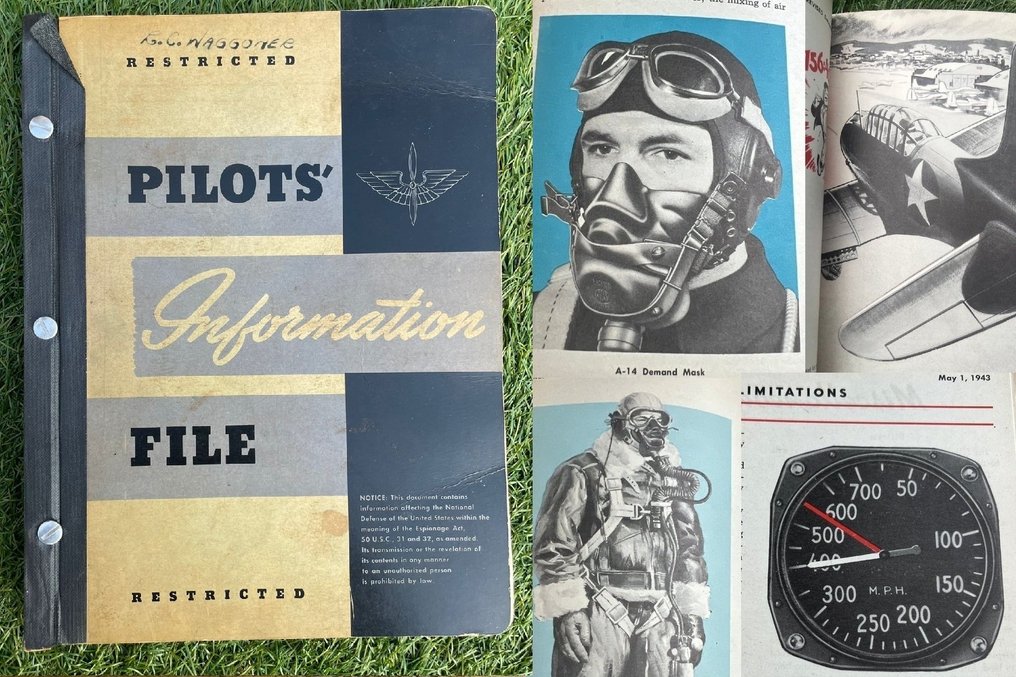
Named to Co-pilot of B-17 of 427th Bomb Group - Stationed in England, an original 1943 English-language WWII pilot's instruction manual, 200 pages, in good condition.
AI-assisted summary
Description from the seller
Offered for auction is a rare and original, 1943-dated WWII-era pilot's instruction manual covering instrument flying with the B-17 and B-24 bombers, among others, that showed the trainee pilot how to use, understand, and control the various cockpit instruments, as well as other aspects. The manual is nicely dedicated to R. C. Waggoner, who was a co-pilot on a B-17 from the 427th BG, which was stationed in England and was the first unit to fly B-17s over Europe. This manual was designed to promote safe flying and operational efficiency. It includes information on flight safety; training; weather flying; effects of height/altitude; oxygen equipment; engines; aircraft parts; armament & gunsights; bailout procedures; forced landings; ditching; parachutes; emergency kits; life vests; first aid kits, and more. Superb reference material. This is an original copy — not a reprint. Beautifully illustrated with comic-like drawings and very realistic depictions of flying and instrument panels. A very nice manual related to combat and aircraft flying during WW2; a gem for the aviation collector! See photos for the condition, as they are part of the description; overall, it is in quite good condition.
Nice WW2 pilot flying manual for your USA WW2 collection!
History of the 427th BG
In April, the Army Air Forces recognized that there was little difference between the reconnaissance squadrons assigned to heavy bombardment groups and their accompanying bombardment squadrons, and they dropped their 'reconnaissance' designation. In this renaming, the 38th became the 427th Bombardment Squadron. The ground echelon left Biggs Field, Texas, in August 1942, arriving at Fort Dix on August 24. It sailed aboard the RMS Queen Mary and arrived in Great Britain on September 10. The air echelon flew through Kellogg Field, Michigan, and Dow Field, Maine, before ferrying its planes across the Atlantic.
Due to the haste to move heavy bombers to Europe, the squadron was insufficiently trained for combat and continued to train in England until it entered combat on November 17, 1942, in a strike against Saint-Nazaire, but returned without striking, having been unable to locate its target. It attacked Saint-Nazaire the following day, although its intended target was La Pallice. Its initial raids focused on airfields, railroads, and submarine pens in France. As one of only four Flying Fortress groups in the VIII Bomber Command during late 1942 and early 1943, the squadron participated in developing the tactics that would be used throughout the air campaign against Germany.
In 1943, the squadron began flying missions to Germany, participating in the first attack by American heavy bombers on a target in Germany, a raid on the submarine yards at Wilhelmshaven on January 27, 1943. From that time, it primarily focused on strategic bombardment of German industry, marshalling yards, and other strategic targets, including the ball bearing plants at Schweinfurt, shipyards at Bremen, and an aircraft engine factory at Hamburg.
The 427th received a Distinguished Unit Citation when adverse weather on January 11, 1944, prevented its fighter cover from joining the group, exposing it to continuous attacks by Luftwaffe fighters. Despite this opposition, the unit successfully struck an aircraft assembly plant at Oschersleben.[13]
Although a strategic bombing unit, the squadron was occasionally diverted to close air support and interdiction for ground forces. It attacked gun emplacements and bridges in Pas-de-Calais during Operation Overlord, the invasion of Normandy, in June 1944; bombed enemy troops during Operation Cobra, the breakout at Saint Lo, and during the Battle of the Bulge. It bombed military installations near Wesel during Operation Lumberjack, the Allied assault across the Rhine. Its last combat mission was an attack on April 25, 1945, against an armament factory at Pilsen.
Following VE Day in May 1945, the 303d Group was reassigned to the North African Division, Air Transport Command, and moved to Casablanca Airfield, French Morocco, to use its B-17 bombers as transports, ferrying personnel from France to Morocco. However, the two B-17 groups moved to Casablanca proved surplus to Air Transport Command's needs, and the squadron was inactivated in late July 1945, with its planes ferried back to the United States.[13][15]
Seller's Story
We specialize in the sale of professional military regulations, academic literature, and other militaria with over 20 years of experience. With a carefully selected range, we serve collectors, historians, defense professionals, and enthusiasts of military history. Our products offer reliable and authentic information and are of high quality. We stand for expertise, reliability, and a passion for military heritage.
Translated by Google TranslateOffered for auction is a rare and original, 1943-dated WWII-era pilot's instruction manual covering instrument flying with the B-17 and B-24 bombers, among others, that showed the trainee pilot how to use, understand, and control the various cockpit instruments, as well as other aspects. The manual is nicely dedicated to R. C. Waggoner, who was a co-pilot on a B-17 from the 427th BG, which was stationed in England and was the first unit to fly B-17s over Europe. This manual was designed to promote safe flying and operational efficiency. It includes information on flight safety; training; weather flying; effects of height/altitude; oxygen equipment; engines; aircraft parts; armament & gunsights; bailout procedures; forced landings; ditching; parachutes; emergency kits; life vests; first aid kits, and more. Superb reference material. This is an original copy — not a reprint. Beautifully illustrated with comic-like drawings and very realistic depictions of flying and instrument panels. A very nice manual related to combat and aircraft flying during WW2; a gem for the aviation collector! See photos for the condition, as they are part of the description; overall, it is in quite good condition.
Nice WW2 pilot flying manual for your USA WW2 collection!
History of the 427th BG
In April, the Army Air Forces recognized that there was little difference between the reconnaissance squadrons assigned to heavy bombardment groups and their accompanying bombardment squadrons, and they dropped their 'reconnaissance' designation. In this renaming, the 38th became the 427th Bombardment Squadron. The ground echelon left Biggs Field, Texas, in August 1942, arriving at Fort Dix on August 24. It sailed aboard the RMS Queen Mary and arrived in Great Britain on September 10. The air echelon flew through Kellogg Field, Michigan, and Dow Field, Maine, before ferrying its planes across the Atlantic.
Due to the haste to move heavy bombers to Europe, the squadron was insufficiently trained for combat and continued to train in England until it entered combat on November 17, 1942, in a strike against Saint-Nazaire, but returned without striking, having been unable to locate its target. It attacked Saint-Nazaire the following day, although its intended target was La Pallice. Its initial raids focused on airfields, railroads, and submarine pens in France. As one of only four Flying Fortress groups in the VIII Bomber Command during late 1942 and early 1943, the squadron participated in developing the tactics that would be used throughout the air campaign against Germany.
In 1943, the squadron began flying missions to Germany, participating in the first attack by American heavy bombers on a target in Germany, a raid on the submarine yards at Wilhelmshaven on January 27, 1943. From that time, it primarily focused on strategic bombardment of German industry, marshalling yards, and other strategic targets, including the ball bearing plants at Schweinfurt, shipyards at Bremen, and an aircraft engine factory at Hamburg.
The 427th received a Distinguished Unit Citation when adverse weather on January 11, 1944, prevented its fighter cover from joining the group, exposing it to continuous attacks by Luftwaffe fighters. Despite this opposition, the unit successfully struck an aircraft assembly plant at Oschersleben.[13]
Although a strategic bombing unit, the squadron was occasionally diverted to close air support and interdiction for ground forces. It attacked gun emplacements and bridges in Pas-de-Calais during Operation Overlord, the invasion of Normandy, in June 1944; bombed enemy troops during Operation Cobra, the breakout at Saint Lo, and during the Battle of the Bulge. It bombed military installations near Wesel during Operation Lumberjack, the Allied assault across the Rhine. Its last combat mission was an attack on April 25, 1945, against an armament factory at Pilsen.
Following VE Day in May 1945, the 303d Group was reassigned to the North African Division, Air Transport Command, and moved to Casablanca Airfield, French Morocco, to use its B-17 bombers as transports, ferrying personnel from France to Morocco. However, the two B-17 groups moved to Casablanca proved surplus to Air Transport Command's needs, and the squadron was inactivated in late July 1945, with its planes ferried back to the United States.[13][15]
Seller's Story
We specialize in the sale of professional military regulations, academic literature, and other militaria with over 20 years of experience. With a carefully selected range, we serve collectors, historians, defense professionals, and enthusiasts of military history. Our products offer reliable and authentic information and are of high quality. We stand for expertise, reliability, and a passion for military heritage.
Translated by Google TranslateDetails
Number of Books
1
Subject
Aviation, Heraldry, Military, War history
Book Title
Named to Co-pilot of B17 of 427th Bomb Group - Stationed in England
Author/ Illustrator
USAAF Bomber / Fighter Pilot Handbook Airforce - Cockpit instruments - Flying
Condition
Good
Publication year oldest item
1943
Edition
1st Edition Thus
Language
English
Original language
Yes
Number of pages
200
Sold by