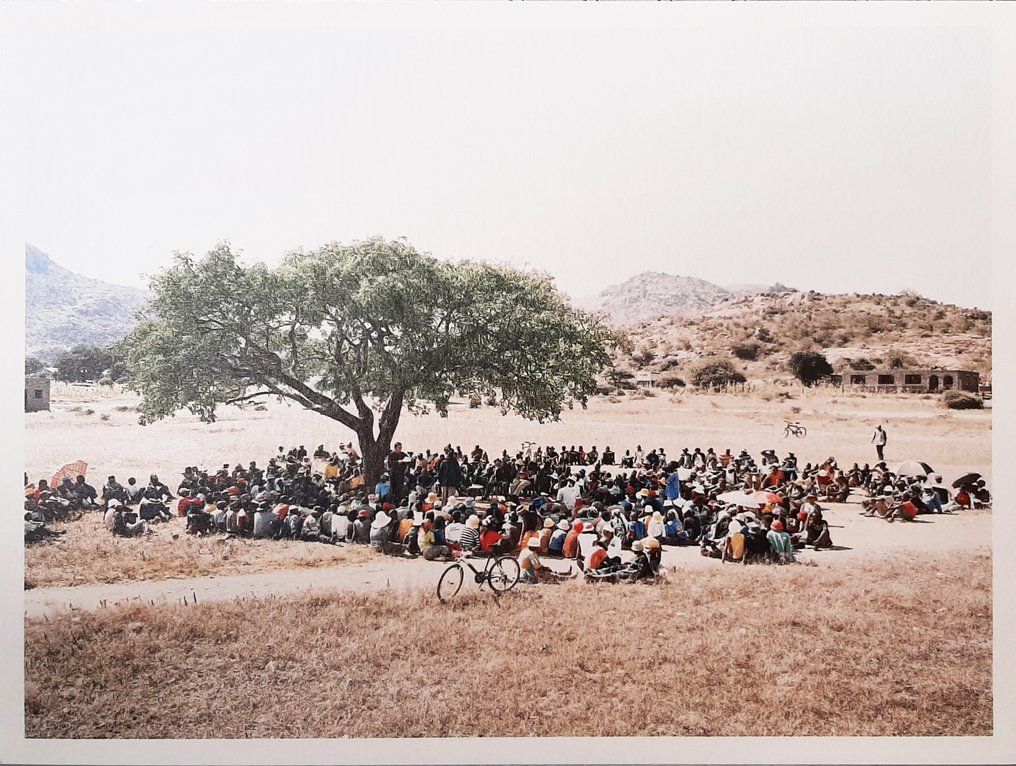
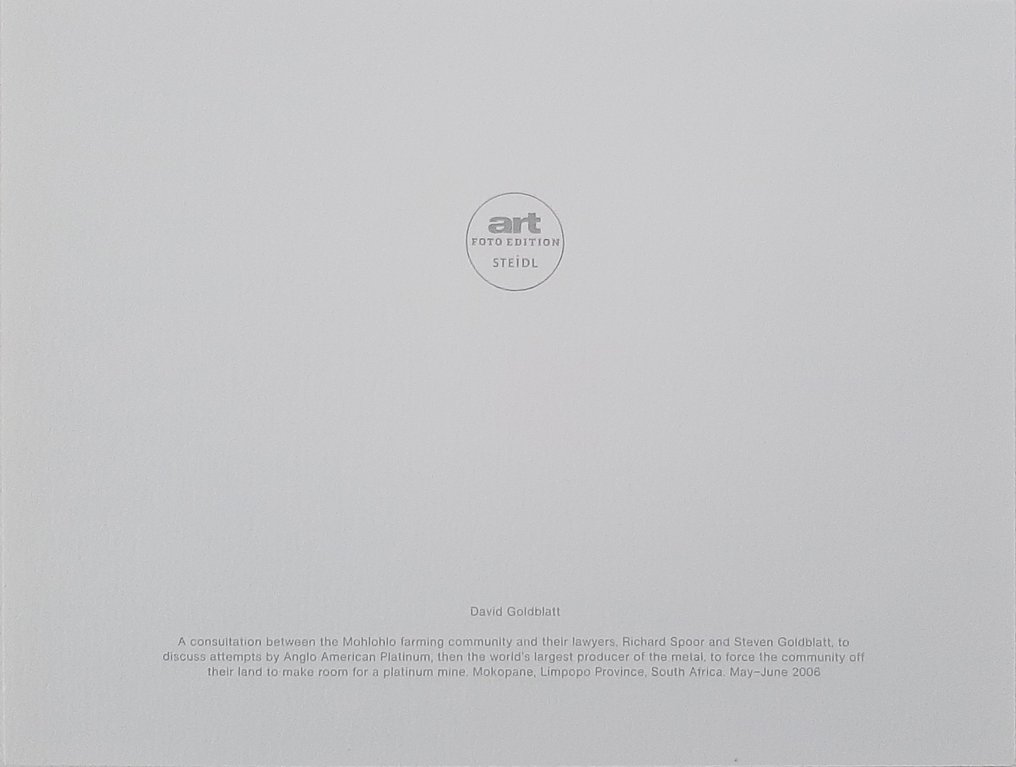
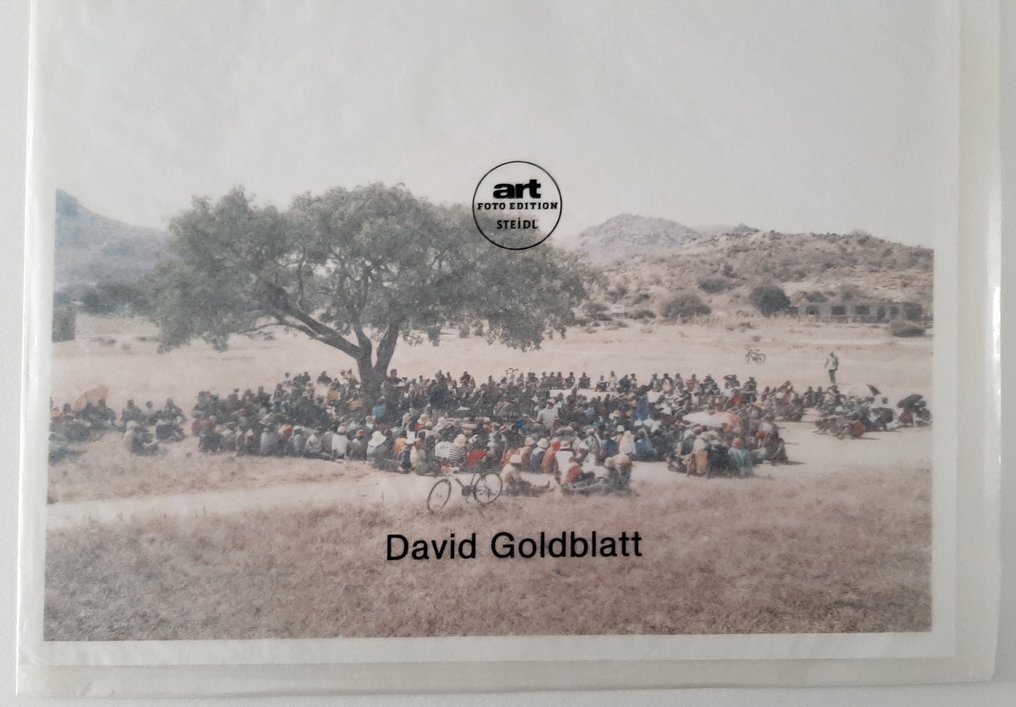
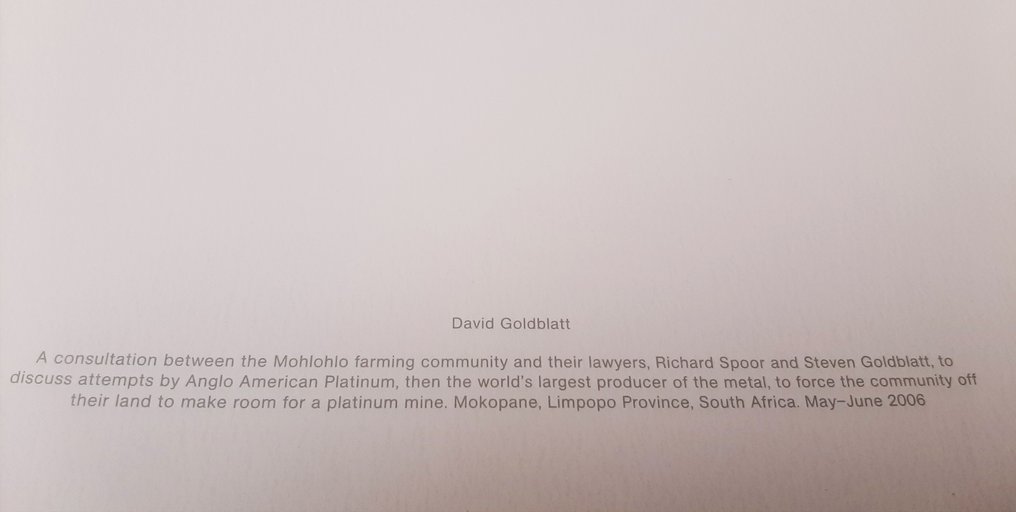
David Goldblatt - A consultation between the Mohlohlo farming community and their lawyers, Richard Spoor and Steven
05
days
07
hours
40
minutes
41
seconds

No bids placed
Catawiki Buyer Protection
Your payment’s safe with us until you receive your object.View details
Trustpilot 4.4 | 122190 reviews
Rated Excellent on Trustpilot.
Description from the seller
Subscribers of the art magazine received this photograph and all others in the series as a noble print from STEIDL Verlag. For each issue, paper, format, and printing process were coordinated with the photographic artist. This creates a high-quality collection of the best contemporary photography in a precious edition.
David Goldblatt on the history of his photograph, color photography, and an unusual motorhome.
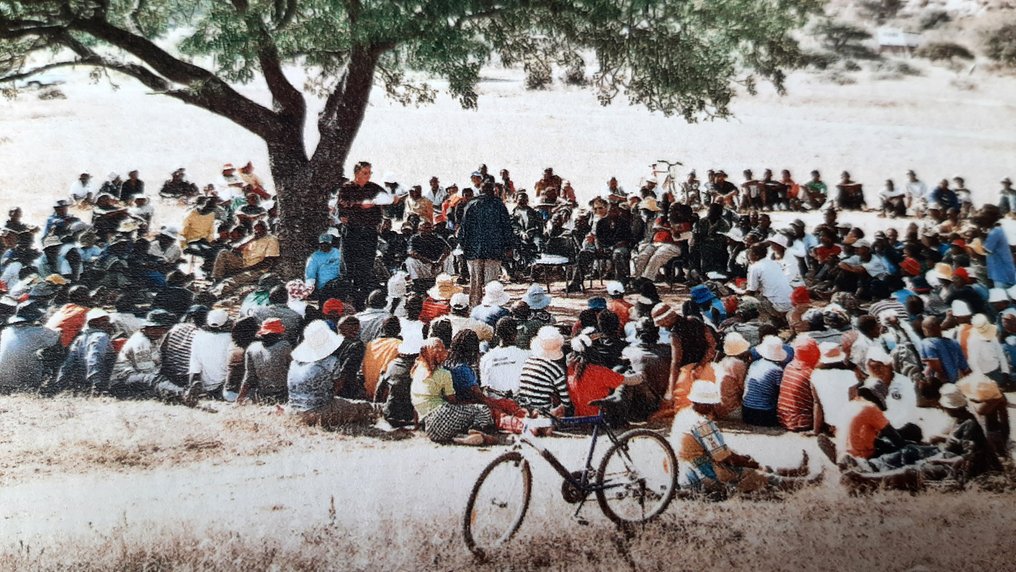
It was 2006 when I accompanied two lawyers to Mokopane, a place in northeastern South Africa. The area is typical bushland, but there are many mineral resources there. The lawyers represented a community.
From farmers involved in a confrontation with ANGLO AMERICAN. The mining company wanted to drive people off their land to establish a platinum mine. The scene under the tree immediately reminded me of a classic colonial motif: a white man speaking to a group of Africans. It could be a missionary reading from the Bible, but in fact, it is an attorney reporting on the fight against the world's largest platinum producer.
To photograph the scene optimally, I climbed onto the roof of my motorhome and took two shots with my 4x5 view camera. I usually only take two shots. The reason I only started using color photography for personal projects in the late nineties is twofold. Firstly, it became finally possible—thanks to better film stock and digital editing—to produce high-quality color prints. Secondly, I found colored photos during the apartheid era simply too sentimental for projects. But now I wanted to rediscover South Africa. That’s why I also bought the motorhome in 2004.
It was originally a pickup, a 'Bakkie,' as we call it here. I had it converted: of course, there is a gas stove, a bed, and whatever else is needed to be on the road for a while. I also had the roof reinforced and can attach two side supports that prevent the vehicle from swaying when I stand on top and take photos. This is especially useful in strong wind. I particularly like the colors in the photo of the gathering: the transition from the shadow under the trees to the people sitting in the sun, and the landscape. The two bicycles are also very important, one in the background and the other in front. They form a visual frame and balance the picture. Without the bicycles, the image simply wouldn't be the same. // David Goldblatt
Subscribers of the art magazine received this photograph and all others in the series as a noble print from STEIDL Verlag. For each issue, paper, format, and printing process were coordinated with the photographic artist. This creates a high-quality collection of the best contemporary photography in a precious edition.
David Goldblatt on the history of his photograph, color photography, and an unusual motorhome.
It was 2006 when I accompanied two lawyers to Mokopane, a place in northeastern South Africa. The area is typical bushland, but there are many mineral resources there. The lawyers represented a community.
From farmers involved in a confrontation with ANGLO AMERICAN. The mining company wanted to drive people off their land to establish a platinum mine. The scene under the tree immediately reminded me of a classic colonial motif: a white man speaking to a group of Africans. It could be a missionary reading from the Bible, but in fact, it is an attorney reporting on the fight against the world's largest platinum producer.
To photograph the scene optimally, I climbed onto the roof of my motorhome and took two shots with my 4x5 view camera. I usually only take two shots. The reason I only started using color photography for personal projects in the late nineties is twofold. Firstly, it became finally possible—thanks to better film stock and digital editing—to produce high-quality color prints. Secondly, I found colored photos during the apartheid era simply too sentimental for projects. But now I wanted to rediscover South Africa. That’s why I also bought the motorhome in 2004.
It was originally a pickup, a 'Bakkie,' as we call it here. I had it converted: of course, there is a gas stove, a bed, and whatever else is needed to be on the road for a while. I also had the roof reinforced and can attach two side supports that prevent the vehicle from swaying when I stand on top and take photos. This is especially useful in strong wind. I particularly like the colors in the photo of the gathering: the transition from the shadow under the trees to the people sitting in the sun, and the landscape. The two bicycles are also very important, one in the background and the other in front. They form a visual frame and balance the picture. Without the bicycles, the image simply wouldn't be the same. // David Goldblatt
Details
Date of print
2006
Artist
David Goldblatt
Sold by
Owner or reseller
Title of artwork
A consultation between the Mohlohlo farming community and their lawyers, Richard Spoor and Steven
Condition
Fine
Technique
Digital print
Height
20 cm
Width
26 cm
Signature
Not signed
Genre
Fine art photography
Sold by