Amos Lambrechts - Manuductio obstetricantium, of handleiding der verloskunde. - 1731



13
days
14
hours
15
minutes
43
seconds
Starting bid
€ 1
Reserve price not met

Expert
Selected by Zena Chiara Masud
Holds a master’s degree in bibliography, with seven years of experience specialising in incunabula and Arabic manuscripts.
Estimate € 550 - € 630
No bids placed
Catawiki Buyer Protection
Your payment’s safe with us until you receive your object.View details
Trustpilot 4.4 | 121798 reviews
Rated Excellent on Trustpilot.
Manuductio obstetricantium, or handleiding der verloskunde, by Amos Lambrechts, is a first edition Dutch medical manual on female reproductive anatomy and midwifery.
AI-assisted summary
Description from the seller
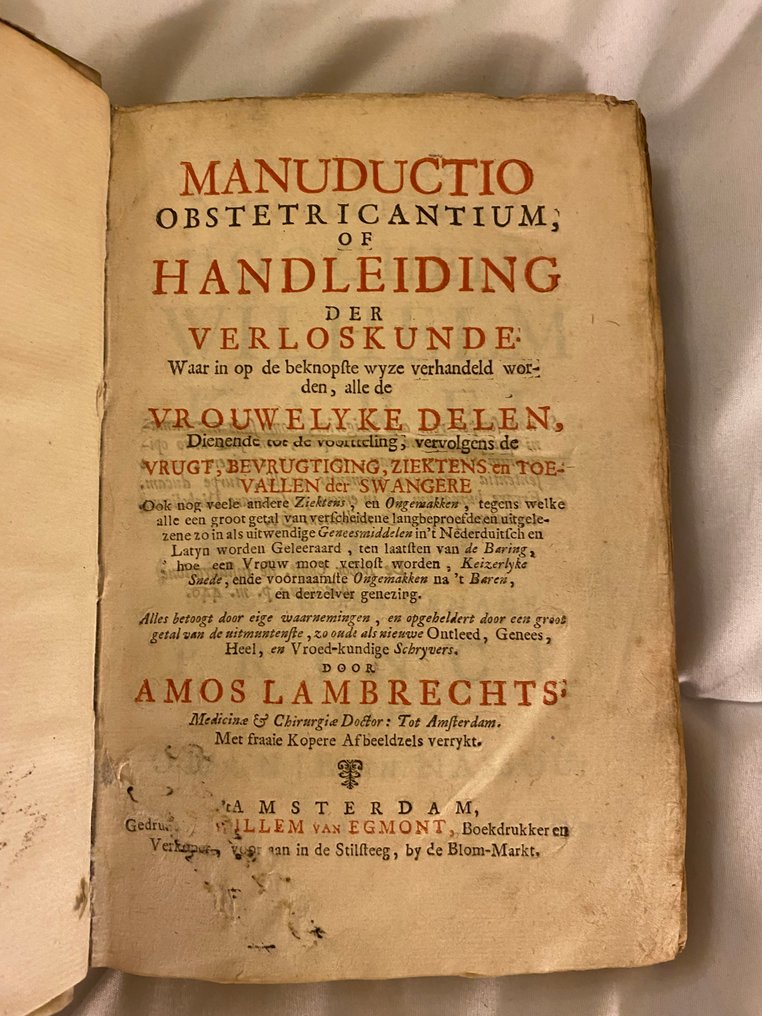
Amos Lambrechts, Manuductio obstetricantium, of handleiding der verloskunde. Waar in op de beknopste wyze verhandeld worden, alle de vrouwelyke delen, dienende tot de voortteling, vervolgens de vrugt, bevrugting, ziektens en toevallen der swangere. Amsterdam: Egmont (1731).
[Manuductio obstetricantium, or manual of midwifery. It deals concisely with all the female parts involved in procreation, as well as with pregnancy, conception, illnesses, and the ailments of the pregnant woman].
Quarto (22 x 15 cm): (24), 268, (6), (10) pages, with five engraved folding plates. The uninitialled plates are impressive and appear unique to this book.
A signature has been removed from the title page, causing some minor superficial damage; an ex-libris has evidently been removed from the front pastedown.
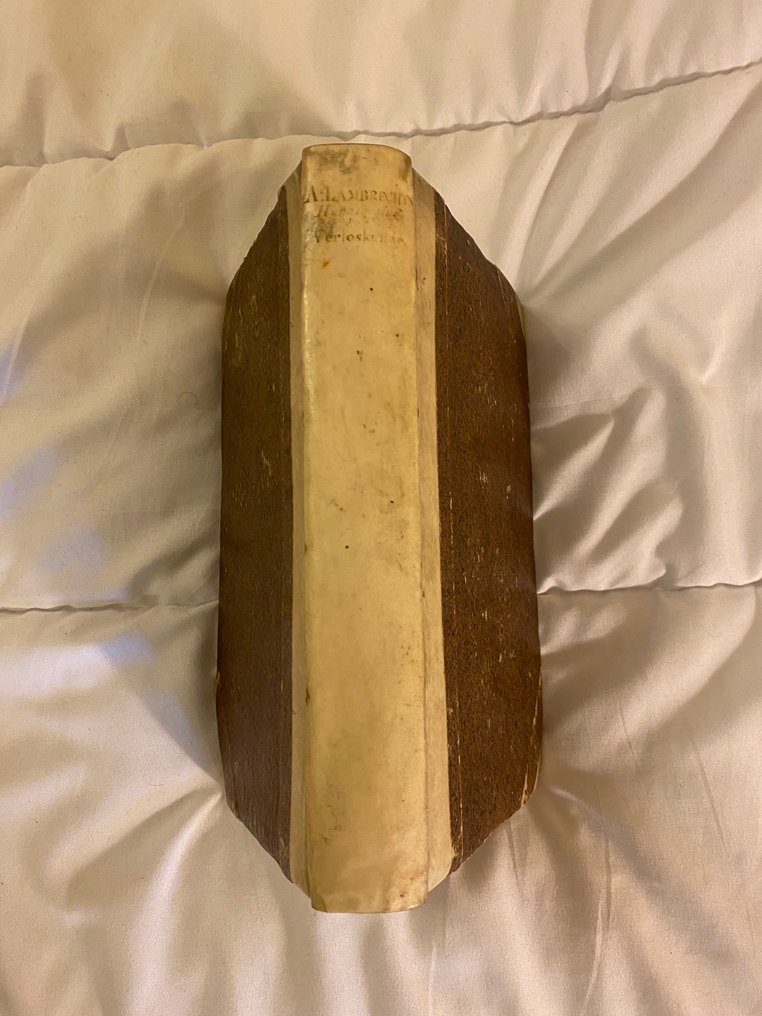
Here and there lightly age-toned but a very impressive copy in contemporary ¾ vellum and boards.
FIRST edition. Very scarce.
The note to readers states in opening:
'''In this treatise, called Manuductio Obstetricantium or Manual of Midwifery, the most important matters of midwifery are shown in the shortest and most lively manner. Their precise knowledge and practice are very useful and dear to the public in general, and especially to the female sex, upon whose well-being the whole human race depends.'''
Sections on anatomy, as the author explains:
'''Because I am aware that the ignorance of many in anatomy has given rise to many errors and misunderstandings in medicine and surgery, I have considered it necessary, before I proceed to the description of midwifery, first to set out an anatomical treatise of the parts relating to generation. From this the modest reader and the eager student will learn to distinguish and avoid many mistakes, misconceptions, and false notions.'''
Manuductio obstetricantium is designed to give a concise yet practical manual of female reproductive anatomy and the processes involved in conception, pregnancy and birth. The readership is announced in title and throughout the text as Verloskundige and Vroedkunde, that is, midwives. One of th engravings shows the arms of a female.
The treatise covers all the female parts serving for generation, followed by discussions of the foetus, fertilisation, and the illnesses and complications that might arise during pregnancy. The focus on the beknopste wyze — the most succinct manner — suggests that the book aimed to be a usable reference rather than a scholarly treatise. It provided essential explanations rather than elaborate theoretical debate, which would have made it particularly suitable for those learning or practising hands-on birth assistance.
The book includes various recipes.
REFERENCES
Gerrit Arie Lindeboom, Dutch medical biography : a biographical dictionary of Dutch physicians and surgeons, 1475-1975 (1984): 1124-1125.
Amos Lambrechts, Manuductio obstetricantium, of handleiding der verloskunde. Waar in op de beknopste wyze verhandeld worden, alle de vrouwelyke delen, dienende tot de voortteling, vervolgens de vrugt, bevrugting, ziektens en toevallen der swangere. Amsterdam: Egmont (1731).
[Manuductio obstetricantium, or manual of midwifery. It deals concisely with all the female parts involved in procreation, as well as with pregnancy, conception, illnesses, and the ailments of the pregnant woman].
Quarto (22 x 15 cm): (24), 268, (6), (10) pages, with five engraved folding plates. The uninitialled plates are impressive and appear unique to this book.
A signature has been removed from the title page, causing some minor superficial damage; an ex-libris has evidently been removed from the front pastedown.
Here and there lightly age-toned but a very impressive copy in contemporary ¾ vellum and boards.
FIRST edition. Very scarce.
The note to readers states in opening:
'''In this treatise, called Manuductio Obstetricantium or Manual of Midwifery, the most important matters of midwifery are shown in the shortest and most lively manner. Their precise knowledge and practice are very useful and dear to the public in general, and especially to the female sex, upon whose well-being the whole human race depends.'''
Sections on anatomy, as the author explains:
'''Because I am aware that the ignorance of many in anatomy has given rise to many errors and misunderstandings in medicine and surgery, I have considered it necessary, before I proceed to the description of midwifery, first to set out an anatomical treatise of the parts relating to generation. From this the modest reader and the eager student will learn to distinguish and avoid many mistakes, misconceptions, and false notions.'''
Manuductio obstetricantium is designed to give a concise yet practical manual of female reproductive anatomy and the processes involved in conception, pregnancy and birth. The readership is announced in title and throughout the text as Verloskundige and Vroedkunde, that is, midwives. One of th engravings shows the arms of a female.
The treatise covers all the female parts serving for generation, followed by discussions of the foetus, fertilisation, and the illnesses and complications that might arise during pregnancy. The focus on the beknopste wyze — the most succinct manner — suggests that the book aimed to be a usable reference rather than a scholarly treatise. It provided essential explanations rather than elaborate theoretical debate, which would have made it particularly suitable for those learning or practising hands-on birth assistance.
The book includes various recipes.
REFERENCES
Gerrit Arie Lindeboom, Dutch medical biography : a biographical dictionary of Dutch physicians and surgeons, 1475-1975 (1984): 1124-1125.
Details
Number of Books
1
Subject
Medicine
Book Title
Manuductio obstetricantium, of handleiding der verloskunde.
Author/ Illustrator
Amos Lambrechts
Condition
Fine
Publication year oldest item
1731
Height
22 cm
Edition
1st Edition
Width
15 cm
Language
Dutch
Original language
Yes
Publisher
Amsterdam: Egmont
Binding/ Material
Half leather
Extras
Fold out maps or plates
Number of pages
310
Sold by
