Anton von Störck - Observations sur l'usage interne du colchique d'automne, du sublimé corrosif, de la feuille - 1746



Opens 11:00
Starting bid
€ 1
Add to your favourites to get an alert when the auction starts.

Expert
Selected by Zena Chiara Masud
Holds a master’s degree in bibliography, with seven years of experience specialising in incunabula and Arabic manuscripts.
Estimate € 450 - € 500
Catawiki Buyer Protection
Your payment’s safe with us until you receive your object.View details
Trustpilot 4.4 | 121899 reviews
Rated Excellent on Trustpilot.
Description from the seller
"The 'Quitameriendas' plant is very abundant in pastures and along routes used by livestock. Its curious name seems to originate from the times when shepherds' food was considered part of their wages. During the seasons with longer days, their afternoon snack was included. When autumn arrived, the days shortened, and the shepherds retired earlier, thus losing their snack from their daily wage. This coincided with the appearance of the Colchicum flower, hence its popular name, 'Quitameriendas' (Afternoon Snack)." – The Magnetic North
"Colchicum autumnale (also known as autumn crocus, autumn flower, autumn daffodil, or wild saffron) is a species of flowering bulbous plant belonging to the Colchicaceae family. The autumn crocus bulb has been used to treat gout since the 17th century. The entire plant contains colchicine, a toxic substance that, in limited quantities, can be used medicinally for its anti-inflammatory properties." – Wikipedia
Very rare first French edition (and only), printed in The Hague in 1764, of "Libellus, quo demonstratur: Colchici", the famous treatise on the therapeutic potential of plants considered poisonous, with special attention to Colchicum autumnale, a plant known in Spain as quitameriendas, ahuyentapastores, despachapastores, cólquico, mataperros, flor de otoño or azafrán silvestre.
Complete work in one volume, preserving the fold-out engraving showing the complete Colchicum autumnale. Tear repaired on the back with Japanese paper. A very rare book, even more so with the engraving. Only one copy exists in Spanish libraries according to the CCPB (Collective Catalog of Bibliographic Heritage), held in the library of the Royal Academy of Medicine of Catalonia, Barcelona (call number B-RAM, 2-467).
The book's author, the Austrian physician Anton von Störck, is famous for having experimented on himself to determine the boundary between therapeutic, toxic, and lethal doses. He was convinced that poisonous plants such as hemlock (Conium maculatum), water hemlock (Cicuta virosa), autumn crocus (Colchicum autumnale), jimsonweed (Datura stramonium), henbane, aconite, spring anemone, and others, despite their toxicity, could have therapeutic uses if the appropriate doses were found. Störck's treatise is followed, with its own title page, by "Mr. Locher's Observations on Venereal Diseases, Epilepsy, and Madness; and on the Internal and External Use of Hemlock," also dated 1764. It is bound in full leather of the period with gilt tooling on the spine. It shows considerable wear, as is typical of such technical bindings, but is still strong and solid. The text is in French. [4], LXXI, [5], [1] folded leaf of plates, 1-70, [2], 71-254, [2] p. (complete). 17 x 10 cm, 275 grams. 2 works in 1 volume, both with their own title pages and continuous pagination:
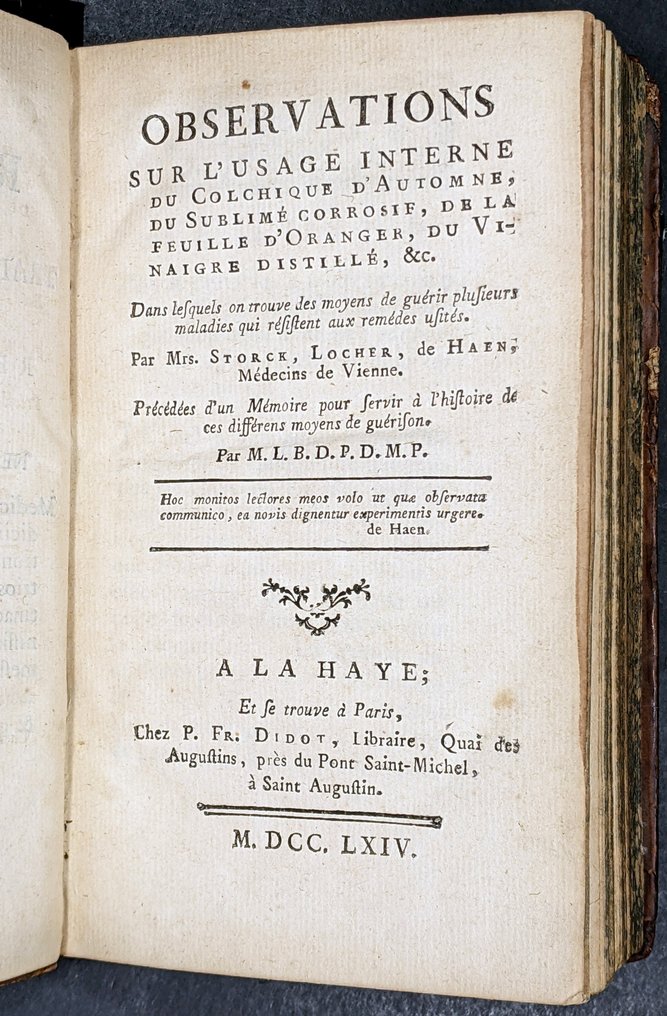
Anton von Störck (1731-1803), Observations sur l'usage interne du colchique d'automne, du sublimé corrosif, de la feuille d'oranger, du vinaigre distillé, &c. Dans lesquels on trouve des moyens de guérir plusieurs maladies qui résistent aux remédes usités. By Mrs. Storck, Locher, de Haen, Médecins de Vienne. Précédées d'un mémoire pour serve à l'histoire de ces différens moyens de guérison par M. L.B.D.P. D.M.P. A La Haye et se trouve à Paris: Chez P. Fr. Didot, Libraire, 1764.
Maximilian Locher, Observations de Monsieur Locher, sur les maladies vénériennes, l'epilepsie, la folie; & sur l'usage interne & externe de la ciguë. A La Haye et se trouve à Paris: Chez P. Fr. Didot, Libraire, 1764.
Bookstore reference: C95390620875
"The 'Quitameriendas' plant is very abundant in pastures and along routes used by livestock. Its curious name seems to originate from the times when shepherds' food was considered part of their wages. During the seasons with longer days, their afternoon snack was included. When autumn arrived, the days shortened, and the shepherds retired earlier, thus losing their snack from their daily wage. This coincided with the appearance of the Colchicum flower, hence its popular name, 'Quitameriendas' (Afternoon Snack)." – The Magnetic North
"Colchicum autumnale (also known as autumn crocus, autumn flower, autumn daffodil, or wild saffron) is a species of flowering bulbous plant belonging to the Colchicaceae family. The autumn crocus bulb has been used to treat gout since the 17th century. The entire plant contains colchicine, a toxic substance that, in limited quantities, can be used medicinally for its anti-inflammatory properties." – Wikipedia
Very rare first French edition (and only), printed in The Hague in 1764, of "Libellus, quo demonstratur: Colchici", the famous treatise on the therapeutic potential of plants considered poisonous, with special attention to Colchicum autumnale, a plant known in Spain as quitameriendas, ahuyentapastores, despachapastores, cólquico, mataperros, flor de otoño or azafrán silvestre.
Complete work in one volume, preserving the fold-out engraving showing the complete Colchicum autumnale. Tear repaired on the back with Japanese paper. A very rare book, even more so with the engraving. Only one copy exists in Spanish libraries according to the CCPB (Collective Catalog of Bibliographic Heritage), held in the library of the Royal Academy of Medicine of Catalonia, Barcelona (call number B-RAM, 2-467).
The book's author, the Austrian physician Anton von Störck, is famous for having experimented on himself to determine the boundary between therapeutic, toxic, and lethal doses. He was convinced that poisonous plants such as hemlock (Conium maculatum), water hemlock (Cicuta virosa), autumn crocus (Colchicum autumnale), jimsonweed (Datura stramonium), henbane, aconite, spring anemone, and others, despite their toxicity, could have therapeutic uses if the appropriate doses were found. Störck's treatise is followed, with its own title page, by "Mr. Locher's Observations on Venereal Diseases, Epilepsy, and Madness; and on the Internal and External Use of Hemlock," also dated 1764. It is bound in full leather of the period with gilt tooling on the spine. It shows considerable wear, as is typical of such technical bindings, but is still strong and solid. The text is in French. [4], LXXI, [5], [1] folded leaf of plates, 1-70, [2], 71-254, [2] p. (complete). 17 x 10 cm, 275 grams. 2 works in 1 volume, both with their own title pages and continuous pagination:
Anton von Störck (1731-1803), Observations sur l'usage interne du colchique d'automne, du sublimé corrosif, de la feuille d'oranger, du vinaigre distillé, &c. Dans lesquels on trouve des moyens de guérir plusieurs maladies qui résistent aux remédes usités. By Mrs. Storck, Locher, de Haen, Médecins de Vienne. Précédées d'un mémoire pour serve à l'histoire de ces différens moyens de guérison par M. L.B.D.P. D.M.P. A La Haye et se trouve à Paris: Chez P. Fr. Didot, Libraire, 1764.
Maximilian Locher, Observations de Monsieur Locher, sur les maladies vénériennes, l'epilepsie, la folie; & sur l'usage interne & externe de la ciguë. A La Haye et se trouve à Paris: Chez P. Fr. Didot, Libraire, 1764.
Bookstore reference: C95390620875
Details
Number of Books
1
Subject
Agriculture, Biology, Botany, Curio & ephemera, Medicine, Natural History, Science
Book Title
Observations sur l'usage interne du colchique d'automne, du sublimé corrosif, de la feuille
Author/ Illustrator
Anton von Störck
Condition
Good
Publication year oldest item
1746
Edition
1st Edition
Language
French
Original language
No
Binding/ Material
Leather
Number of pages
300
