Quevedo, Francisco de - Las tres ultimas Musas Castellanas : Segunda cumbre del Parnaso Español. De D. Francisco de Quevedo - 1772


11
days
10
hours
05
minutes
10
seconds
Current bid
€ 4
Reserve price not met

Expert
Selected by Sebastian Hau
Founded and directed two French book fairs; nearly 20 years of experience in contemporary books.
Estimate € 450 - € 550
12 other people are watching this object
 Bidder 1081 Bidder 1081 | €4 | |
|---|---|---|
 Bidder 4652 Bidder 4652 | €3 | |
| Bidder 1081 | €2 | |
Catawiki Buyer Protection
Your payment’s safe with us until you receive your object.View details
Trustpilot 4.4 | 122529 reviews
Rated Excellent on Trustpilot.
Author/Illustrator: Francisco de Quevedo; Book Title: Las tres ultimas Musas Castellanas: Segunda cumbre del Parnaso Español.
AI-assisted summary
Description from the seller
"What do you have to say, annoying clock? In a breath of unhappy life, which passes so quickly? That I must be dust, like you, if I die. And that I am glass, like you, if I live" - Quevedo, The Hourglass, Muse VIII (p. 175 in this copy).
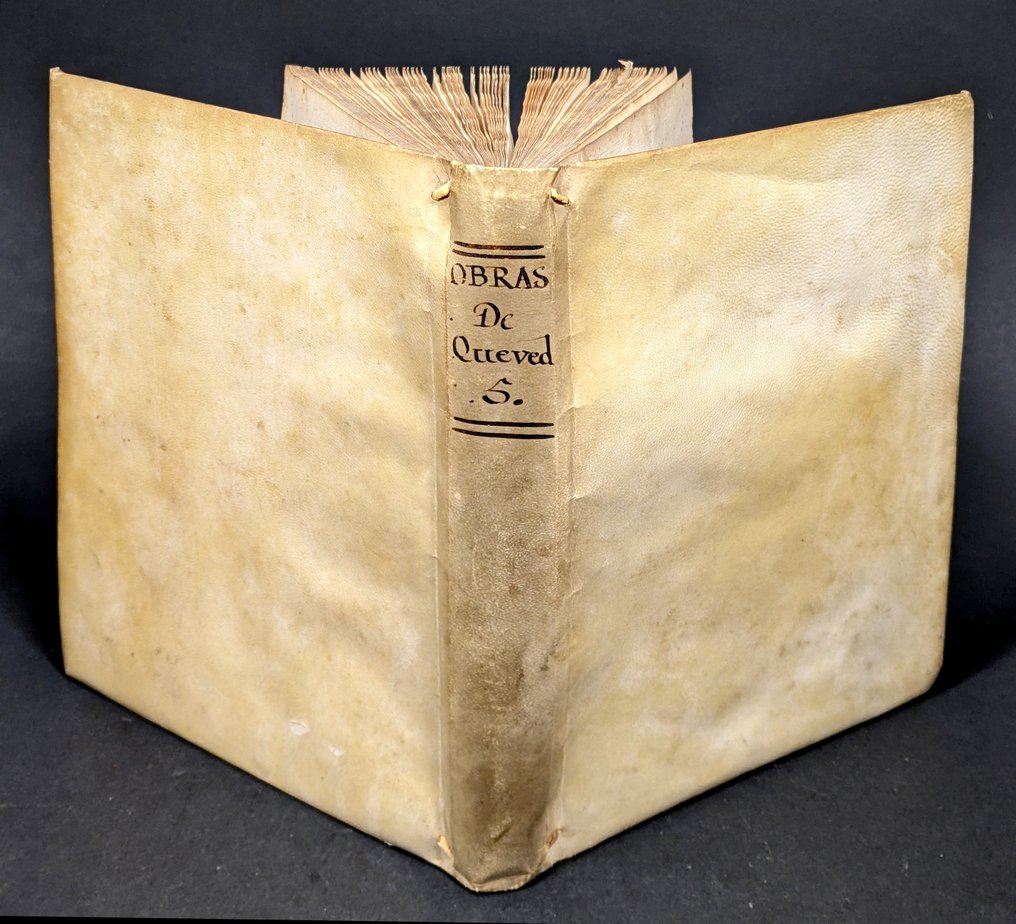
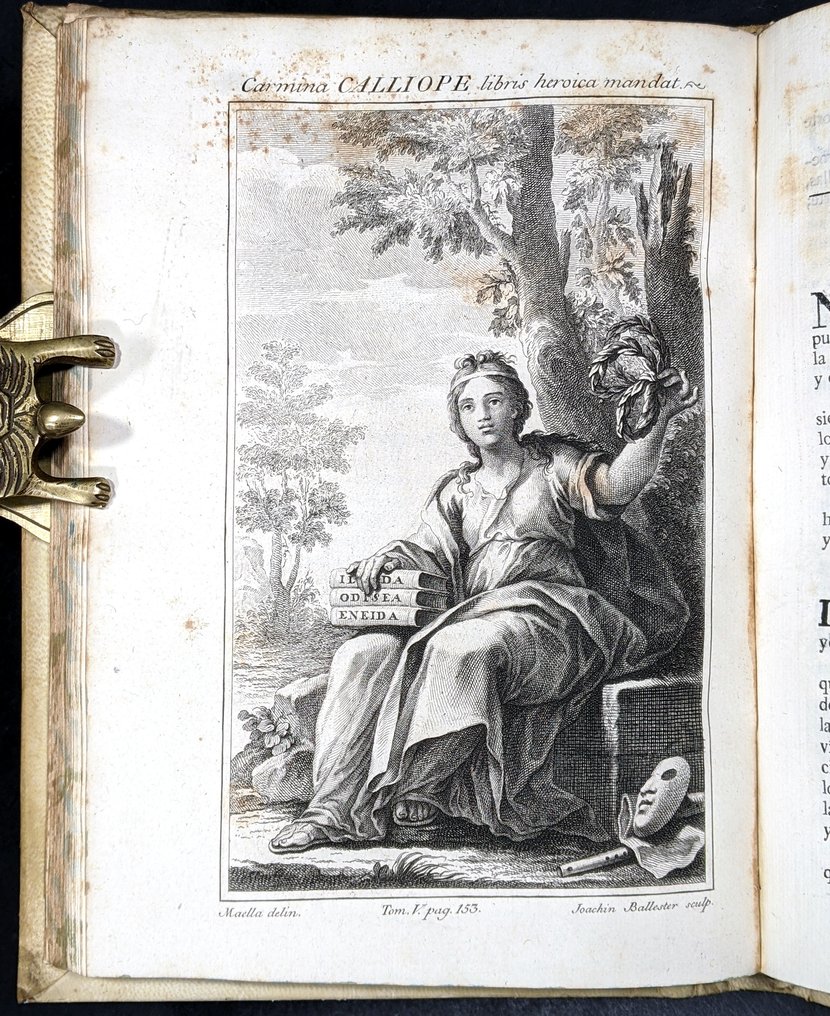
A prestigious illustrated edition of Quevedo's works, printed in Madrid in 1772 at the workshops of Joaquín Ibarra, the finest printer, along with Sancha, in 18th-century Spain. Volume V of his works, containing the "Last Three Castilian Muses." Illustrated with three extraordinary engravings (complete) depicting the Muses Euterpe, Calliope, and Urania. The illustrations, as was typical of Ibarra, were done by the best draftsmen and engravers of the time. Bound in full parchment of the period with a lettered spine. Strong and solid. Original text in Quevedo's Castilian. Some oxidation on the paper. 22 x 16 cm, 430 grams. [6], 314 pp. A fine copy, from the renowned Ibarra presses.
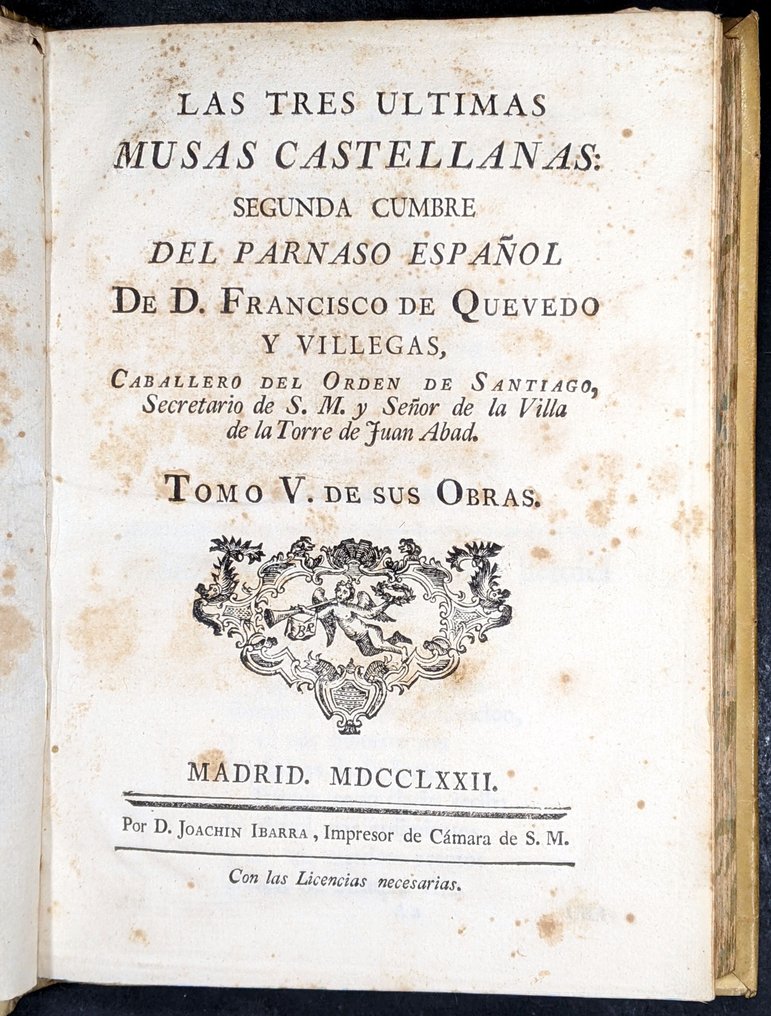
Quevedo, Francisco de (1580-1645), The Last Three Castilian Muses: Second Summit of the Spanish Parnassus. By D. Francisco de Quevedo y Villegas, Knight of the Order of Santiago, Secretary to His Majesty and Lord of the Town of Torre de Juan Abad. Volume V of his works. Madrid: by D. Joachin Ibarra, Printer to His Majesty, 1772.
Francisco de Quevedo y Villegas (Madrid 1580–Villanueva de los Infantes 1645), a writer of the Spanish Golden Age, is one of the most important authors in the history of world literature. He studied at the University of Alcalá and the University of Valladolid, where he began his debate with Góngora. He wrote some of the most brilliant and popular burlesque and satirical works in Spanish literature and brilliantly criticized the vices and weaknesses of humanity. A man of vast erudition, witty, versatile, and with a great sense of humor, he was fluent in Latin, Hebrew, French, Arabic, Greek, and Italian. His works show clear influences from Dante, Petrarch, and the great classical Greek and Latin authors, especially Seneca.
"I say that it is Don Francisco who professes arms and letters with such a name, that Apollo confesses him as his equal" (Cervantes, Journey to Parnassus, II).
Bookstore reference: C953901000875
"What do you have to say, annoying clock? In a breath of unhappy life, which passes so quickly? That I must be dust, like you, if I die. And that I am glass, like you, if I live" - Quevedo, The Hourglass, Muse VIII (p. 175 in this copy).
A prestigious illustrated edition of Quevedo's works, printed in Madrid in 1772 at the workshops of Joaquín Ibarra, the finest printer, along with Sancha, in 18th-century Spain. Volume V of his works, containing the "Last Three Castilian Muses." Illustrated with three extraordinary engravings (complete) depicting the Muses Euterpe, Calliope, and Urania. The illustrations, as was typical of Ibarra, were done by the best draftsmen and engravers of the time. Bound in full parchment of the period with a lettered spine. Strong and solid. Original text in Quevedo's Castilian. Some oxidation on the paper. 22 x 16 cm, 430 grams. [6], 314 pp. A fine copy, from the renowned Ibarra presses.
Quevedo, Francisco de (1580-1645), The Last Three Castilian Muses: Second Summit of the Spanish Parnassus. By D. Francisco de Quevedo y Villegas, Knight of the Order of Santiago, Secretary to His Majesty and Lord of the Town of Torre de Juan Abad. Volume V of his works. Madrid: by D. Joachin Ibarra, Printer to His Majesty, 1772.
Francisco de Quevedo y Villegas (Madrid 1580–Villanueva de los Infantes 1645), a writer of the Spanish Golden Age, is one of the most important authors in the history of world literature. He studied at the University of Alcalá and the University of Valladolid, where he began his debate with Góngora. He wrote some of the most brilliant and popular burlesque and satirical works in Spanish literature and brilliantly criticized the vices and weaknesses of humanity. A man of vast erudition, witty, versatile, and with a great sense of humor, he was fluent in Latin, Hebrew, French, Arabic, Greek, and Italian. His works show clear influences from Dante, Petrarch, and the great classical Greek and Latin authors, especially Seneca.
"I say that it is Don Francisco who professes arms and letters with such a name, that Apollo confesses him as his equal" (Cervantes, Journey to Parnassus, II).
Bookstore reference: C953901000875
Details
Number of Books
1
Subject
Astrology, Literature, Poetry
Book Title
Las tres ultimas Musas Castellanas : Segunda cumbre del Parnaso Español. De D. Francisco de Quevedo
Author/ Illustrator
Quevedo, Francisco de
Condition
Good
Publication year oldest item
1772
Edition
Illustrated Edition
Language
Spanish
Original language
Yes
Binding/ Material
Vellum
Number of pages
314
