Quentin Massys (1465ca.–1530), Follower of - Ecce home



06
days
01
hour
04
minutes
24
seconds
Current bid
€ 700
Reserve price not met

22 other people are watching this object
 Bidder 2501 Bidder 2501 | €700 | |
|---|---|---|
| Bidder 2501 | €550 | |
| Bidder 2501 | €250 | |
Catawiki Buyer Protection
Your payment’s safe with us until you receive your object.View details
Trustpilot 4.4 | 122053 reviews
Rated Excellent on Trustpilot.
Ecce home, a 17th‑century oil painting from Italy in the Baroque style, attributed to a follower of Quentin Massys and sold with its frame.
AI-assisted summary
Description from the seller
By Quentin Massys
(Lovanio, 1466 – Anversa, 1530)
Ecce homo
Oil on canvas, 90 x 77 cm
Frame dimensions, approx. 117 x 104 x 5 cm.
NOTE: Publication of the Intermidiart collection works catalog. Certificate of legitimate provenance. Work with crafted frame (defects):
We present in the auction catalog a magnificent painting, skillfully executed, although it is a faithful copy of the work by Quentin Massys (Leuven, circa 1465 – Antwerp, 1530), preserved at the Palazzo Ducale of MUVE (Fondazione Musei Civici Venezia) (oil on panel measuring 96 x 75 cm, circa 1529, Inv. TS 2° p. n. 24 n. 376).
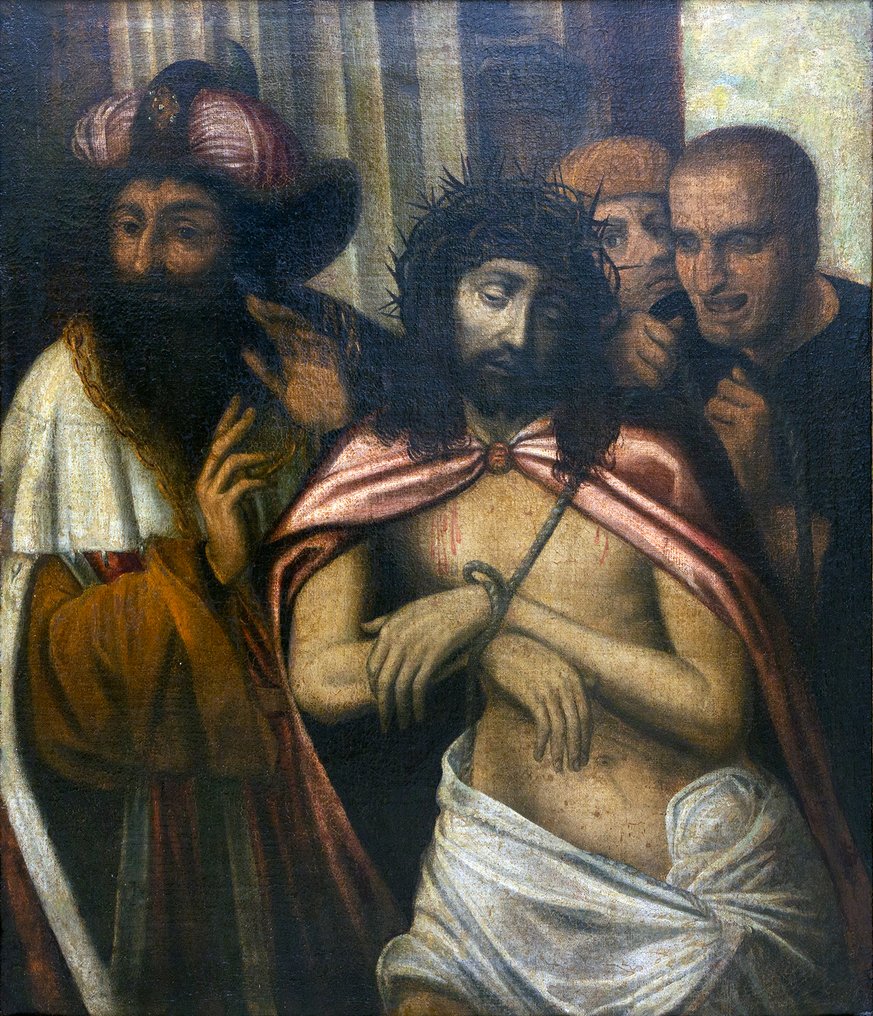
As in the original, Jesus Christ, a prisoner, is shown to the people by Pontius Pilate. He has his hands bound with a rope, held by a tormentor behind him. The crown of thorns wounds his head and forehead. Blood flows copiously through his hair down to his chest. He wears a violet-blue cloak fastened at the center with a jeweled clasp. The white loincloth is draped with a voluminous knot at the waist. His figure of a man of sorrow and gentle resignation contrasts with the faces of the executioners, which are loaded with brutal and violent expressions. Conversely, the face of Pontius Pilate to his left reveals doubt and hesitation, embodying the dilemma inherent in condemning an innocent man. The artist of the painting is Quentin Messys, a renowned Flemish artist active between the late 15th and early 16th centuries in Leuven and Antwerp. Messys played a crucial role in bridging late medieval tradition with the Renaissance and was one of the first Northern artists to look towards Italian art of the period. In this painting, the faces reflect the psychological reactions of the characters to such an extent that they show a clear familiarity with the grotesque heads conceived by Leonardo da Vinci, with whom Massys shared the Renaissance interest in physiognomy. Besides the characterization of his models' faces, Massys is also distinguished by his use of refined gestural rhetoric through meticulous descriptions of hands and their signs. Other details also attract attention, such as the original design of the column capital in the background, which recalls the crown of thorns as a tool of Christ’s martyrdom. The presence of this painting in Venice is documented as early as the late 1500s through the existence of ancient copies and testifies to the Venetian taste for this type of work from Northern Europe, including the three masterpieces by Jheronimus Bosch from the Grimani collection, now housed in the Gallerie dell’Accademia.
This painting, likely attributable to a follower of the Flemish painter, shows significant iconographic similarities with the original work of the Flemish master. Although the attribution remains cautiously hypothesized, the possible involvement of the Venetian in the creation of this piece cannot be excluded.
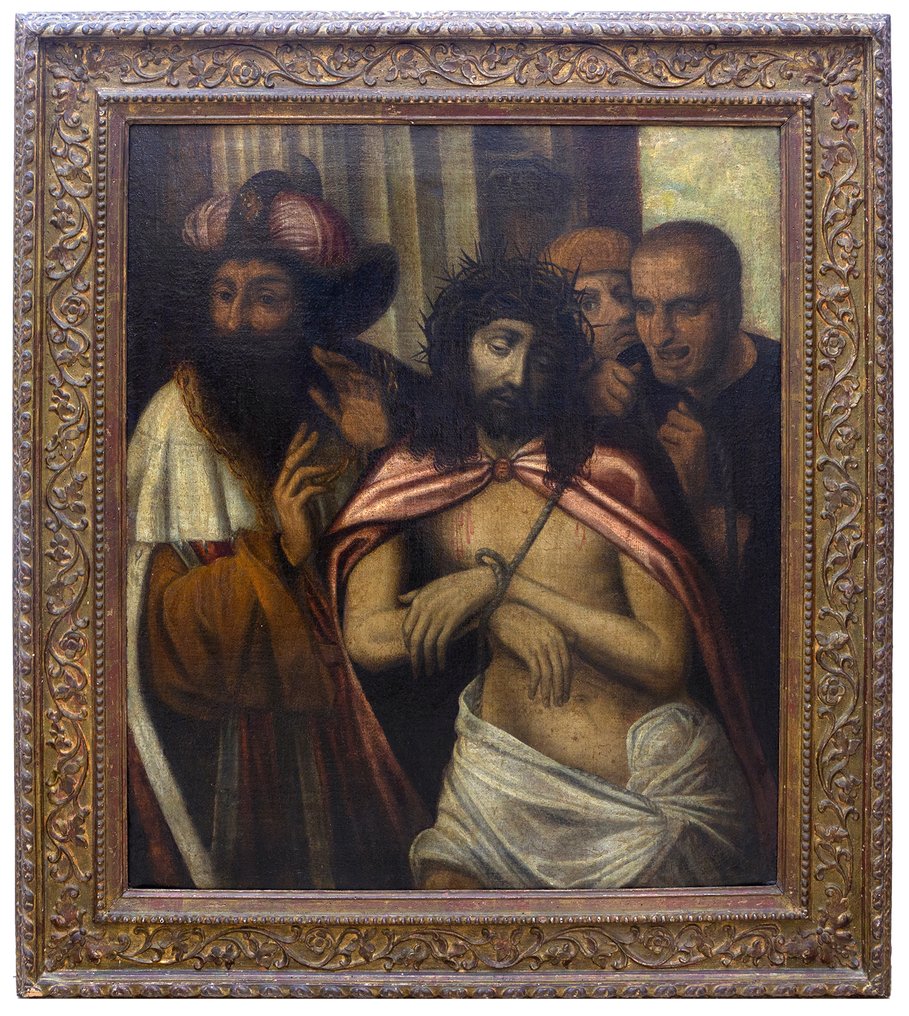
Regarding its conservation state, the canvas appears generally quite decent considering the age of the painting. The painted surface shows a patina, and the overall image is clearly readable beneath a dirty, yellowed varnish. Visibly, the painting exhibits wear, with micro-flakes of paint, retouchings, and abrasions. Under Wood lamp examination, the fluorescence is intense and uniform, revealing additional restorations, but it is not possible to exclude previous restorations due to this. The painting is lined. The condition report we provide is accurate and meticulous but, in any case, entirely partial and not fully exhaustive, as it was not conducted in specialized laboratories with specific technical supports. Under sunlight, a fine craquelure related to the period is visible. The canvas measures 90 x 77 cm. The work is enhanced by a beautiful, crafted frame (the frame measures approximately 117 x 104 x 5 cm, with some defects). The frame shown in the photos above was added to the artwork by the seller or a third party. The frame is provided at no additional cost so that it is ready for display upon arrival. The frame is included as a courtesy and is not considered an integral part of the artwork. Therefore, any potential damage to the frame that does not affect the artwork itself will not be accepted as a valid reason to open a claim or request order cancellation.
Provenance: Private Sicilian Collection
Publication
Unpublished
Myths and the territory in Sicily with its thousand cultures. Unpublished quadreria general catalog of the paintings from the cycle "Myths and the territory," Publisher Lab_04, Marsala, 2025.
The work will be shipped – due to its fragility and large size – in a wooden crate and polystyrene or via a trusted carrier. In the case of sales outside Italian territory, the buyer must wait for the export procedures to be completed.
Due to the holidays, shipments may delay delivery.
Seller's Story
Born in Le Locle, Switzerland, in 1975, graduated as a commercial expert, he is the owner of the Intermidiart Ancient Art Gallery - founded in 2011 - in which he offers a fine selection of works of art, in particular 17th century paintings (such as Guido Reni , Francesco Furini, Pietro Novelli, Carlo Saraceni, Lorenzo Lippi, Bernardo Strozzi, others) and XVIII century (such as Luca Giordano, Giuseppe Maria Crespi, etc.).
He founded the cultural association "Fiera Franca Ss. Salvatore" in 2015, with the aim of representing an important vehicle for promoting knowledge of local art and culture.
It collaborates both with professionals in restoration and specialized laboratories for the technical studies and analysis of ancient works, and with national and international art historians and experts. After gaining work experience in national galleries and exhibitions, he boasts numerous essay publications. He has directed several editions of exhibitions for the unpublished cycle "MYTHS AND THE TERRITORY in Sicily of a thousand cultures", sponsored by the Ministry of Cultural Heritage, the Region of Sicily, Superintendence for Cultural and Environmental Heritage of Trapani, and other bodies.
Translated by Google TranslateBy Quentin Massys
(Lovanio, 1466 – Anversa, 1530)
Ecce homo
Oil on canvas, 90 x 77 cm
Frame dimensions, approx. 117 x 104 x 5 cm.
NOTE: Publication of the Intermidiart collection works catalog. Certificate of legitimate provenance. Work with crafted frame (defects):
We present in the auction catalog a magnificent painting, skillfully executed, although it is a faithful copy of the work by Quentin Massys (Leuven, circa 1465 – Antwerp, 1530), preserved at the Palazzo Ducale of MUVE (Fondazione Musei Civici Venezia) (oil on panel measuring 96 x 75 cm, circa 1529, Inv. TS 2° p. n. 24 n. 376).
As in the original, Jesus Christ, a prisoner, is shown to the people by Pontius Pilate. He has his hands bound with a rope, held by a tormentor behind him. The crown of thorns wounds his head and forehead. Blood flows copiously through his hair down to his chest. He wears a violet-blue cloak fastened at the center with a jeweled clasp. The white loincloth is draped with a voluminous knot at the waist. His figure of a man of sorrow and gentle resignation contrasts with the faces of the executioners, which are loaded with brutal and violent expressions. Conversely, the face of Pontius Pilate to his left reveals doubt and hesitation, embodying the dilemma inherent in condemning an innocent man. The artist of the painting is Quentin Messys, a renowned Flemish artist active between the late 15th and early 16th centuries in Leuven and Antwerp. Messys played a crucial role in bridging late medieval tradition with the Renaissance and was one of the first Northern artists to look towards Italian art of the period. In this painting, the faces reflect the psychological reactions of the characters to such an extent that they show a clear familiarity with the grotesque heads conceived by Leonardo da Vinci, with whom Massys shared the Renaissance interest in physiognomy. Besides the characterization of his models' faces, Massys is also distinguished by his use of refined gestural rhetoric through meticulous descriptions of hands and their signs. Other details also attract attention, such as the original design of the column capital in the background, which recalls the crown of thorns as a tool of Christ’s martyrdom. The presence of this painting in Venice is documented as early as the late 1500s through the existence of ancient copies and testifies to the Venetian taste for this type of work from Northern Europe, including the three masterpieces by Jheronimus Bosch from the Grimani collection, now housed in the Gallerie dell’Accademia.
This painting, likely attributable to a follower of the Flemish painter, shows significant iconographic similarities with the original work of the Flemish master. Although the attribution remains cautiously hypothesized, the possible involvement of the Venetian in the creation of this piece cannot be excluded.
Regarding its conservation state, the canvas appears generally quite decent considering the age of the painting. The painted surface shows a patina, and the overall image is clearly readable beneath a dirty, yellowed varnish. Visibly, the painting exhibits wear, with micro-flakes of paint, retouchings, and abrasions. Under Wood lamp examination, the fluorescence is intense and uniform, revealing additional restorations, but it is not possible to exclude previous restorations due to this. The painting is lined. The condition report we provide is accurate and meticulous but, in any case, entirely partial and not fully exhaustive, as it was not conducted in specialized laboratories with specific technical supports. Under sunlight, a fine craquelure related to the period is visible. The canvas measures 90 x 77 cm. The work is enhanced by a beautiful, crafted frame (the frame measures approximately 117 x 104 x 5 cm, with some defects). The frame shown in the photos above was added to the artwork by the seller or a third party. The frame is provided at no additional cost so that it is ready for display upon arrival. The frame is included as a courtesy and is not considered an integral part of the artwork. Therefore, any potential damage to the frame that does not affect the artwork itself will not be accepted as a valid reason to open a claim or request order cancellation.
Provenance: Private Sicilian Collection
Publication
Unpublished
Myths and the territory in Sicily with its thousand cultures. Unpublished quadreria general catalog of the paintings from the cycle "Myths and the territory," Publisher Lab_04, Marsala, 2025.
The work will be shipped – due to its fragility and large size – in a wooden crate and polystyrene or via a trusted carrier. In the case of sales outside Italian territory, the buyer must wait for the export procedures to be completed.
Due to the holidays, shipments may delay delivery.
Seller's Story
Born in Le Locle, Switzerland, in 1975, graduated as a commercial expert, he is the owner of the Intermidiart Ancient Art Gallery - founded in 2011 - in which he offers a fine selection of works of art, in particular 17th century paintings (such as Guido Reni , Francesco Furini, Pietro Novelli, Carlo Saraceni, Lorenzo Lippi, Bernardo Strozzi, others) and XVIII century (such as Luca Giordano, Giuseppe Maria Crespi, etc.).
He founded the cultural association "Fiera Franca Ss. Salvatore" in 2015, with the aim of representing an important vehicle for promoting knowledge of local art and culture.
It collaborates both with professionals in restoration and specialized laboratories for the technical studies and analysis of ancient works, and with national and international art historians and experts. After gaining work experience in national galleries and exhibitions, he boasts numerous essay publications. He has directed several editions of exhibitions for the unpublished cycle "MYTHS AND THE TERRITORY in Sicily of a thousand cultures", sponsored by the Ministry of Cultural Heritage, the Region of Sicily, Superintendence for Cultural and Environmental Heritage of Trapani, and other bodies.
Translated by Google TranslateDetails
Artist
Quentin Massys (1465ca.–1530)
Sold with frame
Yes
Attribution
Follower of
Title of artwork
Ecce home
Technique
Oil painting
Signature
Not signed
Country of Origin
Italy
Condition
Fair condition
Height
117 cm
Width
104 cm
Weight
8 kg
Depiction/Theme
Religion
Style
Baroque
Period
17th century
Sold by
