Clock - Meissen - Porcelain - 1750-1800


05
days
00
hours
04
minutes
45
seconds
Current bid
€ 1,600
Reserve price not met

Expert
Selected by Florentin Brunz Gaborieau
Holds a master’s in Art History, specialising in Second French Empire and Dutch Golden Age.
Estimate € 4,400 - € 4,900
19 other people are watching this object
 Bidder 4112 Bidder 4112 | €1,600 | |
|---|---|---|
 Bidder 3019 Bidder 3019 | €2 | |
| Bidder 5097 | €1 |
Catawiki Buyer Protection
Your payment’s safe with us until you receive your object.View details
Trustpilot 4.4 | 122630 reviews
Rated Excellent on Trustpilot.
Meissen porcelain desk clock with two sections, circa 1770 by J.J. Kandler; enamelled and glazed, later movement, base marks, measures 45.4 × 24.5 × 16.5 cm, Germany.
AI-assisted summary
Description from the seller
Two-part mantel clock; Meissen, c. 1770. Made by J.J. Kandler
Enameled and glazed porcelain.
It has machinery from a later period.
It has minor flaws and repainting.
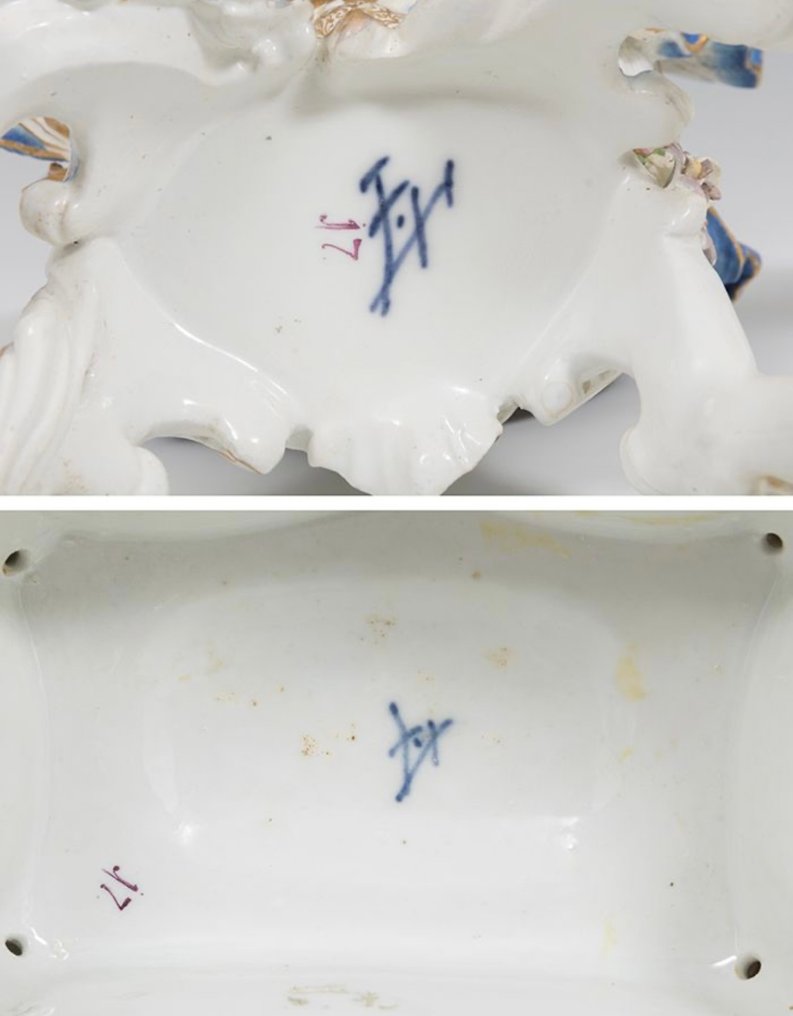
It has markings on the base.
Measurements: 45.4 x 24.5 x 16.5 cm.
An 18th-century mantel clock. The case, molded in a shell shape and rimmed in blue and gold, is ornamented with gilt scrolls topped with trailing, applied flowers. The sides are decorated with openwork panels of gilt latticework, resting on four scroll-shaped feet flanked by reeds and applied flowers. The base, similarly decorated on four scroll-shaped feet, has a molded cartouche painted with flowers on the front and gilt floral panels on the sides and back. The upper section is molded with an elaborate gilt foliate scroll. The enameled dial features black Arabic numerals and blue Roman numerals.
The model appears in Kaendler's work records of July 1766 as a commission for the Chevalier de Saxe, in which he notes that it was modeled with great difficulty from a gilt bronze example. Johann Georg, Chevalier de Saxe (1704–1704), was the illegitimate son of Augustus the Strong and Queen Lubomirska. Another example of this rare clock case and stand model was in the Hermann Emden collection, Hamburg, sold by Rudolph Lepke's Kunst-Auctions-Haus, Berlin, November 3–7, 1908, lot 600.
#ChristmasDinner
Two-part mantel clock; Meissen, c. 1770. Made by J.J. Kandler
Enameled and glazed porcelain.
It has machinery from a later period.
It has minor flaws and repainting.
It has markings on the base.
Measurements: 45.4 x 24.5 x 16.5 cm.
An 18th-century mantel clock. The case, molded in a shell shape and rimmed in blue and gold, is ornamented with gilt scrolls topped with trailing, applied flowers. The sides are decorated with openwork panels of gilt latticework, resting on four scroll-shaped feet flanked by reeds and applied flowers. The base, similarly decorated on four scroll-shaped feet, has a molded cartouche painted with flowers on the front and gilt floral panels on the sides and back. The upper section is molded with an elaborate gilt foliate scroll. The enameled dial features black Arabic numerals and blue Roman numerals.
The model appears in Kaendler's work records of July 1766 as a commission for the Chevalier de Saxe, in which he notes that it was modeled with great difficulty from a gilt bronze example. Johann Georg, Chevalier de Saxe (1704–1704), was the illegitimate son of Augustus the Strong and Queen Lubomirska. Another example of this rare clock case and stand model was in the Hermann Emden collection, Hamburg, sold by Rudolph Lepke's Kunst-Auctions-Haus, Berlin, November 3–7, 1908, lot 600.
#ChristmasDinner
Details
Era
1400-1900
Manufacturer/ Brand
Meissen
Material
Porcelain
Country of Origin
Germany
Height
45.4 cm
Width
24.5 cm
Depth
16.5 cm
Estimated period
1750-1800
Sold by