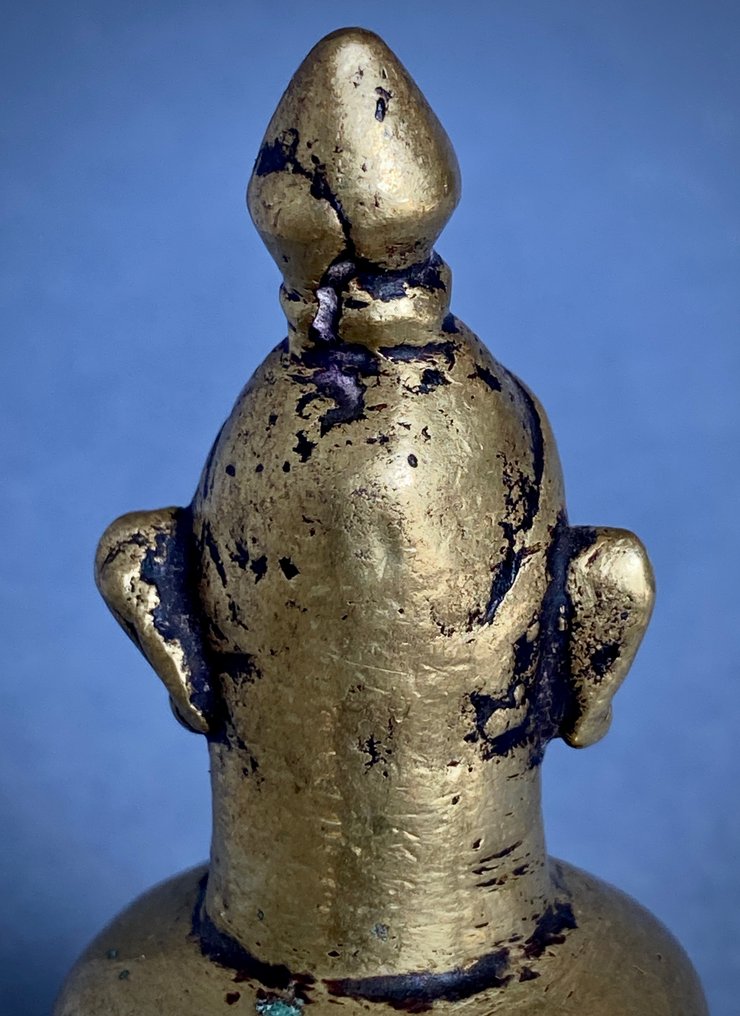
Depicting the face of Śiva, a śaivite cult object, India, 17th - 19th century - Lost wax bronze casting - India - Maratha Empire (1674-1818)

00
days
19
hours
06
minutes
15
seconds
Current bid
€ 10
No reserve price

Surya Rutten
Expert
Selected by Surya Rutten

Has over 25 years' experience in Asian art and owned an art gallery.

Estimate  € 200 - € 300
29 other people are watching this object

itBidder 3369 €10
esBidder 5258 €7
itBidder 3369 €6

Catawiki Buyer Protection

Your payment’s safe with us until you receive your object.View details

Trustpilot 4.4 | 122529 reviews

Rated Excellent on Trustpilot.
Mukhaliṅga depicting the face of Śiva, a Shaivite cult object from India, dating to the Maratha Empire period (1674–1818), cast in lost-wax bronze, height 8.5 cm, in good condition.

AI-assisted summary

Description from the seller

Bronze Mukhaliṅga depicting the face of Śiva, a śaivite cult object made using lost wax casting.

This bronze depicts a mukhaliṅga, that is, a small liṅga topped with the face of Śiva, intended for ritual worship within a Śaivite sanctuary. The truncated conical shape of the base, hollow inside, alludes to the aniconic liṅga, while the upper part, modeled as a bust with a head and a conical headdress culminating in a pointed apex, represents the anthropomorphic aspect of the deity. The full and simplified face, the barely suggested closed eyes, the prominent nose, and the protruding ears, along with traces of dark pigment in the engravings, point to a popular handcrafted tradition from peninsular India (Deccan or South India), where metal mukhaliṅga are documented from the medieval period. The lost-wax casting technique, evident in the internal cavity and the slightly irregular surface, combined with the patina of use and consistent wear, suggests a plausible dating between the 17th and 18th centuries.

Bronze Mukhaliṅga depicting the face of Śiva, a śaivite cult object made using lost wax casting.

This bronze depicts a mukhaliṅga, that is, a small liṅga topped with the face of Śiva, intended for ritual worship within a Śaivite sanctuary. The truncated conical shape of the base, hollow inside, alludes to the aniconic liṅga, while the upper part, modeled as a bust with a head and a conical headdress culminating in a pointed apex, represents the anthropomorphic aspect of the deity. The full and simplified face, the barely suggested closed eyes, the prominent nose, and the protruding ears, along with traces of dark pigment in the engravings, point to a popular handcrafted tradition from peninsular India (Deccan or South India), where metal mukhaliṅga are documented from the medieval period. The lost-wax casting technique, evident in the internal cavity and the slightly irregular surface, combined with the patina of use and consistent wear, suggests a plausible dating between the 17th and 18th centuries.

Details

Dynastic Style/Period
Maratha Empire (1674-1818)
No. of items
1
Country of Origin
India
Attribution
Original
Material
Lost wax bronze casting
Height
8.5 cm
Width
0 cm
Title of artwork
Depicting the face of Śiva, a śaivite cult object, India, 17th - 19th century
Depth
0 cm
Condition
Good condition
ItalyVerified
63
Objects sold
100%
Private

Similar objects

For you in

Indian & Islamic Art