Andrew Thorndike, Annelie Thorndike - Jeder Tag war schön ("THE MOST BEAUTIFUL PHOTOBOOK FROM THE DDR/GDR") - 1966



11
days
06
hours
37
minutes
29
seconds
Current bid
€ 3
No reserve price

Expert
Selected by Sebastian Hau
Founded and directed two French book fairs; nearly 20 years of experience in contemporary books.
Estimate € 380 - € 450
19 other people are watching this object
 Bidder 7475 Bidder 7475 | €3 | |
|---|---|---|
 Bidder 7445 Bidder 7445 | €2 | |
| Bidder 7475 | €1 |
Catawiki Buyer Protection
Your payment’s safe with us until you receive your object.View details
Trustpilot 4.4 | 123113 reviews
Rated Excellent on Trustpilot.
Description from the seller
QUITE POSSIBLY THE MOST BEAUTIFUL BOOK EVER PRODUCED IN THE GDR/DDR and
- in my opinion - one of the MOST BREATHTAKING PHOTO BOOKS EVER CREATED ANYWHERE IN THE WORLD.
IF YOU EVER NEEDED PROOF OF WHAT A PHOTOBOOK CAN BE — it's full creative potential in layout, sequencing, photography, materials (paper, binding etc.), and typography -
THIS BOOK IS THAT PROOF.
ORIGINAL JUTE (BURLAP) BINDING, INSIDE AND OUTSIDE HANDMADE WITH LOVE.
DESIGNED WITH SUCH INDIVIDUALITY THAT IT FEELS LIKE A TRUE ONE-OF-A-KIND PIECE.
VERY FRESH CONDITION AND COMPLETE WITH ALL ELEMENTS (12 integrated inserts).
AN ABSOLUTE ESSENTIAL FOR THE COLLECTION OF ANY PASSIONATE PHOTOBOOK LOVER.
MY HIGHEST RECOMMENDATION.
THIS IS THE VERY FIRST PHOTOBOOK AUCTION ON CATAWIKI - dedicated entirely to the world of the former "DDR"/"GDR" ("GERMAN DEMOCRATIC REPUBLIC" or "EAST GERMANY") which existed from 1949 to 1990.
Still largely undiscovered and unexplored, this field offers a wealth of fascinating discoveries for collectors.
5Uhr30.com presents exceptional works by renowned and emerging artists, survey works, compelling monographs, as well as extraordinarily rare small vintage catalogues, vintage children’s books and vintage factory photobooks; signed publications, posters, and much more.
"Jeder Tag war schön" ("Every Day was beautiful") -
a lavishly and lovingly designed East German travel book (about a journey between Antwerp and Bombay).
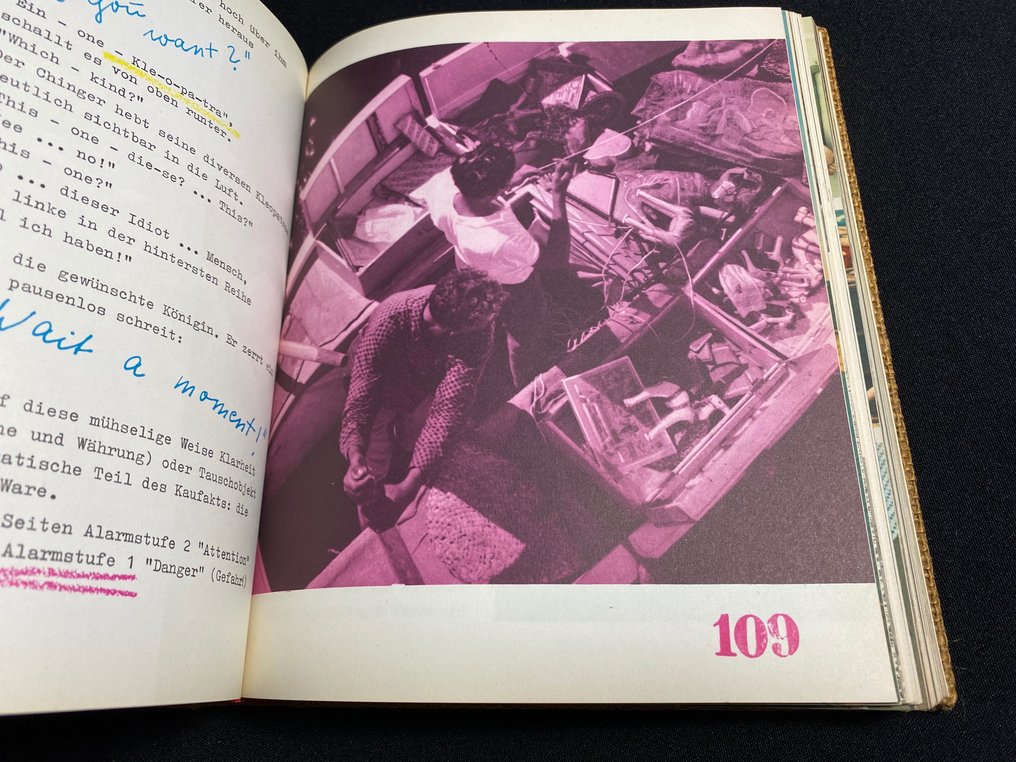
With numerous mounted (pasted) supplements, facsimile (travel) letters -
various typography, various colors.
Wonderful, breath-taking book - printed like a handwritten diary.
Great text by Annelie Thorndike, wonderful photos by Andrew Thorndike,
sensational layout by Heinz Bormann.
Subtitle:
"Erlebnisse, Träume, Geständnisse notiert zwischen Antwerpen und Bombay."
("Experiences, dreams, confessions noted between Antwerp and Bombay.")
"Annelie Thorndike was elected to the Volkskammer in 1963. From 1967 she was a member of the board and from 1980 a member of the presidium of the Association of Film and Television Workers of the GDR, founded by Andrew Thorndike. From 1973 to 1989 she was president of the committee of the International Leipzig Week for Documentary and Short Film, which was responsible for organising the Leipzig Dokfilmwoche."
(Wikipedia)
Like always we guarantee detailed and accurate descriptions, 100% transport protection, 100% transport insurance, and of course, combined shipping - worldwide.
MAKE SURE YOU DON'T MISS THIS UNIQUE CHANCE!
Brought to you exclusively by 5Uhr30.com, Cologne, Germany.
VEB Hinstorff Verlag, Rostock. 1966. First edition, first printing.
Hardcover in linen (stencil printed original jute binding, at that time supplied by Jutespinnerei und -Weberei Meißen). 200 x 240 mm. 312 pages. Photos in color and in black and white. Photos: Andrew Thorndike. Layout: Heinz Bormann. Other contributor: Edith Wäscher. Text: Annelie Thorndike. Text in German.
Condition:
Inside excellent, fresh and flawless, clean with no marks and with no foxing; complete. Outside light trace of use; spine sunned. Overall very fine condition.
Wonderful east-german photobook, in form of an original travel diary with drawings, facsimiles and sketches - my highest recommendation.
"Who today even recalls the names of the documentary filmmakers Annelie and Andrew Thorndike? In West Germany—where their works were seldom shown, partly due to political timidity and narrow-mindedness, partly because of a lack of audience interest—probably almost no one; and in East Germany, presumably only the older generation (who indeed made up the majority at the opening of the exhibition at the Potsdam Film Museum). The Thorndikes’ films—skillful compilations, to be sure—confirmed some viewers in their convictions, while provoking others to contradiction. As Elke Schieber, head of the Potsdam collection, remarked, the films polarized; at the same time, they shaped the historical consciousness of millions in the former GDR.
Praise of their own country, attacks on the Western world, and, not least, a partisan interpretation of history were the filmmakers’ themes; they appeared mostly as writers, more rarely as directors. Reconstruction optimism at East German shipyards is contrasted with stagnation in the West (“From Hamburg to Stralsund,” 1950); an SS leader in the West is exposed (“Vacation on Sylt,” 1957); General Speidel is attacked (“Operation Teutonic Sword,” 1957/58); fifty years of German history are surveyed (“You and Some Comrades,” 1954–56); a paean to the Soviet Union is sung (“The Russian Miracle,” 1959–63); and figures such as Wilhelm Pieck (1951/52), Lenin (1970), and others are portrayed.
The Thorndikes undoubtedly found interesting material, and they had to make skillful use of images as well; yet the images were always forced to subordinate themselves—in selection and editing—to the argument, to serve as proof of theses. Thus, no doubt could ever arise; what was presented was ultimately fixed and predetermined, while everything that did not fit the picture was set aside (such as the German-Soviet Non-Aggression Pact of 1939 in the film about the USSR). Certainly, everything the Thorndikes presented consisted of documents, but the images and words were selected in the spirit and service of a state, for its benefit and glory. This inevitably raises the question of the value of the documentary form, especially when the state itself is both client and censor. How different, by contrast, were the documentary works of Jürgen Böttcher, Winfried Junge, or Volker Koepp—or even those that once came from Poland and Czechoslovakia!
All the same, Andrew and Annelie Thorndike are witnesses to and products of DEFA’s documentary-film production, and as such they deserve attention in historical reflection. The Potsdam Film Museum is dedicating a small exhibition to them, offering insight into their work: production stills, working materials, documents (including those from a legal dispute over the Speidel film), a letter from Brecht declining to collaborate (on the grounds that he could serve only theatre or film), letters, posters, manuscripts (Annelie Thorndike planned a film about Frederick the Great), medals. The work and lives of Andrew (1909–1970) and Annelie Thorndike come alive—also, in a sense, as part of the legacy of the GDR. What is missing is an examination of the possibilities and limits of the documentary film."
- Volker Baer (filmdienst 12/2002) -
Seller's Story
welcome to 5h30.
5Uhr30 is based in ehrenfeld, the trendiest neighborhood in cologne - with a shop and with a showroom for photography.
5H30 offers very rare, very beautiful, very special photobooks - sold-out, modern-antiquarian and antiquarian. we are also offering photo invitation cards, film and photo posters, photo catalogs and original photo prints.
5Uhr30 is specialized on german photo publications,
but also has an exciting range of photo books from all over europe, japan, north and south america. travel brochures, children's books, company brochures...everything that has to do with photography in the narrower or broader sense inspires us. please visit us if you are in cologne or the surrounding area. You will not regret it! :)
5:30 am always tries to offer the best condition.
5h30 is shipping worldwide, fast and safe -
with 100% protection, with full insurance and with tracking number.
please contact us by email, if you have any questions or if you are looking for something special, cause only a part of our offers are online.
Thanks for your interest.
ecki heuser and team
Translated by Google TranslateQUITE POSSIBLY THE MOST BEAUTIFUL BOOK EVER PRODUCED IN THE GDR/DDR and
- in my opinion - one of the MOST BREATHTAKING PHOTO BOOKS EVER CREATED ANYWHERE IN THE WORLD.
IF YOU EVER NEEDED PROOF OF WHAT A PHOTOBOOK CAN BE — it's full creative potential in layout, sequencing, photography, materials (paper, binding etc.), and typography -
THIS BOOK IS THAT PROOF.
ORIGINAL JUTE (BURLAP) BINDING, INSIDE AND OUTSIDE HANDMADE WITH LOVE.
DESIGNED WITH SUCH INDIVIDUALITY THAT IT FEELS LIKE A TRUE ONE-OF-A-KIND PIECE.
VERY FRESH CONDITION AND COMPLETE WITH ALL ELEMENTS (12 integrated inserts).
AN ABSOLUTE ESSENTIAL FOR THE COLLECTION OF ANY PASSIONATE PHOTOBOOK LOVER.
MY HIGHEST RECOMMENDATION.
THIS IS THE VERY FIRST PHOTOBOOK AUCTION ON CATAWIKI - dedicated entirely to the world of the former "DDR"/"GDR" ("GERMAN DEMOCRATIC REPUBLIC" or "EAST GERMANY") which existed from 1949 to 1990.
Still largely undiscovered and unexplored, this field offers a wealth of fascinating discoveries for collectors.
5Uhr30.com presents exceptional works by renowned and emerging artists, survey works, compelling monographs, as well as extraordinarily rare small vintage catalogues, vintage children’s books and vintage factory photobooks; signed publications, posters, and much more.
"Jeder Tag war schön" ("Every Day was beautiful") -
a lavishly and lovingly designed East German travel book (about a journey between Antwerp and Bombay).
With numerous mounted (pasted) supplements, facsimile (travel) letters -
various typography, various colors.
Wonderful, breath-taking book - printed like a handwritten diary.
Great text by Annelie Thorndike, wonderful photos by Andrew Thorndike,
sensational layout by Heinz Bormann.
Subtitle:
"Erlebnisse, Träume, Geständnisse notiert zwischen Antwerpen und Bombay."
("Experiences, dreams, confessions noted between Antwerp and Bombay.")
"Annelie Thorndike was elected to the Volkskammer in 1963. From 1967 she was a member of the board and from 1980 a member of the presidium of the Association of Film and Television Workers of the GDR, founded by Andrew Thorndike. From 1973 to 1989 she was president of the committee of the International Leipzig Week for Documentary and Short Film, which was responsible for organising the Leipzig Dokfilmwoche."
(Wikipedia)
Like always we guarantee detailed and accurate descriptions, 100% transport protection, 100% transport insurance, and of course, combined shipping - worldwide.
MAKE SURE YOU DON'T MISS THIS UNIQUE CHANCE!
Brought to you exclusively by 5Uhr30.com, Cologne, Germany.
VEB Hinstorff Verlag, Rostock. 1966. First edition, first printing.
Hardcover in linen (stencil printed original jute binding, at that time supplied by Jutespinnerei und -Weberei Meißen). 200 x 240 mm. 312 pages. Photos in color and in black and white. Photos: Andrew Thorndike. Layout: Heinz Bormann. Other contributor: Edith Wäscher. Text: Annelie Thorndike. Text in German.
Condition:
Inside excellent, fresh and flawless, clean with no marks and with no foxing; complete. Outside light trace of use; spine sunned. Overall very fine condition.
Wonderful east-german photobook, in form of an original travel diary with drawings, facsimiles and sketches - my highest recommendation.
"Who today even recalls the names of the documentary filmmakers Annelie and Andrew Thorndike? In West Germany—where their works were seldom shown, partly due to political timidity and narrow-mindedness, partly because of a lack of audience interest—probably almost no one; and in East Germany, presumably only the older generation (who indeed made up the majority at the opening of the exhibition at the Potsdam Film Museum). The Thorndikes’ films—skillful compilations, to be sure—confirmed some viewers in their convictions, while provoking others to contradiction. As Elke Schieber, head of the Potsdam collection, remarked, the films polarized; at the same time, they shaped the historical consciousness of millions in the former GDR.
Praise of their own country, attacks on the Western world, and, not least, a partisan interpretation of history were the filmmakers’ themes; they appeared mostly as writers, more rarely as directors. Reconstruction optimism at East German shipyards is contrasted with stagnation in the West (“From Hamburg to Stralsund,” 1950); an SS leader in the West is exposed (“Vacation on Sylt,” 1957); General Speidel is attacked (“Operation Teutonic Sword,” 1957/58); fifty years of German history are surveyed (“You and Some Comrades,” 1954–56); a paean to the Soviet Union is sung (“The Russian Miracle,” 1959–63); and figures such as Wilhelm Pieck (1951/52), Lenin (1970), and others are portrayed.
The Thorndikes undoubtedly found interesting material, and they had to make skillful use of images as well; yet the images were always forced to subordinate themselves—in selection and editing—to the argument, to serve as proof of theses. Thus, no doubt could ever arise; what was presented was ultimately fixed and predetermined, while everything that did not fit the picture was set aside (such as the German-Soviet Non-Aggression Pact of 1939 in the film about the USSR). Certainly, everything the Thorndikes presented consisted of documents, but the images and words were selected in the spirit and service of a state, for its benefit and glory. This inevitably raises the question of the value of the documentary form, especially when the state itself is both client and censor. How different, by contrast, were the documentary works of Jürgen Böttcher, Winfried Junge, or Volker Koepp—or even those that once came from Poland and Czechoslovakia!
All the same, Andrew and Annelie Thorndike are witnesses to and products of DEFA’s documentary-film production, and as such they deserve attention in historical reflection. The Potsdam Film Museum is dedicating a small exhibition to them, offering insight into their work: production stills, working materials, documents (including those from a legal dispute over the Speidel film), a letter from Brecht declining to collaborate (on the grounds that he could serve only theatre or film), letters, posters, manuscripts (Annelie Thorndike planned a film about Frederick the Great), medals. The work and lives of Andrew (1909–1970) and Annelie Thorndike come alive—also, in a sense, as part of the legacy of the GDR. What is missing is an examination of the possibilities and limits of the documentary film."
- Volker Baer (filmdienst 12/2002) -
Seller's Story
welcome to 5h30.
5Uhr30 is based in ehrenfeld, the trendiest neighborhood in cologne - with a shop and with a showroom for photography.
5H30 offers very rare, very beautiful, very special photobooks - sold-out, modern-antiquarian and antiquarian. we are also offering photo invitation cards, film and photo posters, photo catalogs and original photo prints.
5Uhr30 is specialized on german photo publications,
but also has an exciting range of photo books from all over europe, japan, north and south america. travel brochures, children's books, company brochures...everything that has to do with photography in the narrower or broader sense inspires us. please visit us if you are in cologne or the surrounding area. You will not regret it! :)
5:30 am always tries to offer the best condition.
5h30 is shipping worldwide, fast and safe -
with 100% protection, with full insurance and with tracking number.
please contact us by email, if you have any questions or if you are looking for something special, cause only a part of our offers are online.
Thanks for your interest.
ecki heuser and team
Translated by Google TranslateDetails
Number of Books
1
Subject
Art, Photography
Book Title
Jeder Tag war schön ("THE MOST BEAUTIFUL PHOTOBOOK FROM THE DDR/GDR")
Author/ Illustrator
Andrew Thorndike, Annelie Thorndike
Condition
Fine
Publication year oldest item
1966
Height
240 mm
Edition
1st Edition
Width
200 mm
Language
German
Original language
Yes
Publisher
VEB Hinstorff Verlag, Rostock
Binding/ Material
Hardback
Number of pages
312
Sold by
GermanyVerified
protop
Rechtliche Informationen des Verkäufers
- Unternehmen:
- 5Uhr30.com
- Repräsentant:
- Ecki Heuser
- Adresse:
- 5Uhr30.com
Thebäerstr. 34
50823 Köln
GERMANY - Telefonnummer:
- +491728184000
- Email:
- photobooks@5Uhr30.com
- USt-IdNr.:
- DE154811593
AGB
AGB des Verkäufers. Mit einem Gebot auf dieses Los akzeptieren Sie ebenfalls die AGB des Verkäufers.
Widerrufsbelehrung
- Frist: 14 Tage sowie gemäß den hier angegebenen Bedingungen
- Rücksendkosten: Käufer trägt die unmittelbaren Kosten der Rücksendung der Ware
- Vollständige Widerrufsbelehrung