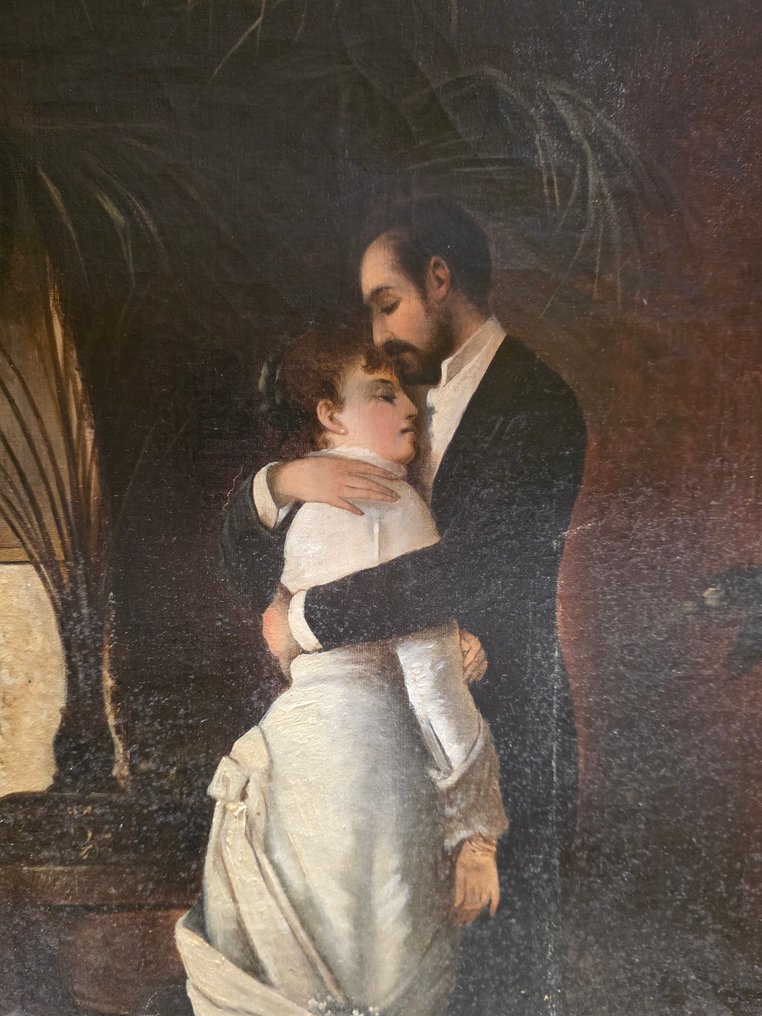
Edoardo Tofano (1838-1920), Seguace - Ritratto di Amanti



02
days
07
hours
10
minutes
09
seconds
Current bid
€ 154
Reserve price not met

Expert
Selected by Caroline Bokobza
Graduated as French auctioneer and worked in Sotheby’s Paris valuation department.
Estimate € 600 - € 800
20 other people are watching this object
 Bidder 7277 Bidder 7277 | €154 | |
|---|---|---|
| Bidder 0963 | €100 | |
| Bidder 7277 | €95 |
Catawiki Buyer Protection
Your payment’s safe with us until you receive your object.View details
Trustpilot 4.4 | 122053 reviews
Rated Excellent on Trustpilot.
Description from the seller
Beautiful oil painting with generous size, only painting, 66x41x6cm.
With Cornice 79x54x6cm
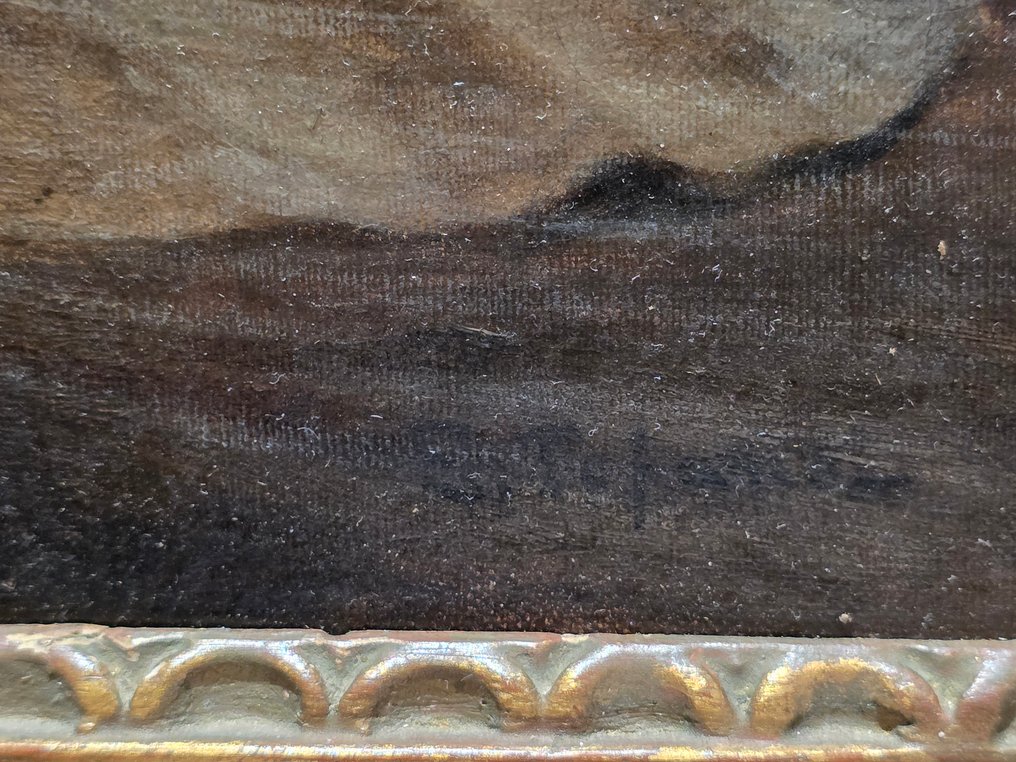
The painting reproduces a cherished theme and repeatedly addressed by the Neapolitan painter Edoardo Tofano (1838-1920) and bears traces of a signature.
Edoardo Tofano
Edoardo Tofano (Naples, 1838-1920) moves from Naples to Turin to attend studies at the Albertina Academy. His subsequent training at the Clementina Academy in Bologna and his Napoletan education with Domenico Morelli (https://www.valutazionearte.it/artisti/domenico-morelli/) (1826-1901) are not yet confirmed.
It is certain that already in 1861, Edoardo Dalbono (https://www.valutazionearte.it/artisti/eduardo-dalbono/X1841-1915), director of the Institute of Fine Arts of Naples, appointed him as a professor. He held the position until 1864, when he decided to dedicate himself entirely to painting.
He debuted in the sixties at the Promotrice di Napoli with a history subject. He continued for several years with paintings of this type, wrapped in an intimate and romantic atmosphere and characterized by remarkable refinement.
Domenico Morelli and Gioacchino Toma (https://www.valutazionearte.it/artisti/gioacchino-toma/) (1836-1891), the former from a historical-veristic perspective and the latter from a sentimental perspective, are the two artists who most influence him during this period.
The contract with Goupil
In 1875, Edoardo Tofano took a trip to Paris that marked a turning point in his career: he met the art dealer Adolphe Goupil, with whom he signed a contract in 1880. From that moment on, he dedicated himself entirely to genre subjects related to bourgeois life of the late 19th century.
Elegant and once again highly refined representations of social pursuits accompany a series of oriental-style watercolors. Continuing to paint and actively participating in the Promotrici and various national and international exhibitions, she achieves remarkable market success.
In 1910, he moved to Rome, where he decided to spend his last years, never ceasing to dedicate himself to painting. He died in the capital in 1920.
The beginnings: history painting
Initially, Edoardo Tofano, mainly influenced by Domenico Morelli, dedicated himself to history painting. At the Neapolitan Promoter in 1863, he exhibited The Capitulation of the Neapolitan Republicans, Emma Liona, Lord Nelson. The painting is truly original: it depicts a historical scene merely by evoking it with the title.
The empty room of a ship is framed, with elegant upholstery; the armchair holds some clothes, and there are sheets of paper on the floor. On the desk, a lit candle. Elsewhere, not visible to the viewer, the meeting between Emma Liona and Horatio Nelson is taking place.
The painting is then followed by other historical subjects, but already filtered through a sentimental bourgeois reading. In fact, at the 1864 Promoter exhibition, it displayed La Monaca, a portrait of Maria Spinelli, the woman loved by the musician Pergolesi, forced into monastic life by her brothers.
In 1867, Edoardo Tofano exhibited Gulnara, while in 1870, already moving away from the historical genre, he presented in Parma Memories of Childhood, Contrariety, and A Nun in the Choir. A certain attention to themes of bourgeois daily life, set in the social salons of late 19th-century Naples, is already evident.
It was also in the early 1870s that, following Morelli's example, he created some paintings with Orientalist themes. In 1872 in Milan, he exhibited the watercolor Testa di turco, and in Naples, Babà Mustafà. However, the complete abandonment of historical subjects would only occur after his trip to Paris in the mid-1870s.
Edoardo Tofano: genre subjects of bourgeois-themed settings
Settling in Paris for Edoardo Tofano means continuing along the path of genre painting that he had already undertaken in Naples.
Become a skilled interpreter of scenes related to late 19th-century bourgeois salon settings. Portraits of women and young girls richly dressed and captured in absorbed or frivolously carefree attitudes are his specialty.
In 1880, like many fashionable artists, he signed a contract with Goupil, supporting him in creating pleasant, delicate, and captivating watercolors.
In Naples in 1875, Sol, B-flat, E-flat, F-sharp, B-flat, C - Madam, the carriage is ready. And again, one of the many, Chinoiseries - Neapolitan factory, Alone! I believe! Their daughters and mother.
Edoardo Tofano participates multiple times in the Paris salons, presenting works such as Mrs. Margareth A. Ketty P.J. and a series of fashionable portraits with soft colors and dreamy atmospheres.
The tones of pink, white, and light blue prevail in giving brightness to the works. At this stage, watercolor is by far the preferred medium, precisely because it allows for a unique chromatic and expressive freedom. This medium is mainly used in the creation of exotic and oriental subjects.
An example of this is The Favorite of the Sultan of 1877, The Odalisque, and The Eastern Cloister. He continues to paint throughout his career with easily understandable themes such as The Appointment, The Enchantment at Pompeii, Where the Heart Calls, Lady in the Lounge, and the very well-known Woman with a Fan.
Beautiful oil painting with generous size, only painting, 66x41x6cm.
With Cornice 79x54x6cm
The painting reproduces a cherished theme and repeatedly addressed by the Neapolitan painter Edoardo Tofano (1838-1920) and bears traces of a signature.
Edoardo Tofano
Edoardo Tofano (Naples, 1838-1920) moves from Naples to Turin to attend studies at the Albertina Academy. His subsequent training at the Clementina Academy in Bologna and his Napoletan education with Domenico Morelli (https://www.valutazionearte.it/artisti/domenico-morelli/) (1826-1901) are not yet confirmed.
It is certain that already in 1861, Edoardo Dalbono (https://www.valutazionearte.it/artisti/eduardo-dalbono/X1841-1915), director of the Institute of Fine Arts of Naples, appointed him as a professor. He held the position until 1864, when he decided to dedicate himself entirely to painting.
He debuted in the sixties at the Promotrice di Napoli with a history subject. He continued for several years with paintings of this type, wrapped in an intimate and romantic atmosphere and characterized by remarkable refinement.
Domenico Morelli and Gioacchino Toma (https://www.valutazionearte.it/artisti/gioacchino-toma/) (1836-1891), the former from a historical-veristic perspective and the latter from a sentimental perspective, are the two artists who most influence him during this period.
The contract with Goupil
In 1875, Edoardo Tofano took a trip to Paris that marked a turning point in his career: he met the art dealer Adolphe Goupil, with whom he signed a contract in 1880. From that moment on, he dedicated himself entirely to genre subjects related to bourgeois life of the late 19th century.
Elegant and once again highly refined representations of social pursuits accompany a series of oriental-style watercolors. Continuing to paint and actively participating in the Promotrici and various national and international exhibitions, she achieves remarkable market success.
In 1910, he moved to Rome, where he decided to spend his last years, never ceasing to dedicate himself to painting. He died in the capital in 1920.
The beginnings: history painting
Initially, Edoardo Tofano, mainly influenced by Domenico Morelli, dedicated himself to history painting. At the Neapolitan Promoter in 1863, he exhibited The Capitulation of the Neapolitan Republicans, Emma Liona, Lord Nelson. The painting is truly original: it depicts a historical scene merely by evoking it with the title.
The empty room of a ship is framed, with elegant upholstery; the armchair holds some clothes, and there are sheets of paper on the floor. On the desk, a lit candle. Elsewhere, not visible to the viewer, the meeting between Emma Liona and Horatio Nelson is taking place.
The painting is then followed by other historical subjects, but already filtered through a sentimental bourgeois reading. In fact, at the 1864 Promoter exhibition, it displayed La Monaca, a portrait of Maria Spinelli, the woman loved by the musician Pergolesi, forced into monastic life by her brothers.
In 1867, Edoardo Tofano exhibited Gulnara, while in 1870, already moving away from the historical genre, he presented in Parma Memories of Childhood, Contrariety, and A Nun in the Choir. A certain attention to themes of bourgeois daily life, set in the social salons of late 19th-century Naples, is already evident.
It was also in the early 1870s that, following Morelli's example, he created some paintings with Orientalist themes. In 1872 in Milan, he exhibited the watercolor Testa di turco, and in Naples, Babà Mustafà. However, the complete abandonment of historical subjects would only occur after his trip to Paris in the mid-1870s.
Edoardo Tofano: genre subjects of bourgeois-themed settings
Settling in Paris for Edoardo Tofano means continuing along the path of genre painting that he had already undertaken in Naples.
Become a skilled interpreter of scenes related to late 19th-century bourgeois salon settings. Portraits of women and young girls richly dressed and captured in absorbed or frivolously carefree attitudes are his specialty.
In 1880, like many fashionable artists, he signed a contract with Goupil, supporting him in creating pleasant, delicate, and captivating watercolors.
In Naples in 1875, Sol, B-flat, E-flat, F-sharp, B-flat, C - Madam, the carriage is ready. And again, one of the many, Chinoiseries - Neapolitan factory, Alone! I believe! Their daughters and mother.
Edoardo Tofano participates multiple times in the Paris salons, presenting works such as Mrs. Margareth A. Ketty P.J. and a series of fashionable portraits with soft colors and dreamy atmospheres.
The tones of pink, white, and light blue prevail in giving brightness to the works. At this stage, watercolor is by far the preferred medium, precisely because it allows for a unique chromatic and expressive freedom. This medium is mainly used in the creation of exotic and oriental subjects.
An example of this is The Favorite of the Sultan of 1877, The Odalisque, and The Eastern Cloister. He continues to paint throughout his career with easily understandable themes such as The Appointment, The Enchantment at Pompeii, Where the Heart Calls, Lady in the Lounge, and the very well-known Woman with a Fan.
Details
Artist
Edoardo Tofano (1838-1920), Seguace
Sold with frame
Yes
Sold by
Owner or reseller
Edition
Original
Title of artwork
Ritratto di Amanti
Technique
Oil painting
Signature
Hand signed
Country of Origin
Italy
Condition
Fair condition
Height
66 cm
Width
41 cm
Weight
8 kg
Style
Classical
Period
1900-1910
Sold by
