Matthioli - Dioscoride - 1550



Opens 11:00
Starting bid
€ 1
Add to your favourites to get an alert when the auction starts.

Expert
Selected by Ilaria Colombo
Specialist in old books, specialising in theological disputes since 1999.
Estimate € 2,000 - € 3,500
Catawiki Buyer Protection
Your payment’s safe with us until you receive your object.View details
Trustpilot 4.4 | 122290 reviews
Rated Excellent on Trustpilot.
Description from the seller
The Magical Tree in the Secret Garden: The Bible of Renaissance Spices
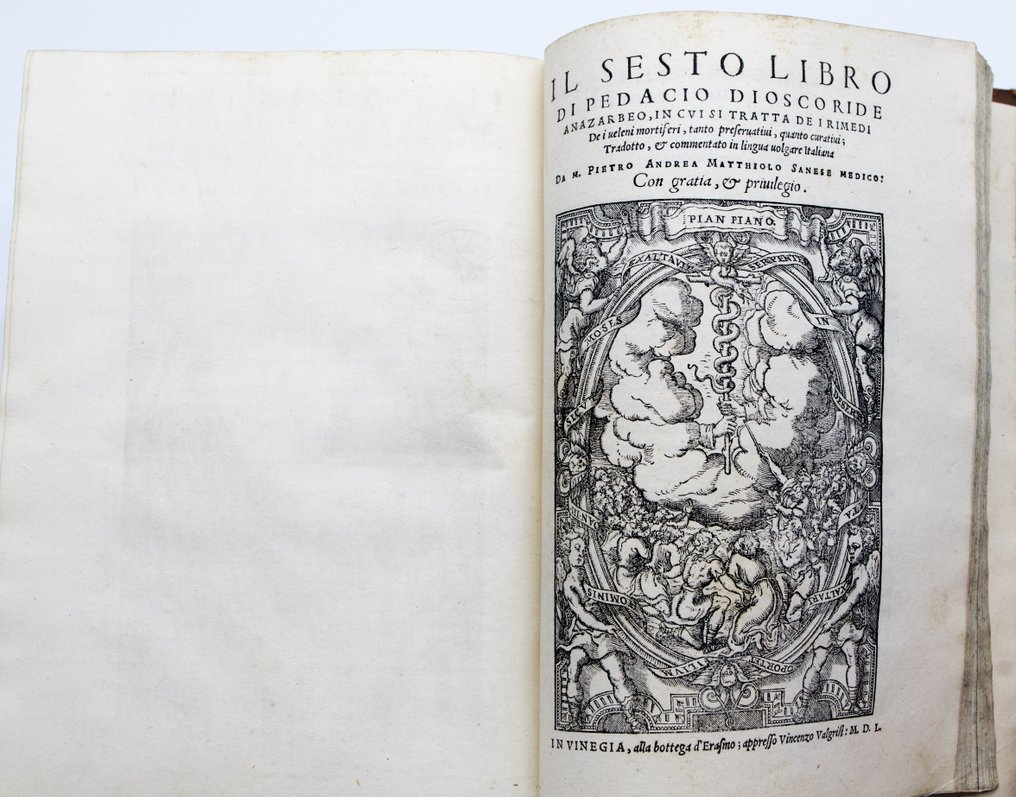
The sixth book, the Antidotary, with its own frontispiece, decorated with a large woodcut illustration: at the top, a head of an angel. Below, the Hebrew people in the desert - motto: Slowly - Sicut Moses exaltavit serpentem in deserto ita exaltari oportet filium hominis Dante III (V498).
This work, one of the most influential in Renaissance botany, originates as a meeting between the ancient pharmacological authority of Dioscoride and the extraordinary scholarly ambition of Pietro Andrea Mattioli, who made it the most widespread medical text of the 16th century. The Venetian edition of 1550, printed by Vincenzo Valgrisi at Erasmo's workshop, stands out for its luminous typographic layout, the elegance of the woodcut initials, and the meticulous editorial arrangement. It encapsulates a worldview in which empirical observation of plants coexists with a symbolic and sometimes occult aura: an ancient heritage reinterpreted in the heart of the Renaissance. For doctors, apothecaries, naturalists, and alchemists, Mattioli was for centuries a gateway to the vast repertoire of nature’s therapeutic and mysterious virtues, shaping their imagination and guiding their practices.
Market value
The market for sixteenth-century copies of Dioscoride by Mattioli is highly variable and depends on preservation, completeness, text integrity, and paper readability. Mid-16th-century Venetian editions generally range from 1,700 to 2,000 euros for copies in average condition; complete, well-preserved copies with bright paper and solid binding can reach 3,500–5,000 euros. Higher prices are associated with particularly rare illustrated copies or those with notable provenance.
Physical description and condition
The sixth book, the Antidotario, with its own frontispiece, adorned with a large woodcut illustration.
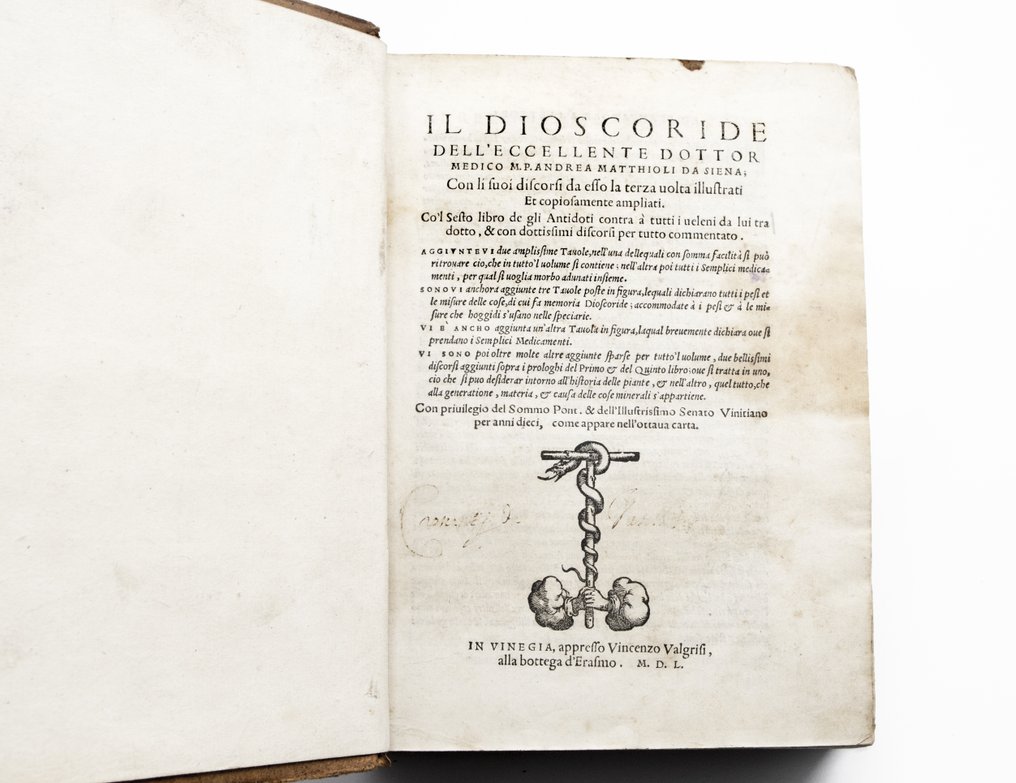
01: alo- a;on l-li stMa (3) 1550 (R) 02: dear heo- o,e- tesp (3) 1550 (R) - Twisted serpent on a staff in the shape of a tau, supported by hands emerging from clouds. (Z1035) - On the front of pt. 1.
Twisted snake on a tau-shaped staff held by hands emerging from clouds (U517) - Finally.
Serpent twisted around a T-shaped staff supported by hands emerging from clouds. At the top, an angel's head. Below, the Jewish people in the desert. Gradually — Sicut Moses exaltavit serpentem in deserto ita exaltari oportet filium hominis Dante III (V498) — on the front of the second part.
Next binding in full leather, back with gilded decorations and a black panel with the title. Signs of wear, a stain on the upper margin of the first pages, reddening. Numerous inhabited woodcut initials. Pp. (2); 132; 818; (2); 130; 14nn; (4). Interesting manuscript (coeval?) at the colophon and on the last page.
Full title and author
The Dioscoride of the excellent doctor of medicine M. P. Andrea Matthioli from Siena; with his discourses, which he illustrated and extensively expanded for the third time. Together with the sixth book of antidotes against all poisons translated by him, and with very learned discourses all commented upon. ... There are also many other additions scattered throughout the volume, including two very beautiful discourses added on the prologues of the first and fifth books.
2: The sixth book of Pedacio Dioscoride Anazarbeo, which deals with remedies for deadly poisons, both preserved and cured; translated and commented on in the Italian vernacular by M. Pietro Andrea Matthiolo, Sienese doctor.
Venice, after Vincenzo Valgrisi, at Erasmo's shop, 1550.
Pietro Andrea Mattioli
Dioscoride Pedanio.
Context and Significance
The text is part of the large humanistic project of recovering ancient natural sciences through a renewed, empirical, and systematic approach. Dioscorides' De materia medica, a cornerstone of Greek pharmacology, is reinterpreted by Mattioli through direct observations, descriptive expansions, and comparisons with the medical practices of his time. The result is a treatise that not only updates the tradition but transforms it: an encyclopedia of natural substances in which Galenic medicine, experimental knowledge, and a symbolic imaginary based on the occult qualities of plants coexist. The Venetian editions by Valgrisi played a decisive role in disseminating the work thanks to their clarity, robust layout, and ability to meet the growing demand for reliable and readable medical texts, becoming essential tools in universities, apothecary workshops, and European alchemical circles.
Biography of the Author
Pietro Andrea Mattioli (Siena, 1501 – Trento, 1578) was a doctor, botanist, and scholar. Trained in Padua, he held positions at various Italian and imperial courts. His scientific work, based on direct observation, earned him a continental reputation. His commentary on De materia medica made Dioscoride accessible to modern readers and transformed the work into the main botanical reference of the 16th century.
Brief biography of Dioscoride
Dioscoride Pedanio (1st century AD), a Greek physician and pharmacologist, is the author of De materia medica, the most influential treatise on pharmacy and botany of antiquity. Used until the modern age, it formed the basis of European therapeutic knowledge for over a millennium and a half.
Printing history and circulation
Dioscoride in the Mattioli edition experienced a remarkable spread in the 16th century, with numerous Venetian editions characterized by variations in the maps, colophons, and the presence of figures. Vincenzo Valgrisi's workshop, active in the first half of the 1500s, became one of the main production centers for Mattioli due to the quality of printing and its ability to reach a broad and specialized audience. The Venetian copies circulated throughout Europe, in universities, courts, apothecaries' workshops, and private libraries, contributing to the development of modern botanical science.
BIBLIOGRAPHY AND REFERENCES
Durling, Richard J., A catalogue of sixteenth-century printed medical books in the National Library of Medicine, Bethesda, 1967 (entry on Mattioli, NLM 16th cent., no. 3024).
Nissen, C., The botanical book illustration. Its history and bibliography, 2 volumes, Stuttgart, 1951–1966 (per Mattioli, no. 1304).
Pritzel, G. A., Thesaurus literaturae botanicae, Leipzig, 1872 (per Mattioli, no. 5987).
Seller's Story
Luxury Books: Your Go-To Guide for Nabbing Literary Treasures!
Embarking on the thrilling journey of collecting rare and timeless printed works? Here's your snappy rundown, "The Collector's Cheat Sheet," to ensure you're not just flipping pages but stacking up the value:
1. Edition and Rarity: Rarity is the name of the game. First editions, limited printings, and books flaunting unique features like eye-catching illustrations or mind-blowing bindings? Consider them the VIPs of the collector's world.
2. Condition & Dimension: Picture this – a book in mint condition, untouched by the woes of wear and tear. Now, flip the script: wear, foxing, discoloration – they're the villains here. And don't forget to size up the dimensions, because a book's size matters in the collector's universe.
3. Authenticity: In a world of replicas and forgeries, verifying a book's authenticity is your superhero move. Expert examination and authentication – your trusty sidekicks in this quest.
4. Provenance: Who owned it before you? If the book has hobnobbed with famous figures or danced through historical events, its value skyrockets. Every book has a story, but some have blockbuster tales.
5. Demand and Market Trends: Think of book values as the stock market of the literary world. Stay savvy on collector trends and market shifts to ride the waves of value.
6. Subject Matter: Some topics are like fine wine – they get better with time. Dive into subjects with a timeless appeal or ride the wave of emerging cultural and historical relevance.
7. Binding and Design: Beauty is more than skin deep. Intricate bindings, stunning covers, and illustrations – these are the accessories that make a book runway-ready in the collector's eyes.
8. Association Copies: Books with a personal touch – whether it's a connection to the author or a famous personality – elevate the historical vibes. A book with a backstory? Count us in.
9. Investment Potential: Passion is the engine, but some collectors eye future returns. Keep in mind, though, that the book market can be as unpredictable as a plot twist.
10. Expert Advice: New to the game? Don't play solo. Seek wisdom from the book gurus, hit up book fairs, and join collector communities. We at Luxury Books are the Yodas of the rare book galaxy, helping you build collections that scream sophistication and cultural clout.
Because collecting rare books isn't just about dollar signs – it's a journey of preserving heritage and embracing literary treasures. Happy collecting!
Translated by Google TranslateThe Magical Tree in the Secret Garden: The Bible of Renaissance Spices
The sixth book, the Antidotary, with its own frontispiece, decorated with a large woodcut illustration: at the top, a head of an angel. Below, the Hebrew people in the desert - motto: Slowly - Sicut Moses exaltavit serpentem in deserto ita exaltari oportet filium hominis Dante III (V498).
This work, one of the most influential in Renaissance botany, originates as a meeting between the ancient pharmacological authority of Dioscoride and the extraordinary scholarly ambition of Pietro Andrea Mattioli, who made it the most widespread medical text of the 16th century. The Venetian edition of 1550, printed by Vincenzo Valgrisi at Erasmo's workshop, stands out for its luminous typographic layout, the elegance of the woodcut initials, and the meticulous editorial arrangement. It encapsulates a worldview in which empirical observation of plants coexists with a symbolic and sometimes occult aura: an ancient heritage reinterpreted in the heart of the Renaissance. For doctors, apothecaries, naturalists, and alchemists, Mattioli was for centuries a gateway to the vast repertoire of nature’s therapeutic and mysterious virtues, shaping their imagination and guiding their practices.
Market value
The market for sixteenth-century copies of Dioscoride by Mattioli is highly variable and depends on preservation, completeness, text integrity, and paper readability. Mid-16th-century Venetian editions generally range from 1,700 to 2,000 euros for copies in average condition; complete, well-preserved copies with bright paper and solid binding can reach 3,500–5,000 euros. Higher prices are associated with particularly rare illustrated copies or those with notable provenance.
Physical description and condition
The sixth book, the Antidotario, with its own frontispiece, adorned with a large woodcut illustration.
01: alo- a;on l-li stMa (3) 1550 (R) 02: dear heo- o,e- tesp (3) 1550 (R) - Twisted serpent on a staff in the shape of a tau, supported by hands emerging from clouds. (Z1035) - On the front of pt. 1.
Twisted snake on a tau-shaped staff held by hands emerging from clouds (U517) - Finally.
Serpent twisted around a T-shaped staff supported by hands emerging from clouds. At the top, an angel's head. Below, the Jewish people in the desert. Gradually — Sicut Moses exaltavit serpentem in deserto ita exaltari oportet filium hominis Dante III (V498) — on the front of the second part.
Next binding in full leather, back with gilded decorations and a black panel with the title. Signs of wear, a stain on the upper margin of the first pages, reddening. Numerous inhabited woodcut initials. Pp. (2); 132; 818; (2); 130; 14nn; (4). Interesting manuscript (coeval?) at the colophon and on the last page.
Full title and author
The Dioscoride of the excellent doctor of medicine M. P. Andrea Matthioli from Siena; with his discourses, which he illustrated and extensively expanded for the third time. Together with the sixth book of antidotes against all poisons translated by him, and with very learned discourses all commented upon. ... There are also many other additions scattered throughout the volume, including two very beautiful discourses added on the prologues of the first and fifth books.
2: The sixth book of Pedacio Dioscoride Anazarbeo, which deals with remedies for deadly poisons, both preserved and cured; translated and commented on in the Italian vernacular by M. Pietro Andrea Matthiolo, Sienese doctor.
Venice, after Vincenzo Valgrisi, at Erasmo's shop, 1550.
Pietro Andrea Mattioli
Dioscoride Pedanio.
Context and Significance
The text is part of the large humanistic project of recovering ancient natural sciences through a renewed, empirical, and systematic approach. Dioscorides' De materia medica, a cornerstone of Greek pharmacology, is reinterpreted by Mattioli through direct observations, descriptive expansions, and comparisons with the medical practices of his time. The result is a treatise that not only updates the tradition but transforms it: an encyclopedia of natural substances in which Galenic medicine, experimental knowledge, and a symbolic imaginary based on the occult qualities of plants coexist. The Venetian editions by Valgrisi played a decisive role in disseminating the work thanks to their clarity, robust layout, and ability to meet the growing demand for reliable and readable medical texts, becoming essential tools in universities, apothecary workshops, and European alchemical circles.
Biography of the Author
Pietro Andrea Mattioli (Siena, 1501 – Trento, 1578) was a doctor, botanist, and scholar. Trained in Padua, he held positions at various Italian and imperial courts. His scientific work, based on direct observation, earned him a continental reputation. His commentary on De materia medica made Dioscoride accessible to modern readers and transformed the work into the main botanical reference of the 16th century.
Brief biography of Dioscoride
Dioscoride Pedanio (1st century AD), a Greek physician and pharmacologist, is the author of De materia medica, the most influential treatise on pharmacy and botany of antiquity. Used until the modern age, it formed the basis of European therapeutic knowledge for over a millennium and a half.
Printing history and circulation
Dioscoride in the Mattioli edition experienced a remarkable spread in the 16th century, with numerous Venetian editions characterized by variations in the maps, colophons, and the presence of figures. Vincenzo Valgrisi's workshop, active in the first half of the 1500s, became one of the main production centers for Mattioli due to the quality of printing and its ability to reach a broad and specialized audience. The Venetian copies circulated throughout Europe, in universities, courts, apothecaries' workshops, and private libraries, contributing to the development of modern botanical science.
BIBLIOGRAPHY AND REFERENCES
Durling, Richard J., A catalogue of sixteenth-century printed medical books in the National Library of Medicine, Bethesda, 1967 (entry on Mattioli, NLM 16th cent., no. 3024).
Nissen, C., The botanical book illustration. Its history and bibliography, 2 volumes, Stuttgart, 1951–1966 (per Mattioli, no. 1304).
Pritzel, G. A., Thesaurus literaturae botanicae, Leipzig, 1872 (per Mattioli, no. 5987).
Seller's Story
Luxury Books: Your Go-To Guide for Nabbing Literary Treasures!
Embarking on the thrilling journey of collecting rare and timeless printed works? Here's your snappy rundown, "The Collector's Cheat Sheet," to ensure you're not just flipping pages but stacking up the value:
1. Edition and Rarity: Rarity is the name of the game. First editions, limited printings, and books flaunting unique features like eye-catching illustrations or mind-blowing bindings? Consider them the VIPs of the collector's world.
2. Condition & Dimension: Picture this – a book in mint condition, untouched by the woes of wear and tear. Now, flip the script: wear, foxing, discoloration – they're the villains here. And don't forget to size up the dimensions, because a book's size matters in the collector's universe.
3. Authenticity: In a world of replicas and forgeries, verifying a book's authenticity is your superhero move. Expert examination and authentication – your trusty sidekicks in this quest.
4. Provenance: Who owned it before you? If the book has hobnobbed with famous figures or danced through historical events, its value skyrockets. Every book has a story, but some have blockbuster tales.
5. Demand and Market Trends: Think of book values as the stock market of the literary world. Stay savvy on collector trends and market shifts to ride the waves of value.
6. Subject Matter: Some topics are like fine wine – they get better with time. Dive into subjects with a timeless appeal or ride the wave of emerging cultural and historical relevance.
7. Binding and Design: Beauty is more than skin deep. Intricate bindings, stunning covers, and illustrations – these are the accessories that make a book runway-ready in the collector's eyes.
8. Association Copies: Books with a personal touch – whether it's a connection to the author or a famous personality – elevate the historical vibes. A book with a backstory? Count us in.
9. Investment Potential: Passion is the engine, but some collectors eye future returns. Keep in mind, though, that the book market can be as unpredictable as a plot twist.
10. Expert Advice: New to the game? Don't play solo. Seek wisdom from the book gurus, hit up book fairs, and join collector communities. We at Luxury Books are the Yodas of the rare book galaxy, helping you build collections that scream sophistication and cultural clout.
Because collecting rare books isn't just about dollar signs – it's a journey of preserving heritage and embracing literary treasures. Happy collecting!
Translated by Google TranslateDetails
Number of Books
1
Subject
Botany
Book Title
Dioscoride
Author/ Illustrator
Matthioli
Condition
Good
Publication year oldest item
1550
Height
235 mm
Edition
1st Edition Thus
Width
179 mm
Language
Italian
Original language
Yes
Publisher
Vinegia, appresso Vincenzo Valgrisi, alla bottega d’Erasmo, 1550
Binding/ Material
Leather
Number of pages
1102
Sold by
