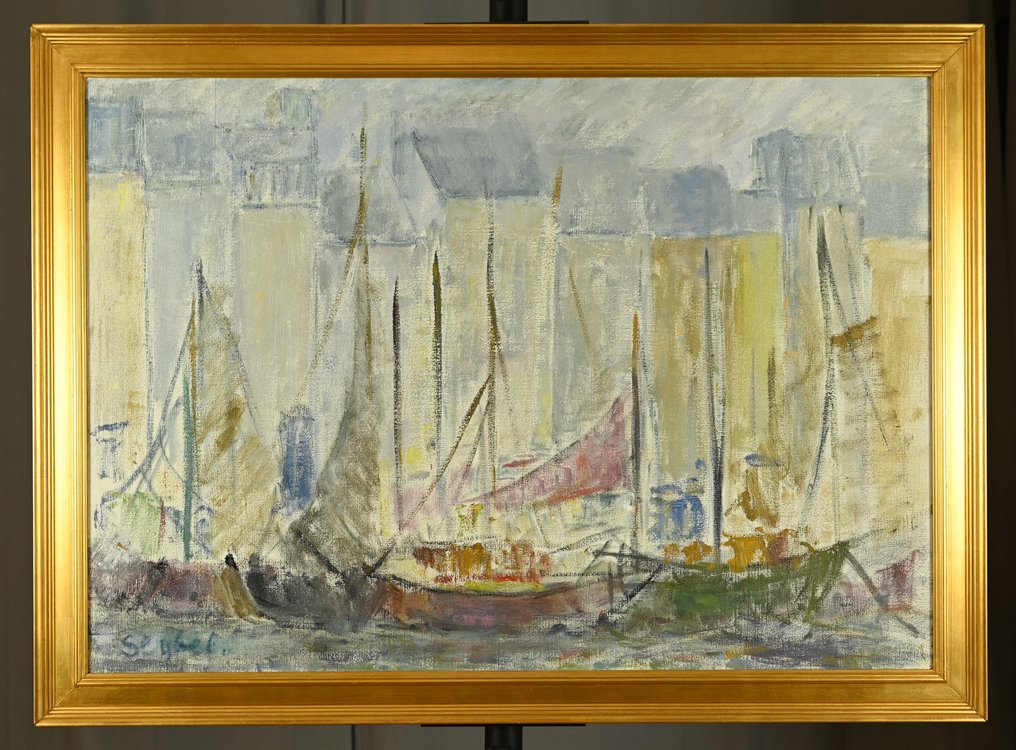
Lyne Seybel (1919-2009) - Tempesta a Honfleur



11
days
20
hours
15
minutes
25
seconds
Current bid
€ 4
Reserve price not met

Expert
Selected by Caterina Maffeis
Master in early Renaissance Italian painting with internship at Sotheby’s and 15 years' experience.
Estimate € 1,800 - € 2,200
16 other people are watching this object
 Bidder 7969 Bidder 7969 | €4 | |
|---|---|---|
 Bidder 4246 Bidder 4246 | €3 | |
 Bidder 4382 Bidder 4382 | €2 | |
Catawiki Buyer Protection
Your payment’s safe with us until you receive your object.View details
Trustpilot 4.4 | 122190 reviews
Rated Excellent on Trustpilot.
Tempesta a Honfleur, an original oil on canvas landscape by Lyne Seybel (1919-2009), created in 1960–1970 in France, sold with a frame.
AI-assisted summary
Description from the seller
Lyne SEYBEL (1919-2009)
Storm in Honfleur
Oil on canvas
Painting size: 65 x 92 cm
Signed at the bottom left.
In perfect condition
Beautiful gold frame free
Dimensions with the frame: 75 x 102 cm.
Provenance
Artist's family
Private collection, Netherlands
Original artwork delivered with invoice and certificate of authenticity.
Fast, careful, and insured shipping.
Buy with confidence!
Lyne SEYBEL (1919-2009)
Her drawing vocation has been present since childhood, using notebooks she always carries with her, capturing the movements of life, colors, the poetry of the moment, and people's humor. It includes 'A Woman Passing by Bicycle,' 'La rue Mouffetard,' 'Children Playing in the Garden,' 'Fishermen Pulling Boats on the Beach,' 'The Black Sweeper,' and 'The Green Boat on the Sea'...
She then attends art classes as a free student at the Beaux-Arts and the École du Louvre, draws a lot from the Antique in the galleries of the Louvre Museum, and explores Paris in all weather with her easel.
During various travels, she meets Pierre BONNARD in Deauville, who shows a great interest in her notebooks and ardently encourages her to continue.
In Cannet, she revisits this great master once again, with whom she has long discussions about the play of light and colors, the expression of his sensitivity, and the resonances of the soul.
She then paints 'La petite fille de lumière', 'Le déjeuner de soleil', 'Lolita au chignon roux', 'Du balcon d’Eze-sur-Mer', 'Les bords de Seine à Bougival', 'Tempête à Honfleur', 'L’église d’Auvers'…
She attends the FROCHOT Academy in Pigalle, where TOULOUSE-LAUTREC also worked; there, she perfects her drawing so that each work in itself becomes a true little painting.
Among the works she created during that time are 'Nude woman on a sofa,' 'The black woman,' 'Alice with the curly bun'...
She works at the Grande Chaumière in Montparnasse, especially in the studio of André LHOTE, where Henri GOETZ offers her support. He understands her views and her personal way of painting, where rich material radiates the inner light of a constructed subject, in colors that are harmoniously pleasing or sometimes bold.
During his stays in Normandy, the mist, pierced by a few rays of sunshine before flooding the landscape, fascinates him. It depicts 'Bateaux à Barfleur', 'Basse mer', 'Bateau vert à Saint-Vaast', 'Brume en Cotentin'...
In Auvergne and more specifically in Cantal, it is the layers of vivid colors that overlap and shape the landscape: 'The mountains', 'Beyond St Urcize', 'The fields', 'Dawn in Auvergne'…
During this period of work, she is encouraged to show herself in the painting salons in Paris. She becomes a member of the French Artists and Independent Artists.
Her works are recognized, and she is sought after to exhibit both in Paris, in the provinces, and abroad. During her various solo exhibitions, she is always deeply moved to see that she conveys a message of joy, happiness, and profound harmony to an audience of all nationalities.
She then increasingly often stays in Venice, where she immerses herself in the mists of light, where pale golds succeed and blend with the pink nacres of dawn. It is not uncommon to see her, early in the morning, with her easel set up, capturing on the canvas the fleeting nuances, the lightness of the air, the diaphanous colors ('Dawn in Venice', 'Light', 'Morning San Giorgio'...). From now on, for some, the small mornings will undoubtedly evoke Lyne's works.
Conversely, the warm and flamboyant tones of Venice sunsets evoke in her an exuberance of colors in an almost theatrical setting ('Venice evening', 'the mauve gondolier', 'a camellia on the lagoon', 'Midnight Carnival', 'Summer evening on the Grand Canal', ...).
In Auvergne, where she will go every year, she dialogues with nature. The fields are for her a source of deep emotions, through the multiplicity, the movement of colors, the transparency of the air, and the musicality of the light. With each step, she perceives an immense song that structures and rises, imbued with tenderness, resonances, and the clarity of the soul. She paints 'Summer Landscape,' 'Fields in Spring,' 'Violet Fields,' 'End of Summer'….
On the Normandy coast, she rediscoveres that gentle musicality of colors, the transparency of the air, and the iridescent light.
Seller's Story
Specialist since 1989 painters of the Ecole Normande - School of Rouen, Art Seine, is an art gallery located in Le Havre where we present works of the 19th, Impressionist and Modern. We scrupulously check the origins of the works and we surround ourselves with all the precautions in use on the art market. We, we are the spokesperson of the seller as the buyer for transactions to be made in the best conditions. Any work sold is accompanied by an invoice and a certificate of authenticity engage our responsibility for a period of 30 years. In collaboration with specialized freight forwarders and carriers we can ensure shipment in France and around the world.
Translated by Google TranslateLyne SEYBEL (1919-2009)
Storm in Honfleur
Oil on canvas
Painting size: 65 x 92 cm
Signed at the bottom left.
In perfect condition
Beautiful gold frame free
Dimensions with the frame: 75 x 102 cm.
Provenance
Artist's family
Private collection, Netherlands
Original artwork delivered with invoice and certificate of authenticity.
Fast, careful, and insured shipping.
Buy with confidence!
Lyne SEYBEL (1919-2009)
Her drawing vocation has been present since childhood, using notebooks she always carries with her, capturing the movements of life, colors, the poetry of the moment, and people's humor. It includes 'A Woman Passing by Bicycle,' 'La rue Mouffetard,' 'Children Playing in the Garden,' 'Fishermen Pulling Boats on the Beach,' 'The Black Sweeper,' and 'The Green Boat on the Sea'...
She then attends art classes as a free student at the Beaux-Arts and the École du Louvre, draws a lot from the Antique in the galleries of the Louvre Museum, and explores Paris in all weather with her easel.
During various travels, she meets Pierre BONNARD in Deauville, who shows a great interest in her notebooks and ardently encourages her to continue.
In Cannet, she revisits this great master once again, with whom she has long discussions about the play of light and colors, the expression of his sensitivity, and the resonances of the soul.
She then paints 'La petite fille de lumière', 'Le déjeuner de soleil', 'Lolita au chignon roux', 'Du balcon d’Eze-sur-Mer', 'Les bords de Seine à Bougival', 'Tempête à Honfleur', 'L’église d’Auvers'…
She attends the FROCHOT Academy in Pigalle, where TOULOUSE-LAUTREC also worked; there, she perfects her drawing so that each work in itself becomes a true little painting.
Among the works she created during that time are 'Nude woman on a sofa,' 'The black woman,' 'Alice with the curly bun'...
She works at the Grande Chaumière in Montparnasse, especially in the studio of André LHOTE, where Henri GOETZ offers her support. He understands her views and her personal way of painting, where rich material radiates the inner light of a constructed subject, in colors that are harmoniously pleasing or sometimes bold.
During his stays in Normandy, the mist, pierced by a few rays of sunshine before flooding the landscape, fascinates him. It depicts 'Bateaux à Barfleur', 'Basse mer', 'Bateau vert à Saint-Vaast', 'Brume en Cotentin'...
In Auvergne and more specifically in Cantal, it is the layers of vivid colors that overlap and shape the landscape: 'The mountains', 'Beyond St Urcize', 'The fields', 'Dawn in Auvergne'…
During this period of work, she is encouraged to show herself in the painting salons in Paris. She becomes a member of the French Artists and Independent Artists.
Her works are recognized, and she is sought after to exhibit both in Paris, in the provinces, and abroad. During her various solo exhibitions, she is always deeply moved to see that she conveys a message of joy, happiness, and profound harmony to an audience of all nationalities.
She then increasingly often stays in Venice, where she immerses herself in the mists of light, where pale golds succeed and blend with the pink nacres of dawn. It is not uncommon to see her, early in the morning, with her easel set up, capturing on the canvas the fleeting nuances, the lightness of the air, the diaphanous colors ('Dawn in Venice', 'Light', 'Morning San Giorgio'...). From now on, for some, the small mornings will undoubtedly evoke Lyne's works.
Conversely, the warm and flamboyant tones of Venice sunsets evoke in her an exuberance of colors in an almost theatrical setting ('Venice evening', 'the mauve gondolier', 'a camellia on the lagoon', 'Midnight Carnival', 'Summer evening on the Grand Canal', ...).
In Auvergne, where she will go every year, she dialogues with nature. The fields are for her a source of deep emotions, through the multiplicity, the movement of colors, the transparency of the air, and the musicality of the light. With each step, she perceives an immense song that structures and rises, imbued with tenderness, resonances, and the clarity of the soul. She paints 'Summer Landscape,' 'Fields in Spring,' 'Violet Fields,' 'End of Summer'….
On the Normandy coast, she rediscoveres that gentle musicality of colors, the transparency of the air, and the iridescent light.
Seller's Story
Specialist since 1989 painters of the Ecole Normande - School of Rouen, Art Seine, is an art gallery located in Le Havre where we present works of the 19th, Impressionist and Modern. We scrupulously check the origins of the works and we surround ourselves with all the precautions in use on the art market. We, we are the spokesperson of the seller as the buyer for transactions to be made in the best conditions. Any work sold is accompanied by an invoice and a certificate of authenticity engage our responsibility for a period of 30 years. In collaboration with specialized freight forwarders and carriers we can ensure shipment in France and around the world.
Translated by Google TranslateDetails
Artist
Lyne Seybel (1919-2009)
Sold with frame
Yes
Sold by
Gallery
Edition
Original
Title of artwork
Tempesta a Honfleur
Technique
Oil painting
Signature
Hand signed
Country of Origin
France
Condition
Excellent condition
Height
75 cm
Width
102 cm
Depiction/Theme
Landscape
Style
Post-Impressionism
Period
1960-1970
Sold by
