C. Giulio Cesare; Francesco Baldelli - (GEOGRAPHY and TECHNOLOGY) I commentari di C. Giulio Cesare da M. Francesco Baldelli - 1554



Opens 11:00
Starting bid
€ 1
Add to your favourites to get an alert when the auction starts.

Expert
Selected by Volker Riepenhausen
Specialist in travel literature and pre-1600 rare prints with 28 years experience.
Estimate € 650 - € 800
Catawiki Buyer Protection
Your payment’s safe with us until you receive your object.View details
Trustpilot 4.4 | 121798 reviews
Rated Excellent on Trustpilot.
Description from the seller
Elegitur presents: Commentaries by Julius Caesar, translated by M. Francesco Baldelli
Venice, Gabriele Giolito de’ Ferrari and Brothers, 1554
With figures and tables; with privilege
Bibliographic description
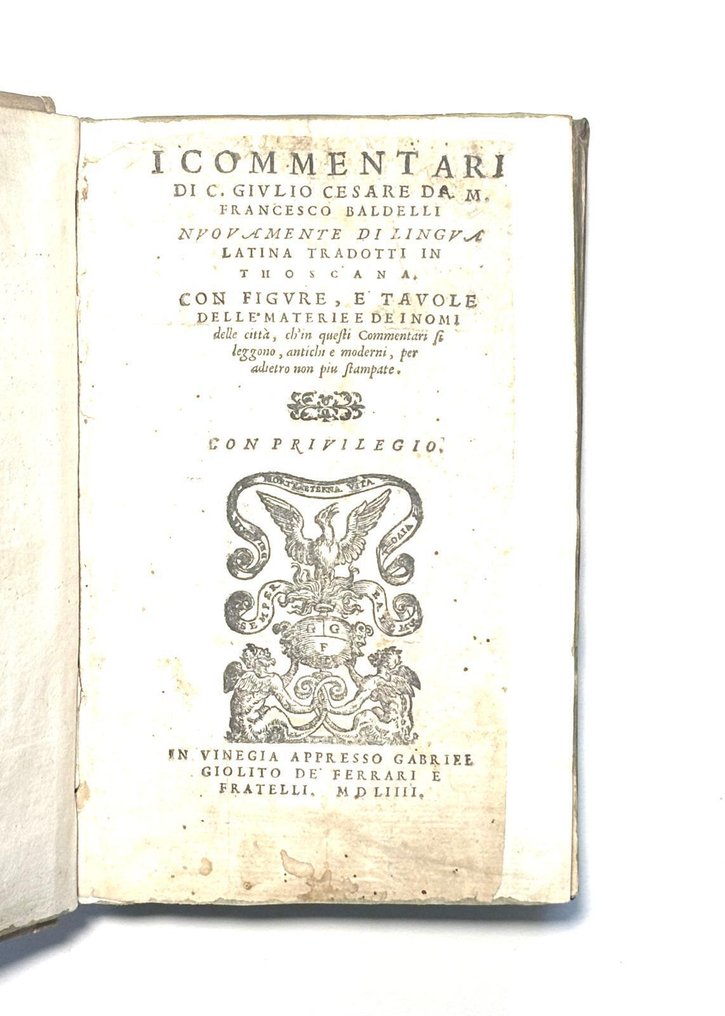
In 8vo. Title page with the famous Giolito typographical trademark (the phoenix on the pyre, with the motto "Semper eadem"). Text in Tuscan vernacular, illustrated with maps, plates, and figures. First or early vernacular edition of the Commentarii caesariani for the Giolito type.
Collation and state of preservation
Excellent condition, the volume has undergone restoration but is complete. The collation is as follows: 7 double-page plates, 65 unnumbered pages, 784 numbered pages. Some numbering errors, but it is complete.
The input is a dash character, which does not require translation.
The author: Gaius Julius Caesar (100–44 BC)
The work collects the two cornerstones of Latin historical prose attributed to Caesar:
• Commentarii de Bello Gallico
• Commentarii de Bello Civili
Caesar, besides being the greatest leader of the late Roman Republic, was the author of a model of military and political prose that became standard in European schools for nearly two millennia. His Commentaries represent:
• an exceptional document of political self-narration,
• a primary source on Roman military strategy and logistics,
• a canonical text in humanistic and Renaissance rhetorical and grammatical education.
His style, defined by Cicero as “naked, pure and luminous”, was considered a paradigm of expressive clarity and historical accuracy.
The input is a dash character, which does not require translation.
The translator: Francesco Baldelli (active in the 16th century)
Francesco Baldelli, a Tuscan humanist, was one of the first systematic translators of Caesar into the vernacular. His version of the Commentaries is characterized by:
• a clear Italian, close to literary Tuscan,
• a philological care that faithfully follows the Latin text,
• notes and apparatus that facilitate geographical and military understanding,
• tables of names, populations, ancient cities and military roles.
Its intent is clearly didactic: to make Caesar accessible to non-Latinist readers, including the administrative and military elites of the Renaissance.
The input is a dash character, which does not require translation.
The printer: Gabriele Giolito de’ Ferrari and Brothers
The Giolito dynasty was the most prestigious Venetian printing house of the sixteenth century. Gabriele Giolito was:
• the main publisher of vernacular publishing,
• promoter of the Tuscan language as a literary standard,
• creator of illustrated editions of exceptional quality,
• innovator in modern book design.
The phoenix logo evokes the idea of renewal and immortality of classical culture. Giolito's editions of Latin texts translated into the vernacular were crucial in spreading humanism beyond scholarly circles.
The input is a dash character, which does not require translation.
Content of the work
This edition of the Commentaries offers:
1. Complete translation of Caesar's texts into Tuscan vernacular.
2. Tables and figures, useful for:
• the reconstruction of the Gallic Wars,
• the topography of the regions described,
• the organization of armies and fortifications.
3. Tables of names and places, ancient and modern, a decisive element for 16th-century readers.
4. An explanatory apparatus updated to reflect Renaissance geographical knowledge.
The volume aims to combine philology, cartography and military teaching.
The input is a dash character, which does not require translation.
Historical and cultural significance
The Giolitian edition of Caesar's Commentaries in the vernacular is fundamental for several reasons:
1. Spread of humanism
It makes Caesar accessible to a wider audience: merchants, secretaries, officials, military captains, non-Latinist readers.
It promotes the “democratization” of classical culture in the Italian peninsula.
2. Renaissance military formation
Caesar was considered the strategic model par excellence. Illustrated editions like this one were consulted by:
condottieri
• military engineers,
• cartographers,
• students of the sixteenth-century military academies.
3. Birth of modern historiography
The narrative clarity, geographical precision, and direct style of the Commentaries had a decisive impact on the historical prose of the Renaissance.
4. Centrality of Venetian typography
Venice in 1550–1560 was the world center of publishing.
The Giolito editions, thanks to their widespread distribution, made classical texts an integral part of European education.
The input is a dash character, which does not require translation.
Curiosity
• Giolitine editions in the vernacular were often prohibited or controlled, because they allowed a wide audience to access texts considered “dangerous” from a political or philosophical point of view.
• The Giolito phoenix changed shape several times: your specimen shows one of the mid-16th century versions.
• The maps included in the edition reflect the influence of Ptolemaic cartography still dominant in Venice.
• This translation was so appreciated that it was reprinted several times and remained in use in schools until the 17th century.
The input is a dash character, which does not require translation.
Conclusion
Baldelli's Cesare, printed by Gabriele Giolito de' Ferrari in 1554, is a pivotal point in the history of publishing and humanism.
This work represents:
• the fusion between classical philology and vernacular language,
• a manual of Renaissance geography and military strategy,
• a very high quality typographic product,
• a piece of the European diffusion of Latin culture.
It is one of the most significant testimonies of the encounter between the ancient world and Renaissance modernity, and one of the best examples of sixteenth-century Venetian publishing skill.
The input is a dash character, which does not require translation.
Collation and state of preservation
Elegitur presents: Commentaries by Julius Caesar, translated by M. Francesco Baldelli
Venice, Gabriele Giolito de’ Ferrari and Brothers, 1554
With figures and tables; with privilege
Bibliographic description
In 8vo. Title page with the famous Giolito typographical trademark (the phoenix on the pyre, with the motto "Semper eadem"). Text in Tuscan vernacular, illustrated with maps, plates, and figures. First or early vernacular edition of the Commentarii caesariani for the Giolito type.
Collation and state of preservation
Excellent condition, the volume has undergone restoration but is complete. The collation is as follows: 7 double-page plates, 65 unnumbered pages, 784 numbered pages. Some numbering errors, but it is complete.
The input is a dash character, which does not require translation.
The author: Gaius Julius Caesar (100–44 BC)
The work collects the two cornerstones of Latin historical prose attributed to Caesar:
• Commentarii de Bello Gallico
• Commentarii de Bello Civili
Caesar, besides being the greatest leader of the late Roman Republic, was the author of a model of military and political prose that became standard in European schools for nearly two millennia. His Commentaries represent:
• an exceptional document of political self-narration,
• a primary source on Roman military strategy and logistics,
• a canonical text in humanistic and Renaissance rhetorical and grammatical education.
His style, defined by Cicero as “naked, pure and luminous”, was considered a paradigm of expressive clarity and historical accuracy.
The input is a dash character, which does not require translation.
The translator: Francesco Baldelli (active in the 16th century)
Francesco Baldelli, a Tuscan humanist, was one of the first systematic translators of Caesar into the vernacular. His version of the Commentaries is characterized by:
• a clear Italian, close to literary Tuscan,
• a philological care that faithfully follows the Latin text,
• notes and apparatus that facilitate geographical and military understanding,
• tables of names, populations, ancient cities and military roles.
Its intent is clearly didactic: to make Caesar accessible to non-Latinist readers, including the administrative and military elites of the Renaissance.
The input is a dash character, which does not require translation.
The printer: Gabriele Giolito de’ Ferrari and Brothers
The Giolito dynasty was the most prestigious Venetian printing house of the sixteenth century. Gabriele Giolito was:
• the main publisher of vernacular publishing,
• promoter of the Tuscan language as a literary standard,
• creator of illustrated editions of exceptional quality,
• innovator in modern book design.
The phoenix logo evokes the idea of renewal and immortality of classical culture. Giolito's editions of Latin texts translated into the vernacular were crucial in spreading humanism beyond scholarly circles.
The input is a dash character, which does not require translation.
Content of the work
This edition of the Commentaries offers:
1. Complete translation of Caesar's texts into Tuscan vernacular.
2. Tables and figures, useful for:
• the reconstruction of the Gallic Wars,
• the topography of the regions described,
• the organization of armies and fortifications.
3. Tables of names and places, ancient and modern, a decisive element for 16th-century readers.
4. An explanatory apparatus updated to reflect Renaissance geographical knowledge.
The volume aims to combine philology, cartography and military teaching.
The input is a dash character, which does not require translation.
Historical and cultural significance
The Giolitian edition of Caesar's Commentaries in the vernacular is fundamental for several reasons:
1. Spread of humanism
It makes Caesar accessible to a wider audience: merchants, secretaries, officials, military captains, non-Latinist readers.
It promotes the “democratization” of classical culture in the Italian peninsula.
2. Renaissance military formation
Caesar was considered the strategic model par excellence. Illustrated editions like this one were consulted by:
condottieri
• military engineers,
• cartographers,
• students of the sixteenth-century military academies.
3. Birth of modern historiography
The narrative clarity, geographical precision, and direct style of the Commentaries had a decisive impact on the historical prose of the Renaissance.
4. Centrality of Venetian typography
Venice in 1550–1560 was the world center of publishing.
The Giolito editions, thanks to their widespread distribution, made classical texts an integral part of European education.
The input is a dash character, which does not require translation.
Curiosity
• Giolitine editions in the vernacular were often prohibited or controlled, because they allowed a wide audience to access texts considered “dangerous” from a political or philosophical point of view.
• The Giolito phoenix changed shape several times: your specimen shows one of the mid-16th century versions.
• The maps included in the edition reflect the influence of Ptolemaic cartography still dominant in Venice.
• This translation was so appreciated that it was reprinted several times and remained in use in schools until the 17th century.
The input is a dash character, which does not require translation.
Conclusion
Baldelli's Cesare, printed by Gabriele Giolito de' Ferrari in 1554, is a pivotal point in the history of publishing and humanism.
This work represents:
• the fusion between classical philology and vernacular language,
• a manual of Renaissance geography and military strategy,
• a very high quality typographic product,
• a piece of the European diffusion of Latin culture.
It is one of the most significant testimonies of the encounter between the ancient world and Renaissance modernity, and one of the best examples of sixteenth-century Venetian publishing skill.
The input is a dash character, which does not require translation.
Collation and state of preservation
Details
Number of Books
1
Subject
Cartography, History, Illustrated, Incunabula & early printing, Original artwork, War history
Book Title
(GEOGRAPHY and TECHNOLOGY) I commentari di C. Giulio Cesare da M. Francesco Baldelli
Author/ Illustrator
C. Giulio Cesare; Francesco Baldelli
Condition
Fine
Publication year oldest item
1554
Edition
1st Edition Thus
Language
Italian, Latin
Original language
No
Publisher
Gabriele Giolito de' Ferrari e fratelli
Binding/ Material
Vellum
Number of pages
784
