Hand fan - Bamboo - Fan of the thousand faces


05
days
16
hours
07
minutes
43
seconds

16 other people are watching this object
 Bidder 1104 Bidder 1104 | €158 |
|---|
Catawiki Buyer Protection
Your payment’s safe with us until you receive your object.View details
Trustpilot 4.4 | 122473 reviews
Rated Excellent on Trustpilot.
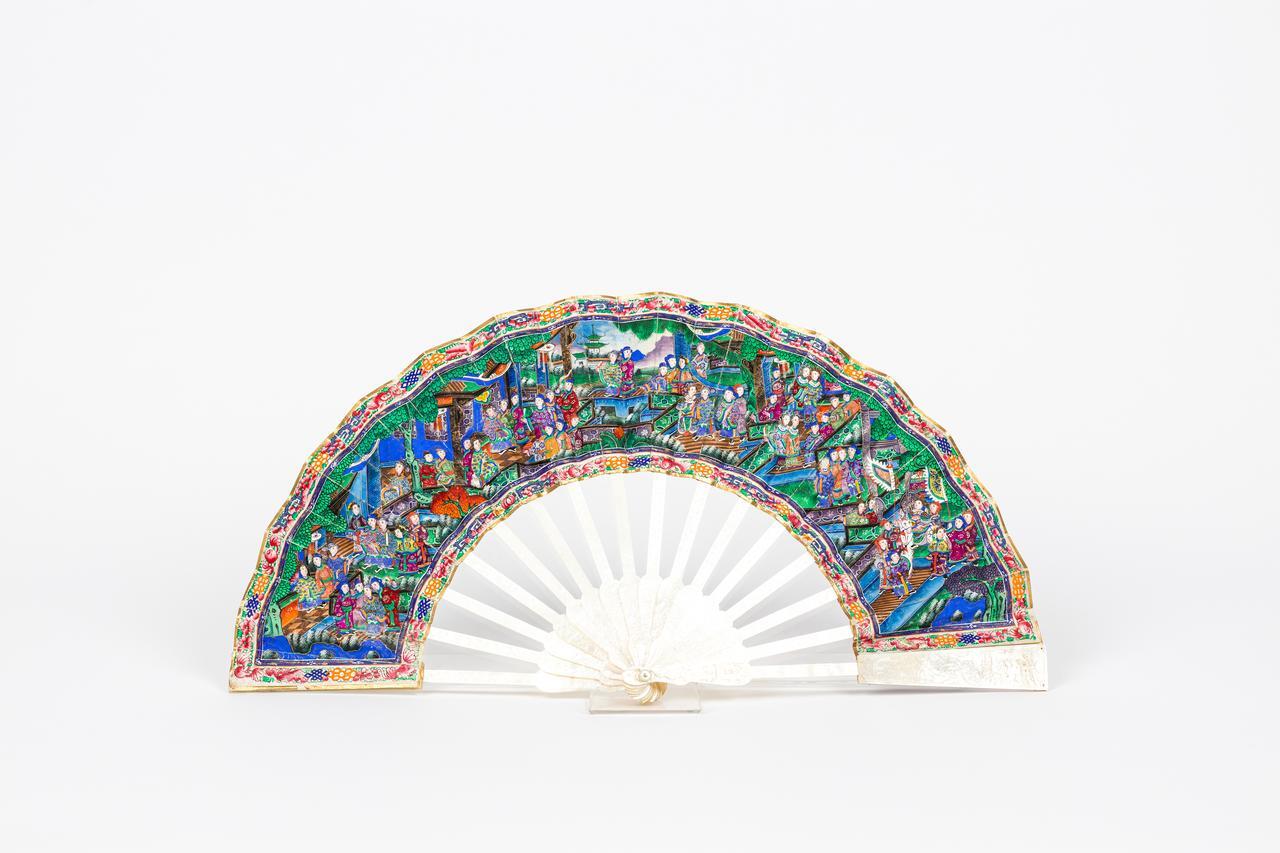
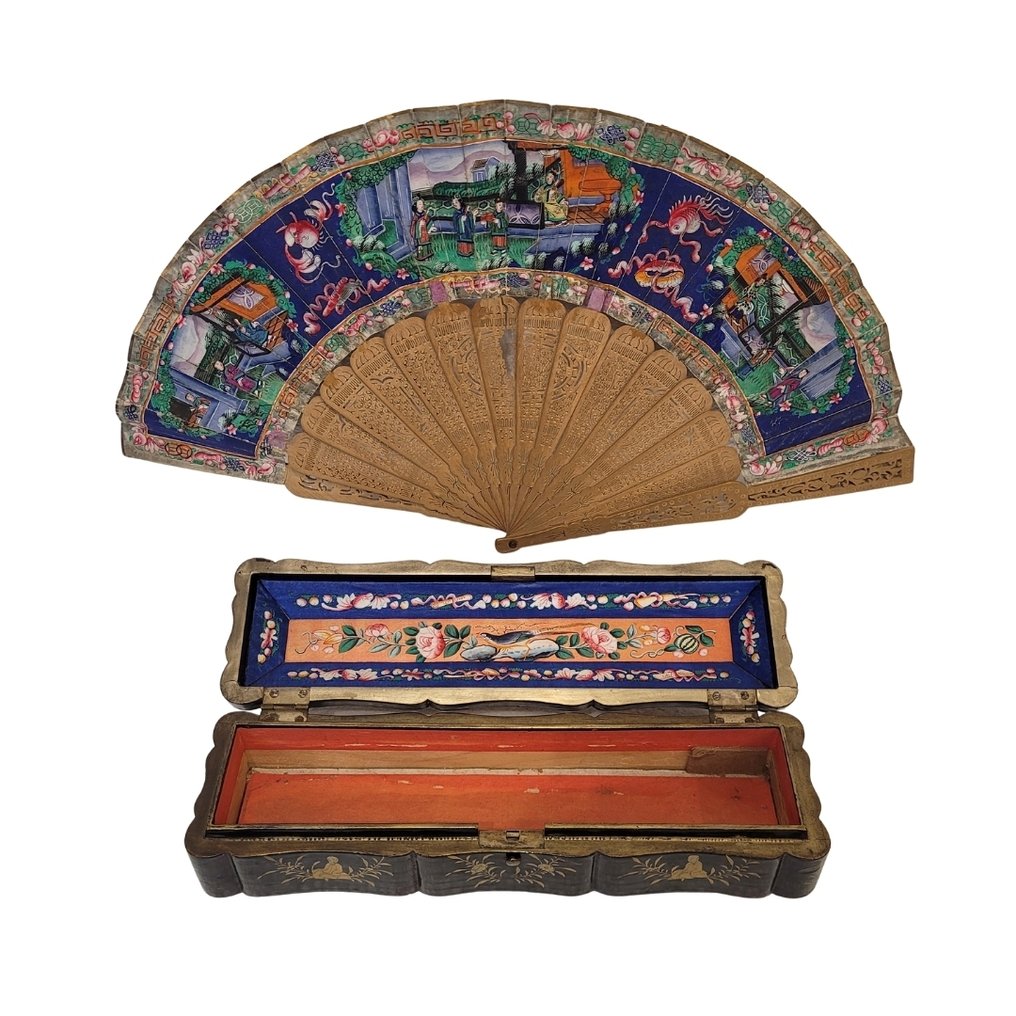
Abanico de las mil caras, with bamboo wood frame, paper leaves and gouache, dating to the late 19th century in Canton, China, and accompanied by its black lacquered box.
AI-assisted summary
Description from the seller
Fan of a Thousand Faces with box, bamboo wood, and gouache, 19th century - China
Fan of a thousand faces
Materials: Paper, bamboo wood, and gouache.
1890s
Country: China
Good condition relative to its age and usage.
Box dimensions: 7 x 28 x 8 cm.
Fan dimensions: 26 x 49 cm.
Exquisite and curious fan of the Mil Caras Chinese with a lacquered box, made in the late 19th century in Canton, the country's main port for export to Europe.
The structure of the frame is made up of finely carved and pierced bamboo wooden rods. The origin of this fan is paper painted on both sides with vivid colors, populated by numerous small human figures, hence its name, 'the thousand faces.' The faces are composed of a thin sheet applied over the paper, recreating the features of the characters.
Depict a lavish court scene, richly detailed, representing a possible ceremonial encounter, palace activities, and ritual episodes typical of the Chinese nobility's imagination. The backgrounds feature intense cobalt blue, with ornate frames and a fragmented narrative across registers. The fan is kept alongside its original lacquered case or box, decorated with gold motifs on the exterior and floral decorations inside. These types of boxes, also produced in Canton, protected the fan during its journey to Europe as part of a luxury set intended for the bourgeoisie in the last third of the 19th century.
The fans of a thousand faces: origin and connection with Spanish culture
The so-called 'fans of a thousand faces' originated in China in the late 18th century and gained particular popularity in Spain during the 19th century. They were characterized by incorporating multiple tiny faces painted or printed on the fan blades, either as repertoires of characters, allegorical figures, or detailed scenes with decorative and social value. In Spanish culture, where the fan became a true gestural code and a symbol of femininity, these fans played a prominent role: they were objects of fashion, collectibles, and non-verbal communication, integrated into dances, gatherings, and courtly customs. Their frequent presence in portraits and scenes of daily life made them an essential element of Spain’s visual identity during that period.
The shipment of the product will be paid for by the buyer according to its dimensions, weight, and destination. We will contact you to arrange the logistics and agree on the budget. Shipping costs include professional custom packaging; personalized shipping, with tracking number, and warranty.
The buyer will be responsible for paying import duties and associated taxes in the destination country, if any. Please note the seller's exemption from liability regarding possible customs charges, as these are levied in the destination country and the amount payable is determined by that country's customs authority.
Seller's Story
- ABOUT US - Fragonard Interiors is a company with experience for more than 30 years, with a team of experts specialized in antiques, design pieces, works of art and interior design projects.
We always seek excellence and originality in each of the pieces, chasing as much customer satisfaction as possible.
By giving a new life to the pieces and works of art, we manage to perpetuate their soul and activate a circular economy of objects.
FOLLOW US ON INSTAGRAM: fragonard_interiors
The packaging is professional and adapted to each piece, with tracking number and shipping insurance. 100% AUTHENTICITY AND QUALITY CONTROL. Each item sold is analyzed, studied and authenticated by experts.
WORLD DELIVERY We ship to all countries served by international courier service providers such as DHL, UPS ...
You can also arrange for yourself to pick up at our physical location.
Translated by Google TranslateFan of a Thousand Faces with box, bamboo wood, and gouache, 19th century - China
Fan of a thousand faces
Materials: Paper, bamboo wood, and gouache.
1890s
Country: China
Good condition relative to its age and usage.
Box dimensions: 7 x 28 x 8 cm.
Fan dimensions: 26 x 49 cm.
Exquisite and curious fan of the Mil Caras Chinese with a lacquered box, made in the late 19th century in Canton, the country's main port for export to Europe.
The structure of the frame is made up of finely carved and pierced bamboo wooden rods. The origin of this fan is paper painted on both sides with vivid colors, populated by numerous small human figures, hence its name, 'the thousand faces.' The faces are composed of a thin sheet applied over the paper, recreating the features of the characters.
Depict a lavish court scene, richly detailed, representing a possible ceremonial encounter, palace activities, and ritual episodes typical of the Chinese nobility's imagination. The backgrounds feature intense cobalt blue, with ornate frames and a fragmented narrative across registers. The fan is kept alongside its original lacquered case or box, decorated with gold motifs on the exterior and floral decorations inside. These types of boxes, also produced in Canton, protected the fan during its journey to Europe as part of a luxury set intended for the bourgeoisie in the last third of the 19th century.
The fans of a thousand faces: origin and connection with Spanish culture
The so-called 'fans of a thousand faces' originated in China in the late 18th century and gained particular popularity in Spain during the 19th century. They were characterized by incorporating multiple tiny faces painted or printed on the fan blades, either as repertoires of characters, allegorical figures, or detailed scenes with decorative and social value. In Spanish culture, where the fan became a true gestural code and a symbol of femininity, these fans played a prominent role: they were objects of fashion, collectibles, and non-verbal communication, integrated into dances, gatherings, and courtly customs. Their frequent presence in portraits and scenes of daily life made them an essential element of Spain’s visual identity during that period.
The shipment of the product will be paid for by the buyer according to its dimensions, weight, and destination. We will contact you to arrange the logistics and agree on the budget. Shipping costs include professional custom packaging; personalized shipping, with tracking number, and warranty.
The buyer will be responsible for paying import duties and associated taxes in the destination country, if any. Please note the seller's exemption from liability regarding possible customs charges, as these are levied in the destination country and the amount payable is determined by that country's customs authority.
Seller's Story
- ABOUT US - Fragonard Interiors is a company with experience for more than 30 years, with a team of experts specialized in antiques, design pieces, works of art and interior design projects.
We always seek excellence and originality in each of the pieces, chasing as much customer satisfaction as possible.
By giving a new life to the pieces and works of art, we manage to perpetuate their soul and activate a circular economy of objects.
FOLLOW US ON INSTAGRAM: fragonard_interiors
The packaging is professional and adapted to each piece, with tracking number and shipping insurance. 100% AUTHENTICITY AND QUALITY CONTROL. Each item sold is analyzed, studied and authenticated by experts.
WORLD DELIVERY We ship to all countries served by international courier service providers such as DHL, UPS ...
You can also arrange for yourself to pick up at our physical location.
Translated by Google TranslateDetails
Era
1400-1900
Wood type
Bamboo
Specific region of origin
Cantón
Title additional information
Fan of the thousand faces
No. of items
1
Country of Origin
China
Material
lacquer, Paper, Wood
Colour
Black, Blue, Brown, Gold, Multicolour, Red
Condition
Fair condition - heavily used & with possibly minor parts missing
Height
7 cm
Width
28 cm
Depth
8 cm
Estimated period
1850-1900
Sold by