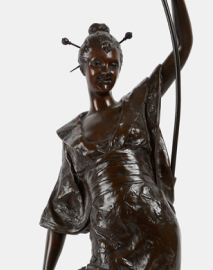
D'après Antoine Louis Barye (1796-1875) - Sculpture, Fou de Rome - 15.9 cm - Bronze


04
days
03
hours
53
minutes
58
seconds
Current bid
€ 3
No reserve price

Expert
Selected by Paul Wullems
He accumulated 18 years' experience, worked as junior specialist at Sotheby’s and managed Kunsthandel Jacques Fijnaut.
Estimate € 200 - € 250
11 other people are watching this object
 Bidder 0433 Bidder 0433 | €3 | |
|---|---|---|
| Bidder 0086 | €1 |
Catawiki Buyer Protection
Your payment’s safe with us until you receive your object.View details
Trustpilot 4.4 | 122190 reviews
Rated Excellent on Trustpilot.
Description from the seller
Description
Antoine-Louis Barye (French, Paris 1795-1875 Paris) Roman Fool (Petit fou de Rome) modeled probably around 1874, executed after 1875
Dimensions: 6 1/4 × 2 3/4 × 2 in | 15.9 × 7 × 5.1 cm
Condition: Very good!
Barye's model of Le Petite Fou de Rome, or Roman Fool, is an interesting sculpture created around 1874 and cast in bronze shortly thereafter. Both Ballu and Pivar suggest in their books that Barye cast this model directly from an authentic Tanagra figure, which would explain the fact that neither sculpture is signed. This would also coincide with the excavations in the Boeotian city of Tanagra in the 1870s, where a large number of these figures were discovered, which would likely have piqued Barye's interest.
Antoine-Louis Barye's masterful animal sculptures—both miniatures and monumental works—earned him commissions from aristocrats and royalty in France and made him a prominent member of Les Animaliers, a group of French artists specializing in the realistic depiction of animals. Barye's animal portrayals, such as the Tiger Surprising an Antelope (1857), testify to the artist's excellent anatomical knowledge. This skill earned him the admiration of Auguste Rodin, who briefly studied with Barye at the Muséum d'Histoire Naturelle. After initial training in metalwork by his father, a goldsmith, Barye studied under the master goldsmith Martin-Guillaume Biennais and the sculptor François-Joseph Bosio before attending the École des Beaux-Arts.
Description
Antoine-Louis Barye (French, Paris 1795-1875 Paris) Roman Fool (Petit fou de Rome) modeled probably around 1874, executed after 1875
Dimensions: 6 1/4 × 2 3/4 × 2 in | 15.9 × 7 × 5.1 cm
Condition: Very good!
Barye's model of Le Petite Fou de Rome, or Roman Fool, is an interesting sculpture created around 1874 and cast in bronze shortly thereafter. Both Ballu and Pivar suggest in their books that Barye cast this model directly from an authentic Tanagra figure, which would explain the fact that neither sculpture is signed. This would also coincide with the excavations in the Boeotian city of Tanagra in the 1870s, where a large number of these figures were discovered, which would likely have piqued Barye's interest.
Antoine-Louis Barye's masterful animal sculptures—both miniatures and monumental works—earned him commissions from aristocrats and royalty in France and made him a prominent member of Les Animaliers, a group of French artists specializing in the realistic depiction of animals. Barye's animal portrayals, such as the Tiger Surprising an Antelope (1857), testify to the artist's excellent anatomical knowledge. This skill earned him the admiration of Auguste Rodin, who briefly studied with Barye at the Muséum d'Histoire Naturelle. After initial training in metalwork by his father, a goldsmith, Barye studied under the master goldsmith Martin-Guillaume Biennais and the sculptor François-Joseph Bosio before attending the École des Beaux-Arts.
Details
Era
1900-2000
Country of Origin
France
Material
Bronze
Artist
D'après Antoine Louis Barye (1796-1875)
Title of artwork
Fou de Rome
Signature
Not signed
Condition
Good condition
Height
15.9 cm
Width
7 cm
Depth
5.1 cm
Sold by