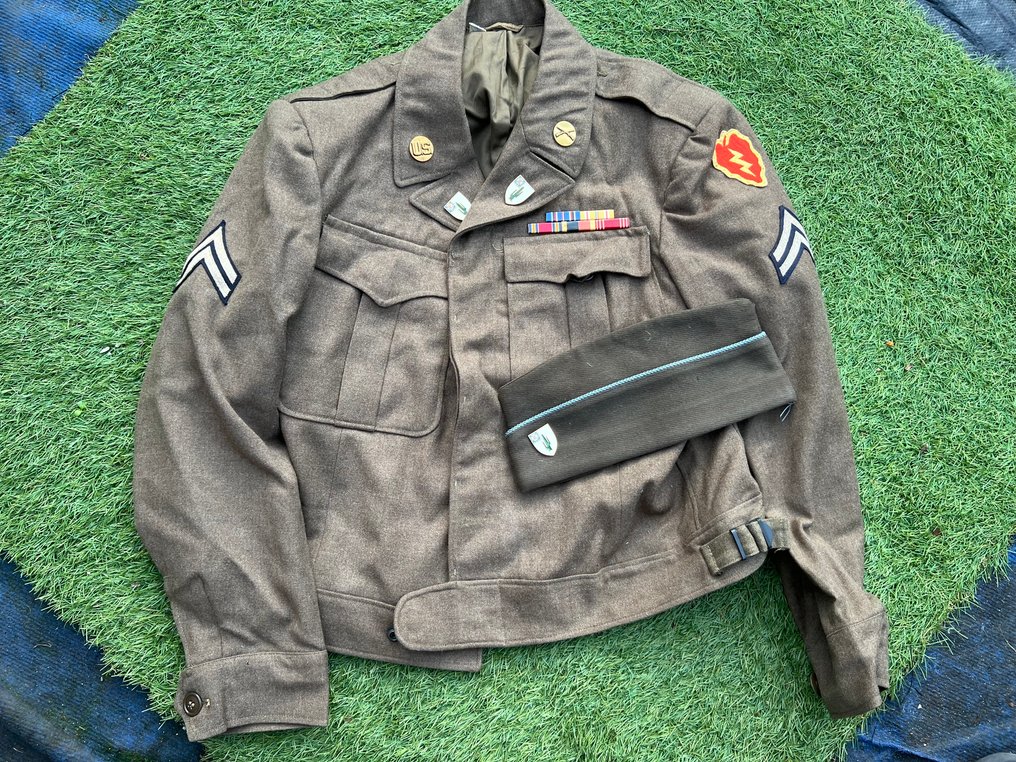
US Army Corporal, 25th Infantry Division, 35th Infantry Regiment Ike Jacket with wool cap - - Military uniform - 1944


10
days
18
hours
28
minutes
34
seconds
Current bid
€ 30
No reserve price

Expert
Selected by Marcel van Hulst
Over 35 years trading and collecting militaria with deep industry knowledge.
Estimate € 230 - € 300
12 other people are watching this object
 Bidder 9459 Bidder 9459 | €30 |
|---|
Catawiki Buyer Protection
Your payment’s safe with us until you receive your object.View details
Trustpilot 4.4 | 121899 reviews
Rated Excellent on Trustpilot.
Two-item lot consisting of an original 1944 US Army Ike jacket and wool overseas cap for a corporal of the 25th Infantry Division, 35th Infantry Regiment, Guadalcanal campaign, in good condition.
AI-assisted summary
Description from the seller
Nice 100% original Ike jacket and wool overseas cap of a Cpl who served with the 25th Infantry Division, 35th Infantry Regiment, as an infantryman. The 25th Infantry Division and the 35th Infantry Regiment are famous for their combat in the Guadalcanal campaign, among others. The Ike jacket is in nicely worn condition. He earned a Good Conduct Medal, American Campaign Medal, WWII Victory Medal, Occupation Medal, and Pacific Campaign Medal, indicating he served in the Pacific with the 25th Infantry Division. The Ike jacket has a beautiful age patina and is not a depot piece. The label dates this jacket to December 1944. The jacket also has a nice original set of infantry collar discs.
A very nice and 100% original Ike Jacket from a famous Infantry unit that saw heavy combat during WW2!
See also our other interesting WW2 items!
History of the 25th Infantry Division
The regiment was sent to Guadalcanal, November 25, 1942, to relieve Marines near Henderson Field. The first elements landed near the Tenaru River, December 17, 1942, and entered combat, January 10, 1943, participating in the seizure of Kokumbona and the reduction of the Mount Austen Pocket alongside the 27th Infantry Regiment, in some of the bitterest fighting of the Pacific campaign. With other units on February 5, 1943, it helped end organized enemy resistance.
A period of garrison duty followed, ending July 21: On that date, advance elements debarked on Munda, New Georgia. The 35th Infantry, under the Northern Landing Force, took part in the capture of Vella Lavella, from August 15 to September 15, 1943. Organized resistance on New Georgia ended on August 25, and the division moved to New Zealand for rest and training, with the last elements arriving on December 5. The 25th was transferred to New Caledonia, from February 3 to March 14, 1944, for continued training.
The division landed in the San Fabian area of Luzon on January 11, 1945, to join the struggle for the liberation of the Philippines. It advanced across the Luzon Central Plain, encountering the enemy at Binalonan on January 17. Moving through the rice paddies, the 25th occupied Umingan, Lupao, and San Jose, and destroyed a significant portion of the Japanese armor on Luzon. On February 21, the division began operations in the Caraballo Mountains. It fought its way along Highway No. 5, capturing Digdig, Putlan, and Kapintalan amidst fierce enemy counterattacks, and took Balete Pass on May 13, opening the gateway to the Cagayan Valley on May 27 with the capture of Santa Fe. Until June 30, when the division was relieved, it conducted mopping-up activities. On July 1, the division moved to Tarlac for training before departing for Japan on September 20. At the end of the war, the 35th was engaged in occupation duties in Japan.
The division was originally activated from Hawaii garrison units during World War II, slightly more than two months before the Japanese Attack on Pearl Harbor began the Pacific War. After spending almost a year training, it fought in the Allied counteroffensive during the Guadalcanal campaign from December 1942, helping to end organized Japanese resistance on that island by early February 1943. The 25th spent a period garrisoning the island, then moved on to fight in the New Georgia Campaign in July. After the Japanese defeat in the latter, it was sent to New Zealand later that year for rest and training, before moving to New Caledonia for further training. The division returned to combat in the January 1945 invasion of Luzon, reducing Japanese resistance on the island until late June, after which it was pulled out of the line for training. The division then served in the occupation of Japan after the surrender of the latter from September 1945.
Seller's Story
We specialize in the sale of professional military regulations, academic literature, and other militaria with over 20 years of experience. With a carefully selected range, we serve collectors, historians, defense professionals, and enthusiasts of military history. Our products offer reliable and authentic information and are of high quality. We stand for expertise, reliability, and a passion for military heritage.
Translated by Google TranslateNice 100% original Ike jacket and wool overseas cap of a Cpl who served with the 25th Infantry Division, 35th Infantry Regiment, as an infantryman. The 25th Infantry Division and the 35th Infantry Regiment are famous for their combat in the Guadalcanal campaign, among others. The Ike jacket is in nicely worn condition. He earned a Good Conduct Medal, American Campaign Medal, WWII Victory Medal, Occupation Medal, and Pacific Campaign Medal, indicating he served in the Pacific with the 25th Infantry Division. The Ike jacket has a beautiful age patina and is not a depot piece. The label dates this jacket to December 1944. The jacket also has a nice original set of infantry collar discs.
A very nice and 100% original Ike Jacket from a famous Infantry unit that saw heavy combat during WW2!
See also our other interesting WW2 items!
History of the 25th Infantry Division
The regiment was sent to Guadalcanal, November 25, 1942, to relieve Marines near Henderson Field. The first elements landed near the Tenaru River, December 17, 1942, and entered combat, January 10, 1943, participating in the seizure of Kokumbona and the reduction of the Mount Austen Pocket alongside the 27th Infantry Regiment, in some of the bitterest fighting of the Pacific campaign. With other units on February 5, 1943, it helped end organized enemy resistance.
A period of garrison duty followed, ending July 21: On that date, advance elements debarked on Munda, New Georgia. The 35th Infantry, under the Northern Landing Force, took part in the capture of Vella Lavella, from August 15 to September 15, 1943. Organized resistance on New Georgia ended on August 25, and the division moved to New Zealand for rest and training, with the last elements arriving on December 5. The 25th was transferred to New Caledonia, from February 3 to March 14, 1944, for continued training.
The division landed in the San Fabian area of Luzon on January 11, 1945, to join the struggle for the liberation of the Philippines. It advanced across the Luzon Central Plain, encountering the enemy at Binalonan on January 17. Moving through the rice paddies, the 25th occupied Umingan, Lupao, and San Jose, and destroyed a significant portion of the Japanese armor on Luzon. On February 21, the division began operations in the Caraballo Mountains. It fought its way along Highway No. 5, capturing Digdig, Putlan, and Kapintalan amidst fierce enemy counterattacks, and took Balete Pass on May 13, opening the gateway to the Cagayan Valley on May 27 with the capture of Santa Fe. Until June 30, when the division was relieved, it conducted mopping-up activities. On July 1, the division moved to Tarlac for training before departing for Japan on September 20. At the end of the war, the 35th was engaged in occupation duties in Japan.
The division was originally activated from Hawaii garrison units during World War II, slightly more than two months before the Japanese Attack on Pearl Harbor began the Pacific War. After spending almost a year training, it fought in the Allied counteroffensive during the Guadalcanal campaign from December 1942, helping to end organized Japanese resistance on that island by early February 1943. The 25th spent a period garrisoning the island, then moved on to fight in the New Georgia Campaign in July. After the Japanese defeat in the latter, it was sent to New Zealand later that year for rest and training, before moving to New Caledonia for further training. The division returned to combat in the January 1945 invasion of Luzon, reducing Japanese resistance on the island until late June, after which it was pulled out of the line for training. The division then served in the occupation of Japan after the surrender of the latter from September 1945.
Seller's Story
We specialize in the sale of professional military regulations, academic literature, and other militaria with over 20 years of experience. With a carefully selected range, we serve collectors, historians, defense professionals, and enthusiasts of military history. Our products offer reliable and authentic information and are of high quality. We stand for expertise, reliability, and a passion for military heritage.
Translated by Google TranslateDetails
Era
1900-2000
Number of items
2
Army Unit
US Army Corporal, 25th Infantry Division, 35th Infantry Regiment Ike Jacket with wool cap -
Year of Manufacture
1944
Condition
Good condition
Original/ Replica
Original
Comes with certificate of authenticity
No
Sold by