François Villon - Escripts de Françoys Villon; La Danse macabre; Villon en son temps, etc. - 1974


07
days
10
hours
40
minutes
05
seconds

18 other people are watching this object
 Bidder 9464 Bidder 9464 | €1 |
|---|
Catawiki Buyer Protection
Your payment’s safe with us until you receive your object.View details
Trustpilot 4.4 | 122028 reviews
Rated Excellent on Trustpilot.
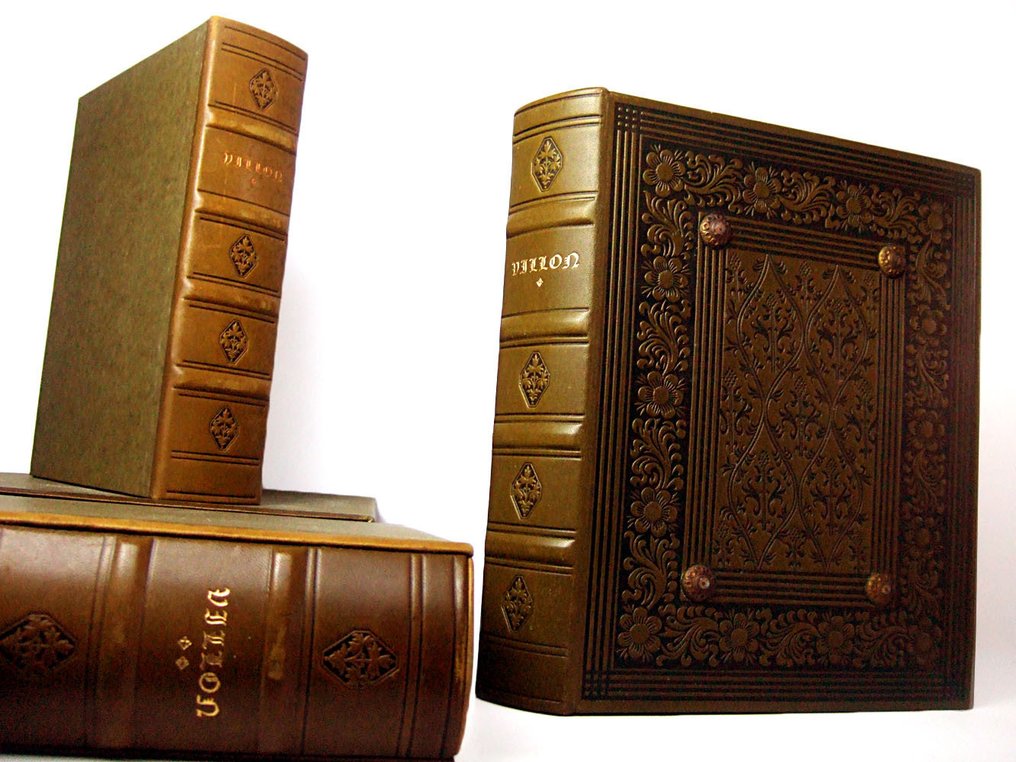
Two-volume luxury edition of Escripts de Françoys Villon; La Danse macabre; Villon en son temps, etc., illustrated and bound in full fauve calfskin with cold-embossed ornaments, numbered edition on Lana rag, with case, inserted plates, and a companion volume in a matching binding.
AI-assisted summary
Description from the seller
Luxurious set in a limited edition of 4,284 copies, this being one of the numbered copies on pure Lana paper, bound in a faux fawn calf leather stamped in gold with medieval-style ornaments and adorned with cabochons, gilded head, housed in a slipcase and a case from the publisher. A second volume, similarly bound, opens in a slipcase and contains various items: playing cards, manuscript facsimiles, a book, a folded plan, reproductions of engravings, etc., as detailed below.
The first volume presents the text of the illuminated and calligraphed Escripts of Françoys Villon by Guignard, in a highly refined pastiche of late Gothic manuscripts, with decorated initials, borders, figurative scenes, and color plays that recreate the atmosphere of codices from the late Middle Ages. The entire work, printed on pure Lana silk paper and bound in full leather stamped in blind, with raised bands and adorned with metal cabochons, places this edition within the great French tradition of 'artist's books' and manuscript facsimile editions, making it a work of art as much as a literary text.
The second volume, presented in a box set, offers an original study by Louis-Robert Plazolles titled 'Villon and His Time,' accompanied by iconographic and historical documents in facsimile that constitute a true dossier on 15th-century Paris. It notably includes a map of Paris from 1552, a danse macabre, drawings and wood engravings, playing cards, and various archival pieces—elements that place Villon (circa 1431 – after 1463) within his social, religious, and judicial environment. This documentary volume significantly enhances the overall interest for the cultural historian, the medievalist, or the bibliophile curious about 'archival facsimiles,' 'old plans of Paris,' 'danse macabre,' and late medieval iconography, making these Escripts of Françoys Villon a reference edition on Villon and his era.
Good overall condition, the cases are slightly scratched, ex-libris stamped on the guard, other minor flaws.
The Scripts of François Villon compile all the known poetry of François Villon (circa 1431 – after 1463), a major figure in medieval French literature, at the crossroads of courtly poetry, satire, and testimony on urban life in the 15th century. A wandering poet, a cleric trained at the University of Paris, involved in fights and thefts, Villon (circa 1431 – after 1463) embodies the troubled atmosphere of the end of the Hundred Years' War and Parisian misery, which gives his Testaments, ballads, and songs a unique tone blending slang, dark humor, and reflections on death. The edition published in 1974 by the Club du Livre, under the editorial direction of Philippe Lebaud (1930–2013), reproduces this corpus in a luxurious presentation, in two large octavo volumes, clearly aimed at bibliophile enthusiasts of medieval poetry and illustrated fine books.
Seller's Story
Les Colporteurs have been practicing for more than twenty years and offer a variety of books with a predilection for the old and the rare. They also act as experts in old books for courts, estates and auctions in Vendée and Aquitaine.
Luxurious set in a limited edition of 4,284 copies, this being one of the numbered copies on pure Lana paper, bound in a faux fawn calf leather stamped in gold with medieval-style ornaments and adorned with cabochons, gilded head, housed in a slipcase and a case from the publisher. A second volume, similarly bound, opens in a slipcase and contains various items: playing cards, manuscript facsimiles, a book, a folded plan, reproductions of engravings, etc., as detailed below.
The first volume presents the text of the illuminated and calligraphed Escripts of Françoys Villon by Guignard, in a highly refined pastiche of late Gothic manuscripts, with decorated initials, borders, figurative scenes, and color plays that recreate the atmosphere of codices from the late Middle Ages. The entire work, printed on pure Lana silk paper and bound in full leather stamped in blind, with raised bands and adorned with metal cabochons, places this edition within the great French tradition of 'artist's books' and manuscript facsimile editions, making it a work of art as much as a literary text.
The second volume, presented in a box set, offers an original study by Louis-Robert Plazolles titled 'Villon and His Time,' accompanied by iconographic and historical documents in facsimile that constitute a true dossier on 15th-century Paris. It notably includes a map of Paris from 1552, a danse macabre, drawings and wood engravings, playing cards, and various archival pieces—elements that place Villon (circa 1431 – after 1463) within his social, religious, and judicial environment. This documentary volume significantly enhances the overall interest for the cultural historian, the medievalist, or the bibliophile curious about 'archival facsimiles,' 'old plans of Paris,' 'danse macabre,' and late medieval iconography, making these Escripts of Françoys Villon a reference edition on Villon and his era.
Good overall condition, the cases are slightly scratched, ex-libris stamped on the guard, other minor flaws.
The Scripts of François Villon compile all the known poetry of François Villon (circa 1431 – after 1463), a major figure in medieval French literature, at the crossroads of courtly poetry, satire, and testimony on urban life in the 15th century. A wandering poet, a cleric trained at the University of Paris, involved in fights and thefts, Villon (circa 1431 – after 1463) embodies the troubled atmosphere of the end of the Hundred Years' War and Parisian misery, which gives his Testaments, ballads, and songs a unique tone blending slang, dark humor, and reflections on death. The edition published in 1974 by the Club du Livre, under the editorial direction of Philippe Lebaud (1930–2013), reproduces this corpus in a luxurious presentation, in two large octavo volumes, clearly aimed at bibliophile enthusiasts of medieval poetry and illustrated fine books.
Seller's Story
Les Colporteurs have been practicing for more than twenty years and offer a variety of books with a predilection for the old and the rare. They also act as experts in old books for courts, estates and auctions in Vendée and Aquitaine.
Details
Number of Books
2
Subject
Cavalry and chivalry, Fine Bindings, Illustrated, Literature
Book Title
Escripts de Françoys Villon; La Danse macabre; Villon en son temps, etc.
Author/ Illustrator
François Villon
Condition
Good
Publication year oldest item
1974
Height
30 cm
Edition
Illustrated Edition, Limited edition, Numbered edition, Special printing
Width
24 cm
Language
French
Original language
Yes
Publisher
Club du livre
Binding/ Material
Leather
Extras
Slipcase, Tipped in plates
Number of pages
273
Sold by
