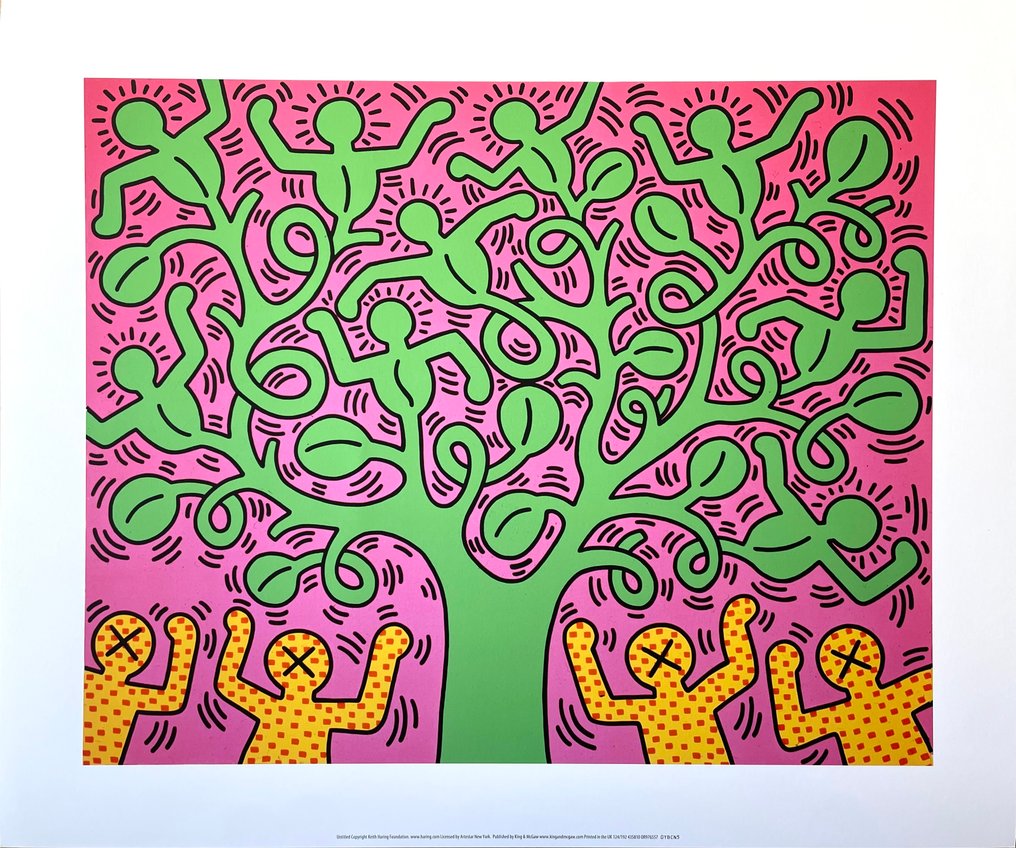
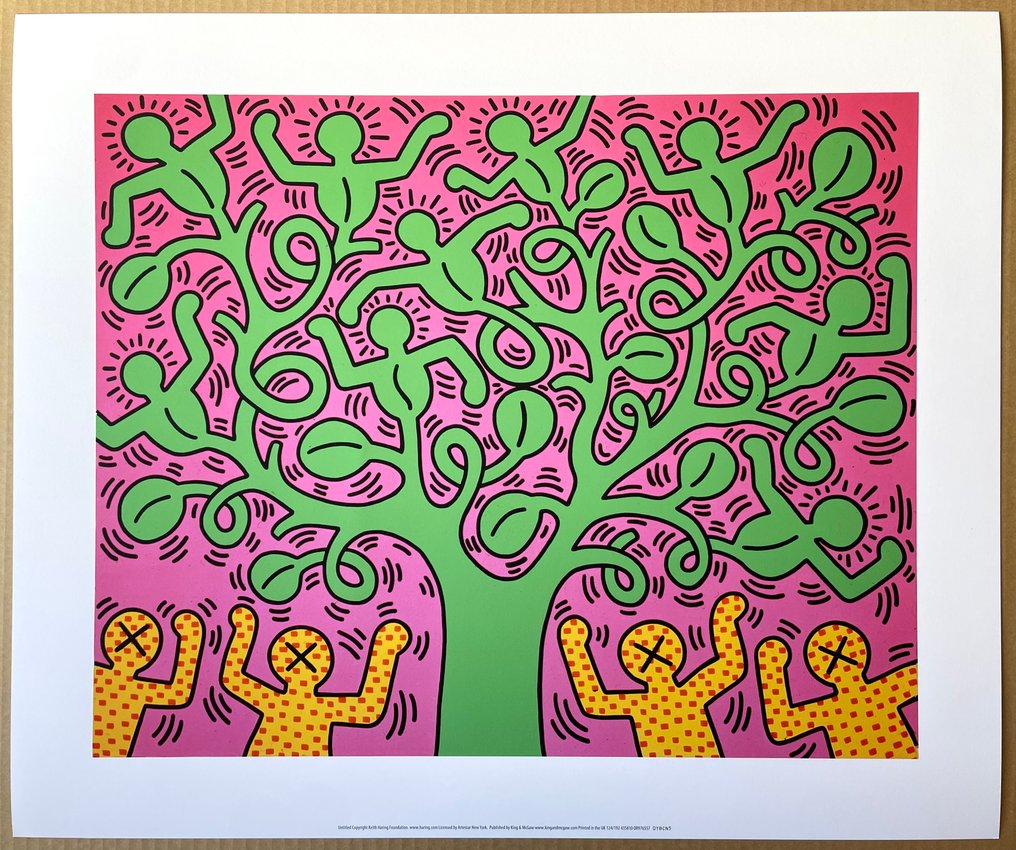
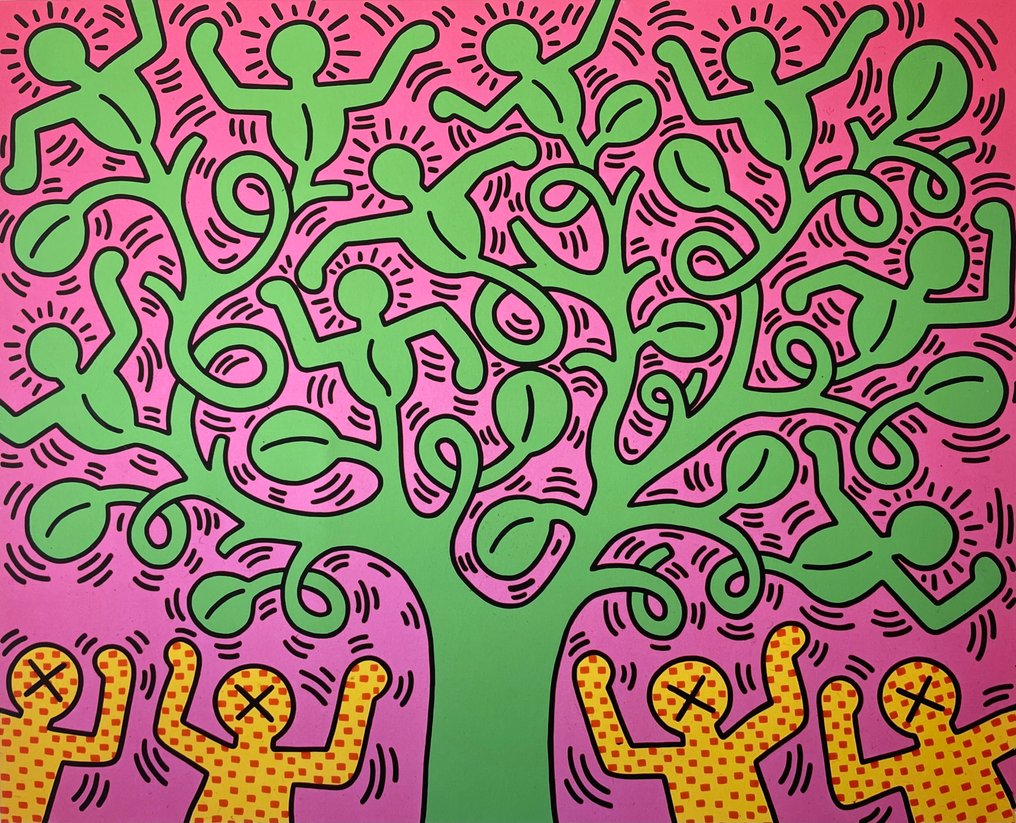
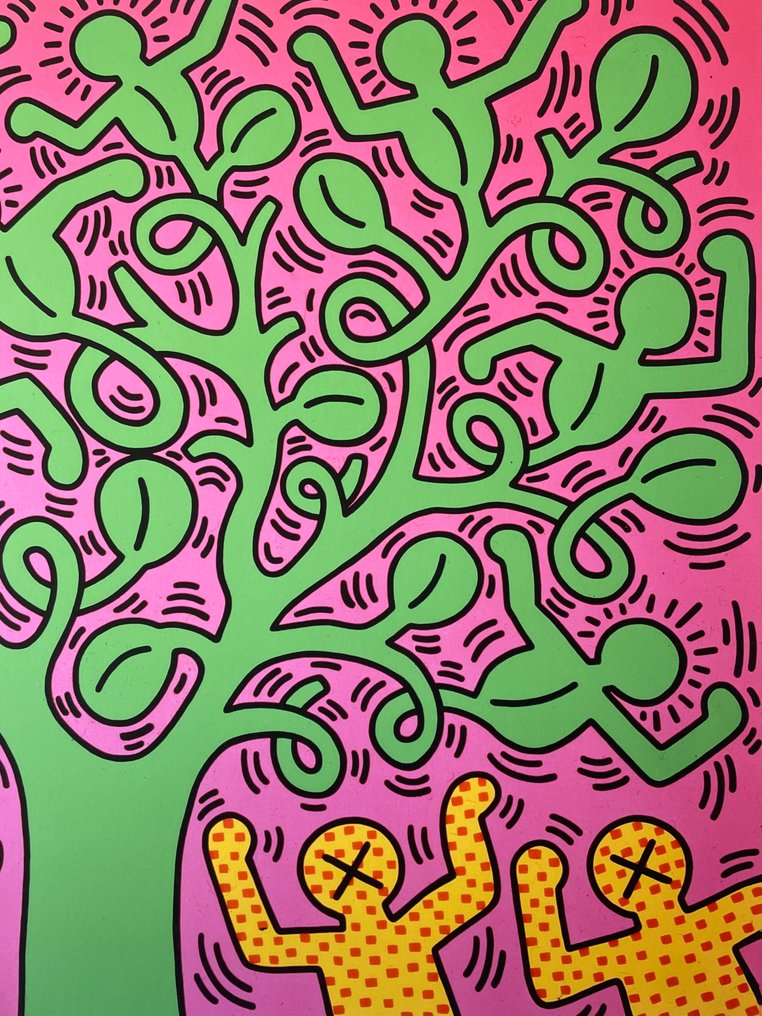
Keith Haring - Untitled (Tree of Life) - Artestar licensed print

Opens 26 December
Starting bid
€ 1
Add to your favourites to get an alert when the auction starts.

Expert
Selected by Juan Antonio Rodríguez
Eight years experience valuing posters, previously valuer at Balclis, Barcelona.
Estimate € 150 - € 200
Catawiki Buyer Protection
Your payment’s safe with us until you receive your object.View details
Trustpilot 4.4 | 122910 reviews
Rated Excellent on Trustpilot.
Description from the seller
Offset lithograph by Keith Haring (*)
Reproduction of the work 'Tree of Life', acrylic on canvas created by Haring in 1985.
Luxury edition on high-weight matte conservation digital paper (250 g/m²).
Printed with permission from Artestar New York. Copyright: Keith Haring Foundation.
Sheet dimensions: 52 x 62 cm
Design dimensions: 40 x 50 cm
- Condition: Excellent (this work has never been framed or exhibited, always kept in a professional art folder, so it is offered in immaculate condition).
Provenance: Private collection.
The artwork will be handled with care and packaged in a reinforced cardboard box. Shipping will be certified with a tracking number (UPS, DPD, DHL, FedEx).
The shipment will also include transport insurance for the final value of the artwork with full reimbursement in case of loss or damage, at no cost to the buyer.
(*) Keith Haring was born in 1958 in Reading, Pennsylvania, United States.
He grew up in Kutztown and showed a great interest in art from a young age. He studied graphic design at The Ivy School of Professional Art in Pittsburgh, and at 19, already openly gay, he moved to New York, where he found inspiration in graffiti art and enrolled at the School of Visual Arts. There he was influenced by Keith Sonnler and Joseph Kossuth, who encouraged him to develop as a conceptual artist through experimentation with form and color.
Haring first came to public attention in 1980, when he began drawing cartoon-like images with markers on the subways of the Big Apple, and then painted comic strips with white chalk on the black panels meant for advertising, which earned him more than one arrest.
Its clean lines, vivid colors, and active figures carried strong messages of life and unity, and its displays were filmed by photographer Tseng Kwong Chi.
Also around this time, he organized an exhibition at Club 57, and participated in a show in Times Square, where he drew, for the first time, animals and human faces.
His first solo exhibition was at Tony Shafrazy's Gallery in 1981, the same year he took part in the Documenta 7 exhibition in Kassel, Germany.
In 1982 he befriended emerging artists of the time such as Kenny Sharf, Madonna and Jean-Michel Basquiat, and even met the famous Andy Warhol.
In 1984 Harin went to Australia and painted several murals in Melbourne and Sydney, and even received money for his work from the National Gallery of Victoria and the Australian Centre for Contemporary Art.
He also visited and painted in Rio de Janeiro, the Museum of Modern Art in Paris, Minneapolis and Manhattan.
Even during this time he designed a pink jacket that Madonna wore to perform her song "Like a Virgin" on the show "Solid Gold".
In 1985, the Museum of Modern Art in Bordeaux held an exhibition of his work, and he also took part in the Paris Biennial.
He appeared in November of that year on the MTV channel where he painted on a program hosted by his friend Nick Rhodes, from the group Duran Duran.
In 1986 he painted murals in Amsterdam, Paris, Phoenix and Berlin, he also painted Grace Jones' body for her music video for the song "I'm not Perfect", and opened a shop to sell his work in SOHO.
By then, his works began to reflect the socio-political problems of the time, such as anti-Apartheid, AIDS, and drugs.
He also created pop art pieces for brands such as Absolut Vodka, Lucky Strike and Coca Cola, and even designed the cover of the charity album "A Very Special Christmas", which featured his friend Madonna.
In 1988 he was included in a select list of artists whose works appeared on the labels of Chateau Mouton Rothschild wines, and that same year he was diagnosed with AIDS, so the following year he inaugurated the Keith Haring Foundation whose objective was to fight against the social problems related to this disease and to publicize the artist's work through exhibitions, publications and licensing of his work.
In June 1989, he painted his last public work on a wall of the convent of the Church of Saint Anthony in Pisa. This work was titled “Tuttomondo”.
Keith Haring died on February 16, 1990, at the young age of 32, a victim of AIDS.
(*) Epic scale and ambition, Tree of Life (1985) was created at the height of Keith Haring's tragically short but intensely dynamic life and career. Standing over three and a half meters tall, Tree of Life takes on almost biblical proportions in its depiction of this fantastical scene. A fusion of punk and pop, Haring injects contemporary energy into this decidedly urban celebration that merges established religious themes and historical references from traditional art with his distinctive modern street art culture. emanating from the swirling branches, a plethora of life bursts forth in the form of dancing bodies, like an explosion of knowledge. Beneath the tree, four fully formed, mottled yellow figures stand in exaltation. With economical lines, the green branches, bright as daylight, seem to vibrate against the fuchsia in a carnival of rhythmic patterns. "Look, when I paint, it’s an experience that, at its best, transcends reality," Haring explained, noting that this dimension also reflected his mental state while working. "When it works, you transport yourself to another place, you connect with things that are completely universal, from total consciousness, far beyond your ego and your own being. That’s what it’s about" (K. Haring, quoted in D. Sheff, "Keith Haring: An Intimate Conversation," in Rolling Stone, August 1989, reprinted at www.haring.com [accessed May 25, 2014]). "The Tree of Life" has been exhibited at the Ludwig Forum for International Art in Aachen, the Museum für Neue Kunst in Karlsruhe, the Museum Boijmans Van Beuningen in Rotterdam, the Milan Triennial in Milan, and the Dexia Banque Internationale in Luxembourg.
Seller's Story
EsKobARTE carefully selects artworks and posters from recognized and emerging artists worldwide to offer them here at affordable prices.*** AUTHENTIC WORKS *** We only sell genuine artworks and posters, as well as officially authorized prints.*** WE ARE PROFESSIONALS *** You can bid on your items with complete confidence. Over 1,000 positive reviews from our clients attest to our experience and professionalism on Catawiki.*** PROTECTED, CERTIFIED, AND INSURED SHIPPING *** All our items are carefully packaged in eco-friendly cardboard packaging. We work with the best shipping companies (UPS-DPD-DHL-FEDEX) to ensure the best service and tracking. Additionally, our shipments include insurance against damage or loss at no cost to the buyer.*** IF YOU PURCHASE MORE THAN ONE ITEM, WE COMBINE SHIPPING *** Even if they come from different auctions, you'll only have to pay the shipping cost for a single item.*** ANY QUESTIONS? CONTACT US *** You can use the chat to talk to us; we will be happy to assist you as soon as possible.*** THANK YOU AND GOOD LUCK WITH YOUR BIDS! ***
Translated by Google TranslateOffset lithograph by Keith Haring (*)
Reproduction of the work 'Tree of Life', acrylic on canvas created by Haring in 1985.
Luxury edition on high-weight matte conservation digital paper (250 g/m²).
Printed with permission from Artestar New York. Copyright: Keith Haring Foundation.
Sheet dimensions: 52 x 62 cm
Design dimensions: 40 x 50 cm
- Condition: Excellent (this work has never been framed or exhibited, always kept in a professional art folder, so it is offered in immaculate condition).
Provenance: Private collection.
The artwork will be handled with care and packaged in a reinforced cardboard box. Shipping will be certified with a tracking number (UPS, DPD, DHL, FedEx).
The shipment will also include transport insurance for the final value of the artwork with full reimbursement in case of loss or damage, at no cost to the buyer.
(*) Keith Haring was born in 1958 in Reading, Pennsylvania, United States.
He grew up in Kutztown and showed a great interest in art from a young age. He studied graphic design at The Ivy School of Professional Art in Pittsburgh, and at 19, already openly gay, he moved to New York, where he found inspiration in graffiti art and enrolled at the School of Visual Arts. There he was influenced by Keith Sonnler and Joseph Kossuth, who encouraged him to develop as a conceptual artist through experimentation with form and color.
Haring first came to public attention in 1980, when he began drawing cartoon-like images with markers on the subways of the Big Apple, and then painted comic strips with white chalk on the black panels meant for advertising, which earned him more than one arrest.
Its clean lines, vivid colors, and active figures carried strong messages of life and unity, and its displays were filmed by photographer Tseng Kwong Chi.
Also around this time, he organized an exhibition at Club 57, and participated in a show in Times Square, where he drew, for the first time, animals and human faces.
His first solo exhibition was at Tony Shafrazy's Gallery in 1981, the same year he took part in the Documenta 7 exhibition in Kassel, Germany.
In 1982 he befriended emerging artists of the time such as Kenny Sharf, Madonna and Jean-Michel Basquiat, and even met the famous Andy Warhol.
In 1984 Harin went to Australia and painted several murals in Melbourne and Sydney, and even received money for his work from the National Gallery of Victoria and the Australian Centre for Contemporary Art.
He also visited and painted in Rio de Janeiro, the Museum of Modern Art in Paris, Minneapolis and Manhattan.
Even during this time he designed a pink jacket that Madonna wore to perform her song "Like a Virgin" on the show "Solid Gold".
In 1985, the Museum of Modern Art in Bordeaux held an exhibition of his work, and he also took part in the Paris Biennial.
He appeared in November of that year on the MTV channel where he painted on a program hosted by his friend Nick Rhodes, from the group Duran Duran.
In 1986 he painted murals in Amsterdam, Paris, Phoenix and Berlin, he also painted Grace Jones' body for her music video for the song "I'm not Perfect", and opened a shop to sell his work in SOHO.
By then, his works began to reflect the socio-political problems of the time, such as anti-Apartheid, AIDS, and drugs.
He also created pop art pieces for brands such as Absolut Vodka, Lucky Strike and Coca Cola, and even designed the cover of the charity album "A Very Special Christmas", which featured his friend Madonna.
In 1988 he was included in a select list of artists whose works appeared on the labels of Chateau Mouton Rothschild wines, and that same year he was diagnosed with AIDS, so the following year he inaugurated the Keith Haring Foundation whose objective was to fight against the social problems related to this disease and to publicize the artist's work through exhibitions, publications and licensing of his work.
In June 1989, he painted his last public work on a wall of the convent of the Church of Saint Anthony in Pisa. This work was titled “Tuttomondo”.
Keith Haring died on February 16, 1990, at the young age of 32, a victim of AIDS.
(*) Epic scale and ambition, Tree of Life (1985) was created at the height of Keith Haring's tragically short but intensely dynamic life and career. Standing over three and a half meters tall, Tree of Life takes on almost biblical proportions in its depiction of this fantastical scene. A fusion of punk and pop, Haring injects contemporary energy into this decidedly urban celebration that merges established religious themes and historical references from traditional art with his distinctive modern street art culture. emanating from the swirling branches, a plethora of life bursts forth in the form of dancing bodies, like an explosion of knowledge. Beneath the tree, four fully formed, mottled yellow figures stand in exaltation. With economical lines, the green branches, bright as daylight, seem to vibrate against the fuchsia in a carnival of rhythmic patterns. "Look, when I paint, it’s an experience that, at its best, transcends reality," Haring explained, noting that this dimension also reflected his mental state while working. "When it works, you transport yourself to another place, you connect with things that are completely universal, from total consciousness, far beyond your ego and your own being. That’s what it’s about" (K. Haring, quoted in D. Sheff, "Keith Haring: An Intimate Conversation," in Rolling Stone, August 1989, reprinted at www.haring.com [accessed May 25, 2014]). "The Tree of Life" has been exhibited at the Ludwig Forum for International Art in Aachen, the Museum für Neue Kunst in Karlsruhe, the Museum Boijmans Van Beuningen in Rotterdam, the Milan Triennial in Milan, and the Dexia Banque Internationale in Luxembourg.
Seller's Story
EsKobARTE carefully selects artworks and posters from recognized and emerging artists worldwide to offer them here at affordable prices.*** AUTHENTIC WORKS *** We only sell genuine artworks and posters, as well as officially authorized prints.*** WE ARE PROFESSIONALS *** You can bid on your items with complete confidence. Over 1,000 positive reviews from our clients attest to our experience and professionalism on Catawiki.*** PROTECTED, CERTIFIED, AND INSURED SHIPPING *** All our items are carefully packaged in eco-friendly cardboard packaging. We work with the best shipping companies (UPS-DPD-DHL-FEDEX) to ensure the best service and tracking. Additionally, our shipments include insurance against damage or loss at no cost to the buyer.*** IF YOU PURCHASE MORE THAN ONE ITEM, WE COMBINE SHIPPING *** Even if they come from different auctions, you'll only have to pay the shipping cost for a single item.*** ANY QUESTIONS? CONTACT US *** You can use the chat to talk to us; we will be happy to assist you as soon as possible.*** THANK YOU AND GOOD LUCK WITH YOUR BIDS! ***
Translated by Google TranslateDetails
Era
1900-2000
Designer/Artist
Keith Haring
Poster title
Untitled (Tree of Life) - Artestar licensed print
Condition
A (excellent - mint condition)
Height
52 cm
Width
62 cm