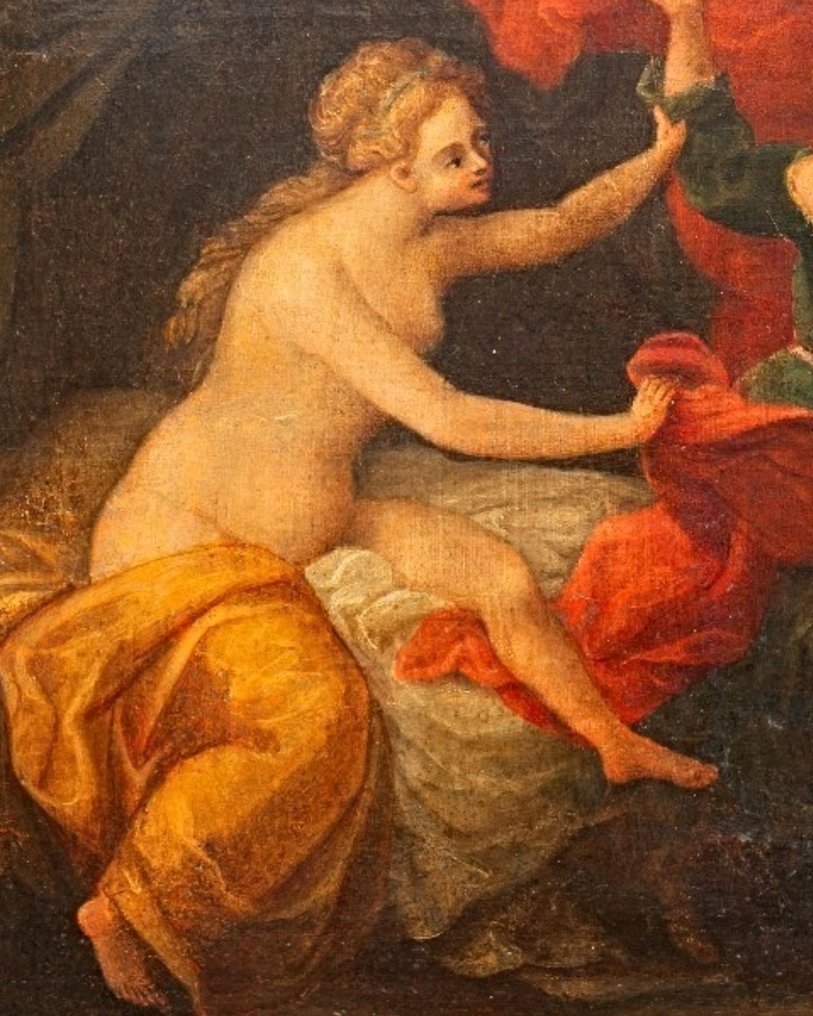
Giovanni Bilivert (1576-1644), Follower of - Giuseppe e la moglie di Putifarre



09
days
08
hours
12
minutes
33
seconds
Current bid
€ 2
Reserve price not met

12 other people are watching this object
 Bidder 7683 Bidder 7683 | €2 | |
|---|---|---|
 Bidder 2623 Bidder 2623 | €1 |
Catawiki Buyer Protection
Your payment’s safe with us until you receive your object.View details
Trustpilot 4.4 | 122529 reviews
Rated Excellent on Trustpilot.
Giuseppe e la moglie di Putifarre, an 18th‑century oil painting from Italy by a follower of Giovanni Bilivert, sold with frame.
AI-assisted summary
Description from the seller
Main features of the work
Giovanni Bilivert (1585–1644), follower of • “Joseph and Potiphar’s Wife” • Oil on canvas • 47×61 cm, 54×68 cm with frame • Gold wooden frame included • Provenance: Cardinal Vincenzo Vannutelli (1836-1930), dean of the College of Cardinals; inherited by his descendants
Opera belonging to the Italian Baroque movement.
Baroque style
The scene depicts the biblical episode narrated in Genesis (chapter 39), where Joseph flees from Potiphar's wife, who tries to hold him back by grabbing his cloak. The work reproduces the famous painting by Giovanni Bilivert, 'Joseph and Potiphar's Wife,' now housed at the Galleria Nazionale di Arte Antica at Palazzo Barberini in Rome, following its compositional layout. The dramatic gesture, the contrast between the bodies, and the movement of the drapery create an intense theatrical scene.
The work was created in the 18th century by a painter associated with the tradition of Giovanni Bilivert, who reproduces his style and composition without substantial variations. The scene, chiaroscuro, and drapery show a direct knowledge of the original painting kept at Palazzo Barberini. The attribution to a follower is based on comparisons with other 18th-century copies attributable to the same model, which was highly sought after by collectors of the time. The canvas is in good overall condition, while the period gilded frame shows some signs of age consistent with its age.
Giovanni Bilivert (Florence, 1585 – 1644) was one of the leading figures of seventeenth-century Florentine painting, trained in the workshop of Ludovico Cigoli and active for the Medici court as well as for prestigious religious and aristocratic commissions. His work, marked by compositional elegance and strong theatricality, contributed to shaping the Baroque language in the Tuscan area, in dialogue with the great masters of Italian Baroque such as Pietro da Cortona and Guido Reni. His narrative and luminous style became a reference point for numerous painters active between Florence and Rome.
The buyer will receive the artwork in carefully packed and sturdy packaging. Very fast shipping. Free pickup available in Monza/Milan.
Main features of the work
Giovanni Bilivert (1585–1644), follower of • “Joseph and Potiphar’s Wife” • Oil on canvas • 47×61 cm, 54×68 cm with frame • Gold wooden frame included • Provenance: Cardinal Vincenzo Vannutelli (1836-1930), dean of the College of Cardinals; inherited by his descendants
Opera belonging to the Italian Baroque movement.
Baroque style
The scene depicts the biblical episode narrated in Genesis (chapter 39), where Joseph flees from Potiphar's wife, who tries to hold him back by grabbing his cloak. The work reproduces the famous painting by Giovanni Bilivert, 'Joseph and Potiphar's Wife,' now housed at the Galleria Nazionale di Arte Antica at Palazzo Barberini in Rome, following its compositional layout. The dramatic gesture, the contrast between the bodies, and the movement of the drapery create an intense theatrical scene.
The work was created in the 18th century by a painter associated with the tradition of Giovanni Bilivert, who reproduces his style and composition without substantial variations. The scene, chiaroscuro, and drapery show a direct knowledge of the original painting kept at Palazzo Barberini. The attribution to a follower is based on comparisons with other 18th-century copies attributable to the same model, which was highly sought after by collectors of the time. The canvas is in good overall condition, while the period gilded frame shows some signs of age consistent with its age.
Giovanni Bilivert (Florence, 1585 – 1644) was one of the leading figures of seventeenth-century Florentine painting, trained in the workshop of Ludovico Cigoli and active for the Medici court as well as for prestigious religious and aristocratic commissions. His work, marked by compositional elegance and strong theatricality, contributed to shaping the Baroque language in the Tuscan area, in dialogue with the great masters of Italian Baroque such as Pietro da Cortona and Guido Reni. His narrative and luminous style became a reference point for numerous painters active between Florence and Rome.
The buyer will receive the artwork in carefully packed and sturdy packaging. Very fast shipping. Free pickup available in Monza/Milan.
Details
Artist
Giovanni Bilivert (1576-1644)
Sold with frame
Yes
Attribution
Follower of
Title of artwork
Giuseppe e la moglie di Putifarre
Technique
Oil painting
Signature
Not signed
Country of Origin
Italy
Condition
Good condition
Height
54 cm
Width
68 cm
Style
Baroque
Period
18th century
Sold by