Tomàs Viver Aymerich (1876–1951) - The girl and her doll



03
days
16
hours
00
minutes
08
seconds
Current bid
€ 41
Reserve price not met

6 other people are watching this object
 Bidder 8534 Bidder 8534 | €41 | |
|---|---|---|
 Bidder 9345 Bidder 9345 | €36 | |
| Bidder 9345 | €26 |
Catawiki Buyer Protection
Your payment’s safe with us until you receive your object.View details
Trustpilot 4.4 | 122529 reviews
Rated Excellent on Trustpilot.
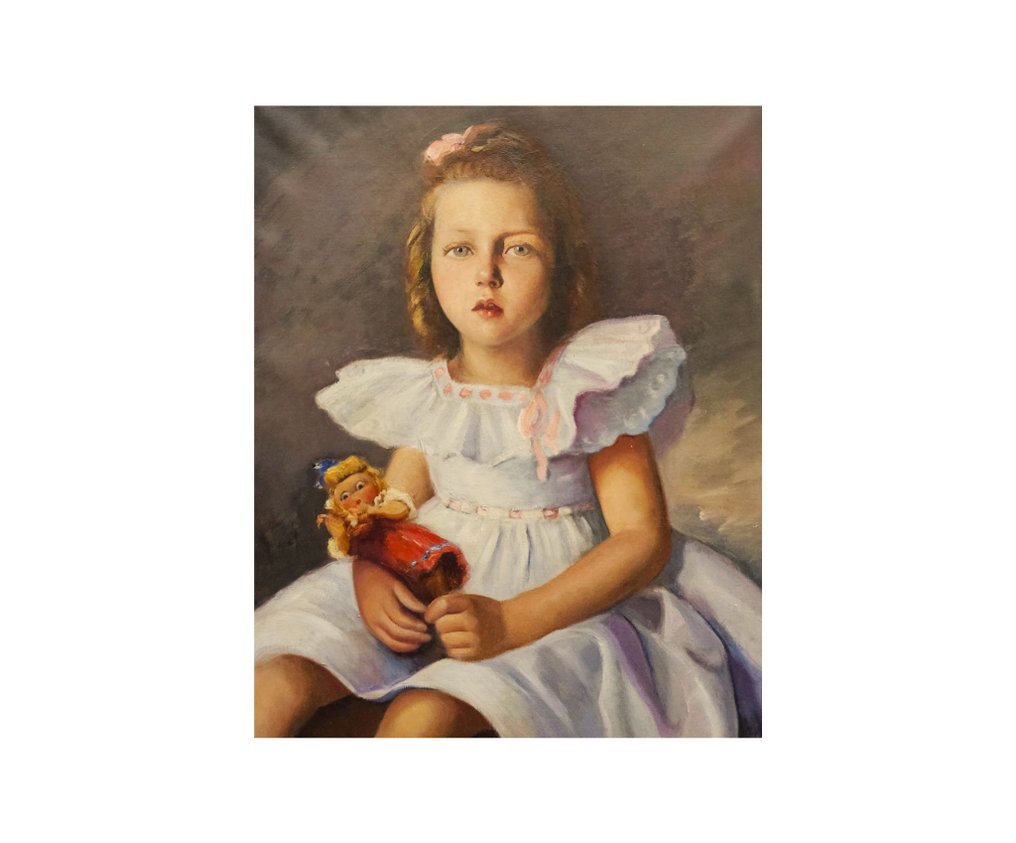
The Girl and Her Doll, an oil painting on canvas from Spain from 1940–1950 by Tomàs Viver Aymerich, sold with frame.
AI-assisted summary
Description from the seller
Tomàs Viver Aymerich (1876–1951)
The girl in the white dress and her doll.
Oil on canvas, 60 × 50 cm.
Marco: 75 × 65 cm
Technical sheet
Author: Tomàs Viver Aymerich (1876–1951)
School: Catalan, first half of the 20th century.
Technique: oil on canvas
Measurements: 60 × 50 cm (artwork); 75 × 65 cm (framed)
Signature: Signed in the bottom right corner.
Support: Canvas stretched on original frame.
Marco: Magnificent gilded frame with smooth reliefs featuring sinuous and elegant lines, which adds solemnity and enhances the portrait.
Condition: Good, with a homogeneous patina and fine craquelure consistent with its age.
2. Compositional and iconographic description
A work of exquisite sensitivity where Viver Aymerich depicts a girl in an introspective pose, dressed in a luminous white dress edged in pink tones. The palette, dominated by mauves and pearly whites, envelops the scene in a soft atmosphere that enhances the intimate character of the childhood portrait.
The girl holds a popular doll of the era — detailed with warm tones and an innocent expression — symbolizing innocence, affection, and inner world. The artist constructs the face with extraordinary precision: fixed gaze, slightly parted lips, and a frontal light caressing the skin, reminiscent of the great Catalan portraitists.
Viver demonstrates a technical mastery comparable to Modest Teixidor or Pablo Salinas, and the sweet and emotional finish recalls esteemed artists like Émile Munier or Godward in their treatment of idealized childhood.
3. Style, School, and Assessment
Tomàs Viver Aymerich was a prominent Catalan painter specializing in psychological portraiture, characterized by a pursuit of intimate expressiveness rather than solemn poses. This work synthesizes his stylistic maturity: refined naturalism, mastery of light, and delicate detailing that place the piece among the finest Catalan bourgeois portraits of the early 20th century.
The balanced composition, quality of modeling, and impeccable treatment of fabrics and leathers make this portrait a highly attractive piece for collectors of figurative and children's painting. Its rarity and excellent preservation increase its interest within the specialized market.
Seller's Story
At Barcelona Art Gallery, we are a large family of art collectors in Barcelona who have been acquiring all kinds of paintings for 2 centuries.
Headquartered in the Les Corts neighborhood of Barcelona.
We offer part of our private collection for auction: high period and modern paintings that we have been acquiring over time, mainly from art galleries, antique dealers, auctions, private collections and very diverse origins.
Translated by Google TranslateTomàs Viver Aymerich (1876–1951)
The girl in the white dress and her doll.
Oil on canvas, 60 × 50 cm.
Marco: 75 × 65 cm
Technical sheet
Author: Tomàs Viver Aymerich (1876–1951)
School: Catalan, first half of the 20th century.
Technique: oil on canvas
Measurements: 60 × 50 cm (artwork); 75 × 65 cm (framed)
Signature: Signed in the bottom right corner.
Support: Canvas stretched on original frame.
Marco: Magnificent gilded frame with smooth reliefs featuring sinuous and elegant lines, which adds solemnity and enhances the portrait.
Condition: Good, with a homogeneous patina and fine craquelure consistent with its age.
2. Compositional and iconographic description
A work of exquisite sensitivity where Viver Aymerich depicts a girl in an introspective pose, dressed in a luminous white dress edged in pink tones. The palette, dominated by mauves and pearly whites, envelops the scene in a soft atmosphere that enhances the intimate character of the childhood portrait.
The girl holds a popular doll of the era — detailed with warm tones and an innocent expression — symbolizing innocence, affection, and inner world. The artist constructs the face with extraordinary precision: fixed gaze, slightly parted lips, and a frontal light caressing the skin, reminiscent of the great Catalan portraitists.
Viver demonstrates a technical mastery comparable to Modest Teixidor or Pablo Salinas, and the sweet and emotional finish recalls esteemed artists like Émile Munier or Godward in their treatment of idealized childhood.
3. Style, School, and Assessment
Tomàs Viver Aymerich was a prominent Catalan painter specializing in psychological portraiture, characterized by a pursuit of intimate expressiveness rather than solemn poses. This work synthesizes his stylistic maturity: refined naturalism, mastery of light, and delicate detailing that place the piece among the finest Catalan bourgeois portraits of the early 20th century.
The balanced composition, quality of modeling, and impeccable treatment of fabrics and leathers make this portrait a highly attractive piece for collectors of figurative and children's painting. Its rarity and excellent preservation increase its interest within the specialized market.
Seller's Story
At Barcelona Art Gallery, we are a large family of art collectors in Barcelona who have been acquiring all kinds of paintings for 2 centuries.
Headquartered in the Les Corts neighborhood of Barcelona.
We offer part of our private collection for auction: high period and modern paintings that we have been acquiring over time, mainly from art galleries, antique dealers, auctions, private collections and very diverse origins.
Translated by Google TranslateDetails
Artist
Tomàs Viver Aymerich (1876–1951)
Sold with frame
Yes
Sold by
Gallery
Edition
Original
Title of artwork
The girl and her doll
Technique
Oil painting
Signature
Hand signed
Country of Origin
Spain
Condition
Good condition
Height
75 cm
Width
65 cm
Weight
5 kg
Depiction/Theme
Portrait
Style
Realism
Period
1940-1950
Sold by
