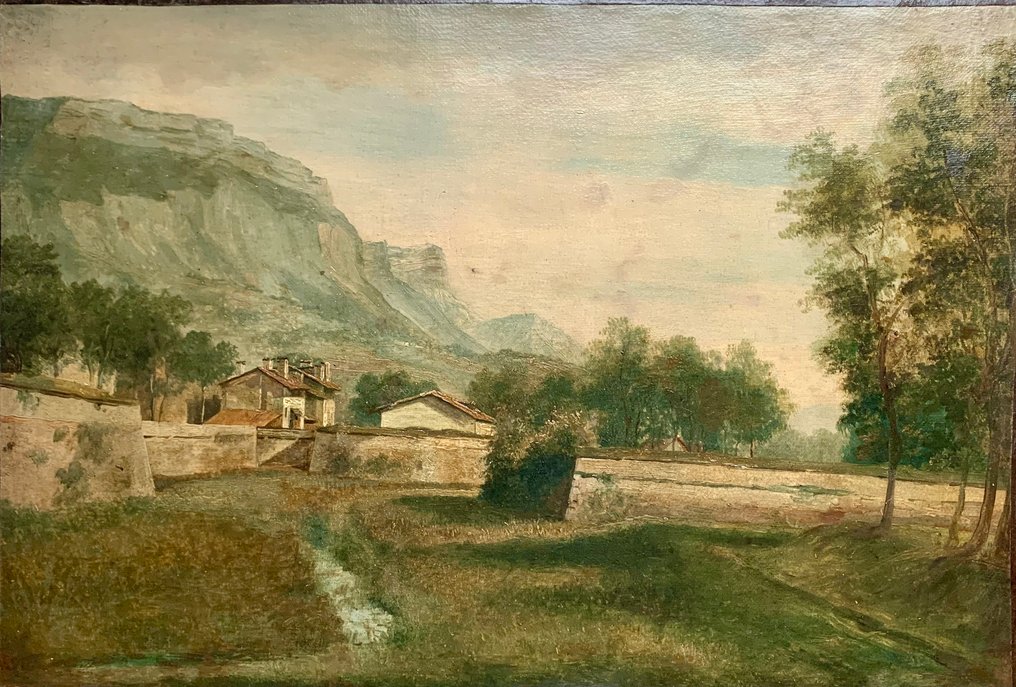
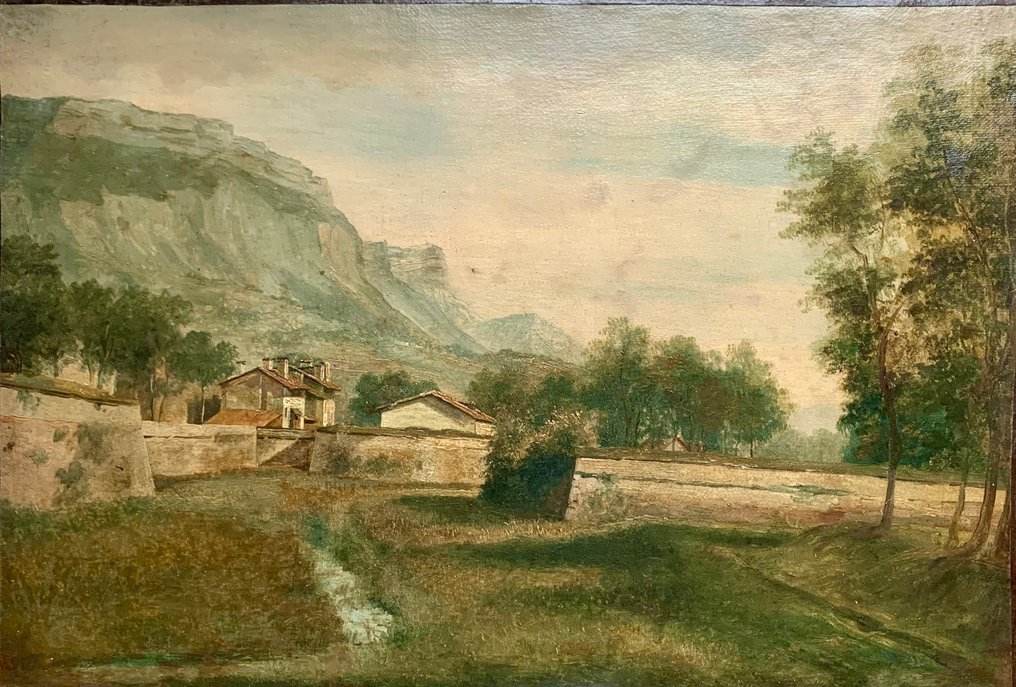
Ecole française du XIXème siècle, Attributed to - Vue prise au faubourg Très-Cloîtres



08
days
23
hours
01
minute
14
seconds
Starting bid
€ 1
Reserve price not met

Expert
Selected by Caroline Bokobza
Graduated as French auctioneer and worked in Sotheby’s Paris valuation department.
Estimate € 800 - € 900
No bids placed
Catawiki Buyer Protection
Your payment’s safe with us until you receive your object.View details
Trustpilot 4.4 | 122910 reviews
Rated Excellent on Trustpilot.
Vue prise au faubourg Très-Cloîtres, a 19th‑century French oil painting on paper mounted on canvas, attributed to an École française du XIXe siècle, depicting a landscape, with dimensions 26.5 × 38 cm, weight 500 g, unsigned, in good condition.
AI-assisted summary
Description from the seller
Formerly attributed to Wolfgang-Adam Töpffer (1766-1847), this oil on paper mounted on canvas depicts a view taken from the Très-Cloîtres suburb in Grenoble, towards the Chartreuse massif, probably the Dent de Crolles. The old inscription on the reverse ('faubourg tres cloitres') anchors the landscape in a specific site, treated with the same topographical accuracy and fresh light that characterize Töpffer's outdoor studies.
Through its composition with broad horizontal plans, its palette of muted greens and bluish grays, and its panoramic format typical of the artist's small oil sketches on paper, the work aligns with the neo-classical and pre-romantic landscape movement originating from Valenciennes and propagated in Geneva by Töpffer. He is one of the first Swiss painters to practice painting en plein air in the Alps and the Geneva region; several of his views of the surroundings of Geneva and Savoie, with similar technique and comparable dimensions, offer very convincing parallels with this painting.
The choice of the Très-Cloîtres suburb, to the east of Grenoble, is not accidental: in the early 19th century, this ancient neighborhood of convents and walls, in the process of secularization after the Revolution, marks the transition between the fortified city and the plains of Grésivaudan. Around 1810-1820, the likely period of the work, Grenoble becomes an entry point to the Alpine landscapes that fascinate Romantic travelers; this peaceful landscape, where modest architecture recedes before the mineral mass of the Chartreuse, reflects this new perspective on the mountain, at the crossroads of local history and the emergence of modern landscape painting.
In terms of its quality of execution and documentary interest, a work worthy of the collection of the Museum of Fine Arts of Grenoble.
Formerly attributed to Wolfgang-Adam Töpffer (1766-1847), this oil on paper mounted on canvas depicts a view taken from the Très-Cloîtres suburb in Grenoble, towards the Chartreuse massif, probably the Dent de Crolles. The old inscription on the reverse ('faubourg tres cloitres') anchors the landscape in a specific site, treated with the same topographical accuracy and fresh light that characterize Töpffer's outdoor studies.
Through its composition with broad horizontal plans, its palette of muted greens and bluish grays, and its panoramic format typical of the artist's small oil sketches on paper, the work aligns with the neo-classical and pre-romantic landscape movement originating from Valenciennes and propagated in Geneva by Töpffer. He is one of the first Swiss painters to practice painting en plein air in the Alps and the Geneva region; several of his views of the surroundings of Geneva and Savoie, with similar technique and comparable dimensions, offer very convincing parallels with this painting.
The choice of the Très-Cloîtres suburb, to the east of Grenoble, is not accidental: in the early 19th century, this ancient neighborhood of convents and walls, in the process of secularization after the Revolution, marks the transition between the fortified city and the plains of Grésivaudan. Around 1810-1820, the likely period of the work, Grenoble becomes an entry point to the Alpine landscapes that fascinate Romantic travelers; this peaceful landscape, where modest architecture recedes before the mineral mass of the Chartreuse, reflects this new perspective on the mountain, at the crossroads of local history and the emergence of modern landscape painting.
In terms of its quality of execution and documentary interest, a work worthy of the collection of the Museum of Fine Arts of Grenoble.
Details
Artist
Ecole française du XIXème siècle
Sold with frame
No
Attribution
Attributed to
Title of artwork
Vue prise au faubourg Très-Cloîtres
Technique
Oil painting
Signature
Not signed
Country of Origin
France
Condition
Good condition
Height
26.5 cm
Width
38 cm
Weight
500 g
Depiction/Theme
Landscape
Period
19th century
Sold by
