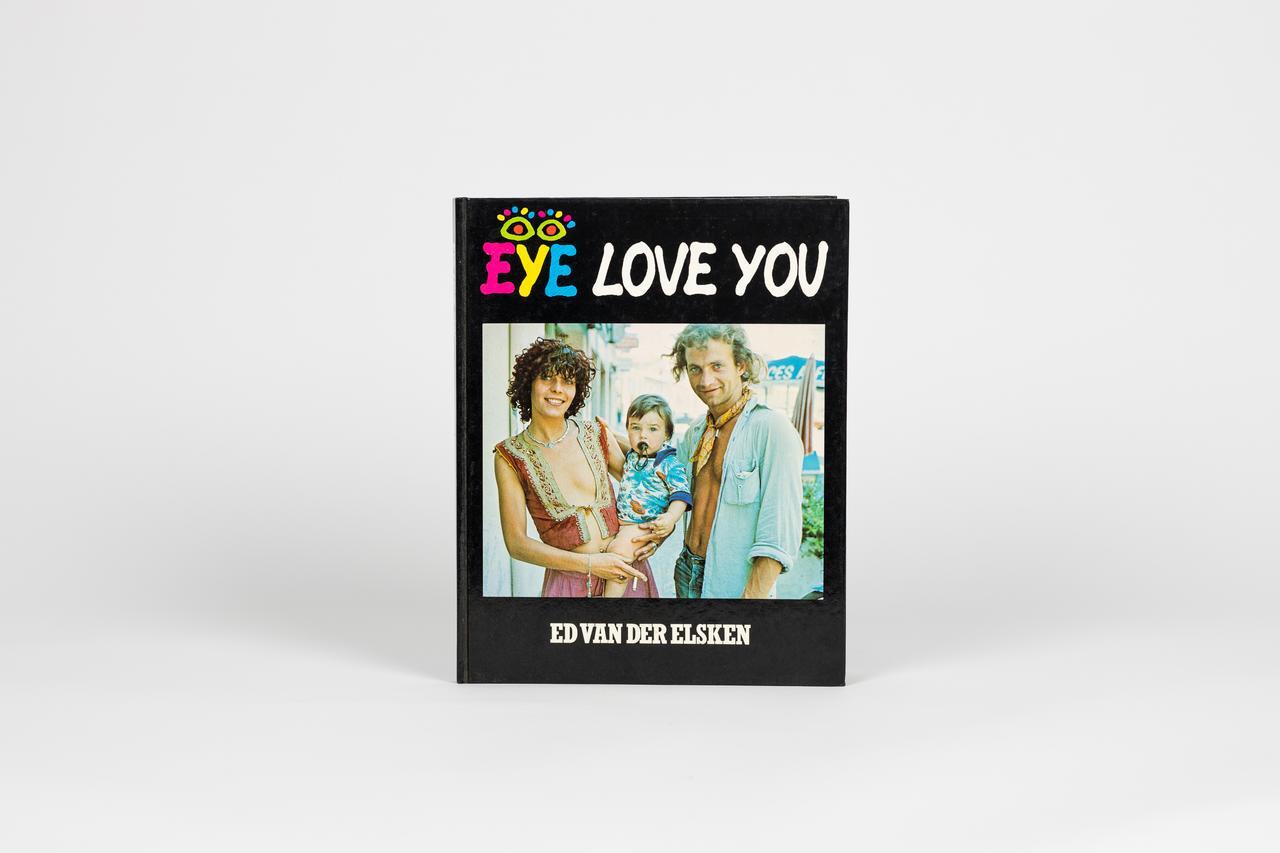
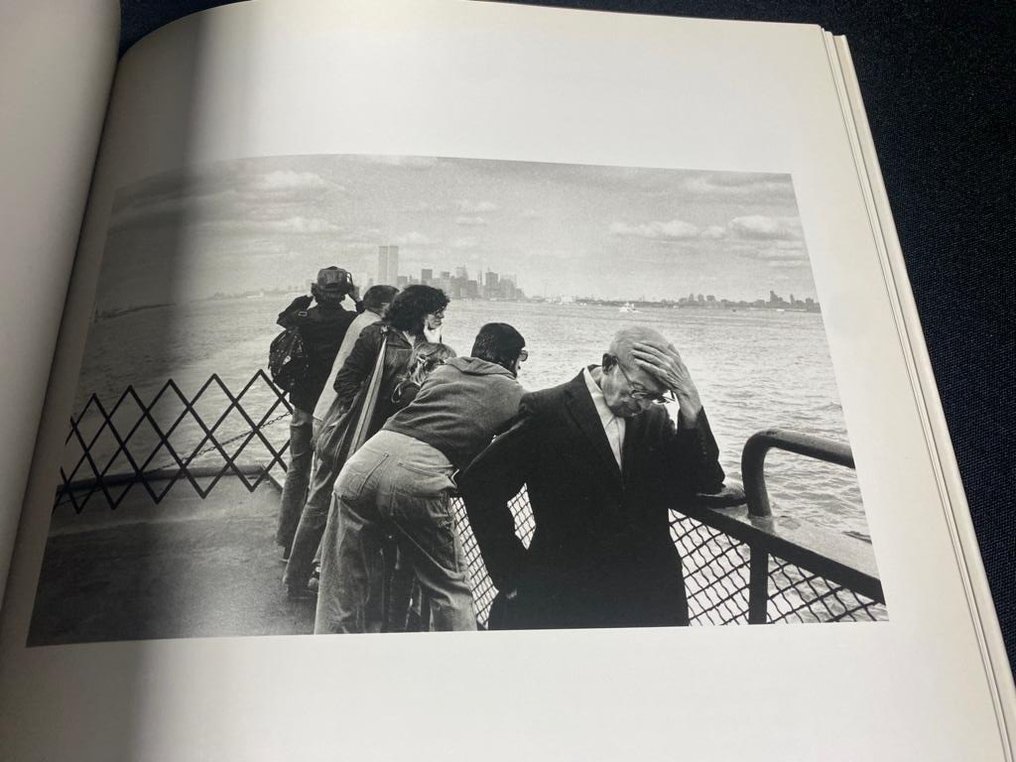
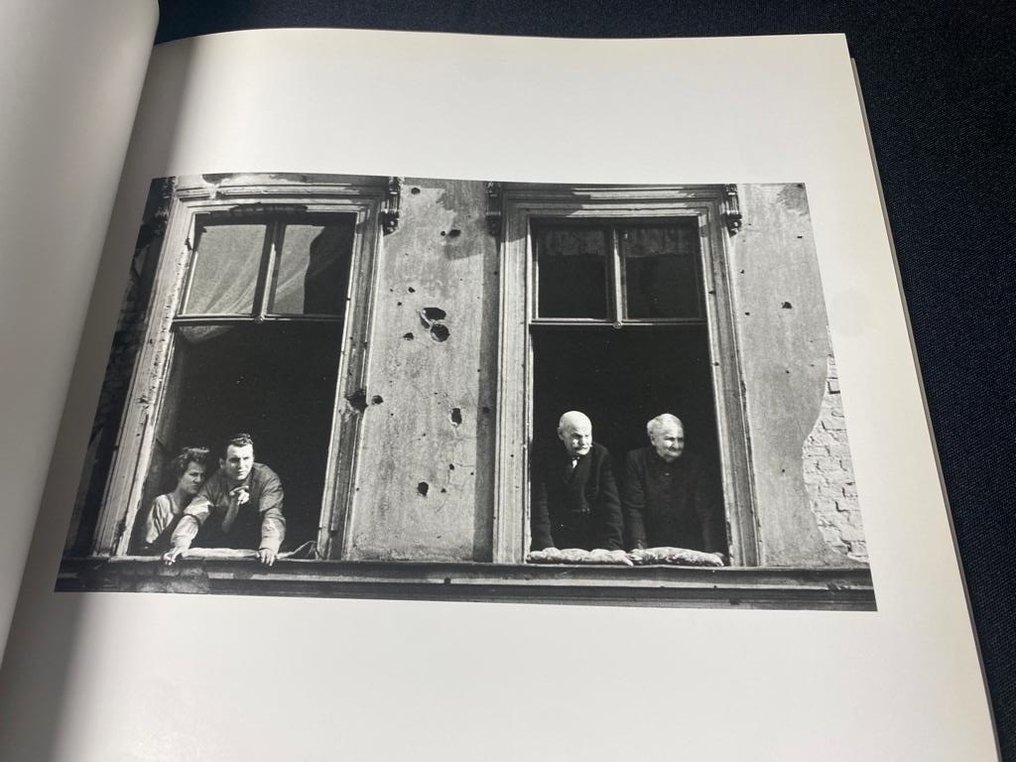
SIGNED; Arno Fischer - Photographien (FIRST BOOK, FIRST MONOGRAPH) - 1997



Opens 11:00
Starting bid
€ 1
Add to your favourites to get an alert when the auction starts.
Catawiki Buyer Protection
Your payment’s safe with us until you receive your object.View details
Trustpilot 4.4 | 122813 reviews
Rated Excellent on Trustpilot.
Description from the seller
THIS IS THE VERY FIRST PHOTOBOOK AUCTION ON CATAWIKI - dedicated entirely to the world of the former "DDR"/"GDR" ("GERMAN DEMOCRATIC REPUBLIC" or "EAST GERMANY") which existed from 1949 to 1990.
Still largely undiscovered and unexplored, this field offers a wealth of fascinating discoveries for collectors.
5Uhr30.com presents exceptional works by renowned and emerging artists, survey works, compelling monographs, as well as extraordinarily rare small vintage catalogues, vintage children’s books and vintage factory photobooks; signed publications, posters, and much more.
SUPER RARE OPPORTUNITY to purchase this VERY BEAUTIFUL FIRST BOOK AND MONOGRAPH by
Arno Fischer (1927-2011), one of the biggest and most influential figures in East German photography -
SIGNED BY THE ARTIST.
Signed books by Arno Fischer are scarce
I GUARANTEE THE AUTHENTICITY OF THE SIGNATURE.
Like always we guarantee detailed and accurate descriptions, 100% transport protection, 100% transport insurance, and of course, combined shipping - worldwide.
MAKE SURE YOU DON'T MISS THIS UNIQUE CHANCE!
Brought to you exclusively by 5Uhr30.com, Cologne, Germany.
Connewitzer Verlagsbuchhandlung, Leipzig. 1997. First edition, first printing.
Paperback with flaps. 250 x 290 mm. 158 pages. Photos: Arno Fischer. Edited by T.O. Immisch, Klaus E. Göltz. Text: Jutta Voigt, Andreas Krase. Text in German.
Condition:
Book inside clean with no marks and with no foxing and with no remakable flaws or defects. Book outside with well-preserved covers; spine yellowed. Overall fine condition.
Great monograph by Arno Fischer - rare opportunity to purchase this title signed.
"Arno Fischer was a German photographer and university teacher. Arno Fischer's father worked as a type setter. Arno attended school locally from 1933 till 1941 when he started training in aspects of carpentry (wood carving/modelling, pattern making). On reaching 17 he joined the army in 1944/45 concluding his military career as a prisoner of war held by the British, who released him in 1946.
He was able to resume his civilian life in 1947, studying at the Käthe Kollwitz art school in Berlin where initially he attended drawing classes before switching to (wood) sculpture. He moved on in 1948 to Berlin's Weißensee Arts Academy where he continued with his study of sculpture and where he remained till 1951. By this time the political division of Berlin between the eastern part, which was administered by the Soviets and the western parts of the city, divided into three sectors controlled respectively by the French, the British and the Americans, was looking more permanent than had been widely anticipated a few years earlier, and the move to Weißensee involved a move from West Berlin to East Berlin. He moved on again in 1951, and from then till 1953 he was a student at the (recently renamed) Weißensee Academy of Art Berlin back in West Berlin, studying sculpture under Alexander Gonda.
Later Fischer recalled that he took his first photograph in 1944, of Berlin burning as Germany's defeat in the war loomed. He never received any formal training in photography; but nor, after 1944, did he ever lose his interest in it, and as his studies progressed he became aware that he was unlikely ever to make much money out of sculpture. His move into the world of photography started in 1955/56 with a year as a laboratory assistant at an X-ray institute. In 1956 he returned to the Arts Academy in Weißensee with a mandate to set up an archive, work as a general assistant, and "take photographs". By 1957, still without any formal photographic training, he had a job with The Academy as Senior Assistant to Prof. Klaus Wittkugel, a position he retained till 1971.
In addition he undertook photo-journalistic assignments for the fashion and arts women's magazine Sibylle and for other periodicals. His growing body of fashion and travel photography from the second part of the 1950s were set firmly in the new "Life photography" mainstream. Fischer later said that the focus of his photography work was on the condition of society, the interpersonal relationships of people, the core condition of the individual and his/her existence. These features are abundantly evident in "Situation Berlin", another project on which he worked between 1953 and 1960. By 1960 he was working very intensively on preparing for publication by "Edition Leipzig" of the resulting collection, evoking the moods and sights of the rapidly changing city in the 1950s. Pictures from the book, by now fully written and prepared for launch, were on display on the publisher's stand at the Leipzig Book Fair in the Autumn of 1961. The fair was held very shortly after the government had suddenly started their feverish construction of the Berlin Wall which for the next (nearly) three decades would cut off East Berlin from the west. A group of officials stopped off at the publisher's stand to look at some of the pictures on display under the "Situation Berlin" banner. One said to the others the chilling words, "Berlin ist kein Situation mehr" ("Berlin is no longer a situation"). The reference was to the way that the exodus of East Germans to the west through Berlin had been blocked by the new wall, but the meaning for Arno Fischer and his publishers was that "Situation Berlin" was not going to be published within foreseeable time.
Arno Fischer was once asked whether in the wake of his experience with "Situation Berlin" he was ever tempted to try and escape from East Germany, but while he sometimes found the country's bureaucratic constraints limiting, he was generally accepting of the situation in which he found himself. A change of managing editor at "Sibylle" gave him freedom to develop, apply and promote his own ideas on fashion photography while status as a distinguished photo-journalist gave him excellent travel entitlements: some of his most celebrated fashion/celebrity shots, notably a set taken of Marlene Dietrich in 1964, were taken while traveling on assignment in Moscow. In 1965/66 he and a like minded group of East German photographers founded a Photographers' Group which in 1969 became known as "Direkt". Mutual acceptance of and by the establishment was also evident in the guest lectureship which he held in 1972/74 at the Higher Academy for Visual Arts (HGB / Hochschule für Grafik und Buchkunst) at Leipzig. From 1975 till 1982, together with Peter Voigt he was responsible for selecting the photographs shown on the Image Display Pillars flanking the Marx-Engels Forum which contained Ludwig Engelhardt's politically important Marx Engels Memorial. In 1981 Fischer was involved in the co-founding of the Photographers' Working Group in the national Visual Artists' Association (VBK) and 1983 he took a teaching contract back at the HGB where between 1985 and 1993 he held a position as Professor for Photographic Arts."
(Wikipedia)
Seller's Story
welcome to 5h30.
5Uhr30 is based in ehrenfeld, the trendiest neighborhood in cologne - with a shop and with a showroom for photography.
5H30 offers very rare, very beautiful, very special photobooks - sold-out, modern-antiquarian and antiquarian. we are also offering photo invitation cards, film and photo posters, photo catalogs and original photo prints.
5Uhr30 is specialized on german photo publications,
but also has an exciting range of photo books from all over europe, japan, north and south america. travel brochures, children's books, company brochures...everything that has to do with photography in the narrower or broader sense inspires us. please visit us if you are in cologne or the surrounding area. You will not regret it! :)
5:30 am always tries to offer the best condition.
5h30 is shipping worldwide, fast and safe -
with 100% protection, with full insurance and with tracking number.
please contact us by email, if you have any questions or if you are looking for something special, cause only a part of our offers are online.
Thanks for your interest.
ecki heuser and team
Translated by Google TranslateTHIS IS THE VERY FIRST PHOTOBOOK AUCTION ON CATAWIKI - dedicated entirely to the world of the former "DDR"/"GDR" ("GERMAN DEMOCRATIC REPUBLIC" or "EAST GERMANY") which existed from 1949 to 1990.
Still largely undiscovered and unexplored, this field offers a wealth of fascinating discoveries for collectors.
5Uhr30.com presents exceptional works by renowned and emerging artists, survey works, compelling monographs, as well as extraordinarily rare small vintage catalogues, vintage children’s books and vintage factory photobooks; signed publications, posters, and much more.
SUPER RARE OPPORTUNITY to purchase this VERY BEAUTIFUL FIRST BOOK AND MONOGRAPH by
Arno Fischer (1927-2011), one of the biggest and most influential figures in East German photography -
SIGNED BY THE ARTIST.
Signed books by Arno Fischer are scarce
I GUARANTEE THE AUTHENTICITY OF THE SIGNATURE.
Like always we guarantee detailed and accurate descriptions, 100% transport protection, 100% transport insurance, and of course, combined shipping - worldwide.
MAKE SURE YOU DON'T MISS THIS UNIQUE CHANCE!
Brought to you exclusively by 5Uhr30.com, Cologne, Germany.
Connewitzer Verlagsbuchhandlung, Leipzig. 1997. First edition, first printing.
Paperback with flaps. 250 x 290 mm. 158 pages. Photos: Arno Fischer. Edited by T.O. Immisch, Klaus E. Göltz. Text: Jutta Voigt, Andreas Krase. Text in German.
Condition:
Book inside clean with no marks and with no foxing and with no remakable flaws or defects. Book outside with well-preserved covers; spine yellowed. Overall fine condition.
Great monograph by Arno Fischer - rare opportunity to purchase this title signed.
"Arno Fischer was a German photographer and university teacher. Arno Fischer's father worked as a type setter. Arno attended school locally from 1933 till 1941 when he started training in aspects of carpentry (wood carving/modelling, pattern making). On reaching 17 he joined the army in 1944/45 concluding his military career as a prisoner of war held by the British, who released him in 1946.
He was able to resume his civilian life in 1947, studying at the Käthe Kollwitz art school in Berlin where initially he attended drawing classes before switching to (wood) sculpture. He moved on in 1948 to Berlin's Weißensee Arts Academy where he continued with his study of sculpture and where he remained till 1951. By this time the political division of Berlin between the eastern part, which was administered by the Soviets and the western parts of the city, divided into three sectors controlled respectively by the French, the British and the Americans, was looking more permanent than had been widely anticipated a few years earlier, and the move to Weißensee involved a move from West Berlin to East Berlin. He moved on again in 1951, and from then till 1953 he was a student at the (recently renamed) Weißensee Academy of Art Berlin back in West Berlin, studying sculpture under Alexander Gonda.
Later Fischer recalled that he took his first photograph in 1944, of Berlin burning as Germany's defeat in the war loomed. He never received any formal training in photography; but nor, after 1944, did he ever lose his interest in it, and as his studies progressed he became aware that he was unlikely ever to make much money out of sculpture. His move into the world of photography started in 1955/56 with a year as a laboratory assistant at an X-ray institute. In 1956 he returned to the Arts Academy in Weißensee with a mandate to set up an archive, work as a general assistant, and "take photographs". By 1957, still without any formal photographic training, he had a job with The Academy as Senior Assistant to Prof. Klaus Wittkugel, a position he retained till 1971.
In addition he undertook photo-journalistic assignments for the fashion and arts women's magazine Sibylle and for other periodicals. His growing body of fashion and travel photography from the second part of the 1950s were set firmly in the new "Life photography" mainstream. Fischer later said that the focus of his photography work was on the condition of society, the interpersonal relationships of people, the core condition of the individual and his/her existence. These features are abundantly evident in "Situation Berlin", another project on which he worked between 1953 and 1960. By 1960 he was working very intensively on preparing for publication by "Edition Leipzig" of the resulting collection, evoking the moods and sights of the rapidly changing city in the 1950s. Pictures from the book, by now fully written and prepared for launch, were on display on the publisher's stand at the Leipzig Book Fair in the Autumn of 1961. The fair was held very shortly after the government had suddenly started their feverish construction of the Berlin Wall which for the next (nearly) three decades would cut off East Berlin from the west. A group of officials stopped off at the publisher's stand to look at some of the pictures on display under the "Situation Berlin" banner. One said to the others the chilling words, "Berlin ist kein Situation mehr" ("Berlin is no longer a situation"). The reference was to the way that the exodus of East Germans to the west through Berlin had been blocked by the new wall, but the meaning for Arno Fischer and his publishers was that "Situation Berlin" was not going to be published within foreseeable time.
Arno Fischer was once asked whether in the wake of his experience with "Situation Berlin" he was ever tempted to try and escape from East Germany, but while he sometimes found the country's bureaucratic constraints limiting, he was generally accepting of the situation in which he found himself. A change of managing editor at "Sibylle" gave him freedom to develop, apply and promote his own ideas on fashion photography while status as a distinguished photo-journalist gave him excellent travel entitlements: some of his most celebrated fashion/celebrity shots, notably a set taken of Marlene Dietrich in 1964, were taken while traveling on assignment in Moscow. In 1965/66 he and a like minded group of East German photographers founded a Photographers' Group which in 1969 became known as "Direkt". Mutual acceptance of and by the establishment was also evident in the guest lectureship which he held in 1972/74 at the Higher Academy for Visual Arts (HGB / Hochschule für Grafik und Buchkunst) at Leipzig. From 1975 till 1982, together with Peter Voigt he was responsible for selecting the photographs shown on the Image Display Pillars flanking the Marx-Engels Forum which contained Ludwig Engelhardt's politically important Marx Engels Memorial. In 1981 Fischer was involved in the co-founding of the Photographers' Working Group in the national Visual Artists' Association (VBK) and 1983 he took a teaching contract back at the HGB where between 1985 and 1993 he held a position as Professor for Photographic Arts."
(Wikipedia)
Seller's Story
welcome to 5h30.
5Uhr30 is based in ehrenfeld, the trendiest neighborhood in cologne - with a shop and with a showroom for photography.
5H30 offers very rare, very beautiful, very special photobooks - sold-out, modern-antiquarian and antiquarian. we are also offering photo invitation cards, film and photo posters, photo catalogs and original photo prints.
5Uhr30 is specialized on german photo publications,
but also has an exciting range of photo books from all over europe, japan, north and south america. travel brochures, children's books, company brochures...everything that has to do with photography in the narrower or broader sense inspires us. please visit us if you are in cologne or the surrounding area. You will not regret it! :)
5:30 am always tries to offer the best condition.
5h30 is shipping worldwide, fast and safe -
with 100% protection, with full insurance and with tracking number.
please contact us by email, if you have any questions or if you are looking for something special, cause only a part of our offers are online.
Thanks for your interest.
ecki heuser and team
Translated by Google TranslateDetails
Number of Books
1
Subject
Art, Photography
Book Title
Photographien (FIRST BOOK, FIRST MONOGRAPH)
Author/ Illustrator
SIGNED; Arno Fischer
Condition
Very good
Publication year oldest item
1997
Height
290 mm
Edition
1st Edition
Width
250 mm
Language
German
Original language
Yes
Publisher
Connewitzer Verlagsbuchhandlung, Leipzig
Binding/ Material
Softback
Extras
Dust jacket, Signed
Number of pages
158
Sold by
GermanyVerified
protop
Rechtliche Informationen des Verkäufers
- Unternehmen:
- 5Uhr30.com
- Repräsentant:
- Ecki Heuser
- Adresse:
- 5Uhr30.com
Thebäerstr. 34
50823 Köln
GERMANY - Telefonnummer:
- +491728184000
- Email:
- photobooks@5Uhr30.com
- USt-IdNr.:
- DE154811593
AGB
AGB des Verkäufers. Mit einem Gebot auf dieses Los akzeptieren Sie ebenfalls die AGB des Verkäufers.
Widerrufsbelehrung
- Frist: 14 Tage sowie gemäß den hier angegebenen Bedingungen
- Rücksendkosten: Käufer trägt die unmittelbaren Kosten der Rücksendung der Ware
- Vollständige Widerrufsbelehrung