Mario Logli - Staccionata


00
days
22
hours
20
minutes
09
seconds

9 other people are watching this object
 Bidder 4138 Bidder 4138 | €1 |
|---|
Catawiki Buyer Protection
Your payment’s safe with us until you receive your object.View details
Trustpilot 4.4 | 122630 reviews
Rated Excellent on Trustpilot.
Description from the seller
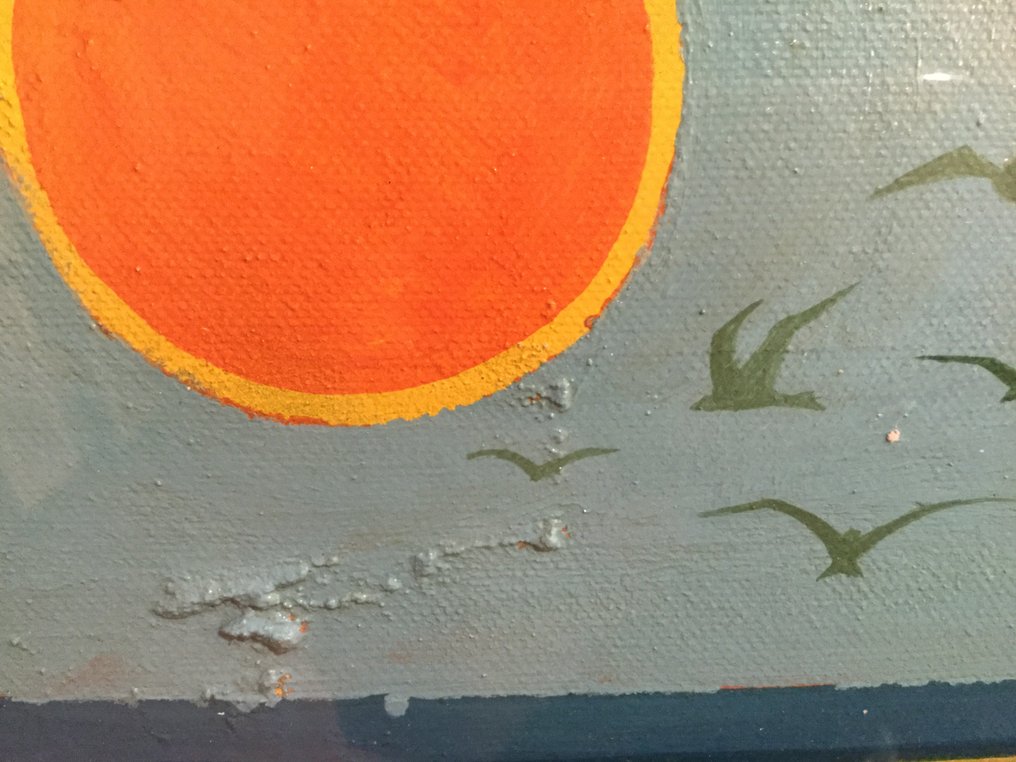
Oil on canvas from 1972 by Mario Logli.
Mario Logli was born in Urbino in 1933 and trained at the School of the Book in the Lithography section directed by Carlo Ceci. The School for Illustration and Decoration of the Book has an extensive library, and the stylistics teacher, initially Francesco Carnevali and later Carlo Ceci, guided students to study theatrical literature and interpret texts, staging real performances as an educational program aimed at illustrating a story.
A significant moment in the apprenticeship of art is the subsequent attendance at the workshop of the ceramist Armando De Santi.
In 1955, he moved to Milan, called to carry out his activity at Garzanti publishing house. In the Lombard capital, Logli could put to good use his knowledge through contact with directors and set designers of great intelligence, and also bring theatrical elements into painting as a sign of the memory of places—Urbino and the towns of the Marche region, situated on hills like Recanati or touched by the sea like Senigallia—visible repositories of history.
From 1964 to 2002, he was responsible for the illustrative department of the Istituto Geografico De Agostini. At the same time, he collaborated with Ezio Frigerio, designing theatrical costumes for the Piccolo, then led by Strehler. His first recognition as a painter came in 1970 at the Galleria Libreria di Porta Romana, where he exhibited No-Man-Land, presented by Marco Valsecchi. The unsettling theme of Earth's pollution by humans was explored further in 1975 with The Invaders.
Each exhibition gathers around a theme a series of works, so in 1980 the 'Flying Islands' are born and in 1982 'After the Triumphs,' for which Paolo Volponi writes among other things: 'Obsessively Urbinate is his group of works, and not only or even mainly because of the subjects but precisely because of the essence, the internal quality that is recognized in each painting as a work of art of the poured and irresistible climate of Urbino: dimension, flow, quiet catastrophe. And also because it still contains within itself, after thirty years of the painter's practice, ingredients, ferments, recipes, manipulations typical of the glorious School of the Book, already in the low rooms of the Ducal Palace: all its virtues of application, research, control, material, hand, and also its small faults of insistence, meticulousness.'
In the same year, on the same subject, Carlo Bo intervenes: 'What is Urbino in memory? Logli has been providing a satisfying answer for years, to the point of not fearing contradictions. More than the places, he refers to ideas, inner images of the heart, and along this path, he ends up touching the true point of the matter: recreating, passing through the filter of intelligence two or three essential categories or those that are essential for him.'
From 1984 is the Teatro delle memorie and from 1987 Archeologie del futuro, presented by Enrico Baj.
In Raffaele De Grada's introduction to Geometrie lunari of 1987, it is felt that Logli was born in Urbino, and that his way of framing the picture reflects distant and sober spatial visions, for which it is also possible to invoke the great shadows of the masters of the past in the sense of a mental disposition.
Thanks to the exhibition 'Windows of the Soul,' organized in Recanati in 1988 for the Leopardian celebrations, Logli can be present in the main museums around the world.
Following in 1992 are 'Silent Nature' and in 1996 'Architectures of the Soul,' with the presentation by Rossana Bossaglia.
From 1997 to 2008, exhibitions such as 'Città in fuga', 'Città del sogno', held in Urbino and San Marino, 'Tra terra e cielo', 'Il sogno dei Duchi', and 'I luoghi del ritorno' in Recanati for Beniamino Gigli took place. In 2010, in Senigallia, he exhibited 'Lieti colli e spaziosi campi', dedicated to his friend Giacomelli, for which Carlo Emanuele Bugatti wrote: 'Logli entered the history of Italian art partly as a singer and partly as a prophet. He will remain because his works will fit well in any modern art museum, representing the anxieties and splendors of the end of the millennium. Provided that museums do not escape into space, with their cities.'
It was reported in 1973 and ’74 in the Bolaffi catalogs. It was chosen by a jury of European critics among the five best Italian artists of the moment. As a guest, it participated in the Festival dei Due Mondi in Spoleto and at European Art in Japan at the Museo Laforet in Tokyo. Among the many awards, mention should be made of the Ambrogino d’oro of Milan, the Lombardy Prize, and the award for Fantastic Art in Stuttgart.
Oil on canvas from 1972 by Mario Logli.
Mario Logli was born in Urbino in 1933 and trained at the School of the Book in the Lithography section directed by Carlo Ceci. The School for Illustration and Decoration of the Book has an extensive library, and the stylistics teacher, initially Francesco Carnevali and later Carlo Ceci, guided students to study theatrical literature and interpret texts, staging real performances as an educational program aimed at illustrating a story.
A significant moment in the apprenticeship of art is the subsequent attendance at the workshop of the ceramist Armando De Santi.
In 1955, he moved to Milan, called to carry out his activity at Garzanti publishing house. In the Lombard capital, Logli could put to good use his knowledge through contact with directors and set designers of great intelligence, and also bring theatrical elements into painting as a sign of the memory of places—Urbino and the towns of the Marche region, situated on hills like Recanati or touched by the sea like Senigallia—visible repositories of history.
From 1964 to 2002, he was responsible for the illustrative department of the Istituto Geografico De Agostini. At the same time, he collaborated with Ezio Frigerio, designing theatrical costumes for the Piccolo, then led by Strehler. His first recognition as a painter came in 1970 at the Galleria Libreria di Porta Romana, where he exhibited No-Man-Land, presented by Marco Valsecchi. The unsettling theme of Earth's pollution by humans was explored further in 1975 with The Invaders.
Each exhibition gathers around a theme a series of works, so in 1980 the 'Flying Islands' are born and in 1982 'After the Triumphs,' for which Paolo Volponi writes among other things: 'Obsessively Urbinate is his group of works, and not only or even mainly because of the subjects but precisely because of the essence, the internal quality that is recognized in each painting as a work of art of the poured and irresistible climate of Urbino: dimension, flow, quiet catastrophe. And also because it still contains within itself, after thirty years of the painter's practice, ingredients, ferments, recipes, manipulations typical of the glorious School of the Book, already in the low rooms of the Ducal Palace: all its virtues of application, research, control, material, hand, and also its small faults of insistence, meticulousness.'
In the same year, on the same subject, Carlo Bo intervenes: 'What is Urbino in memory? Logli has been providing a satisfying answer for years, to the point of not fearing contradictions. More than the places, he refers to ideas, inner images of the heart, and along this path, he ends up touching the true point of the matter: recreating, passing through the filter of intelligence two or three essential categories or those that are essential for him.'
From 1984 is the Teatro delle memorie and from 1987 Archeologie del futuro, presented by Enrico Baj.
In Raffaele De Grada's introduction to Geometrie lunari of 1987, it is felt that Logli was born in Urbino, and that his way of framing the picture reflects distant and sober spatial visions, for which it is also possible to invoke the great shadows of the masters of the past in the sense of a mental disposition.
Thanks to the exhibition 'Windows of the Soul,' organized in Recanati in 1988 for the Leopardian celebrations, Logli can be present in the main museums around the world.
Following in 1992 are 'Silent Nature' and in 1996 'Architectures of the Soul,' with the presentation by Rossana Bossaglia.
From 1997 to 2008, exhibitions such as 'Città in fuga', 'Città del sogno', held in Urbino and San Marino, 'Tra terra e cielo', 'Il sogno dei Duchi', and 'I luoghi del ritorno' in Recanati for Beniamino Gigli took place. In 2010, in Senigallia, he exhibited 'Lieti colli e spaziosi campi', dedicated to his friend Giacomelli, for which Carlo Emanuele Bugatti wrote: 'Logli entered the history of Italian art partly as a singer and partly as a prophet. He will remain because his works will fit well in any modern art museum, representing the anxieties and splendors of the end of the millennium. Provided that museums do not escape into space, with their cities.'
It was reported in 1973 and ’74 in the Bolaffi catalogs. It was chosen by a jury of European critics among the five best Italian artists of the moment. As a guest, it participated in the Festival dei Due Mondi in Spoleto and at European Art in Japan at the Museo Laforet in Tokyo. Among the many awards, mention should be made of the Ambrogino d’oro of Milan, the Lombardy Prize, and the award for Fantastic Art in Stuttgart.
Details
Artist
Mario Logli
Sold with frame
Yes
Sold by
Owner or reseller
Edition
Original
Title of artwork
Staccionata
Technique
Oil painting
Signature
Signed
Country of Origin
Italy
Year
1972
Condition
Excellent condition
Height
40 cm
Width
60 cm
Depiction/Theme
Landscape
Style
Contemporary
Period
1970-1980
Sold by
