Jussepe de Ribera (1591-1652), Manner of, After - San Pablo



07
days
10
hours
49
minutes
27
seconds
Current bid
€ 600
Reserve price not met

Expert
Selected by Caterina Maffeis
Master in early Renaissance Italian painting with internship at Sotheby’s and 15 years' experience.
Estimate € 1,500 - € 2,000
15 other people are watching this object
 Bidder 4189 Bidder 4189 | €600 |
|---|
Catawiki Buyer Protection
Your payment’s safe with us until you receive your object.View details
Trustpilot 4.4 | 122986 reviews
Rated Excellent on Trustpilot.
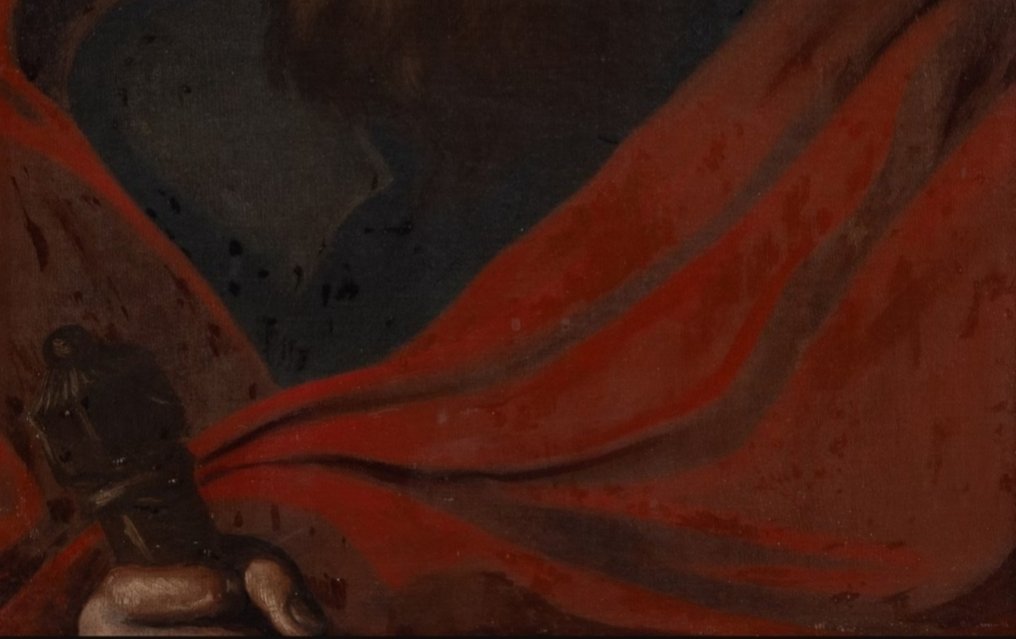
San Pablo, oil on canvas in the Baroque style from 17th-century Italy, attributed to the manner of Jusepe de Ribera, 68 × 50 cm, weighs about 5 kg, sold with frame.
AI-assisted summary
Description from the seller
It was possibly a commission from a religious institution to the Neapolitan workshop of Jusepe de Ribera.
Bartolomeo Passante (1618–1648)
Direct or very close disciple of Ribera.
Hard modeling, deep shadows, figures in strong introspection.
Ochre carnations, beard treated with heavy material.
Their saints and philosophers have exactly this blend of tenebrism and severity.
Your painting shares with Passante.
✓ front illuminated with intensity
Pronounced wrinkles
earth-toned colorful
Absolute black background
Saint Paul with a sword grip
Academic description
Oil on canvas adhered to a panel support.
The work depicts Saint Paul, identified by the hilt of the sword — a symbol of both his martyrdom and the 'sword of the Spirit' (Eph 6:17). The figure appears cut out against a dark, compact background, illuminated by a strong lateral spotlight that models the face and bald head with raw and direct naturalism. The treatment of the flesh tones, achieved through abrupt contrasts and a marked sense of volume, as well as the compositional austerity, reveal a clear affiliation with Neapolitan naturalism of the first half of the 17th century.
The hard and sculptural modeling of the features, with wrinkles defined by clean planes and areas of dense shadow, approaches the pictorial resources of José de Ribera's environment (1591–1652), whose influence dominated Neapolitan painting between 1620 and 1640. The work shows affinities with the production of the master's closest followers, including Bartolomeo Passante, Battistello Caracciolo, and the brothers Francesco and Cesare Fracanzano, all characterized by a strict assimilation of Caravaggist naturalism and a sustained interest in depicting apostles, philosophers, and half-length figures in meditative poses.
The composition, stripped of accessory elements, and the psychological intensity of the face suggest that the work belongs to an intimate devotional context, possibly intended for a private oratory or a meditation space. The presence of a canvas later adhered to a panel indicates a conservation intervention from an earlier period—probably the 18th or 19th century—that has contributed to the stability of the support.
The framed artwork measures 88cm x 70cm. Restored in the mid-20th century with the canvas flattened onto the board, I confirm the good preservation of the piece, as the craquelure is practically nonexistent.
The frame is a gift that accompanies the painting.
It was possibly a commission from a religious institution to the Neapolitan workshop of Jusepe de Ribera.
Bartolomeo Passante (1618–1648)
Direct or very close disciple of Ribera.
Hard modeling, deep shadows, figures in strong introspection.
Ochre carnations, beard treated with heavy material.
Their saints and philosophers have exactly this blend of tenebrism and severity.
Your painting shares with Passante.
✓ front illuminated with intensity
Pronounced wrinkles
earth-toned colorful
Absolute black background
Saint Paul with a sword grip
Academic description
Oil on canvas adhered to a panel support.
The work depicts Saint Paul, identified by the hilt of the sword — a symbol of both his martyrdom and the 'sword of the Spirit' (Eph 6:17). The figure appears cut out against a dark, compact background, illuminated by a strong lateral spotlight that models the face and bald head with raw and direct naturalism. The treatment of the flesh tones, achieved through abrupt contrasts and a marked sense of volume, as well as the compositional austerity, reveal a clear affiliation with Neapolitan naturalism of the first half of the 17th century.
The hard and sculptural modeling of the features, with wrinkles defined by clean planes and areas of dense shadow, approaches the pictorial resources of José de Ribera's environment (1591–1652), whose influence dominated Neapolitan painting between 1620 and 1640. The work shows affinities with the production of the master's closest followers, including Bartolomeo Passante, Battistello Caracciolo, and the brothers Francesco and Cesare Fracanzano, all characterized by a strict assimilation of Caravaggist naturalism and a sustained interest in depicting apostles, philosophers, and half-length figures in meditative poses.
The composition, stripped of accessory elements, and the psychological intensity of the face suggest that the work belongs to an intimate devotional context, possibly intended for a private oratory or a meditation space. The presence of a canvas later adhered to a panel indicates a conservation intervention from an earlier period—probably the 18th or 19th century—that has contributed to the stability of the support.
The framed artwork measures 88cm x 70cm. Restored in the mid-20th century with the canvas flattened onto the board, I confirm the good preservation of the piece, as the craquelure is practically nonexistent.
The frame is a gift that accompanies the painting.
Details
Artist
Jussepe de Ribera (1591-1652), Manner of
Sold with frame
Yes
Attribution
After
Title of artwork
San Pablo
Technique
Oil painting
Signature
Not signed
Country of Origin
Italy
Condition
Good condition
Height
68 cm
Width
50 cm
Weight
5 kg
Depiction/Theme
Religion
Style
Baroque
Period
17th century
Sold by
