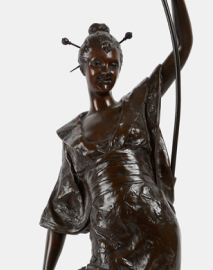
Sculpture, Pan con pifferi - 71 cm - Patinated bronze


03
days
18
hours
53
minutes
44
seconds
Current bid
€ 60
Reserve price not met

Expert
Selected by Paul Wullems
He accumulated 18 years' experience, worked as junior specialist at Sotheby’s and managed Kunsthandel Jacques Fijnaut.
Estimate € 1,300 - € 1,600
17 other people are watching this object
 Bidder 3943 Bidder 3943 | €60 | |
|---|---|---|
 Bidder 5030 Bidder 5030 | €5 | |
| Bidder 2633 | €4 | |
Catawiki Buyer Protection
Your payment’s safe with us until you receive your object.View details
Trustpilot 4.4 | 122190 reviews
Rated Excellent on Trustpilot.
Description from the seller
Bronze Sculpture – Faun with Pipes
Italy, lost wax casting
This precious sculpture depicting the Faunus musician is born from the elegant reinterpretation of some drawings found in the excavations of Pompeii and of a fresco now preserved at the National Archaeological Museum of Naples.
The work brings to life the ancient rural deity: a being with goat legs, a flowing tail, and a human torso, caught in the act of playing the pipes, an instrument traditionally associated with him.
Central figure of the Greek-Roman imaginary, the Faun – identified in Greek tradition with Pan – is the god of forests, pastures, and wild life. Symbol of joyful freedom, vitality, celebration, and unspoiled nature, he embodies the primordial energy of the rural world and the thrill of music that arises directly from the earth.
The input is a dash character, which does not require translation.
Characteristics
Material: Bronze – lost-wax casting
• Base: Bronze – lost wax casting
Dimensions: 71 × 36 × 24.5 cm
Base height: 18 cm.
Weight: 14 kg
Production: Italy
The input is a dash character, which does not require translation.
Historical and Mythological Notes
The Faun, according to myth, did not dwell on Mount Olympus but in the wild woods, where his impetuous voice could intimidate anyone daring to disturb him. As a deity of fields and pastures, he is the protagonist of numerous legends that also recount his origins: in some traditions, he is the son of Zeus and the nymph Callisto.
It expresses nature in all its nuances, benevolent and feral, and is associated with fertility and the pleasure of free life. It is attributed to the birth of the Pan flute: the nymph Siringa, chased by the god, was transformed by the Naiads into a marsh reed; the wind blowing through the stalks produced a sound so sweet that the Faun decided to make it into a musical instrument.
The input is a dash character, which does not require translation.
Maintenance
To preserve the brilliance of bronze, it is recommended to clean it regularly with a soft, dry cloth. Avoid the use of harsh chemical products, which could compromise its patina.
Bronze Sculpture – Faun with Pipes
Italy, lost wax casting
This precious sculpture depicting the Faunus musician is born from the elegant reinterpretation of some drawings found in the excavations of Pompeii and of a fresco now preserved at the National Archaeological Museum of Naples.
The work brings to life the ancient rural deity: a being with goat legs, a flowing tail, and a human torso, caught in the act of playing the pipes, an instrument traditionally associated with him.
Central figure of the Greek-Roman imaginary, the Faun – identified in Greek tradition with Pan – is the god of forests, pastures, and wild life. Symbol of joyful freedom, vitality, celebration, and unspoiled nature, he embodies the primordial energy of the rural world and the thrill of music that arises directly from the earth.
The input is a dash character, which does not require translation.
Characteristics
Material: Bronze – lost-wax casting
• Base: Bronze – lost wax casting
Dimensions: 71 × 36 × 24.5 cm
Base height: 18 cm.
Weight: 14 kg
Production: Italy
The input is a dash character, which does not require translation.
Historical and Mythological Notes
The Faun, according to myth, did not dwell on Mount Olympus but in the wild woods, where his impetuous voice could intimidate anyone daring to disturb him. As a deity of fields and pastures, he is the protagonist of numerous legends that also recount his origins: in some traditions, he is the son of Zeus and the nymph Callisto.
It expresses nature in all its nuances, benevolent and feral, and is associated with fertility and the pleasure of free life. It is attributed to the birth of the Pan flute: the nymph Siringa, chased by the god, was transformed by the Naiads into a marsh reed; the wind blowing through the stalks produced a sound so sweet that the Faun decided to make it into a musical instrument.
The input is a dash character, which does not require translation.
Maintenance
To preserve the brilliance of bronze, it is recommended to clean it regularly with a soft, dry cloth. Avoid the use of harsh chemical products, which could compromise its patina.
Details
Era
1900-2000
Bronze type
Patinated bronze
Country of Origin
Italy
Style
Antique
Material
Bronze
Title of artwork
Pan con pifferi
Signature
Not signed
Condition
Excellent condition
Height
71 cm
Width
36 cm
Depth
24 cm
Weight
10 kg
Sold by