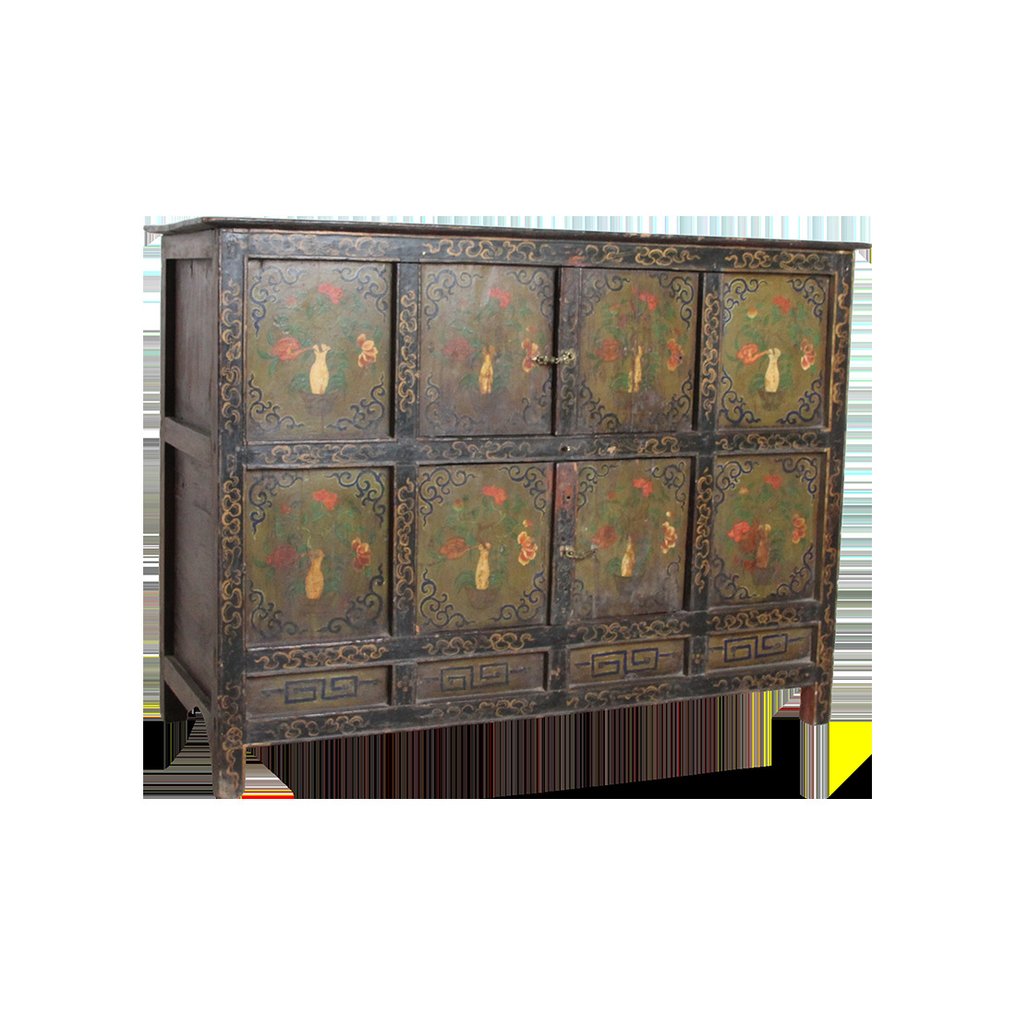
Tibetan Altar Cabinet - Softwood - Nepal - 19th century


Opens Friday
Starting bid
€ 1
Add to your favourites to get an alert when the auction starts.

Expert
Selected by Surya Rutten
Has over 25 years' experience in Asian art and owned an art gallery.
Estimate € 1,900 - € 2,100
Catawiki Buyer Protection
Your payment’s safe with us until you receive your object.View details
Trustpilot 4.4 | 123113 reviews
Rated Excellent on Trustpilot.
Description from the seller
Tibetan Altar Cabinet
19th Century
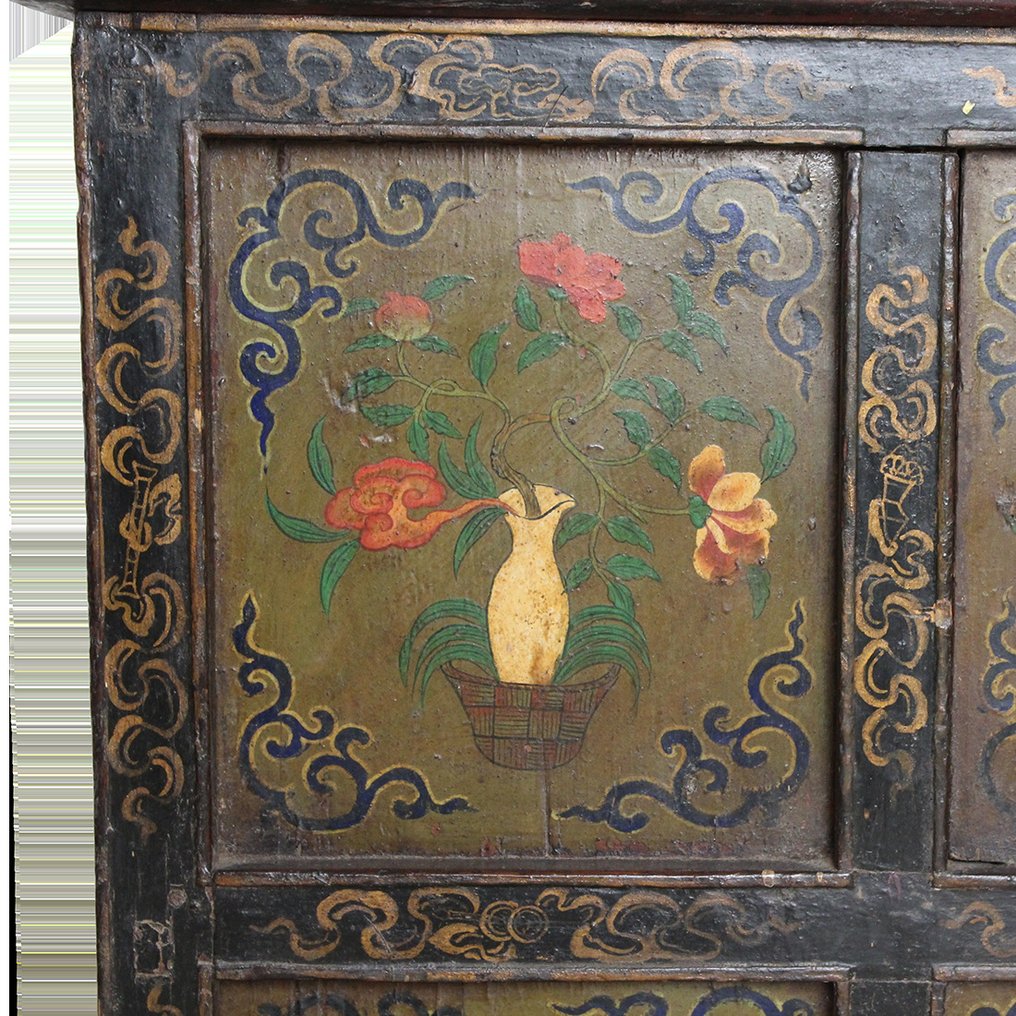
Green painted with lotus flowers
-8 panels on the front side
Dimensions: W135 x D54 x H99 cm
This antique Tibetan cabinet with a greenish background features paintings of lotus flowers on all panels. The lotus flower symbolizes the primordial purity of body, speech, and mind, floating above the muddy waters of attachment and desire.
The four front doors open fully, allowing easy access to the interior space.
Doors are finished with a carved brass lock.
The cabinet is hand-hewn with an axe, which underscores its originality.
We were able to buy a collection of old Tibetan cabinets 4-5 years ago.
They came from Tibet to Nepal and were moved from Nepal to India in 2012.
Certificates are in place.
Tibetan cabinets
In ancient Tibet, widespread use of wooden furniture was not common, as it was restricted to monasteries and the upper and middle classes of Tibetans. The population of Tibet was also small, so not much was ever produced. Their numbers were further reduced when the Chinese invaded Tibet and destroyed a large number of these works of art.
By nature, original Tibetan pieces are increasingly rare to find.
cabinets
Rectangular cabinets are the most common type, but they can come in many different sizes. Tibetans used these for storing everything from foodstuffs to brick tea, incense, religious artifacts, or perhaps clothing and other valuables. They are usually divided into two compartments by a shelf. It is often difficult to tell where the cabinet opens because only some of the panels swing open, while others remain fixed.
They are mostly found with an oily appearance due to their many functions. The grease acts as a protective layer for the cabinet.
The carvings and paintings on cabinets are rich with Buddhist symbolism, such as the lotus flower (representing enlightenment), bamboo (strength and persistence), and protective symbols.
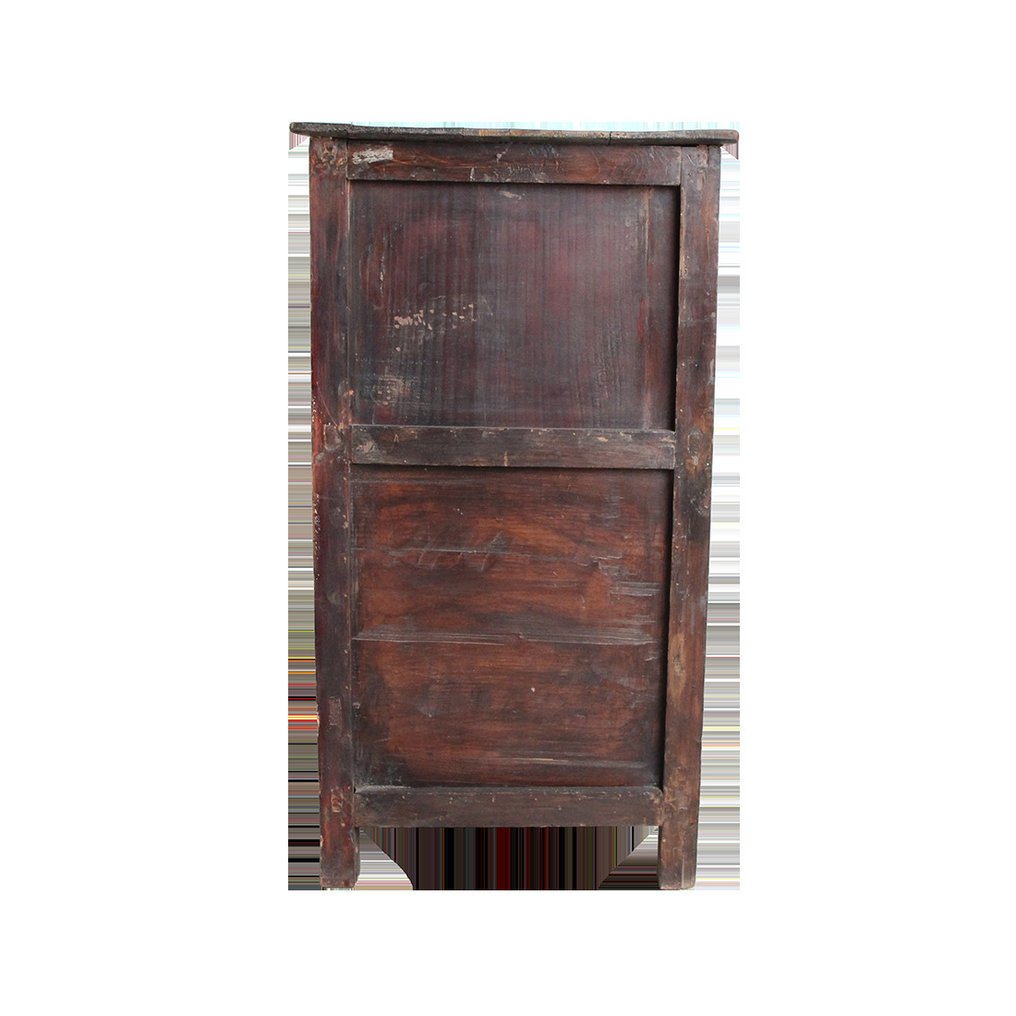
Tibetan furniture is primarily made from pine and other Himalayan soft woods (Elm, Pine, Poplar, or Cedarwood). They are known for the various designs and motifs painted on the surface and the carved decoration that make them unique. They are typically decorated with images of deities, animals, flowers and vines or mythical beasts (like Dragons) and religious symbols. Quite a few pieces will have sides that are not painted. If two tables or cabinets were kept side by side, then the hidden sides were left unpainted.
Due to the high altitude climate, which is dry and free of insect pests, they are usually well preserved.
For painting furniture, the Tibetans made extensive use of mineral pigments bound in animal glue. The pigments were ground by stone, which resulted in softer tones. The paint is finally coated with shellac-based varnish.
As for the furniture's structure, sophisticated joining methods were rarely employed, with the usual system being tongue and groove or mortise & tenon. Sometimes, wooden pegs were used to secure the pieces together. The fittings, hinges, and nails are typically made of iron, with brass hardware occasionally used as well.
Tibetan furniture is ancient and simple yet gorgeous. It is also renowned for its decorative patterns, which are believed to bring fortune and wealth into people's lives. It is also known for its vitality, embodied in its design, decoration, and vibrant colors.
Seller's Story
For 28 years, we have been buying and selling old and antique items from India and Indonesia.
Several times a year, we go there ourselves and buy and fill up many containers.
In both countries, we have trustworthy contacts who collect special objects for us daily.
Our extended warehouse in Amsterdam is full of regular antiques like cabinets and tables, but also contains nice and special objects.
Translated by Google TranslateTibetan Altar Cabinet
19th Century
Green painted with lotus flowers
-8 panels on the front side
Dimensions: W135 x D54 x H99 cm
This antique Tibetan cabinet with a greenish background features paintings of lotus flowers on all panels. The lotus flower symbolizes the primordial purity of body, speech, and mind, floating above the muddy waters of attachment and desire.
The four front doors open fully, allowing easy access to the interior space.
Doors are finished with a carved brass lock.
The cabinet is hand-hewn with an axe, which underscores its originality.
We were able to buy a collection of old Tibetan cabinets 4-5 years ago.
They came from Tibet to Nepal and were moved from Nepal to India in 2012.
Certificates are in place.
Tibetan cabinets
In ancient Tibet, widespread use of wooden furniture was not common, as it was restricted to monasteries and the upper and middle classes of Tibetans. The population of Tibet was also small, so not much was ever produced. Their numbers were further reduced when the Chinese invaded Tibet and destroyed a large number of these works of art.
By nature, original Tibetan pieces are increasingly rare to find.
cabinets
Rectangular cabinets are the most common type, but they can come in many different sizes. Tibetans used these for storing everything from foodstuffs to brick tea, incense, religious artifacts, or perhaps clothing and other valuables. They are usually divided into two compartments by a shelf. It is often difficult to tell where the cabinet opens because only some of the panels swing open, while others remain fixed.
They are mostly found with an oily appearance due to their many functions. The grease acts as a protective layer for the cabinet.
The carvings and paintings on cabinets are rich with Buddhist symbolism, such as the lotus flower (representing enlightenment), bamboo (strength and persistence), and protective symbols.
Tibetan furniture is primarily made from pine and other Himalayan soft woods (Elm, Pine, Poplar, or Cedarwood). They are known for the various designs and motifs painted on the surface and the carved decoration that make them unique. They are typically decorated with images of deities, animals, flowers and vines or mythical beasts (like Dragons) and religious symbols. Quite a few pieces will have sides that are not painted. If two tables or cabinets were kept side by side, then the hidden sides were left unpainted.
Due to the high altitude climate, which is dry and free of insect pests, they are usually well preserved.
For painting furniture, the Tibetans made extensive use of mineral pigments bound in animal glue. The pigments were ground by stone, which resulted in softer tones. The paint is finally coated with shellac-based varnish.
As for the furniture's structure, sophisticated joining methods were rarely employed, with the usual system being tongue and groove or mortise & tenon. Sometimes, wooden pegs were used to secure the pieces together. The fittings, hinges, and nails are typically made of iron, with brass hardware occasionally used as well.
Tibetan furniture is ancient and simple yet gorgeous. It is also renowned for its decorative patterns, which are believed to bring fortune and wealth into people's lives. It is also known for its vitality, embodied in its design, decoration, and vibrant colors.
Seller's Story
For 28 years, we have been buying and selling old and antique items from India and Indonesia.
Several times a year, we go there ourselves and buy and fill up many containers.
In both countries, we have trustworthy contacts who collect special objects for us daily.
Our extended warehouse in Amsterdam is full of regular antiques like cabinets and tables, but also contains nice and special objects.
Translated by Google TranslateDetails
Dynastic Style/Period
19th century
No. of items
1
Country of Origin
Nepal
Material
Softwood
Height
99 cm
Width
135 cm
Title of artwork
Tibetan Altar Cabinet
Depth
54 cm
Condition
Good condition
Sold by