Castagna Maurizio 1961 - XL - Il Fluttuare del Tempo


03
days
21
hours
57
minutes
26
seconds
Current bid
€ 320
Reserve price not met

Expert
Selected by Itziar Ramos
Holds a bachelor’s degree in art history and led modern and contemporary post-war art at Bonhams.
Gallery Estimate € 3,000 - € 3,600
9 other people are watching this object
 Bidder 1875 Bidder 1875 | €320 | |
|---|---|---|
 Bidder 0317 Bidder 0317 | €300 | |
| Bidder 6727 | €250 | |
Catawiki Buyer Protection
Your payment’s safe with us until you receive your object.View details
Trustpilot 4.4 | 122813 reviews
Rated Excellent on Trustpilot.
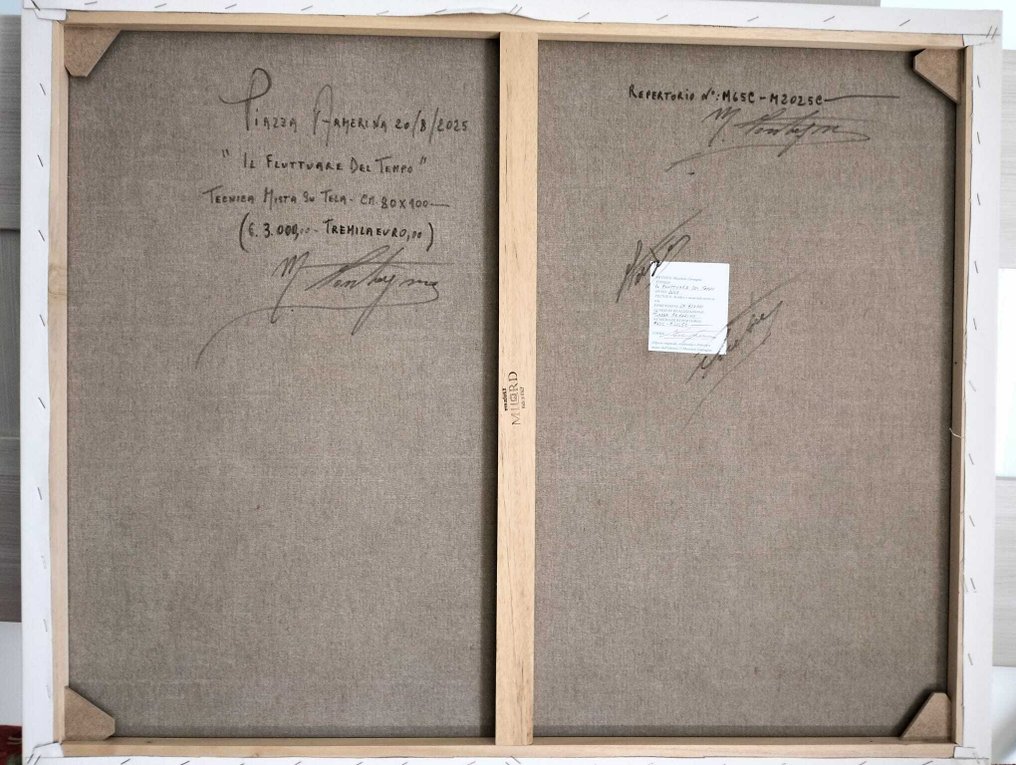
Maurizio Castagna (born 1961) presents Il Fluttuare del Tempo, an original edition from 2025 in mixed media on canvas (80 x 100 cm), signed by hand and in excellent condition, produced in Italy.
AI-assisted summary
Description from the seller
Maurizio Castagna, an Italian painter featured in numerous art publications and catalogs: a powerful textured abstract on the theme of time, rich in gesturality and of strong collector interest.
Maurizio Castagna, an Italian painter trained at the Albertina Academy of Turin and long active in sacred painting and official portraiture for important ecclesiastical and civic commissions, arrives at works like The Fluctuation of Time after a complex journey: from the discipline of classical figurative language to the gradual dissolution of form into pure chromatic and gestural energy. His canvases, present in public and private collections across Europe, America, and Asia and frequently published in major catalogs of contemporary Italian art, testify to an evolution that places him within the tradition of Action Painting and European Informalism, in an ideal dialogue with Pollock, De Kooning, Rothko, Francis – whom the artist has known – and with Italian masters such as Afro, Birolli, Severini, and Montanarini.
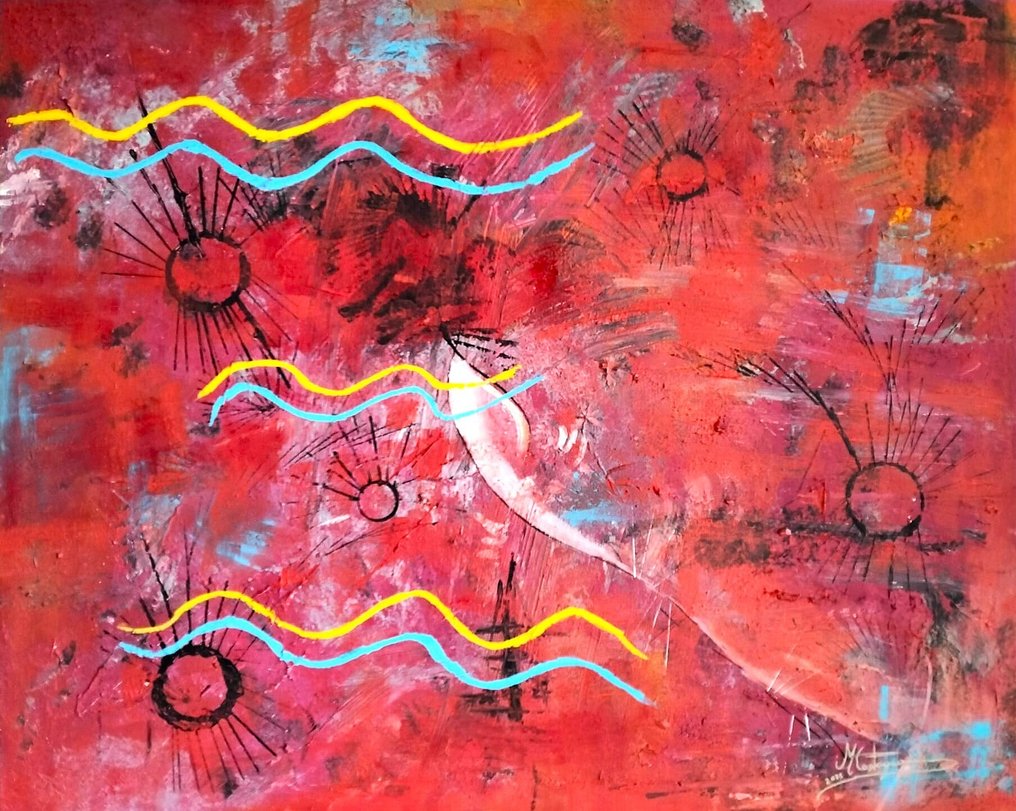
In the fluctuation of time, Castagna does not attempt to depict time as an abstract concept but as a living force, a current that passes through matter and that painting makes perceptible. The work does not merely evoke time: it sets it in motion, makes it pulse on the surface. It is the result of a layered and complex technique—pigments, egg tempera, enamels, acrylics, and resins he prepared himself—that constructs the canvas as a growing organism, where the underlying layers remain visible, surface, contradicting any idea of a smooth, definitive surface.
The strength of the painting lies precisely in this fleshy material, densely worked, where every groove and thickness becomes the sensitive traces of a time that is not linear, but sedimented, shattered, reassembled. The surface seems the result of slow and profound processes, almost geological, as if the painting had grown by itself, layer after layer. Here, matter does not decorate: it narrates.
The warm, vibrant red-copper background creates a dense emotional atmosphere, more of a mood than just a color. It is a kind of primordial magma from which the movement of time emerges. It does not represent a simple backdrop but an internal pressure, a primary energy that sustains the entire visual system, perhaps a memory of its long familiarity with large devotional formats and sacred iconography, now transfigured into a completely abstract language.
On this fiery base, yellow and turquoise wavy lines are inscribed, drawn with an impulsive and partly automatic gesturality that brings Castagna closer to surrealist practices and Action Painting. The yellow is the moment that ignites, the flash of the present that emerges suddenly and then dissolves. The turquoise, more relaxed and mental, evokes memory, distance, and the portion of time that recedes and returns. Their intertwining creates a rhythm that is not accidental: it is the very breath of the flow of time, sometimes rapid, sometimes slowed, guided by a gesture that — as Okwui Enwezor observed — is never purely accidental but the result of an inner tension that the artist balances and controls through color, density, and material.
Radiant black circles, scratched on the surface like indelible footprints, mark the moments that resist the passage of time: nodes of consciousness, points where time seems to stand still before resuming. They have nothing of ornament; they are gestural pressures, necessary, as if the artist had fixed moments of sudden revelation. The gesture, an anarchic and liberating force, becomes a universal language, beyond any cultural boundary, and is charged with a symbolic and almost therapeutic value: it tells a story of emotion at the very moment it is born.
The whole creates a rare effect: the painting does not depict time; it makes it happen. The viewer does not just observe it: they enter into it, perceiving the flow, the drift, the return. The composition, though fully abstract, possesses the narrative strength of an inner journey. In 'Il fluttuare del tempo,' time is not a line but a wave: it expands, folds, returns, and flutters. And in the hands of the skilled Maurizio Castagna, painting finally takes on a body.
Maurizio Castagna, an Italian painter featured in numerous art publications and catalogs: a powerful textured abstract on the theme of time, rich in gesturality and of strong collector interest.
Maurizio Castagna, an Italian painter trained at the Albertina Academy of Turin and long active in sacred painting and official portraiture for important ecclesiastical and civic commissions, arrives at works like The Fluctuation of Time after a complex journey: from the discipline of classical figurative language to the gradual dissolution of form into pure chromatic and gestural energy. His canvases, present in public and private collections across Europe, America, and Asia and frequently published in major catalogs of contemporary Italian art, testify to an evolution that places him within the tradition of Action Painting and European Informalism, in an ideal dialogue with Pollock, De Kooning, Rothko, Francis – whom the artist has known – and with Italian masters such as Afro, Birolli, Severini, and Montanarini.
In the fluctuation of time, Castagna does not attempt to depict time as an abstract concept but as a living force, a current that passes through matter and that painting makes perceptible. The work does not merely evoke time: it sets it in motion, makes it pulse on the surface. It is the result of a layered and complex technique—pigments, egg tempera, enamels, acrylics, and resins he prepared himself—that constructs the canvas as a growing organism, where the underlying layers remain visible, surface, contradicting any idea of a smooth, definitive surface.
The strength of the painting lies precisely in this fleshy material, densely worked, where every groove and thickness becomes the sensitive traces of a time that is not linear, but sedimented, shattered, reassembled. The surface seems the result of slow and profound processes, almost geological, as if the painting had grown by itself, layer after layer. Here, matter does not decorate: it narrates.
The warm, vibrant red-copper background creates a dense emotional atmosphere, more of a mood than just a color. It is a kind of primordial magma from which the movement of time emerges. It does not represent a simple backdrop but an internal pressure, a primary energy that sustains the entire visual system, perhaps a memory of its long familiarity with large devotional formats and sacred iconography, now transfigured into a completely abstract language.
On this fiery base, yellow and turquoise wavy lines are inscribed, drawn with an impulsive and partly automatic gesturality that brings Castagna closer to surrealist practices and Action Painting. The yellow is the moment that ignites, the flash of the present that emerges suddenly and then dissolves. The turquoise, more relaxed and mental, evokes memory, distance, and the portion of time that recedes and returns. Their intertwining creates a rhythm that is not accidental: it is the very breath of the flow of time, sometimes rapid, sometimes slowed, guided by a gesture that — as Okwui Enwezor observed — is never purely accidental but the result of an inner tension that the artist balances and controls through color, density, and material.
Radiant black circles, scratched on the surface like indelible footprints, mark the moments that resist the passage of time: nodes of consciousness, points where time seems to stand still before resuming. They have nothing of ornament; they are gestural pressures, necessary, as if the artist had fixed moments of sudden revelation. The gesture, an anarchic and liberating force, becomes a universal language, beyond any cultural boundary, and is charged with a symbolic and almost therapeutic value: it tells a story of emotion at the very moment it is born.
The whole creates a rare effect: the painting does not depict time; it makes it happen. The viewer does not just observe it: they enter into it, perceiving the flow, the drift, the return. The composition, though fully abstract, possesses the narrative strength of an inner journey. In 'Il fluttuare del tempo,' time is not a line but a wave: it expands, folds, returns, and flutters. And in the hands of the skilled Maurizio Castagna, painting finally takes on a body.
Details
Artist
Castagna Maurizio 1961 - XL
Sold with frame
No
Sold by
Direct from the artist
Edition
Original
Title of artwork
Il Fluttuare del Tempo
Technique
Mixed media
Signature
Hand signed
Country of Origin
Italy
Year
2025
Condition
Excellent condition
Height
80 cm
Width
100 cm
Weight
2.7 kg
Style
Abstract Expressionism
Period
2020+
