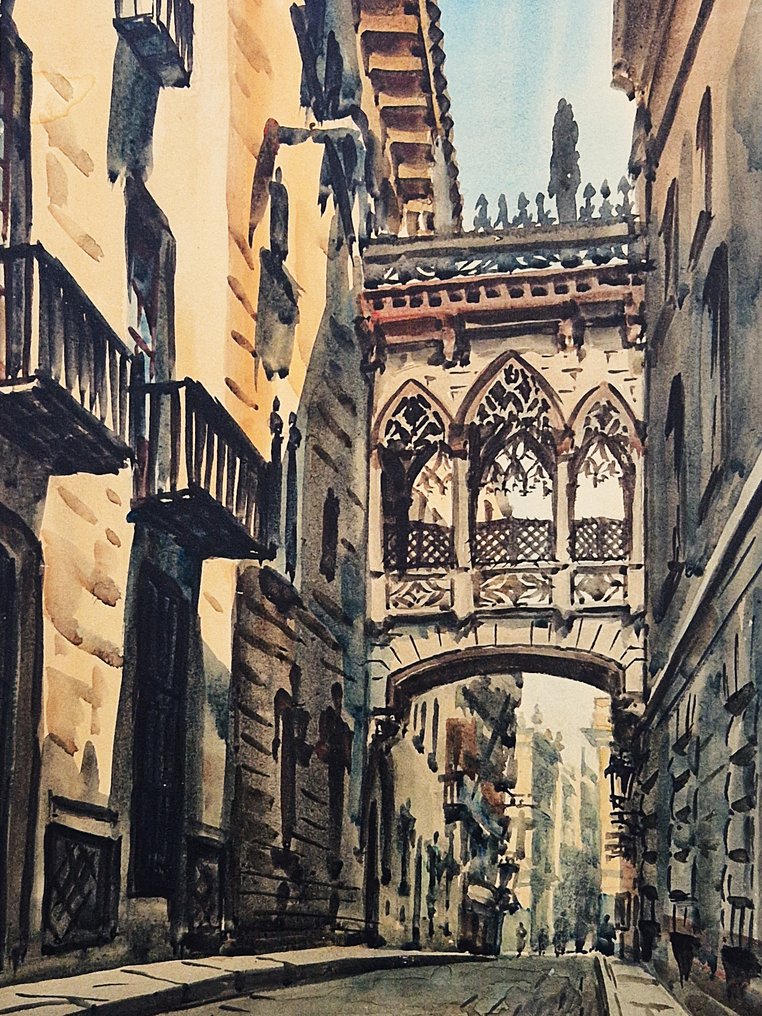
Matthieu Wiegman (1886-1971) - Late summer afternoon Pont del Bispe / Carrer del Bispe Barcelona


03
days
07
hours
11
minutes
28
seconds
Current bid
€ 75
Reserve price not met

Expert
Selected by Leo Setz
Over 30 years’ experience as art dealer, appraiser and restorer.
Estimate € 180 - € 200
16 other people are watching this object
 Bidder 7120 Bidder 7120 | €75 | |
|---|---|---|
| Bidder 7120 | €50 | |
| Bidder 6166 | €15 | |
Catawiki Buyer Protection
Your payment’s safe with us until you receive your object.View details
Trustpilot 4.4 | 122630 reviews
Rated Excellent on Trustpilot.
Late summer afternoon Pont del Bispe / Carrer del Bispe Barcelona, a watercolor from the 1930–1940 period, originated in the Netherlands.
AI-assisted summary
Description from the seller
Atmospheric watercolor on paper, created around 1930 by the well-known Bergense school painter Matthieu Wiegman (1886-1971). The watercolor is in very good condition with remarkably beautiful colors considering the age of the paper (a lovely late summer day atmosphere). Signed lower left. The dimensions of the watercolor (the paper) are 34x23cm (H x W).
Mattheus Johannes Maria (Matthieu) Wiegman (Zwolle, May 31, 1886 – Bergen (NH), April 5, 1971) was a Dutch artist. He was a painter, draftsman, muralist, and stained glass artist, also known for his posters and book covers. Furthermore, he created mosaics.
Life and work
Wiegman visited the Ambachtsschool in Alkmaar. He arrived in Bergen in 1911, after completing his studies between 1905 and 1909 at the Rijksakademie van Beeldende Kunsten in Amsterdam. He was, along with Leo Gestel and Arnout Colnot, one of the key figures within the Bergense School. He had great admiration for the work of Paul Cézanne.
In 1909, he created the design for his first religious painting, The preaching of Saint Willibrord. Throughout his career, he produced many religious scenes. The Bergense painters pointed out the new possibilities to him, and Wiegman eagerly participated. He especially immersed himself in luminist work. He also regularly traveled to France to work there. He was a member of the Hollandse Kunstenaarskring. In 1918, at the age of 32, he was approached for a professorship at the Amsterdam Academy.
Stained glass window in the Valerius Clinic (1938)
More and more, the optimistic element in Wiegman's work begins to predominate, even in the last 20 years of his life, during which he used the most vivid and intense colors—colors that are very unusual. An important aspect of Wiegman's work was his still lifes inspired by his friend De Zarate. Wiegman preferred to use the objects to be painted as filling for the background.
In Italy, in the seaside town of Rapallo, he installed a large mosaic of the angel Raphael in 1958 on the blind wall of a house belonging to his friends from Bergense, Chris and 'Polletje' Dekker. In his hands, the angel holds a cloth with the Dutch inscription 'GOD THE LORD SAYS THIS'. By 2018, the angel was still present and in very good condition.
Honorary awards
On May 31, 1961, Mayor Lo de Ruiter presented him with the Honorary Medal of the municipality of Bergen (NH) on the occasion of his 75th birthday, along with a certificate, created by Henk van den Idsert.
Atmospheric watercolor on paper, created around 1930 by the well-known Bergense school painter Matthieu Wiegman (1886-1971). The watercolor is in very good condition with remarkably beautiful colors considering the age of the paper (a lovely late summer day atmosphere). Signed lower left. The dimensions of the watercolor (the paper) are 34x23cm (H x W).
Mattheus Johannes Maria (Matthieu) Wiegman (Zwolle, May 31, 1886 – Bergen (NH), April 5, 1971) was a Dutch artist. He was a painter, draftsman, muralist, and stained glass artist, also known for his posters and book covers. Furthermore, he created mosaics.
Life and work
Wiegman visited the Ambachtsschool in Alkmaar. He arrived in Bergen in 1911, after completing his studies between 1905 and 1909 at the Rijksakademie van Beeldende Kunsten in Amsterdam. He was, along with Leo Gestel and Arnout Colnot, one of the key figures within the Bergense School. He had great admiration for the work of Paul Cézanne.
In 1909, he created the design for his first religious painting, The preaching of Saint Willibrord. Throughout his career, he produced many religious scenes. The Bergense painters pointed out the new possibilities to him, and Wiegman eagerly participated. He especially immersed himself in luminist work. He also regularly traveled to France to work there. He was a member of the Hollandse Kunstenaarskring. In 1918, at the age of 32, he was approached for a professorship at the Amsterdam Academy.
Stained glass window in the Valerius Clinic (1938)
More and more, the optimistic element in Wiegman's work begins to predominate, even in the last 20 years of his life, during which he used the most vivid and intense colors—colors that are very unusual. An important aspect of Wiegman's work was his still lifes inspired by his friend De Zarate. Wiegman preferred to use the objects to be painted as filling for the background.
In Italy, in the seaside town of Rapallo, he installed a large mosaic of the angel Raphael in 1958 on the blind wall of a house belonging to his friends from Bergense, Chris and 'Polletje' Dekker. In his hands, the angel holds a cloth with the Dutch inscription 'GOD THE LORD SAYS THIS'. By 2018, the angel was still present and in very good condition.
Honorary awards
On May 31, 1961, Mayor Lo de Ruiter presented him with the Honorary Medal of the municipality of Bergen (NH) on the occasion of his 75th birthday, along with a certificate, created by Henk van den Idsert.
Details
Artist
Matthieu Wiegman (1886-1971)
Sold with frame
No
Sold by
Owner or reseller
Edition
Original
Title of artwork
Late summer afternoon Pont del Bispe / Carrer del Bispe Barcelona
Technique
Watercolour painting
Signature
Hand signed
Country of Origin
Netherlands
Year
1930
Condition
Excellent condition
Height
40 cm
Width
30 cm
Depiction/Theme
Cityscape
Style
Realism
Period
1930-1940
Sold by
