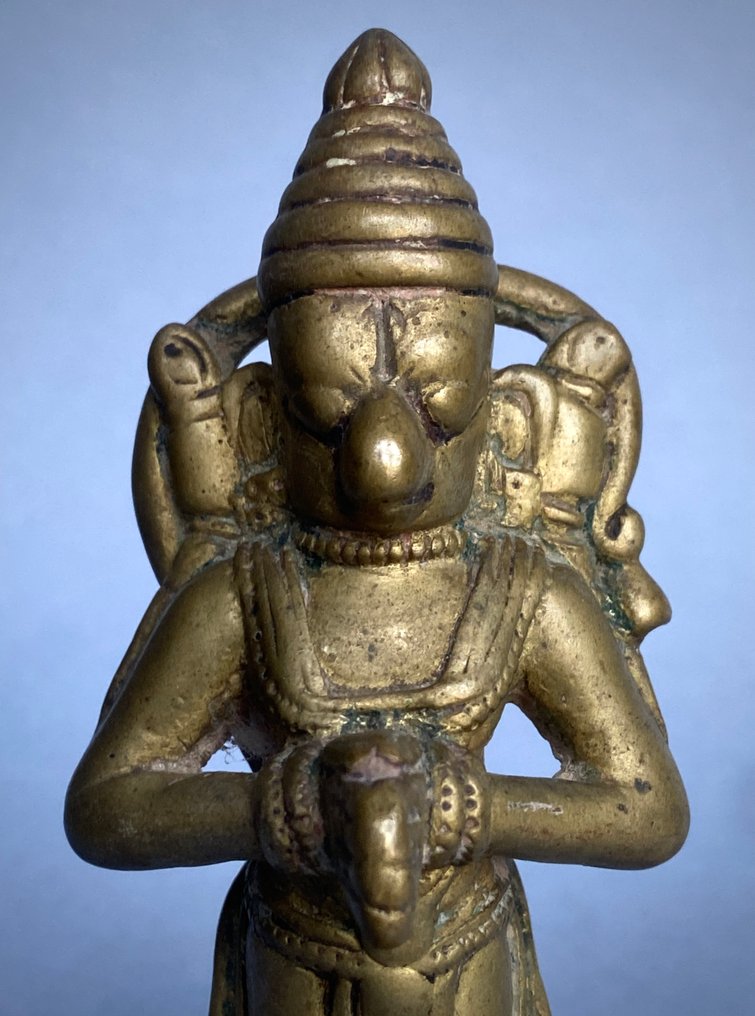
Sculpture, Hanumān in añjali mudrā – Bronzo votivo, India meridionale (prob. Tamil Nadu/Karnataka), XIX secolo - 13.5 cm - Lost wax bronze casting



03
days
11
hours
07
minutes
26
seconds
Starting bid
€ 1
Reserve price not met

Expert
Selected by Surya Rutten
Has over 25 years' experience in Asian art and owned an art gallery.
Estimate € 400 - € 450
No bids placed
Catawiki Buyer Protection
Your payment’s safe with us until you receive your object.View details
Trustpilot 4.4 | 122529 reviews
Rated Excellent on Trustpilot.
India; Hanumān in añjali mudrā – a bronze votive statue from South India (likely Tamil Nadu/Karnataka), 19th century, unsigned and in good condition, height 13.5 cm.
AI-assisted summary
Description from the seller
Hanumān in añjali mudrā – Votive bronze, Southern India (probably Tamil Nadu/Karnataka), 19th century
Votive sculpture in cast bronze from wax lost technique, with a uniform patina and traces of ritual pigments, depicting Hanumān standing on a stepped plinth with hands joined in añjali mudrā, a gesture of veneration and devotion towards Rāma. The monkey god wears a conical (mukuṭa) banded headdress, a torque, and granulated bracelets; his dhoti is decorated with cords and pendants, with well-defined feet showing traces of red from pūjā. The long tail wraps around the shoulders in an arch, creating a natural prabhāvali, a typical detail of South Indian production. The lower cavity retains residues of the core, consistent with a domestic or small shrine cult image. The modeling, solid and compact, belongs to the folk devotional style of the 19th century: simplicity of surfaces and strict proportions are combined with detailed craftsmanship, conveying an image of intense bhakti rather than mere decoration. The geographical attribution points to the Dravidian area, based on the style of the mukuṭa, treatment of jewelry, structure of the base, and the tail's flow.
Solid and heavy law, in good conservation condition.
Hanumān in añjali mudrā – Votive bronze, Southern India (probably Tamil Nadu/Karnataka), 19th century
Votive sculpture in cast bronze from wax lost technique, with a uniform patina and traces of ritual pigments, depicting Hanumān standing on a stepped plinth with hands joined in añjali mudrā, a gesture of veneration and devotion towards Rāma. The monkey god wears a conical (mukuṭa) banded headdress, a torque, and granulated bracelets; his dhoti is decorated with cords and pendants, with well-defined feet showing traces of red from pūjā. The long tail wraps around the shoulders in an arch, creating a natural prabhāvali, a typical detail of South Indian production. The lower cavity retains residues of the core, consistent with a domestic or small shrine cult image. The modeling, solid and compact, belongs to the folk devotional style of the 19th century: simplicity of surfaces and strict proportions are combined with detailed craftsmanship, conveying an image of intense bhakti rather than mere decoration. The geographical attribution points to the Dravidian area, based on the style of the mukuṭa, treatment of jewelry, structure of the base, and the tail's flow.
Solid and heavy law, in good conservation condition.
Details
Era
1400-1900
Over 200 years old
No
Country of Origin
India
Style
Antique
Material
Lost wax bronze casting
Title of artwork
Hanumān in añjali mudrā – Bronzo votivo, India meridionale (prob. Tamil Nadu/Karnataka), XIX secolo
Dynastic Style/Period
Mughal Empire (1526-1857)
Signature
Not signed
Provenance
Private collection
Condition
Good condition
Sold with stand
No
Height
13.5 cm
Width
0 cm
Depth
0 cm
Sold by