Hannes Postma (1933-2020) - Optocht der vrouwen



04
days
11
hours
56
minutes
22
seconds
Current bid
€ 1
No reserve price

Expert
Selected by Leo Setz
Over 30 years’ experience as art dealer, appraiser and restorer.
Estimate € 150 - € 200
8 other people are watching this object
 Bidder 0613 Bidder 0613 | €1 |
|---|
Catawiki Buyer Protection
Your payment’s safe with us until you receive your object.View details
Trustpilot 4.4 | 122529 reviews
Rated Excellent on Trustpilot.
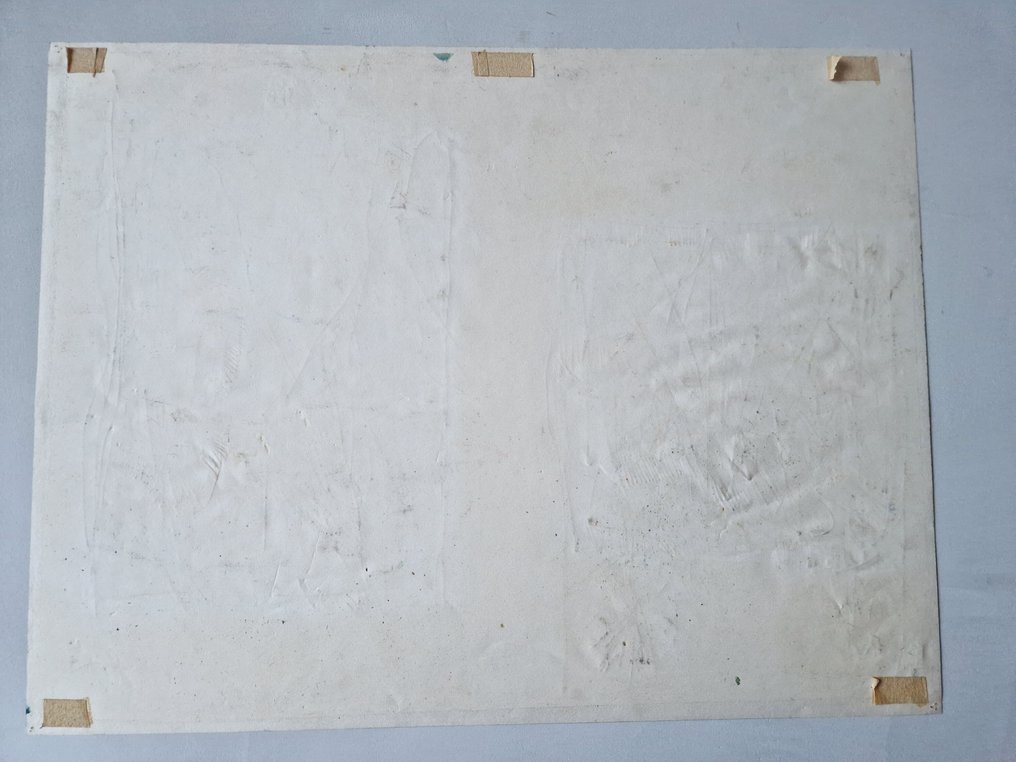
“Optocht der vrouwen”, a 1962 Dutch artwork from the 1960–1970 period, created with a mixed technique (pastel, watercolor, ink).
AI-assisted summary
Description from the seller
Medium: mixed media (pastel, watercolor, ink)
Dating: August 10, 1962
Numbered
Signed: with pastel chalk
In good condition
Procession of Women
loose leaf - sheet size 50 x 65 cm
Hannes Postma (Haarlem, 1933 – Amsterdam 2020)
A close examination reveals that what happens to the people in Hannes Postma's drawings isn't very pleasant. At the very least, they are stretched into a kind of bread rolls or compressed into packages of arms and legs. They are constantly in intense turmoil, rising up, floating, or being shot across the plane, colliding, caught in explosions, and divided into strips by sharp-edged surfaces. Their hands and feet let go, multiply, and fly into space. Their heads merge into balloons, which then expand back into bodies further away. They bump into all kinds of cosmic furniture (planks, crates, coat hangers, hats, undulating earth crusts) that makes space unsafe... Naturally, it is no coincidence that Hannes Postma composes with forms that evoke our own world rather than circles and squares. His space is a real space, where the near and far have become interchangeable, an immense space in which the earth appears fragmentarily... The events, the sharp edges, reach us through the drawn flesh. On a visible color stream, wordless balloons drift out of our field of view like smoke clouds or blood drops. The crates contain surprises (not just nice ones; Postma calls them Pandora's boxes), embryos, pieces of landscape and water; perhaps they are also hiding places. Helpless little people hang opposite the cosmic authority of enormous coats and hats, in a world where everything, including themselves, is simultaneously itself and something else, or at least in the process of becoming something else. 'Hannes Postma is a visual artist, someone who, like a magician, conjures up people and spaces. But he is also a viewer of those images, who, with some irony, observes all that flailing and is capable of making jokes with a mysterious twist. Without imposing his personality on us, he speaks a very personal language.' This is also reflected in the title, Hocus Focus. The title and the lithographs are a clear statement in which a new insight emerges through a small intervention. Postma associates a new word meaning; language is living matter. The title is 'a pun.' The traditional magic phrase is 'hocus pocus pilatus pas,' where the trick is that something temporarily disappears or appears. It is the sensation of the curtain opening, the story beginning, and the moment of wonder being felt with a transformative power. Further, on the first lithograph, it states: 'two is infinitely one in focus.' Focus means focal point, or something like mental concentration. However, it is used here as the word 'attention.' Attention is: directing the perceptual ability at one point. By using the word 'focus,' the emphasis shifts from what the mind itself does to the subject of attention—the 'focal point.' In the rhyming Hocus Focus, Postma slightly alters the meaning (by just one letter) and resolutely shifts it to the focal point, the magical moment of wonder of Hocus and Focus in its infinity.
Medium: mixed media (pastel, watercolor, ink)
Dating: August 10, 1962
Numbered
Signed: with pastel chalk
In good condition
Procession of Women
loose leaf - sheet size 50 x 65 cm
Hannes Postma (Haarlem, 1933 – Amsterdam 2020)
A close examination reveals that what happens to the people in Hannes Postma's drawings isn't very pleasant. At the very least, they are stretched into a kind of bread rolls or compressed into packages of arms and legs. They are constantly in intense turmoil, rising up, floating, or being shot across the plane, colliding, caught in explosions, and divided into strips by sharp-edged surfaces. Their hands and feet let go, multiply, and fly into space. Their heads merge into balloons, which then expand back into bodies further away. They bump into all kinds of cosmic furniture (planks, crates, coat hangers, hats, undulating earth crusts) that makes space unsafe... Naturally, it is no coincidence that Hannes Postma composes with forms that evoke our own world rather than circles and squares. His space is a real space, where the near and far have become interchangeable, an immense space in which the earth appears fragmentarily... The events, the sharp edges, reach us through the drawn flesh. On a visible color stream, wordless balloons drift out of our field of view like smoke clouds or blood drops. The crates contain surprises (not just nice ones; Postma calls them Pandora's boxes), embryos, pieces of landscape and water; perhaps they are also hiding places. Helpless little people hang opposite the cosmic authority of enormous coats and hats, in a world where everything, including themselves, is simultaneously itself and something else, or at least in the process of becoming something else. 'Hannes Postma is a visual artist, someone who, like a magician, conjures up people and spaces. But he is also a viewer of those images, who, with some irony, observes all that flailing and is capable of making jokes with a mysterious twist. Without imposing his personality on us, he speaks a very personal language.' This is also reflected in the title, Hocus Focus. The title and the lithographs are a clear statement in which a new insight emerges through a small intervention. Postma associates a new word meaning; language is living matter. The title is 'a pun.' The traditional magic phrase is 'hocus pocus pilatus pas,' where the trick is that something temporarily disappears or appears. It is the sensation of the curtain opening, the story beginning, and the moment of wonder being felt with a transformative power. Further, on the first lithograph, it states: 'two is infinitely one in focus.' Focus means focal point, or something like mental concentration. However, it is used here as the word 'attention.' Attention is: directing the perceptual ability at one point. By using the word 'focus,' the emphasis shifts from what the mind itself does to the subject of attention—the 'focal point.' In the rhyming Hocus Focus, Postma slightly alters the meaning (by just one letter) and resolutely shifts it to the focal point, the magical moment of wonder of Hocus and Focus in its infinity.
Details
Artist
Hannes Postma (1933-2020)
Sold by
Owner or reseller
Edition
Original
Title of artwork
Optocht der vrouwen
Technique
Crayon, Ink, Mixed media, Pastel
Signature
Signed
Country of Origin
Netherlands
Year
1962
Condition
Good condition
Colour
Multicolour
Height
50 cm
Width
65 cm
Weight
50 g
Depiction/Theme
Nude
Style
Contemporary
Period
1960-1970
Sold by
