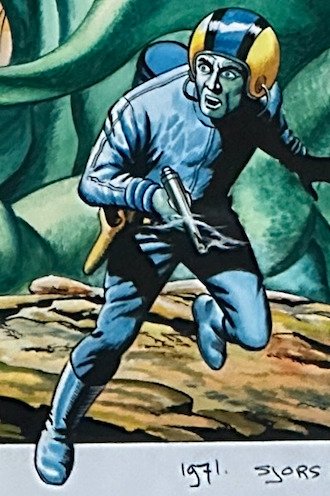
Bus, Bert - 1 Original cover - Trigië - gesigneerd - 1971



16
days
06
hours
05
minutes
43
seconds
Starting bid
€ 1
Reserve price not met

Expert
Selected by Filippo Piras
Specialises in Italian comics and organiser of comics exhibitions and events.
Estimate € 750 - € 900
No bids placed
Catawiki Buyer Protection
Your payment’s safe with us until you receive your object.View details
Trustpilot 4.4 | 122385 reviews
Rated Excellent on Trustpilot.
Bert Bus created this museum-grade painting for the Trigië cover of Sjors issue no. 14 (1971), signed at the lower right, framed at 45 × 49 cm with the artwork measuring about 33 × 37 cm (color area about 25 × 25 cm), in excellent condition.
AI-assisted summary
Description from the seller
Over Trigië
The series ran from 1965 to 1982 and first appeared in the English magazine 'Ranger', drawn by Don Lawrence based on scripts by Mike Butterworth. Don Lawrence illustrated the comic until 1976, after which various other artists worked on the series: Ron Embleton, Miguel Quesada, Philip Corke, Oliver Frey, and Gerry Wood. The scripts for the latter artist were written by Ken Roscoe.
The clothing, weapons, and cities are initially inspired by the Roman Empire. Other nations also evoke images of classical civilizations like the Greeks and Persians. The story of a nomadic tribe from the desert founding a world empire recalls the rise of Islam and the first caliphates. But as Trigië becomes more powerful, increasingly modern weapons, buildings, and vehicles appear. Eventually, the empire even has intergalactic spacecraft, causing the stories to shift more and more from adventure to science fiction.
About the first artist
The first artist, Don Lawrence, initially drew two pages of Trigië each week for the magazine 'Ranger', which later merged into 'Look and Learn' by publisher I.P.C. When he discovered at a comic festival in London in 1976 how popular his work was abroad, he demanded a raise and a share of the foreign royalties. As he did not receive these, Lawrence decided to stop working on Trigië. He later gained further fame with his series Storm. The series was taken over by other artists but was less popular than when Don Lawrence was the artist. In the Netherlands, the publication of the series in the comic magazine Eppo was discontinued in March 1977.
In the Netherlands, Bert Bus was chosen to create some covers for the weekly magazine SJORS of Trigië.
About the artist of the current offering.
Bert Bus was a Dutch comic artist with a career spanning from the late 1940s to the 1980s. Most of his series appeared in the comic magazine Sjors and its successors Eppo, Eppo Wordt Vervolgd, and Sjors & Sjimmie Stripblad. Bus's career is considered unique in the Netherlands. He was the only Dutch artist who worked on his own comic creations for more than 40 years as a permanent artist, not on a freelance basis, which ensured him a steady income and a pension. His series alternate between science fiction and history, including creations such as 'Olaf Noord' (1953-1957), 'Theban, the First World Traveler' (1957-1959), 'Cliff Rendall' (1963-1965), 'Stef Ardoba' (1975-1982), 'Malorix' (1983-1985), and 'Russ Bender' (1986-1989). Furthermore, Bus is remembered by a whole generation of comic fans for his locally produced version of the British comic 'Archie the Robot' (1971-1974). Bus regarded American artist Alex Raymond ('Flash Gordon') as one of his main influences for his science fiction work, while Hal Foster ('Prince Valiant') served as an example for his historical comics. His passion for history also flourished in his activities as an amateur archaeologist in the Velsen region.
Early life and career
Bert Bus was born in 1931 in Santpoort, near Haarlem. His education was interrupted during the war years, and after liberation, the young man struggled to keep his thoughts focused on his lessons because his interests were elsewhere. Through reading books about ancient Egypt and novels by Jules Verne, Bus developed a passion for both science fiction and history. In 1947, the 16-year-old artist presented himself at the office of the Haarlem publishing house De Spaarnestad. After obtaining a first proficiency certificate, Bus was hired as an assistant artist in the publisher's art studio on Nassauplein in Haarlem. This marked the beginning of his long career with this publisher, which later became part of the VNU company. The studio provided illustrations, restorations, lettering, and other production art for De Spaarnestad's magazines, such as Libelle, Katholieke Illustratie, and Panorama. Initially, Bus worked under the direction of studio chief Jacques Bouwman, who was later replaced by Frans Piët and then by Ab Schatorjé. Other early artists included Jan Giling and Nico van Dam; the latter became his lifelong friend. The team was later joined by Ben Bulters, Ruud Looman, and especially Harry Balm. The trio of Bus, Van Dam, and Balm became VNU's longest-serving staff artists, remaining in service until their retirement in the 1980s and 1990s.
Olaf Noord
Bert Bus's first job was drawing patterns, puzzles, and illustrations for the women's magazine Libelle. He also attended evening art classes to further develop his drawing skills. After completing his military service from 1950 to 1952, Bus returned to the Spaarnestad Studio, where he began working on comic strips for children's publications. The first was about space traveler 'Olaf Noord', which was published in Panorama's supplement Rebellenclub. It continued in Sjors, the successor to all of De Spaarnestad's children's supplements (Rebellenclub, Grabbelton, Tombola), from September 1954 to 1957. 'Olaf Noord' was about an American pilot who is abducted by Venusians and ends up in various space adventures. Bus had developed the strip at home and initially made it in his free time. Eventually, he got the opportunity to produce his strips during the day in the studio. The series consists of four stories, ranging from 30 to 90 pages in length. It is one of the first Dutch science fiction comics; however, it should be noted that Auke Tadema was the one who introduced the genre to the Netherlands in the 1930s.
Besides 'Olaf Noord', Bert Bus created a gag comic about a know-it-all hole boy named 'Skokan, a slimming from year zero'. Between 1955 and 1956, Sjors published 37 gag strips. The comic included both speech balloons and caption texts, the latter written by editor Lou Vierhout. Bus also occasionally made filler pages for 'Sjors van de Rebellenclub' for Carol Voges. In 1957, 'Olaf Noord' was considered too difficult for the young readership of the magazine Sjors, and Bus decided to try his luck with a historical series.
Theban, The First World Traveler
This became 'Theban, the first world traveler' (1957-1959), a mix of history, mythology, and fiction. The 104-page story recounts the adventures of Thebans, a Dorian Greek who lived around 1000 BC. The hero travels to the then-known parts of the world, encountering various dangers, from sea monsters to the Minotaur. The series ran for two years until the magazine Sjors was restyled. The artist later expressed some shame about the historical inaccuracies in this comic strip. In his later historical comics, he used more research and always kept the educational value of his work in mind.
Latex strips
Cliff Rendall was followed by a comic adaptation of Mark Twain's 'Huckleberry Finn' (1965-1966), and then by another science fiction series, the epic trilogy 'The Exile of Nimmorac' featuring the hero 'Lance Barton' (1967-1968). Although almost all of Bert Bus's original creations were from the realistic genre, he also wrote children's comics for many years, featuring the two gnomes 'Woep and Wap' for his friend Nico van Dam. It appeared from September 1958 to March 1966 on the back cover of the women's weekly magazine Rosita.
Nancy Drew
Bert Bus also has historical significance because he was the first local artist to appear in the girls' magazine Tina, which at the time was still a translation of the British magazine Prinses Tina. His first series was a text comic based on the American children's book series "Nancy Drew" (1969) by a collective of ghostwriters under the name Carolyn Keene. His second and final comic for the magazine was the science fiction story "Jola en de Ruimterace" (1970). Tina's focus on original comics material increased in the 1970s, when authors like Andries Brandt and Patty Klein made prominent contributions.
Archie the robot
In 1971, he returned to Sjors to draw a modernized version of the originally British comic strip "Archie the Robot" by E. George Cowan and Ted Kearon. The strip had appeared in Sjors since 1959 under the title "Archie, de Man van Staal" (Archie, the Man of Steel). The Dutch version (1971-1974) appeared after Archie's British home base, Lion, canceled the strip. Bus worked on ten action-packed adventures featuring the Man of Steel, his two human companions, and their time-traveling tower. Although most of the plots were still based on contemporary British stories, the redrawn artwork was initially a joint production by Bus, Van Dam, and Balm. In the updated, full-color Sjors version, Archie's companions Ted and Ken were given a more contemporary look, while Archie was colored a bluish silver instead of the red of the English publications. Bus later created the strip entirely himself, with the last two stories being originals written by Tina editor Fenna Ridderbos. In 1973, a book collection featuring two of Bus's stories was published under the Amsterdam Boek label. Between 1980 and 1982, Oberon published the artist's complete series of works on the series in nine books.
Stef Ardoba
Bert Bus's last creation for Sjors magazine was "Stef Ardoba" (1975-1982), a series about a journalist with a strong focus on time travel. Bus was now able to combine his two disciplines and create stories set in both the past and the future. The main sources of inspiration were the popular science literature of the time, including the hypothetical works about extraterrestrial influences on early human culture by Erich von Däniken and Peter Kolosimo. "Stef Ardoba" continued in Eppo magazine, the continuation of VNU's comic magazines Sjors and Pep. The studio at Nassauplein had by then closed, and Bert Bus was working at the office of the company's comics division, Oberon. The last two stories in "Stef Ardoba" were written by Eppo editor Kees Vuik.
Malorix/Russ Bender
For his new historical series "Malorix" (1983-1985), Bert Bus focused on the Frisian region (now the provinces of Frisia and North Holland) as part of the Roman Empire during the early days of the Christian era. This "grounded fantasy" or "romanticized history" tells the story of the battle between the Romans and the Frisians around Castellum Flevum near Velsen. The artist drew most of his inspiration from his work as an amateur archaeologist in the Velsen region and did his best to depict clothing, landscapes, and buildings with historical accuracy. Unfortunately, Bus suffered an accident in 1985 and was unable to work for several months. He returned to the pages of Eppo Wordt Vervolgd, and subsequently to Sjors & Sjimmie Stripblad with the science fiction trilogy "Russ Bender" (1986-1989), about a fighter pilot in the US Navy. The artist spent the last years of his service from home.
Recognition
On October 22-23, 2004, Bus, along with his former studio colleagues Harry Balm and Nico van Dam, received the Bulletje & Boonestaakschaal (Bullet & Boonestaak Award) for their contributions to the Dutch comics scene during the Comics Days in Alphen aan den Rijn. On April 29, 2010, Bus and Van Dam were knighted in the Order of Orange-Nassau for their archaeological work, and Bus was also knighted for the educational value of his comic strip "Malorix."
Last years and death
Bert Bus is also known for the painted cover illustrations he created for the Dutch editions of the British comic series "Trigan Empire," drawn by Don Lawrence. The artist took early retirement in early 1990, partly as a result of a reorganization of Sjors & Sjimmie Stripblad. This marked the end of his more than forty-year career as a comics artist. His only venture outside of the magazines Spaarnestad/Oberon was his contribution to the science fiction magazine Essef, which was edited and published by Raymond Donkersloot. Under the pseudonym Max Mutesius, Bus created the erotic comic "De Vechters van Shar-Yaban" (The Fighters of Shar-Yaban) (1977-1979).
When Oberon launched its black-and-white comics collection in 1976, most of Bert Bus's earlier series were eventually published in book form. In 1984, De Lijn Publishers published part of a "Bert Bus Bibliography," which collected his "Olaf Noord" stories. Reprints of "Malorix" and "Russ Bender" after his retirement made him a frequent guest at book signings at comic festivals. Since their retirement, Bus and Van Dam have devoted most of their time to the Archaeological Study Group Velsen. The two were closely involved in the excavation of the Roman Fort Velsen. The 1998 book edition of "Malorix" by Big Balloon in collaboration with the Archaeological Museum Haarlem, as well as the editions published by Amor Vincit Omnia in 1996, 2008, and 2011, have been widely used in schools as teaching materials. Bert Bus passed away in the night of 27 to 28 August 2017 at the age of 86.
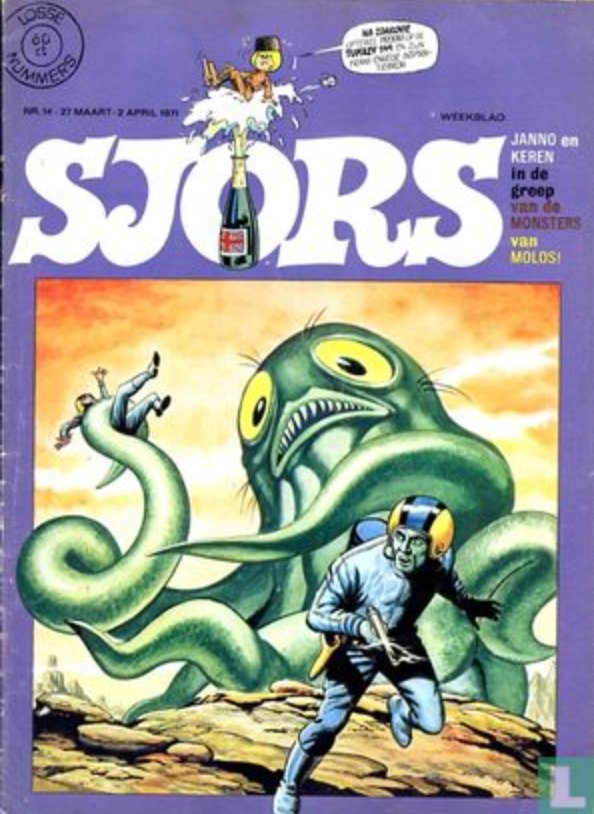
This lot is a museum masterpiece; it features a beautiful, large painting of the Trigan Empire, created by Bert Bus for the cover of Sjors magazine, issue 14, in 1971. Signed lower right. See the last image, which serves as an example and is not included in this lot. A magnificent cover painting that captures everything Trigan Empire stands for—excitement and action—captured in beautiful colors. The painting is completely authentic, has never seen the light of day, and is therefore 100% as Don Lawrence created it 30 years ago. This beautiful painting is beautifully framed. The frame measures 45 x 49 cm, and the artwork itself measures approximately 33 x 37 cm (the color portion is approximately 25 x 25 cm).
See also the photos that are part of the description, as they provide a good picture of the quality of the offered item.
The painting will be very well packaged and sent by registered mail to the new owner.
Over Trigië
The series ran from 1965 to 1982 and first appeared in the English magazine 'Ranger', drawn by Don Lawrence based on scripts by Mike Butterworth. Don Lawrence illustrated the comic until 1976, after which various other artists worked on the series: Ron Embleton, Miguel Quesada, Philip Corke, Oliver Frey, and Gerry Wood. The scripts for the latter artist were written by Ken Roscoe.
The clothing, weapons, and cities are initially inspired by the Roman Empire. Other nations also evoke images of classical civilizations like the Greeks and Persians. The story of a nomadic tribe from the desert founding a world empire recalls the rise of Islam and the first caliphates. But as Trigië becomes more powerful, increasingly modern weapons, buildings, and vehicles appear. Eventually, the empire even has intergalactic spacecraft, causing the stories to shift more and more from adventure to science fiction.
About the first artist
The first artist, Don Lawrence, initially drew two pages of Trigië each week for the magazine 'Ranger', which later merged into 'Look and Learn' by publisher I.P.C. When he discovered at a comic festival in London in 1976 how popular his work was abroad, he demanded a raise and a share of the foreign royalties. As he did not receive these, Lawrence decided to stop working on Trigië. He later gained further fame with his series Storm. The series was taken over by other artists but was less popular than when Don Lawrence was the artist. In the Netherlands, the publication of the series in the comic magazine Eppo was discontinued in March 1977.
In the Netherlands, Bert Bus was chosen to create some covers for the weekly magazine SJORS of Trigië.
About the artist of the current offering.
Bert Bus was a Dutch comic artist with a career spanning from the late 1940s to the 1980s. Most of his series appeared in the comic magazine Sjors and its successors Eppo, Eppo Wordt Vervolgd, and Sjors & Sjimmie Stripblad. Bus's career is considered unique in the Netherlands. He was the only Dutch artist who worked on his own comic creations for more than 40 years as a permanent artist, not on a freelance basis, which ensured him a steady income and a pension. His series alternate between science fiction and history, including creations such as 'Olaf Noord' (1953-1957), 'Theban, the First World Traveler' (1957-1959), 'Cliff Rendall' (1963-1965), 'Stef Ardoba' (1975-1982), 'Malorix' (1983-1985), and 'Russ Bender' (1986-1989). Furthermore, Bus is remembered by a whole generation of comic fans for his locally produced version of the British comic 'Archie the Robot' (1971-1974). Bus regarded American artist Alex Raymond ('Flash Gordon') as one of his main influences for his science fiction work, while Hal Foster ('Prince Valiant') served as an example for his historical comics. His passion for history also flourished in his activities as an amateur archaeologist in the Velsen region.
Early life and career
Bert Bus was born in 1931 in Santpoort, near Haarlem. His education was interrupted during the war years, and after liberation, the young man struggled to keep his thoughts focused on his lessons because his interests were elsewhere. Through reading books about ancient Egypt and novels by Jules Verne, Bus developed a passion for both science fiction and history. In 1947, the 16-year-old artist presented himself at the office of the Haarlem publishing house De Spaarnestad. After obtaining a first proficiency certificate, Bus was hired as an assistant artist in the publisher's art studio on Nassauplein in Haarlem. This marked the beginning of his long career with this publisher, which later became part of the VNU company. The studio provided illustrations, restorations, lettering, and other production art for De Spaarnestad's magazines, such as Libelle, Katholieke Illustratie, and Panorama. Initially, Bus worked under the direction of studio chief Jacques Bouwman, who was later replaced by Frans Piët and then by Ab Schatorjé. Other early artists included Jan Giling and Nico van Dam; the latter became his lifelong friend. The team was later joined by Ben Bulters, Ruud Looman, and especially Harry Balm. The trio of Bus, Van Dam, and Balm became VNU's longest-serving staff artists, remaining in service until their retirement in the 1980s and 1990s.
Olaf Noord
Bert Bus's first job was drawing patterns, puzzles, and illustrations for the women's magazine Libelle. He also attended evening art classes to further develop his drawing skills. After completing his military service from 1950 to 1952, Bus returned to the Spaarnestad Studio, where he began working on comic strips for children's publications. The first was about space traveler 'Olaf Noord', which was published in Panorama's supplement Rebellenclub. It continued in Sjors, the successor to all of De Spaarnestad's children's supplements (Rebellenclub, Grabbelton, Tombola), from September 1954 to 1957. 'Olaf Noord' was about an American pilot who is abducted by Venusians and ends up in various space adventures. Bus had developed the strip at home and initially made it in his free time. Eventually, he got the opportunity to produce his strips during the day in the studio. The series consists of four stories, ranging from 30 to 90 pages in length. It is one of the first Dutch science fiction comics; however, it should be noted that Auke Tadema was the one who introduced the genre to the Netherlands in the 1930s.
Besides 'Olaf Noord', Bert Bus created a gag comic about a know-it-all hole boy named 'Skokan, a slimming from year zero'. Between 1955 and 1956, Sjors published 37 gag strips. The comic included both speech balloons and caption texts, the latter written by editor Lou Vierhout. Bus also occasionally made filler pages for 'Sjors van de Rebellenclub' for Carol Voges. In 1957, 'Olaf Noord' was considered too difficult for the young readership of the magazine Sjors, and Bus decided to try his luck with a historical series.
Theban, The First World Traveler
This became 'Theban, the first world traveler' (1957-1959), a mix of history, mythology, and fiction. The 104-page story recounts the adventures of Thebans, a Dorian Greek who lived around 1000 BC. The hero travels to the then-known parts of the world, encountering various dangers, from sea monsters to the Minotaur. The series ran for two years until the magazine Sjors was restyled. The artist later expressed some shame about the historical inaccuracies in this comic strip. In his later historical comics, he used more research and always kept the educational value of his work in mind.
Latex strips
Cliff Rendall was followed by a comic adaptation of Mark Twain's 'Huckleberry Finn' (1965-1966), and then by another science fiction series, the epic trilogy 'The Exile of Nimmorac' featuring the hero 'Lance Barton' (1967-1968). Although almost all of Bert Bus's original creations were from the realistic genre, he also wrote children's comics for many years, featuring the two gnomes 'Woep and Wap' for his friend Nico van Dam. It appeared from September 1958 to March 1966 on the back cover of the women's weekly magazine Rosita.
Nancy Drew
Bert Bus also has historical significance because he was the first local artist to appear in the girls' magazine Tina, which at the time was still a translation of the British magazine Prinses Tina. His first series was a text comic based on the American children's book series "Nancy Drew" (1969) by a collective of ghostwriters under the name Carolyn Keene. His second and final comic for the magazine was the science fiction story "Jola en de Ruimterace" (1970). Tina's focus on original comics material increased in the 1970s, when authors like Andries Brandt and Patty Klein made prominent contributions.
Archie the robot
In 1971, he returned to Sjors to draw a modernized version of the originally British comic strip "Archie the Robot" by E. George Cowan and Ted Kearon. The strip had appeared in Sjors since 1959 under the title "Archie, de Man van Staal" (Archie, the Man of Steel). The Dutch version (1971-1974) appeared after Archie's British home base, Lion, canceled the strip. Bus worked on ten action-packed adventures featuring the Man of Steel, his two human companions, and their time-traveling tower. Although most of the plots were still based on contemporary British stories, the redrawn artwork was initially a joint production by Bus, Van Dam, and Balm. In the updated, full-color Sjors version, Archie's companions Ted and Ken were given a more contemporary look, while Archie was colored a bluish silver instead of the red of the English publications. Bus later created the strip entirely himself, with the last two stories being originals written by Tina editor Fenna Ridderbos. In 1973, a book collection featuring two of Bus's stories was published under the Amsterdam Boek label. Between 1980 and 1982, Oberon published the artist's complete series of works on the series in nine books.
Stef Ardoba
Bert Bus's last creation for Sjors magazine was "Stef Ardoba" (1975-1982), a series about a journalist with a strong focus on time travel. Bus was now able to combine his two disciplines and create stories set in both the past and the future. The main sources of inspiration were the popular science literature of the time, including the hypothetical works about extraterrestrial influences on early human culture by Erich von Däniken and Peter Kolosimo. "Stef Ardoba" continued in Eppo magazine, the continuation of VNU's comic magazines Sjors and Pep. The studio at Nassauplein had by then closed, and Bert Bus was working at the office of the company's comics division, Oberon. The last two stories in "Stef Ardoba" were written by Eppo editor Kees Vuik.
Malorix/Russ Bender
For his new historical series "Malorix" (1983-1985), Bert Bus focused on the Frisian region (now the provinces of Frisia and North Holland) as part of the Roman Empire during the early days of the Christian era. This "grounded fantasy" or "romanticized history" tells the story of the battle between the Romans and the Frisians around Castellum Flevum near Velsen. The artist drew most of his inspiration from his work as an amateur archaeologist in the Velsen region and did his best to depict clothing, landscapes, and buildings with historical accuracy. Unfortunately, Bus suffered an accident in 1985 and was unable to work for several months. He returned to the pages of Eppo Wordt Vervolgd, and subsequently to Sjors & Sjimmie Stripblad with the science fiction trilogy "Russ Bender" (1986-1989), about a fighter pilot in the US Navy. The artist spent the last years of his service from home.
Recognition
On October 22-23, 2004, Bus, along with his former studio colleagues Harry Balm and Nico van Dam, received the Bulletje & Boonestaakschaal (Bullet & Boonestaak Award) for their contributions to the Dutch comics scene during the Comics Days in Alphen aan den Rijn. On April 29, 2010, Bus and Van Dam were knighted in the Order of Orange-Nassau for their archaeological work, and Bus was also knighted for the educational value of his comic strip "Malorix."
Last years and death
Bert Bus is also known for the painted cover illustrations he created for the Dutch editions of the British comic series "Trigan Empire," drawn by Don Lawrence. The artist took early retirement in early 1990, partly as a result of a reorganization of Sjors & Sjimmie Stripblad. This marked the end of his more than forty-year career as a comics artist. His only venture outside of the magazines Spaarnestad/Oberon was his contribution to the science fiction magazine Essef, which was edited and published by Raymond Donkersloot. Under the pseudonym Max Mutesius, Bus created the erotic comic "De Vechters van Shar-Yaban" (The Fighters of Shar-Yaban) (1977-1979).
When Oberon launched its black-and-white comics collection in 1976, most of Bert Bus's earlier series were eventually published in book form. In 1984, De Lijn Publishers published part of a "Bert Bus Bibliography," which collected his "Olaf Noord" stories. Reprints of "Malorix" and "Russ Bender" after his retirement made him a frequent guest at book signings at comic festivals. Since their retirement, Bus and Van Dam have devoted most of their time to the Archaeological Study Group Velsen. The two were closely involved in the excavation of the Roman Fort Velsen. The 1998 book edition of "Malorix" by Big Balloon in collaboration with the Archaeological Museum Haarlem, as well as the editions published by Amor Vincit Omnia in 1996, 2008, and 2011, have been widely used in schools as teaching materials. Bert Bus passed away in the night of 27 to 28 August 2017 at the age of 86.
This lot is a museum masterpiece; it features a beautiful, large painting of the Trigan Empire, created by Bert Bus for the cover of Sjors magazine, issue 14, in 1971. Signed lower right. See the last image, which serves as an example and is not included in this lot. A magnificent cover painting that captures everything Trigan Empire stands for—excitement and action—captured in beautiful colors. The painting is completely authentic, has never seen the light of day, and is therefore 100% as Don Lawrence created it 30 years ago. This beautiful painting is beautifully framed. The frame measures 45 x 49 cm, and the artwork itself measures approximately 33 x 37 cm (the color portion is approximately 25 x 25 cm).
See also the photos that are part of the description, as they provide a good picture of the quality of the offered item.
The painting will be very well packaged and sent by registered mail to the new owner.
Details
Item
Original cover
No. of items
1
Series
Trigië - gesigneerd
Condition
Excellent condition
Artist
Bus, Bert
Year
1971
Width
43.5 cm
Height
38.5 cm