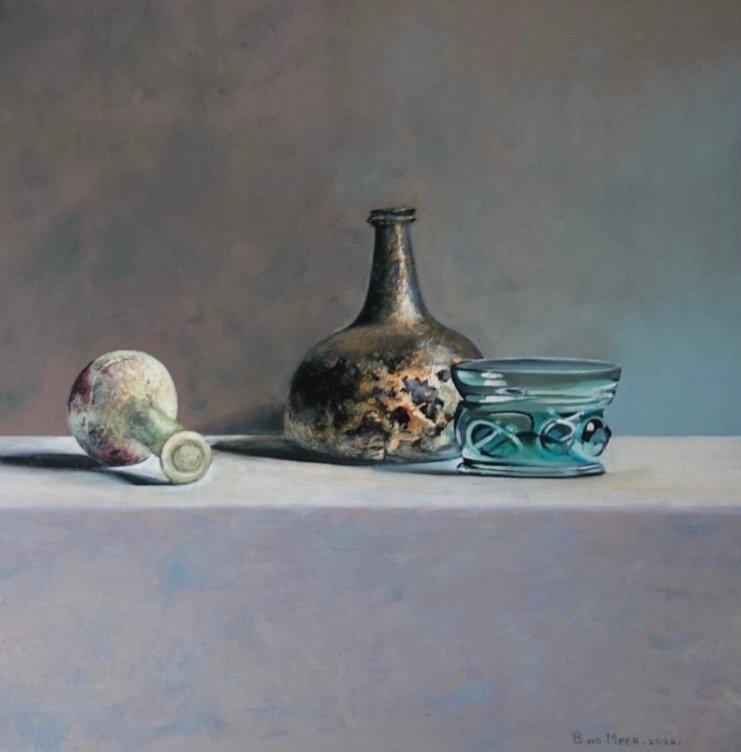
Bert van der Meer (1980) - Stilleven met Romeins Glas, Waldglas en de 17e-Eeuwse Fles


04
days
18
hours
01
minute
18
seconds
Current bid
€ 1
Reserve price not met

Expert
Selected by Caroline Bokobza
Graduated as French auctioneer and worked in Sotheby’s Paris valuation department.
Estimate € 1,100 - € 1,300
22 other people are watching this object
 Bidder 9123 Bidder 9123 | €1 |
|---|
Catawiki Buyer Protection
Your payment’s safe with us until you receive your object.View details
Trustpilot 4.4 | 122630 reviews
Rated Excellent on Trustpilot.
Bert van der Meer’s oil painting on panel, titled Stilleven met Romeins Glas, Waldglas en de 17e-Eeuwse Fles, created in 2024 in the Netherlands in a Realisme still life, signed and sold by the artist direct, in excellent condition and framed, measuring 84 × 84 cm including the frame.
AI-assisted summary
Description from the seller
Bert van der Meer – Still life with Roman glass, Wald glass, and the 17th-century bottle.
Oil painting on panel
This painting features ancient objects: a Roman glass, a 17th-century bottle, and a waldglas, all from the artist's personal collection. Due to their long burial in the earth, the glass surfaces have been corroded by acids, creating a beautiful iridescent sheen.
Van der Meer masterfully captures this fragile beauty in thin layers of oil paint, where light, time, and impermanence come together in a subtle and harmonious whole.
A remarkable work that exudes both craftsmanship and passion – a valuable addition for any enthusiast of contemporary classical realism.
Inner size: 68 x 68 cm
Size including frame: 84 x 84 cm
Information about the artist
Bert van der Meer was born in 1980 in Surhuisterveen, Friesland. From a young age, he began drawing and developed a strong interest in form, light, and composition. Since 2003, he has been working as a painter, with a preference for still lifes and portraits in oil paint.
Van der Meer is largely self-taught. Through extensive practice and independent research, he has developed a distinctive style that combines craftsmanship and personal imagination.
In his work, he mainly focuses on still lifes with objects that show traces of time, such as old glass bottles, archaeological finds, and worn utensils. He owns a large collection of objects ranging from Roman glass to medieval pottery, which often serve as inspiration and recur in his paintings. These objects symbolize the passage of time and give his work a poetic and sometimes nostalgic atmosphere.
His paintings stand out for their traditional compositions, soft color tones, and careful attention to light and shadow. This aligns his style with 20th-century realistic painters. Yet, he manages to add a contemporary sensitivity to his classical way of working.
In addition to still lifes, he also paints portraits and experiments with landscapes and studies in color and light.
Bert van der Meer – Still life with Roman glass, Wald glass, and the 17th-century bottle.
Oil painting on panel
This painting features ancient objects: a Roman glass, a 17th-century bottle, and a waldglas, all from the artist's personal collection. Due to their long burial in the earth, the glass surfaces have been corroded by acids, creating a beautiful iridescent sheen.
Van der Meer masterfully captures this fragile beauty in thin layers of oil paint, where light, time, and impermanence come together in a subtle and harmonious whole.
A remarkable work that exudes both craftsmanship and passion – a valuable addition for any enthusiast of contemporary classical realism.
Inner size: 68 x 68 cm
Size including frame: 84 x 84 cm
Information about the artist
Bert van der Meer was born in 1980 in Surhuisterveen, Friesland. From a young age, he began drawing and developed a strong interest in form, light, and composition. Since 2003, he has been working as a painter, with a preference for still lifes and portraits in oil paint.
Van der Meer is largely self-taught. Through extensive practice and independent research, he has developed a distinctive style that combines craftsmanship and personal imagination.
In his work, he mainly focuses on still lifes with objects that show traces of time, such as old glass bottles, archaeological finds, and worn utensils. He owns a large collection of objects ranging from Roman glass to medieval pottery, which often serve as inspiration and recur in his paintings. These objects symbolize the passage of time and give his work a poetic and sometimes nostalgic atmosphere.
His paintings stand out for their traditional compositions, soft color tones, and careful attention to light and shadow. This aligns his style with 20th-century realistic painters. Yet, he manages to add a contemporary sensitivity to his classical way of working.
In addition to still lifes, he also paints portraits and experiments with landscapes and studies in color and light.
Details
Artist
Bert van der Meer (1980)
Sold with frame
Yes
Sold by
Direct from the artist
Edition
Original
Title of artwork
Stilleven met Romeins Glas, Waldglas en de 17e-Eeuwse Fles
Technique
Oil painting
Signature
Hand signed
Country of Origin
Netherlands
Year
2024
Condition
Excellent condition
Height
84 cm
Width
84 cm
Depiction/Theme
Still life
Style
Realism
Period
2020+
Sold by
