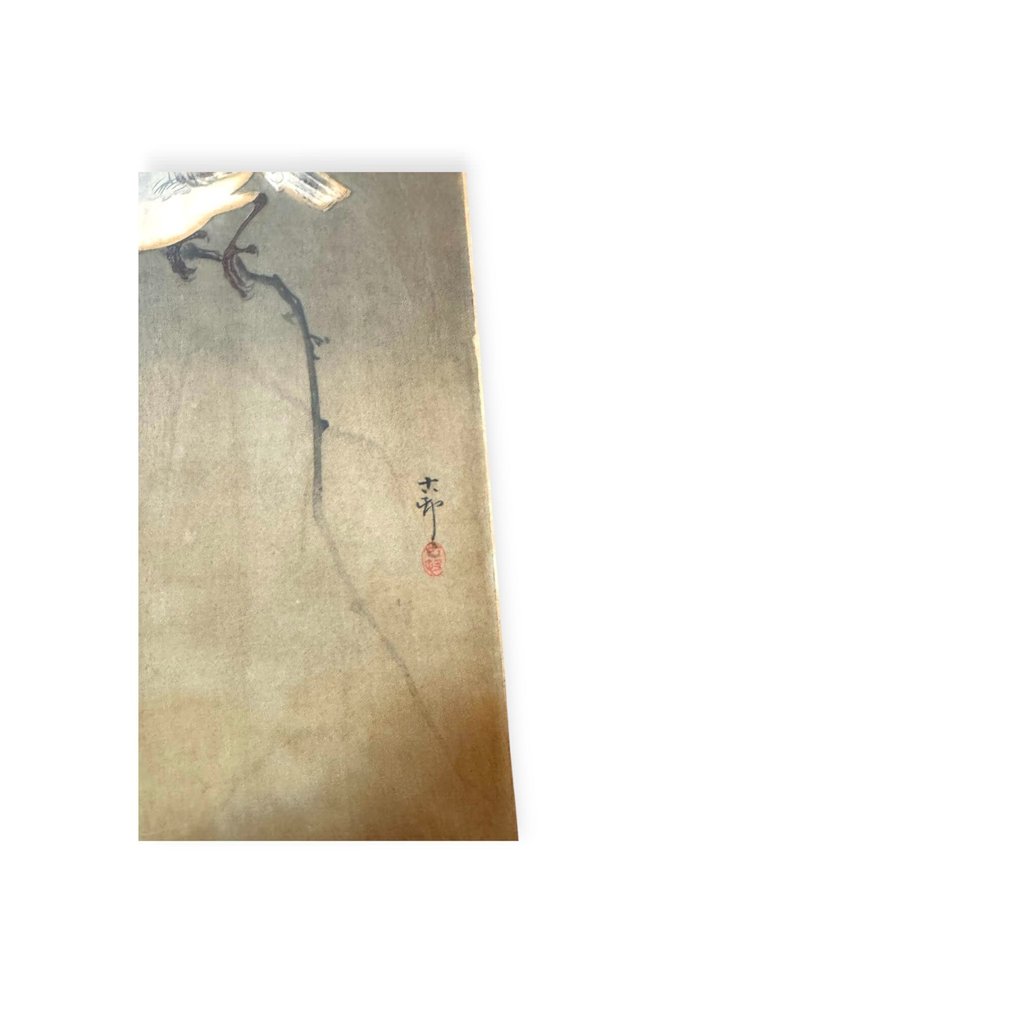
Ohara Koson (Shōson) – "Japanese Waxwings on Bittersweet Vine", Original Print with Condition Issues - Japan - Meiji period (1868-1912)



06
days
04
hours
58
minutes
58
seconds

No bids placed
Catawiki Buyer Protection
Your payment’s safe with us until you receive your object.View details
Trustpilot 4.4 | 122910 reviews
Rated Excellent on Trustpilot.
Original Meiji-period woodblock print by Ohara Koson (Shōson) depicting two Japanese waxwings perched on a bittersweet vine with red berries, with a tear in the upper area and age-related wear.
AI-assisted summary
Description from the seller
– Ohara Koson (1877–1945): master of shin-hanga kachō-e, renowned for intimate winter bird studies – Pair of crested Japanese waxwings perched on vine with crimson berries – rare subject demonstrating Koson's ornithological precision – Original edition with visible condition issues: tear to upper area, age-related wear; priced accordingly for collectors willing to restore
Summary: This original woodblock print depicts two Japanese waxwings (hirenjakō) perched on a bittersweet vine (meginomi) laden with vivid red berries. The composition showcases Koson's mastery of winter bird subjects, a category that represents some of his finest work. The waxwings are rendered with characteristic precision: soft grey-brown bodies, distinctive crests, delicate wing barring, and touches of coral-pink on the heads. Their postures suggest companionable interaction, one bird facing forward while its mate turns aside. The vine curves diagonally across the picture plane, its gnarled branches punctuated by clusters of bright red berries that provide both visual accent and seasonal context. The background features refined bokashi gradation from darker grey-green at the base to pale cream at the top, creating atmospheric depth. However, this print has sustained damage: a visible tear to the upper portion, additional age-related wear, foxing on the verso, and minor paper lifting at edges. Despite these condition issues, the print retains significant artistic merit and offers collectors an opportunity to acquire an original Koson work at accessible pricing, ideal for restoration or study purposes.
Japanese waxwings are elusive birds, appearing in winter flocks that descend on berry-laden trees and vines, strip them clean, then vanish. Their unpredictable movements and striking appearance – sleek crested heads, soft plumage, yellow-tipped tail feathers – made them prized subjects for Japanese bird painters. Koson returned to waxwing imagery repeatedly, producing variations that capture different aspects of their behaviour: feeding, perching, flying in formation. This print depicts a moment of stillness between feeding bouts, the two birds pausing on the vine as if surveying their surroundings before resuming their feast.
The composition is anchored by the diagonal movement of the bittersweet vine, which enters from the lower left, curves upward through the centre, and extends toward the upper right where crimson berries cluster densely. This diagonal creates dynamic tension while providing natural perches for both birds. The left bird occupies the central area, body angled slightly toward the viewer, head turned in profile to reveal its distinctive crest – a swept-back plume that gives waxwings their aristocratic appearance. The right bird sits higher on the branch, body facing away but head turned back over its shoulder, creating a sense of communication between the pair.
The plumage rendering demonstrates Koson's observational discipline. Japanese waxwings (Bombycilla japonica) have soft grey-brown bodies with subtle gradations from darker backs to paler underparts. The heads show touches of coral-pink on the crown and throat, rendered here with delicate pigment application that suggests colour without overwhelming the overall muted palette. The wings display fine barring in grey and brown, with distinctive yellow tips on the tail feathers – diagnostic field marks that Koson includes faithfully. These details confirm his commitment to naturalistic accuracy; anyone familiar with waxwings would recognise the species immediately.
The berries provide chromatic punctuation – bright red orbs clustered along the branches, their vivid colour contrasting sharply with the subdued tones of the birds and background. These are likely bittersweet (Celastrus orbiculatus) or a similar vine species whose berries persist through winter, providing crucial food for birds when other sources have vanished. The berries' placement is compositionally deliberate: they draw the eye upward along the branch, create visual weight in the upper right, and balance the massed forms of the two birds in the central area.
The background demonstrates sophisticated bokashi technique. The gradation shifts from darker grey-green at the bottom – suggesting earth or winter undergrowth – through mid-tones in the central area, to pale cream at the top. This atmospheric transition creates depth without literal landscape elements; the birds exist in a suggestive space rather than a specific location. The printer achieved this gradation through careful hand-wiping of the block, controlling moisture and pigment density to create seamless tonal shifts. Such refinement requires years of experience and cannot be replicated mechanically.
Ohara Koson's training under Kōno Bairei emphasised direct observation of nature. Bairei's students spent hours sketching live birds, studying their anatomy, behaviour, and characteristic postures. This discipline permeates Koson's work – his birds are never generic symbols but recognisable individuals captured in specific moments. The waxwings' postures here are utterly convincing: the weight distribution, the grip of feet on branch, the angle of heads – all reflect close observation of actual birds rather than artistic convention.
The condition issues cannot be overlooked. The most significant damage is a tear to the upper portion of the print, visible in the provided photographs. This appears to be a clean split in the paper without loss of material, affecting the background gradation area rather than the primary subjects. Additional wear includes foxing (age-related brown spotting) on the verso, minor paper lifting at edges, and overall toning consistent with decades of existence. The recto (printed side) shows good colour retention despite these issues – the reds remain vibrant, the greys maintain their subtlety, the keyblock lines read clearly.
For collectors, condition-challenged prints occupy a complex position. Purists seeking museum-grade examples will pass over damaged works. However, others recognise that such prints offer accessible entry into artists' work that would otherwise remain financially out of reach. A pristine Koson waxwing print might command premium pricing; this example, with its condition issues, becomes attainable for collectors willing to accept imperfection or undertake restoration.
Restoration options exist. Professional paper conservators can perform repairs that, while never erasing damage entirely, can stabilise tears and improve overall presentation. The tear could be mended using Japanese tissue and wheat-starch paste – traditional materials that remain reversible and maintain archival standards. Foxing can sometimes be reduced through careful washing, though this requires expert handling to avoid damaging pigments. Such interventions require specialist skills and should never be attempted without conservation training.
Even in its current state, the print retains significant value as a study piece or for collectors who prioritise artistic content over pristine condition. The composition remains legible, the birds' charm undiminished, Koson's technical mastery still evident in the surviving bokashi work and precise rendering. Frame it behind glass with acid-free matting, and the damage becomes less prominent when viewed at normal distance. The tear, while visible, does not intersect the primary subjects – the birds remain intact and compelling.
Japanese waxwings appear less frequently in Koson's oeuvre than more common species like sparrows, crows, or waterfowl. This relative scarcity adds interest for collectors building comprehensive Koson holdings. The subject matter – winter birds on berry vines – represents a classic kachō-e theme that connects to centuries of Japanese painting tradition while remaining accessible to Western viewers through its naturalistic approach.
In terms of market positioning, condition-challenged prints serve an important function. They allow emerging collectors to acquire original works by major artists while learning about print quality, condition assessment, and market values. They provide opportunities for hands-on study of printing techniques, paper qualities, and ageing patterns. And they offer possibilities for restoration practice or simply acceptance of imperfection – embracing the Japanese aesthetic principle of wabi-sabi that finds beauty in aged, worn objects bearing traces of their passage through time.
For European collectors, the subject matter transcends cultural boundaries. Winter birds feeding on berries is a universal image, recognised from Scandinavia to Britain to Central Europe. The waxwings' elegant forms and the vine's dynamic diagonal movement work equally well in traditional or contemporary interiors. The muted colour palette – greys, browns, touches of red – harmonises with natural materials and neutral furnishings.
This print represents an honest offering: original Koson work with acknowledged condition issues, priced to reflect its compromised state. For collectors who value artistic merit over perfect preservation, or who seek affordable entry into shin-hanga collecting, it offers opportunity. The damage is disclosed, the quality evident, the decision straightforward.
Shipping & Handling We ship worldwide via DHL or EMS with full insurance and tracking. Professional packing ensures safe arrival; combined shipping available for multiple wins. Local customs duties are the buyer's responsibility.
Seller Guarantee We specialise in authentic Japanese prints and guarantee this piece's authenticity. Questions welcome – we reply within 24 hours.
Seller's Story
Hello, and thank you for visiting my page. I primarily handle Japanese antiques, as well as Western antiques, art pieces, and pre-loved items that have been cherished in Japan. Growing up in a family of historians—my grandfather was a historian and my father was an archaeologist—I have always been captivated by the eras and stories these historic objects and works of art carry with them.
My listings feature collections from both Japan and the West, pieces that have stood the test of time and remained beloved through the ages. Through these rare treasures, I hope to share with you the delight of ownership and discovery. As a professional, I strive for honest and sincere transactions to ensure customer satisfaction, always leveraging my experience and eye for quality.
I strongly believe in not letting buyers down, so I describe items as accurately and thoroughly as possible, prioritizing secure and careful packaging. If you have any questions or concerns, please feel free to reach out. It would be my pleasure to help enrich your collecting experience.
Thank you for your interest, and I look forward to doing business with you.
– Ohara Koson (1877–1945): master of shin-hanga kachō-e, renowned for intimate winter bird studies – Pair of crested Japanese waxwings perched on vine with crimson berries – rare subject demonstrating Koson's ornithological precision – Original edition with visible condition issues: tear to upper area, age-related wear; priced accordingly for collectors willing to restore
Summary: This original woodblock print depicts two Japanese waxwings (hirenjakō) perched on a bittersweet vine (meginomi) laden with vivid red berries. The composition showcases Koson's mastery of winter bird subjects, a category that represents some of his finest work. The waxwings are rendered with characteristic precision: soft grey-brown bodies, distinctive crests, delicate wing barring, and touches of coral-pink on the heads. Their postures suggest companionable interaction, one bird facing forward while its mate turns aside. The vine curves diagonally across the picture plane, its gnarled branches punctuated by clusters of bright red berries that provide both visual accent and seasonal context. The background features refined bokashi gradation from darker grey-green at the base to pale cream at the top, creating atmospheric depth. However, this print has sustained damage: a visible tear to the upper portion, additional age-related wear, foxing on the verso, and minor paper lifting at edges. Despite these condition issues, the print retains significant artistic merit and offers collectors an opportunity to acquire an original Koson work at accessible pricing, ideal for restoration or study purposes.
Japanese waxwings are elusive birds, appearing in winter flocks that descend on berry-laden trees and vines, strip them clean, then vanish. Their unpredictable movements and striking appearance – sleek crested heads, soft plumage, yellow-tipped tail feathers – made them prized subjects for Japanese bird painters. Koson returned to waxwing imagery repeatedly, producing variations that capture different aspects of their behaviour: feeding, perching, flying in formation. This print depicts a moment of stillness between feeding bouts, the two birds pausing on the vine as if surveying their surroundings before resuming their feast.
The composition is anchored by the diagonal movement of the bittersweet vine, which enters from the lower left, curves upward through the centre, and extends toward the upper right where crimson berries cluster densely. This diagonal creates dynamic tension while providing natural perches for both birds. The left bird occupies the central area, body angled slightly toward the viewer, head turned in profile to reveal its distinctive crest – a swept-back plume that gives waxwings their aristocratic appearance. The right bird sits higher on the branch, body facing away but head turned back over its shoulder, creating a sense of communication between the pair.
The plumage rendering demonstrates Koson's observational discipline. Japanese waxwings (Bombycilla japonica) have soft grey-brown bodies with subtle gradations from darker backs to paler underparts. The heads show touches of coral-pink on the crown and throat, rendered here with delicate pigment application that suggests colour without overwhelming the overall muted palette. The wings display fine barring in grey and brown, with distinctive yellow tips on the tail feathers – diagnostic field marks that Koson includes faithfully. These details confirm his commitment to naturalistic accuracy; anyone familiar with waxwings would recognise the species immediately.
The berries provide chromatic punctuation – bright red orbs clustered along the branches, their vivid colour contrasting sharply with the subdued tones of the birds and background. These are likely bittersweet (Celastrus orbiculatus) or a similar vine species whose berries persist through winter, providing crucial food for birds when other sources have vanished. The berries' placement is compositionally deliberate: they draw the eye upward along the branch, create visual weight in the upper right, and balance the massed forms of the two birds in the central area.
The background demonstrates sophisticated bokashi technique. The gradation shifts from darker grey-green at the bottom – suggesting earth or winter undergrowth – through mid-tones in the central area, to pale cream at the top. This atmospheric transition creates depth without literal landscape elements; the birds exist in a suggestive space rather than a specific location. The printer achieved this gradation through careful hand-wiping of the block, controlling moisture and pigment density to create seamless tonal shifts. Such refinement requires years of experience and cannot be replicated mechanically.
Ohara Koson's training under Kōno Bairei emphasised direct observation of nature. Bairei's students spent hours sketching live birds, studying their anatomy, behaviour, and characteristic postures. This discipline permeates Koson's work – his birds are never generic symbols but recognisable individuals captured in specific moments. The waxwings' postures here are utterly convincing: the weight distribution, the grip of feet on branch, the angle of heads – all reflect close observation of actual birds rather than artistic convention.
The condition issues cannot be overlooked. The most significant damage is a tear to the upper portion of the print, visible in the provided photographs. This appears to be a clean split in the paper without loss of material, affecting the background gradation area rather than the primary subjects. Additional wear includes foxing (age-related brown spotting) on the verso, minor paper lifting at edges, and overall toning consistent with decades of existence. The recto (printed side) shows good colour retention despite these issues – the reds remain vibrant, the greys maintain their subtlety, the keyblock lines read clearly.
For collectors, condition-challenged prints occupy a complex position. Purists seeking museum-grade examples will pass over damaged works. However, others recognise that such prints offer accessible entry into artists' work that would otherwise remain financially out of reach. A pristine Koson waxwing print might command premium pricing; this example, with its condition issues, becomes attainable for collectors willing to accept imperfection or undertake restoration.
Restoration options exist. Professional paper conservators can perform repairs that, while never erasing damage entirely, can stabilise tears and improve overall presentation. The tear could be mended using Japanese tissue and wheat-starch paste – traditional materials that remain reversible and maintain archival standards. Foxing can sometimes be reduced through careful washing, though this requires expert handling to avoid damaging pigments. Such interventions require specialist skills and should never be attempted without conservation training.
Even in its current state, the print retains significant value as a study piece or for collectors who prioritise artistic content over pristine condition. The composition remains legible, the birds' charm undiminished, Koson's technical mastery still evident in the surviving bokashi work and precise rendering. Frame it behind glass with acid-free matting, and the damage becomes less prominent when viewed at normal distance. The tear, while visible, does not intersect the primary subjects – the birds remain intact and compelling.
Japanese waxwings appear less frequently in Koson's oeuvre than more common species like sparrows, crows, or waterfowl. This relative scarcity adds interest for collectors building comprehensive Koson holdings. The subject matter – winter birds on berry vines – represents a classic kachō-e theme that connects to centuries of Japanese painting tradition while remaining accessible to Western viewers through its naturalistic approach.
In terms of market positioning, condition-challenged prints serve an important function. They allow emerging collectors to acquire original works by major artists while learning about print quality, condition assessment, and market values. They provide opportunities for hands-on study of printing techniques, paper qualities, and ageing patterns. And they offer possibilities for restoration practice or simply acceptance of imperfection – embracing the Japanese aesthetic principle of wabi-sabi that finds beauty in aged, worn objects bearing traces of their passage through time.
For European collectors, the subject matter transcends cultural boundaries. Winter birds feeding on berries is a universal image, recognised from Scandinavia to Britain to Central Europe. The waxwings' elegant forms and the vine's dynamic diagonal movement work equally well in traditional or contemporary interiors. The muted colour palette – greys, browns, touches of red – harmonises with natural materials and neutral furnishings.
This print represents an honest offering: original Koson work with acknowledged condition issues, priced to reflect its compromised state. For collectors who value artistic merit over perfect preservation, or who seek affordable entry into shin-hanga collecting, it offers opportunity. The damage is disclosed, the quality evident, the decision straightforward.
Shipping & Handling We ship worldwide via DHL or EMS with full insurance and tracking. Professional packing ensures safe arrival; combined shipping available for multiple wins. Local customs duties are the buyer's responsibility.
Seller Guarantee We specialise in authentic Japanese prints and guarantee this piece's authenticity. Questions welcome – we reply within 24 hours.
Seller's Story
Hello, and thank you for visiting my page. I primarily handle Japanese antiques, as well as Western antiques, art pieces, and pre-loved items that have been cherished in Japan. Growing up in a family of historians—my grandfather was a historian and my father was an archaeologist—I have always been captivated by the eras and stories these historic objects and works of art carry with them.
My listings feature collections from both Japan and the West, pieces that have stood the test of time and remained beloved through the ages. Through these rare treasures, I hope to share with you the delight of ownership and discovery. As a professional, I strive for honest and sincere transactions to ensure customer satisfaction, always leveraging my experience and eye for quality.
I strongly believe in not letting buyers down, so I describe items as accurately and thoroughly as possible, prioritizing secure and careful packaging. If you have any questions or concerns, please feel free to reach out. It would be my pleasure to help enrich your collecting experience.
Thank you for your interest, and I look forward to doing business with you.
Details
Dynastic Style/Period
Meiji period (1868-1912)
No. of items
1
Country of Origin
Japan
Height
34 cm
Width
19 cm
Title of artwork
Ohara Koson (Shōson) – "Japanese Waxwings on Bittersweet Vine", Original Print with Condition Issues
Condition
Good condition
Sold by
