Martin Luther - Epistel der Aposteln - 1567

07
days
15
hours
51
minutes
03
seconds
Current bid
€ 1,500
Reserve price not met

Expert
Selected by Ilaria Colombo
Specialist in old books, specialising in theological disputes since 1999.
Estimate € 3,000 - € 4,000
19 other people are watching this object
 Bidder 5169 Bidder 5169 | €1,500 | |
|---|---|---|
 Bidder 7230 Bidder 7230 | €1,300 |
Catawiki Buyer Protection
Your payment’s safe with us until you receive your object.View details
Trustpilot 4.4 | 122529 reviews
Rated Excellent on Trustpilot.
Martin Luther, Epistel der Aposteln, Wittenberg, 1567, 1st edition in this format, in German (original language), a Renaissance pigskin binding on wooden boards with ornamental tooling and handsomely hand‑coloured illustrations, folio, 1146 pages, in good condition.
AI-assisted summary
Description from the seller
Martin Luther and His Arc of Light - An Exceptionally Prestigious Renaissance Legacy
IN FOLIO
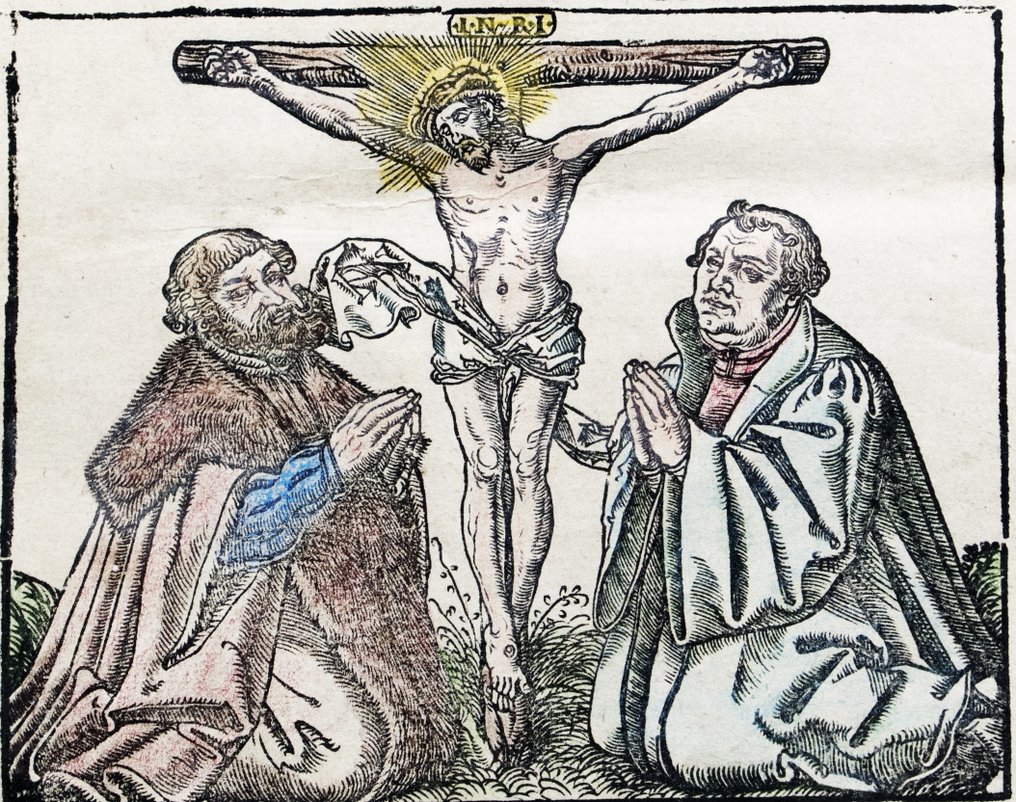
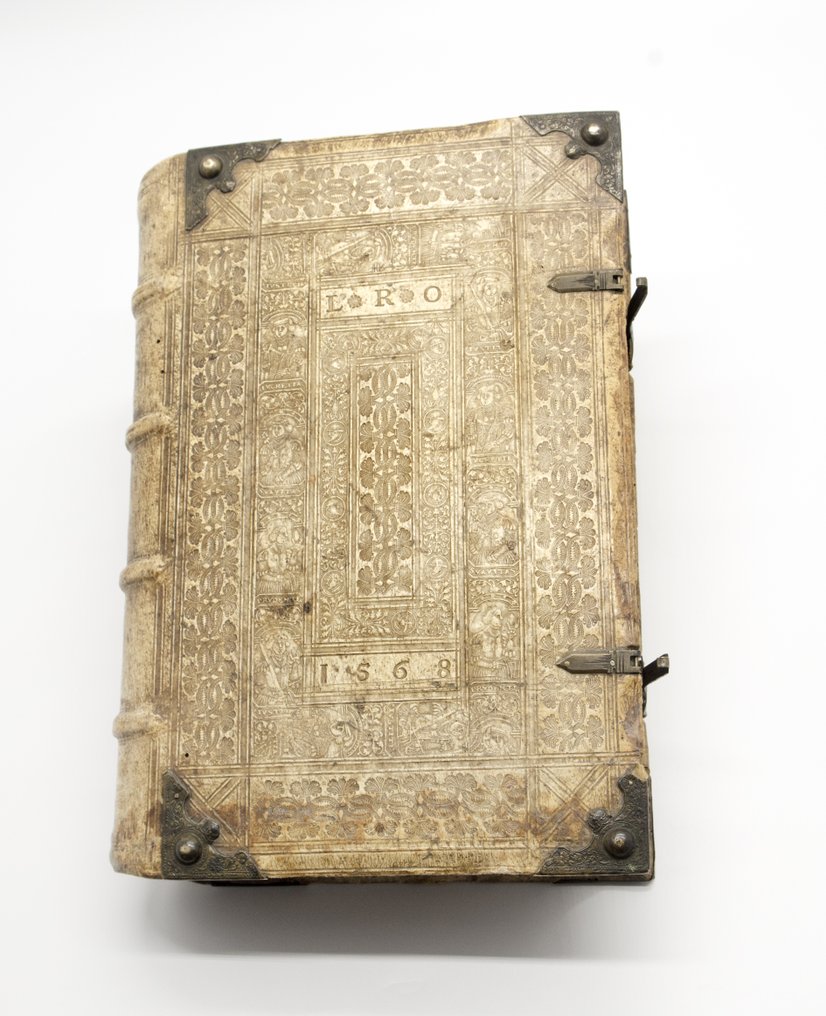
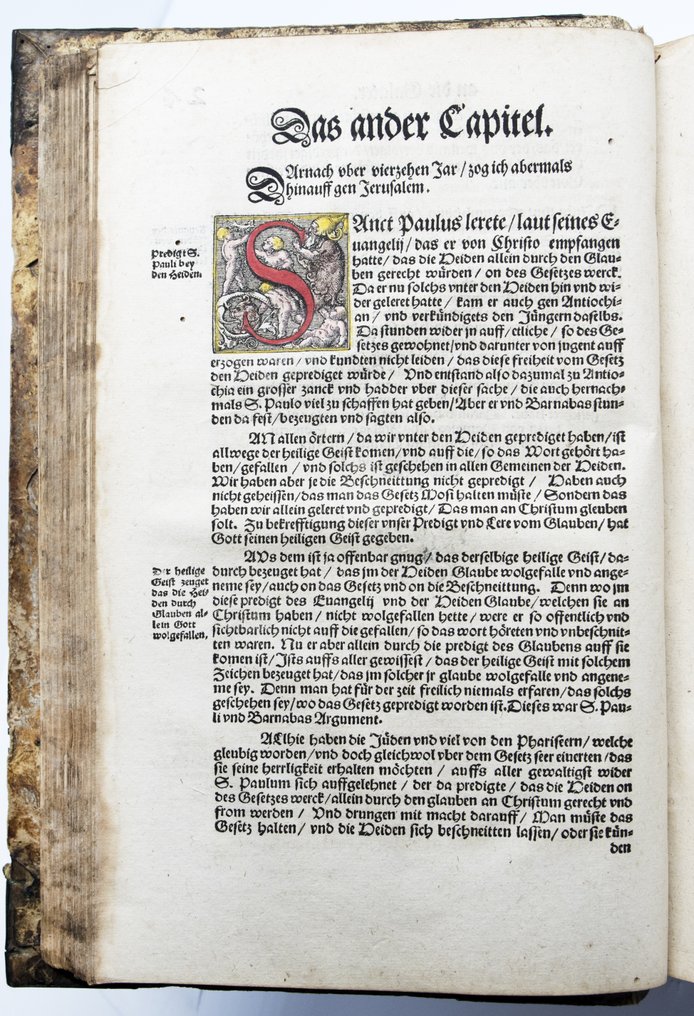
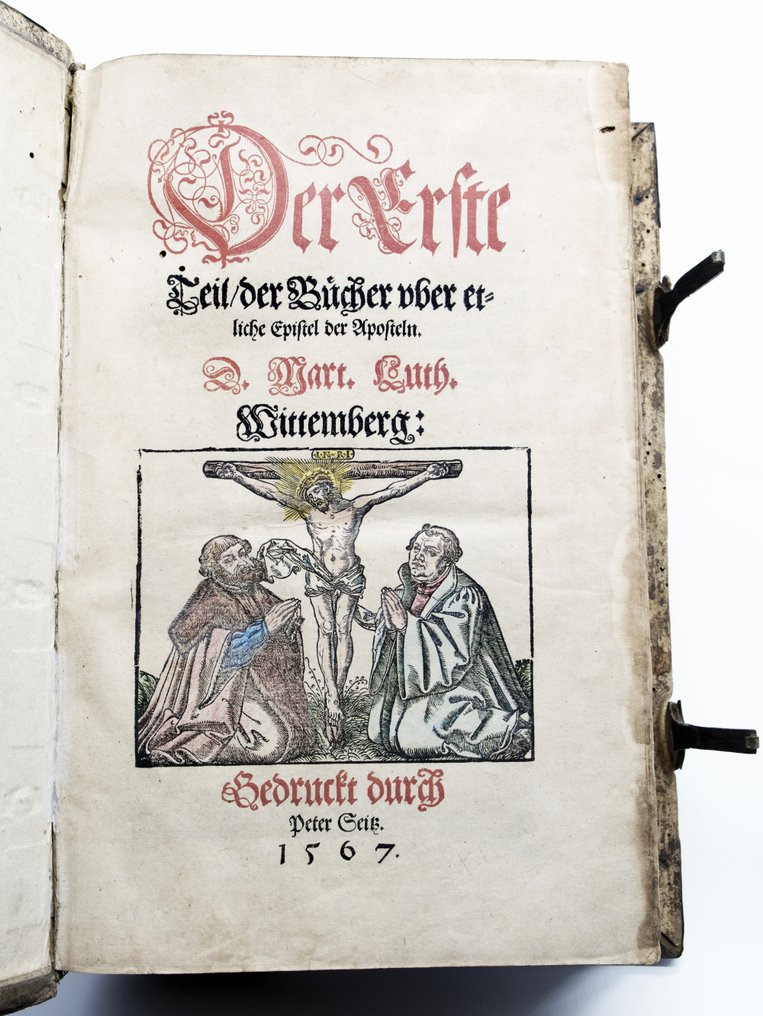
Magnificent contemporary binding in pigskin on wooden boards, decorated in blind with a rich Renaissance design featuring frames and allegorical figures (Lucretia, Justicia, Prudentia). Bronze corners, bosses, and two brass clasps, all perfectly preserved. On the front cover: the letters L*R*O and the date 1568 (related to the binding, a year after the edition). The printed title page in red and black, with a woodcut depicting Christ on the cross and two figures in prayer. Initials in criblé and the vignette of the title page finely watercolor-painted by a later hand.
This monumental in-folio by Martin Luther stands as one of the most powerful materializations of Reformed thought in the second half of the 16th century. It is not just a book: it is a doctrinal vector, a theological object designed to project Martin Luther's legacy beyond his death, stabilizing its interpretative authority in a Europe still in confessional ferment.
The contemporary binding of 1568, a masterpiece of German art on wooden boards, dry-stamped with allegorical figures of extraordinary moral strength (Lucretia, Justicia, Prudentia), transforms the volume into a civil and religious relic. The sow's leather, the studs, the bronze corners, and the intact clasps remain today as a three-dimensional manifesto of the renewed book culture: a book that does not merely contain the Lutheran word but physically embodies it.
The Wittenberg print – a hub of the Reformation and posthumous exegesis activity – intertwines Gothic characters, woodcut initials, and a title page in red and black around the image of Christ on the cross, creating a pedagogical device that unites devotion, doctrine, and visual authority. The entire specimen is a bridge between word and matter: a rare testament to the typographic and spiritual elite that made Luther not only an author but a cultural institution.
Market value
The Lutheran exegetical editions in folio, printed in Wittenberg in the 1560s of the 16th century, represent the pinnacle of post-Lutheran production. When preserved in contemporary bindings on wooden boards with original hardware, they reach values of 3,000–4,500 euros; specimens with higher-quality Renaissance figurative bindings, like the present one, are consistently valued between 6,000 and 7,500 euros, with potential increases in cases of prestigious provenance or exceptional condition.
Physical description and condition
Magnificent contemporary binding in pigskin on wooden boards, decorated in blind with a complex Renaissance design featuring frames and allegorical figures (Lucretia, Justicia, Prudentia). Bronze corners, bosses, and two brass clasps in perfect condition. On the front cover: the letters LRO and the date 1568, related to the binding. Title page in red and black with a woodcut depicting Christ on the cross and two figures in prayer. Criblé initials and finely watercolor-illustrated vignette by a later hand. Text in German in Gothic type. Ornate woodcut initials. Overall browning; some pages darker; small marginal wormholes without significant loss. Pages 22nn; 1124.
Full title and author
The first part of the books about many epistles of the apostles.
Wittenberg, Peter Seitz, 1567.
Martin Luther
Context and Significance
This work represents one of the cornerstones of post-Reformation Lutheran exegesis, a body of work intended to define evangelical preaching for generations. Luther's authority, already monumental in the theological landscape, finds here one of its most impressive editorial manifestations: a text designed to serve as a stable doctrinal foundation in the turbulent period following his death. The 1567 Wittenberg print uses visual and typographical language that combines medieval tradition with modern editorial practices, responding to the Reformed need to make Scripture understandable, memorable, and authoritative. The 1568 binding adds a moral and symbolic dimension: the virtues engraved on the cover act as emblems of the new Lutheran Christian society, founded on justice, integrity, and prudence. The copy thus serves as both a material and ideological testament of the first century of the Reformation.
Biography of the Author
Martin Luther (1483–1546), theologian, reformer, translator of the Bible, and a pivotal figure in European history, transformed the relationship between the individual, Scripture, and religious authority. His exegetical works, along with his translation of the Bible, laid the foundation for Protestant identity and the entire evangelical theological tradition.
Printing history and circulation
Printed in Wittenberg by Peter Seitz in 1567, in one of the most important centers of Lutheran production. The Wittenberg printing press, closely linked to the university and Luther's intellectual heirs, contributed to the international spread of the Reformation through an editorial program that favored doctrinal texts and tools for preaching. The copies remaining in contemporary binding on wooden boards with decorative figures and intact hardware are now rare and particularly sought after.
BIBLIOGRAPHY AND REFERENCES
VD16, Lutheran printed editions in Wittenberg.
Kuczynski, bibliography of the Luther prints.
Benzing, The printers of the 16th and 17th centuries in the German-speaking area (officina Seitz).
Wittenberg prints of the 16th century, historical catalogs.
Studies on 16th-century Lutheran exegesis.
Höfert, Renaissance German Bookbindings (German figurative ligatures of the 16th century).
International auction catalogs (Reiss & Sohn, Ketterer, Christie’s): sales of Lutheran in-folio editions with figurated Renaissance bindings.
Seller's Story
Luxury Books: Your Go-To Guide for Nabbing Literary Treasures!
Embarking on the thrilling journey of collecting rare and timeless printed works? Here's your snappy rundown, "The Collector's Cheat Sheet," to ensure you're not just flipping pages but stacking up the value:
1. Edition and Rarity: Rarity is the name of the game. First editions, limited printings, and books flaunting unique features like eye-catching illustrations or mind-blowing bindings? Consider them the VIPs of the collector's world.
2. Condition & Dimension: Picture this – a book in mint condition, untouched by the woes of wear and tear. Now, flip the script: wear, foxing, discoloration – they're the villains here. And don't forget to size up the dimensions, because a book's size matters in the collector's universe.
3. Authenticity: In a world of replicas and forgeries, verifying a book's authenticity is your superhero move. Expert examination and authentication – your trusty sidekicks in this quest.
4. Provenance: Who owned it before you? If the book has hobnobbed with famous figures or danced through historical events, its value skyrockets. Every book has a story, but some have blockbuster tales.
5. Demand and Market Trends: Think of book values as the stock market of the literary world. Stay savvy on collector trends and market shifts to ride the waves of value.
6. Subject Matter: Some topics are like fine wine – they get better with time. Dive into subjects with a timeless appeal or ride the wave of emerging cultural and historical relevance.
7. Binding and Design: Beauty is more than skin deep. Intricate bindings, stunning covers, and illustrations – these are the accessories that make a book runway-ready in the collector's eyes.
8. Association Copies: Books with a personal touch – whether it's a connection to the author or a famous personality – elevate the historical vibes. A book with a backstory? Count us in.
9. Investment Potential: Passion is the engine, but some collectors eye future returns. Keep in mind, though, that the book market can be as unpredictable as a plot twist.
10. Expert Advice: New to the game? Don't play solo. Seek wisdom from the book gurus, hit up book fairs, and join collector communities. We at Luxury Books are the Yodas of the rare book galaxy, helping you build collections that scream sophistication and cultural clout.
Because collecting rare books isn't just about dollar signs – it's a journey of preserving heritage and embracing literary treasures. Happy collecting!
Translated by Google TranslateMartin Luther and His Arc of Light - An Exceptionally Prestigious Renaissance Legacy
IN FOLIO
Magnificent contemporary binding in pigskin on wooden boards, decorated in blind with a rich Renaissance design featuring frames and allegorical figures (Lucretia, Justicia, Prudentia). Bronze corners, bosses, and two brass clasps, all perfectly preserved. On the front cover: the letters L*R*O and the date 1568 (related to the binding, a year after the edition). The printed title page in red and black, with a woodcut depicting Christ on the cross and two figures in prayer. Initials in criblé and the vignette of the title page finely watercolor-painted by a later hand.
This monumental in-folio by Martin Luther stands as one of the most powerful materializations of Reformed thought in the second half of the 16th century. It is not just a book: it is a doctrinal vector, a theological object designed to project Martin Luther's legacy beyond his death, stabilizing its interpretative authority in a Europe still in confessional ferment.
The contemporary binding of 1568, a masterpiece of German art on wooden boards, dry-stamped with allegorical figures of extraordinary moral strength (Lucretia, Justicia, Prudentia), transforms the volume into a civil and religious relic. The sow's leather, the studs, the bronze corners, and the intact clasps remain today as a three-dimensional manifesto of the renewed book culture: a book that does not merely contain the Lutheran word but physically embodies it.
The Wittenberg print – a hub of the Reformation and posthumous exegesis activity – intertwines Gothic characters, woodcut initials, and a title page in red and black around the image of Christ on the cross, creating a pedagogical device that unites devotion, doctrine, and visual authority. The entire specimen is a bridge between word and matter: a rare testament to the typographic and spiritual elite that made Luther not only an author but a cultural institution.
Market value
The Lutheran exegetical editions in folio, printed in Wittenberg in the 1560s of the 16th century, represent the pinnacle of post-Lutheran production. When preserved in contemporary bindings on wooden boards with original hardware, they reach values of 3,000–4,500 euros; specimens with higher-quality Renaissance figurative bindings, like the present one, are consistently valued between 6,000 and 7,500 euros, with potential increases in cases of prestigious provenance or exceptional condition.
Physical description and condition
Magnificent contemporary binding in pigskin on wooden boards, decorated in blind with a complex Renaissance design featuring frames and allegorical figures (Lucretia, Justicia, Prudentia). Bronze corners, bosses, and two brass clasps in perfect condition. On the front cover: the letters LRO and the date 1568, related to the binding. Title page in red and black with a woodcut depicting Christ on the cross and two figures in prayer. Criblé initials and finely watercolor-illustrated vignette by a later hand. Text in German in Gothic type. Ornate woodcut initials. Overall browning; some pages darker; small marginal wormholes without significant loss. Pages 22nn; 1124.
Full title and author
The first part of the books about many epistles of the apostles.
Wittenberg, Peter Seitz, 1567.
Martin Luther
Context and Significance
This work represents one of the cornerstones of post-Reformation Lutheran exegesis, a body of work intended to define evangelical preaching for generations. Luther's authority, already monumental in the theological landscape, finds here one of its most impressive editorial manifestations: a text designed to serve as a stable doctrinal foundation in the turbulent period following his death. The 1567 Wittenberg print uses visual and typographical language that combines medieval tradition with modern editorial practices, responding to the Reformed need to make Scripture understandable, memorable, and authoritative. The 1568 binding adds a moral and symbolic dimension: the virtues engraved on the cover act as emblems of the new Lutheran Christian society, founded on justice, integrity, and prudence. The copy thus serves as both a material and ideological testament of the first century of the Reformation.
Biography of the Author
Martin Luther (1483–1546), theologian, reformer, translator of the Bible, and a pivotal figure in European history, transformed the relationship between the individual, Scripture, and religious authority. His exegetical works, along with his translation of the Bible, laid the foundation for Protestant identity and the entire evangelical theological tradition.
Printing history and circulation
Printed in Wittenberg by Peter Seitz in 1567, in one of the most important centers of Lutheran production. The Wittenberg printing press, closely linked to the university and Luther's intellectual heirs, contributed to the international spread of the Reformation through an editorial program that favored doctrinal texts and tools for preaching. The copies remaining in contemporary binding on wooden boards with decorative figures and intact hardware are now rare and particularly sought after.
BIBLIOGRAPHY AND REFERENCES
VD16, Lutheran printed editions in Wittenberg.
Kuczynski, bibliography of the Luther prints.
Benzing, The printers of the 16th and 17th centuries in the German-speaking area (officina Seitz).
Wittenberg prints of the 16th century, historical catalogs.
Studies on 16th-century Lutheran exegesis.
Höfert, Renaissance German Bookbindings (German figurative ligatures of the 16th century).
International auction catalogs (Reiss & Sohn, Ketterer, Christie’s): sales of Lutheran in-folio editions with figurated Renaissance bindings.
Seller's Story
Luxury Books: Your Go-To Guide for Nabbing Literary Treasures!
Embarking on the thrilling journey of collecting rare and timeless printed works? Here's your snappy rundown, "The Collector's Cheat Sheet," to ensure you're not just flipping pages but stacking up the value:
1. Edition and Rarity: Rarity is the name of the game. First editions, limited printings, and books flaunting unique features like eye-catching illustrations or mind-blowing bindings? Consider them the VIPs of the collector's world.
2. Condition & Dimension: Picture this – a book in mint condition, untouched by the woes of wear and tear. Now, flip the script: wear, foxing, discoloration – they're the villains here. And don't forget to size up the dimensions, because a book's size matters in the collector's universe.
3. Authenticity: In a world of replicas and forgeries, verifying a book's authenticity is your superhero move. Expert examination and authentication – your trusty sidekicks in this quest.
4. Provenance: Who owned it before you? If the book has hobnobbed with famous figures or danced through historical events, its value skyrockets. Every book has a story, but some have blockbuster tales.
5. Demand and Market Trends: Think of book values as the stock market of the literary world. Stay savvy on collector trends and market shifts to ride the waves of value.
6. Subject Matter: Some topics are like fine wine – they get better with time. Dive into subjects with a timeless appeal or ride the wave of emerging cultural and historical relevance.
7. Binding and Design: Beauty is more than skin deep. Intricate bindings, stunning covers, and illustrations – these are the accessories that make a book runway-ready in the collector's eyes.
8. Association Copies: Books with a personal touch – whether it's a connection to the author or a famous personality – elevate the historical vibes. A book with a backstory? Count us in.
9. Investment Potential: Passion is the engine, but some collectors eye future returns. Keep in mind, though, that the book market can be as unpredictable as a plot twist.
10. Expert Advice: New to the game? Don't play solo. Seek wisdom from the book gurus, hit up book fairs, and join collector communities. We at Luxury Books are the Yodas of the rare book galaxy, helping you build collections that scream sophistication and cultural clout.
Because collecting rare books isn't just about dollar signs – it's a journey of preserving heritage and embracing literary treasures. Happy collecting!
Translated by Google TranslateDetails
Number of Books
1
Subject
Incunabula & early printing
Book Title
Epistel der Aposteln
Author/ Illustrator
Martin Luther
Condition
Good
Publication year oldest item
1567
Height
328 mm
Edition
1st Edition Thus
Width
228 mm
Language
German
Original language
Yes
Publisher
Wittenberg, Peter Seitz, 1567
Binding/ Material
Leather
Extras
Hand coloured illustrations
Number of pages
1146
Sold by
