Pierre de Ronsard - Oeuvres de Ronsard - 1617-1630


10
days
12
hours
53
minutes
10
seconds
Current bid
€ 110
No reserve price

Expert
Selected by Volker Riepenhausen
Specialist in travel literature and pre-1600 rare prints with 28 years experience.
Estimate € 2,900 - € 3,500
5 other people are watching this object
 Bidder 7965 Bidder 7965 | €110 | |
|---|---|---|
| Bidder 3334 | €100 | |
| Bidder 7965 | €55 | |
Catawiki Buyer Protection
Your payment’s safe with us until you receive your object.View details
Trustpilot 4.4 | 122385 reviews
Rated Excellent on Trustpilot.
Oeuvres de Ronsard, a complete set of five small-format volumes bound in brown morocco, comprising 11 volumes in total dating from 1617 to 1630 with a late 19th‑century rebind and French text.
AI-assisted summary
Description from the seller
RONSARD (Pierre de)
The Works of Pierre de Ronsard, Gentil-homme Vandomois, Prince of French Poets. Revised and enlarged.
In Paris, at Mathurin Henault, 1629 (first volume)
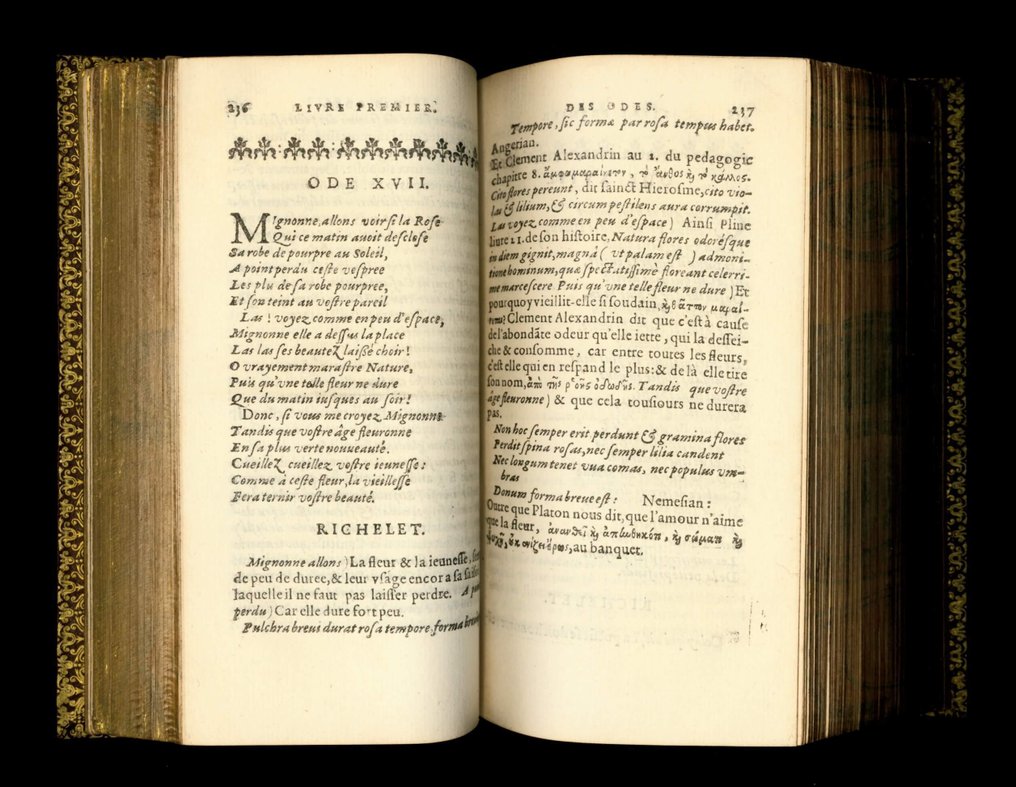
The Odes of P. de Ronsard, Gentleman of Vandomois. To King Henry II. of this name. Commented by N. Richelet, Parisian. Volume Two (of the Works).
In Paris, at Samuel Tbout and Rolin Baraigne, 1630 (second volume)
The First Four Books of the Franciade. To the Most Christian King Charles IX of this name. By P. de Ronsard, Gentleman of Vandomois, Volume III.
In Paris, at Samuel Tibout and Rolin Baraigne, 1630 (third volume)
The Royal Boscage by P. de Ronsard, Gentleman of Vandomois. Dedicated to Henry III, King of France and Poland. Volume IV.
In Paris, at Samuel Tibout and Rolin Baraigne, 1630 (third volume)
The Eclogues and Mascarades by P. de Ronsard, Gentleman of Vandomois. In memory of the most illustrious and most virtuous French Prince of France, Duke of Anjou, son and brother of the King. Volume V
In Paris, at Samuel Tibout and Rolin Baraigne, 1630 (third volume)
The Elegies of P. de Ronsard, gentleman of Vandomois. To the very virtuous lord Anne, Duke of Joyeuse, peer and admiral of France, governor of Normandy. Volume VI.
In Paris, at Samuel Tibout and Rolin Baraigne, 1630 (third volume)
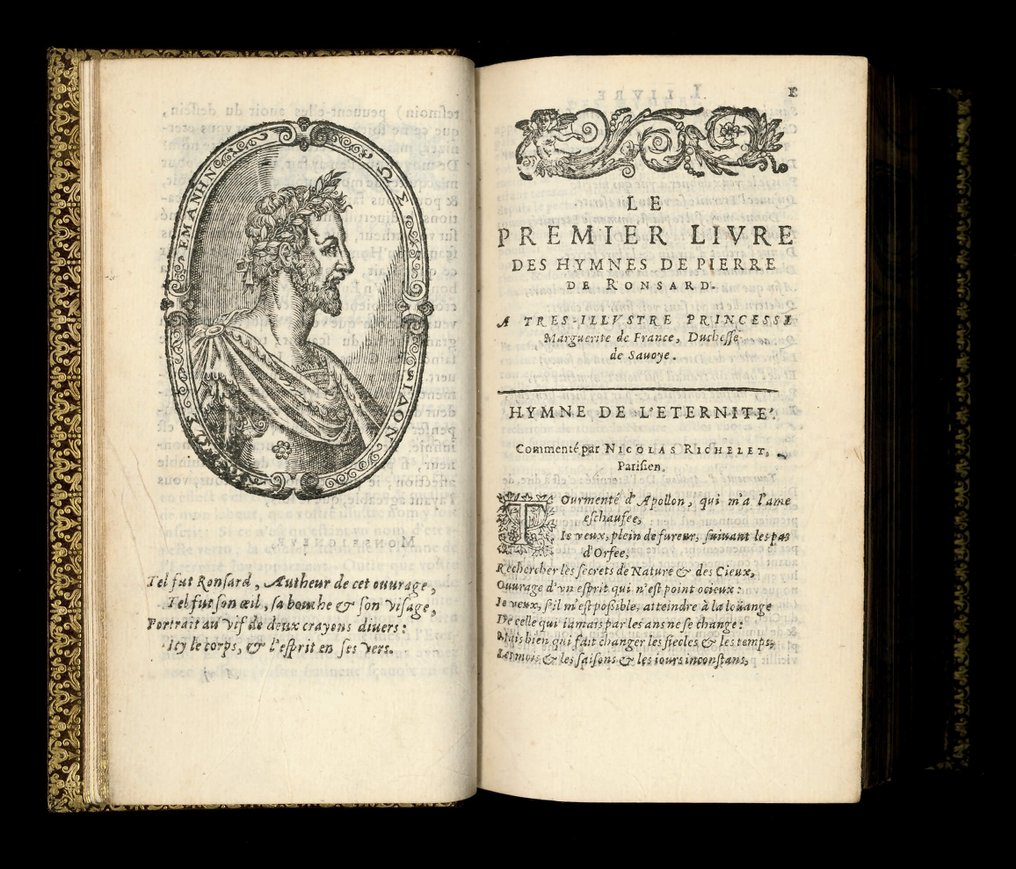
The Hymns of P. de Ronsard, Gentil-homme Vandomois. To the most illustrious Princess Marguerite of France, Duchess of Savoy. Seventh volume (of the Works).
In Paris, at Nicolas Buon's, 1617 (fourth volume)
The Poems of P. de Ronsard, Gentleman of Vandomois. Dedicated to the Most High, Most Illustrious, and Most Virtuous Princess Marie Stuart, Queen of Scotland. Eighth Volume (of the Works).
In Paris, at Nicolas Buon's, 1617 (fourth volume)
Discourse on the Miseries of This Time, by P. de Ronsard, Gentleman of Vandomois. To Catherine de Médicis, Queen Mother of Kings François II, Charles IX, and Henri III. Volume IX (of the Works).
In Paris, at Samuel Tibout and Rolin Baraigne, 1630 (fifth volume)
The Epitaphs on various subjects by P. de Ronsard, Gentil-homme Vandomois. Together with the last verses of the same author, along with his life and his tomb. Volume X (fifth volume)
Collection of Sonnets, Odes, Hymns, Elegies, and other pieces omitted from previous editions of the works of P. de Ronsard, Gentilhomme Vandomois. With some others previously unpublished.
In Paris, at Samuel Tibout and Rolin Baraigne, 1630 (fifth volume)
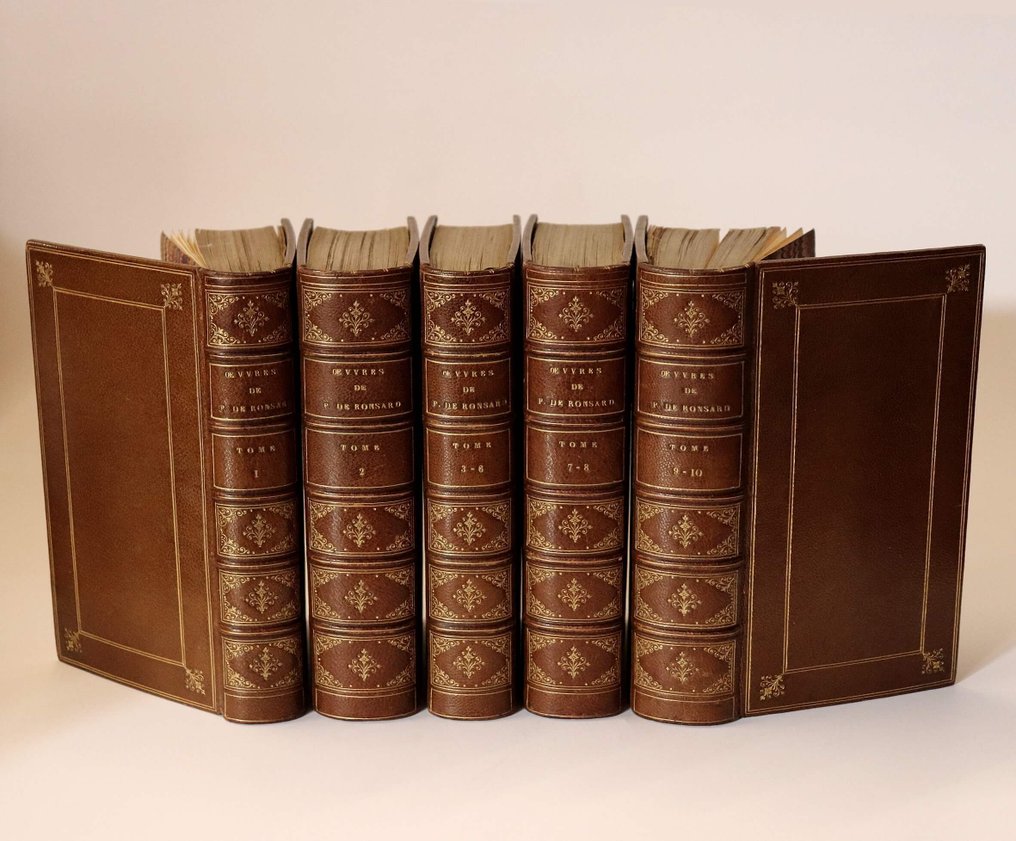
Complete set of 11 volumes bound into 5 small, sturdy volumes in in-12 format (147 x 87 mm | Margin height: 143 mm). The pagination is as follows: First volume contains the first tome, consisting of (16)-680-(18) pages. Second volume contains the second tome, consisting of 917-(5) pages. Third volume contains volumes 3 to 6, totaling 724-(6) pages (continuous pagination). Fourth volume contains volumes 7 and 8, totaling 855-(11) pages (continuous pagination). Fifth and final volume contains volumes 9, 10, and 11, totaling 855-(11) pages (continuous pagination). Fully collated.
Volumes VII and VIII, which make up the fourth volume, are from the 1617 edition at the address of Nicolas Buon. The format is identical, with italic type like the other volumes, and the text is the same as the 1630 edition of the other volumes, except for the typographical and engraved ornaments, which differ for these two volumes.
Homogeneous full brown morocco binding with small grain, spine decorated with small gold tools, covers adorned with a gold-ruled border in the style of Du Seuil, a gold roulette framing the inner edges of the covers, liners and endpapers made of comb paper, edges gilded on marbled paper (bindings executed around 1850-1860, surprisingly unsigned but of high craftsmanship). Fresh bindings. Very fresh interior. Printed on thin paper.
Fifteenth and final collective edition of the Works of Pierre de Ronsard (excluding volumes 7 and 8, which are from the 1617 edition by Nicolas Buon). There are no textual differences between the editions of Nicolas Buon and the 1630 edition; only a few pieces have been removed or added from one to the other.
The engraved frontispieces have not been bound in our copy. Portraits engraved on wood of Ronsard and King Henri III (repeated).
It will be necessary to wait for the 1857-1867 edition in 8 volumes published by the Bibliothèque Elzévirienne under the care of Prosper Blanchemain to have a new complete and annotated edition of the Works of Pierre de Ronsard. Ronsard had then been forgotten for more than two centuries.
Ronsard was the Prince of French poets of his time. Born in September 1524 at the Château de la Possonnière, near the village of Couture-sur-Loir in Vendômois, he died on December 27, 1585, at the priory of Saint-Cosme in Tours. He is one of the most important French poets of the 16th century. 'Prince of poets and poet of princes,' Pierre de Ronsard is a major figure in Renaissance poetic literature. Author of a vast body of work that, over more than thirty years, ranged from engaged and official poetry during the Wars of Religion with The Hymns and Discourses (1555-1564), to epic poetry with La Franciade (1572), and lyrical poetry with collections such as The Odes (1550-1552) and The Loves (The Loves of Cassandre, 1552; Continuation of the Loves, 1555; Sonnets for Hélène, 1578). Imitating ancient authors, Ronsard initially used the forms of the ode ('Come, let us see if the rose') and the hymn, considered major forms, but he increasingly employed the sonnet, introduced to France by Clément Marot in 1536, using the decasyllable ('My God, my God, how beautiful my mistress is!') as the 'modern' meter of the alexandrine ('As you see on the branch...'). He was the originator of the movement known as La Pléiade, along with his friend Joachim du Bellay, and also including Baïf, Dorat, Jodelle, Belleau, and many others. Although Ronsard should primarily be seen as a court poet, he never ceased to declare love in his most tender and sometimes lightest verses. The 17th century of Louis XIV and the entire 18th century left him lost in the limbo. It was the 19th century that rediscovered him, along with his fellow poets of La Pléiade.
References: Brunet, IV, 1375; Tchemerzine V, 492; Barbier-Mueller, II, no. 38.
Luxuriously bound copy from the mid-19th century of this last edition published in the 17th century.
RONSARD (Pierre de)
The Works of Pierre de Ronsard, Gentil-homme Vandomois, Prince of French Poets. Revised and enlarged.
In Paris, at Mathurin Henault, 1629 (first volume)
The Odes of P. de Ronsard, Gentleman of Vandomois. To King Henry II. of this name. Commented by N. Richelet, Parisian. Volume Two (of the Works).
In Paris, at Samuel Tbout and Rolin Baraigne, 1630 (second volume)
The First Four Books of the Franciade. To the Most Christian King Charles IX of this name. By P. de Ronsard, Gentleman of Vandomois, Volume III.
In Paris, at Samuel Tibout and Rolin Baraigne, 1630 (third volume)
The Royal Boscage by P. de Ronsard, Gentleman of Vandomois. Dedicated to Henry III, King of France and Poland. Volume IV.
In Paris, at Samuel Tibout and Rolin Baraigne, 1630 (third volume)
The Eclogues and Mascarades by P. de Ronsard, Gentleman of Vandomois. In memory of the most illustrious and most virtuous French Prince of France, Duke of Anjou, son and brother of the King. Volume V
In Paris, at Samuel Tibout and Rolin Baraigne, 1630 (third volume)
The Elegies of P. de Ronsard, gentleman of Vandomois. To the very virtuous lord Anne, Duke of Joyeuse, peer and admiral of France, governor of Normandy. Volume VI.
In Paris, at Samuel Tibout and Rolin Baraigne, 1630 (third volume)
The Hymns of P. de Ronsard, Gentil-homme Vandomois. To the most illustrious Princess Marguerite of France, Duchess of Savoy. Seventh volume (of the Works).
In Paris, at Nicolas Buon's, 1617 (fourth volume)
The Poems of P. de Ronsard, Gentleman of Vandomois. Dedicated to the Most High, Most Illustrious, and Most Virtuous Princess Marie Stuart, Queen of Scotland. Eighth Volume (of the Works).
In Paris, at Nicolas Buon's, 1617 (fourth volume)
Discourse on the Miseries of This Time, by P. de Ronsard, Gentleman of Vandomois. To Catherine de Médicis, Queen Mother of Kings François II, Charles IX, and Henri III. Volume IX (of the Works).
In Paris, at Samuel Tibout and Rolin Baraigne, 1630 (fifth volume)
The Epitaphs on various subjects by P. de Ronsard, Gentil-homme Vandomois. Together with the last verses of the same author, along with his life and his tomb. Volume X (fifth volume)
Collection of Sonnets, Odes, Hymns, Elegies, and other pieces omitted from previous editions of the works of P. de Ronsard, Gentilhomme Vandomois. With some others previously unpublished.
In Paris, at Samuel Tibout and Rolin Baraigne, 1630 (fifth volume)
Complete set of 11 volumes bound into 5 small, sturdy volumes in in-12 format (147 x 87 mm | Margin height: 143 mm). The pagination is as follows: First volume contains the first tome, consisting of (16)-680-(18) pages. Second volume contains the second tome, consisting of 917-(5) pages. Third volume contains volumes 3 to 6, totaling 724-(6) pages (continuous pagination). Fourth volume contains volumes 7 and 8, totaling 855-(11) pages (continuous pagination). Fifth and final volume contains volumes 9, 10, and 11, totaling 855-(11) pages (continuous pagination). Fully collated.
Volumes VII and VIII, which make up the fourth volume, are from the 1617 edition at the address of Nicolas Buon. The format is identical, with italic type like the other volumes, and the text is the same as the 1630 edition of the other volumes, except for the typographical and engraved ornaments, which differ for these two volumes.
Homogeneous full brown morocco binding with small grain, spine decorated with small gold tools, covers adorned with a gold-ruled border in the style of Du Seuil, a gold roulette framing the inner edges of the covers, liners and endpapers made of comb paper, edges gilded on marbled paper (bindings executed around 1850-1860, surprisingly unsigned but of high craftsmanship). Fresh bindings. Very fresh interior. Printed on thin paper.
Fifteenth and final collective edition of the Works of Pierre de Ronsard (excluding volumes 7 and 8, which are from the 1617 edition by Nicolas Buon). There are no textual differences between the editions of Nicolas Buon and the 1630 edition; only a few pieces have been removed or added from one to the other.
The engraved frontispieces have not been bound in our copy. Portraits engraved on wood of Ronsard and King Henri III (repeated).
It will be necessary to wait for the 1857-1867 edition in 8 volumes published by the Bibliothèque Elzévirienne under the care of Prosper Blanchemain to have a new complete and annotated edition of the Works of Pierre de Ronsard. Ronsard had then been forgotten for more than two centuries.
Ronsard was the Prince of French poets of his time. Born in September 1524 at the Château de la Possonnière, near the village of Couture-sur-Loir in Vendômois, he died on December 27, 1585, at the priory of Saint-Cosme in Tours. He is one of the most important French poets of the 16th century. 'Prince of poets and poet of princes,' Pierre de Ronsard is a major figure in Renaissance poetic literature. Author of a vast body of work that, over more than thirty years, ranged from engaged and official poetry during the Wars of Religion with The Hymns and Discourses (1555-1564), to epic poetry with La Franciade (1572), and lyrical poetry with collections such as The Odes (1550-1552) and The Loves (The Loves of Cassandre, 1552; Continuation of the Loves, 1555; Sonnets for Hélène, 1578). Imitating ancient authors, Ronsard initially used the forms of the ode ('Come, let us see if the rose') and the hymn, considered major forms, but he increasingly employed the sonnet, introduced to France by Clément Marot in 1536, using the decasyllable ('My God, my God, how beautiful my mistress is!') as the 'modern' meter of the alexandrine ('As you see on the branch...'). He was the originator of the movement known as La Pléiade, along with his friend Joachim du Bellay, and also including Baïf, Dorat, Jodelle, Belleau, and many others. Although Ronsard should primarily be seen as a court poet, he never ceased to declare love in his most tender and sometimes lightest verses. The 17th century of Louis XIV and the entire 18th century left him lost in the limbo. It was the 19th century that rediscovered him, along with his fellow poets of La Pléiade.
References: Brunet, IV, 1375; Tchemerzine V, 492; Barbier-Mueller, II, no. 38.
Luxuriously bound copy from the mid-19th century of this last edition published in the 17th century.
Details
Number of Books
5
Subject
Literature, Poetry
Book Title
Oeuvres de Ronsard
Author/ Illustrator
Pierre de Ronsard
Condition
Very good
Publication year oldest item
1617
Publication year youngest item
1630
Height
14.7 cm
Edition
Other edition
Width
8.7 cm
Language
French
Original language
Yes
Publisher
A Paris, chez Samuel Tbout et Rolin Baraigne [aussi chez Nicolas Buon]
Binding/ Material
Leather
Number of pages
4500
Sold by
